A Mother’s Face on a Bright Mountain
Every August 26th, the roads of Poland fill with people walking. Some have been on foot for 9 days; others have flown in from Chicago, London, or Sydney. All are heading toward the same place: a hilltop monastery in the south of Poland called Jasna Góra, the “Bright Mountain,” where a dark, wounded, and utterly beloved image of the Blessed Virgin Mary has been venerated for more than 600 years. This is the Solemnity of Our Lady of Częstochowa, and for the Polish people it is nothing less than the heartbeat of the nation.
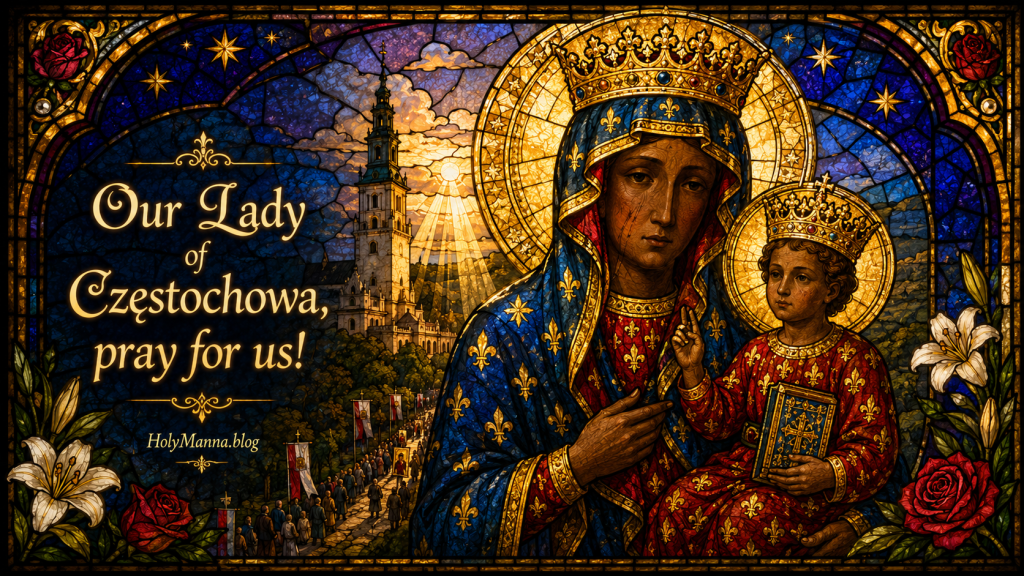
The image at the center of it all is a Byzantine-style icon of the Hodegetria type, a name that means “She Who Shows the Way.” Mary holds the Child Jesus on her left arm and gestures toward Him with her right hand, as if to say that everything about her points to Him. Two long scars mark her right cheek. Her face and hands are dark, which is why the icon is known around the world as the Black Madonna. She looks like a mother who has been through something, and that is exactly why so many people love her.
The Catechism of the Catholic Church teaches that “the Church’s devotion to the Blessed Virgin is intrinsic to Christian worship” (CCC 971). Our Lady of Częstochowa is one of the clearest illustrations of that truth in the modern world. This is not a celebration of a painting. It is a celebration of the maternal presence of Mary in the life of the Church, expressed through an image that has been slashed, stolen, besieged, crowned, and carried through a century of tyranny without ever losing its power to draw people to her Son.
How an Ancient Icon Came to Rest in Poland
The story of how the icon arrived at Jasna Góra begins with certainty in the 14th century and reaches back much further in tradition. What the historical record supports is this: in the year 1382, Duke Władysław of Opole brought a community of Pauline monks, the Order of Saint Paul the First Hermit, from Hungary to a small hill near the town of Częstochowa. According to the tradition preserved by the Pauline Fathers, the duke had brought the icon from the town of Belz in what is now Ukraine, and he entrusted it to the monks’ care. Tradition holds that the image was placed on the Bright Mountain on August 26th, which is why Pope Pius XI later chose that date for the celebration.
Behind that documented arrival stands a much older tradition, and it must be labeled clearly as tradition rather than proven history. The tradition holds that Saint Luke the Evangelist painted the image on a tabletop from the home of the Holy Family in Nazareth, that Saint Helena discovered it in Jerusalem in the 4th century, and that it was carried to Constantinople before eventually reaching Poland. Art historians generally describe the icon as a Byzantine work whose original layers cannot be dated with confidence, and they note that the visible surface was substantially repainted in the 15th century after the icon was damaged.
What is not in dispute is the violence the icon endured. In 1430, a band of raiders, often identified as Hussite sympathizers, attacked the monastery, tore the icon from its place, slashed the face of the Virgin, and left it damaged and desecrated. King Władysław Jagiełło had the icon carried to Kraków for restoration. The tradition of the shrine holds that the painters were unable to make the scars disappear, and whether that is a matter of medieval technique or of divine intention, the scars remain to this day. Two are clearly visible on the right cheek. The Polish people came to see them not as a flaw but as a wound Mary shares with a suffering nation.
The century that made Częstochowa a national symbol was the 17th. In 1655, during the Swedish invasion known in Polish history as the Deluge, Swedish forces swept through the country and laid siege to Jasna Góra. The prior of the monastery, Father Augustyn Kordecki, refused to surrender. From November 18th to December 27th, 1655, a small garrison of monks, soldiers, and local volunteers held the fortified monastery against a far larger army. The Swedes eventually withdrew, and Poles credited the defense of Jasna Góra to the protection of the Mother of God.
The following spring, on April 1st, 1656, King John II Casimir made a solemn vow in the cathedral of Lwów, entrusting the kingdom to the Blessed Virgin and proclaiming her Queen of the Crown of Poland. That royal act, known as the Lwów Oath, is the historical root of the title Mary still bears in Poland today: Queen of Poland. From that point forward, the icon on the Bright Mountain was no longer simply a devotional image. It was the throne of a queen.
The Foundations of a Title Rather Than an Apparition
Readers looking for a Marian apparition in this story will not find one. Our Lady of Częstochowa is not an apparition title like Lourdes or Fatima. There is no visionary, no series of messages, and no formal ecclesiastical judgment on a supernatural event, because no such event is claimed as the origin of the devotion. The Church has never judged a specific miracle connected to the icon in the way it has judged apparitions. What the Church has done, repeatedly and at the highest levels, is recognize and honor the devotion itself.
That distinction matters, and the Catechism explains why. Private revelations, even approved ones, “do not belong, however, to the deposit of faith. It is not their role to improve or complete Christ’s definitive Revelation, but to help live more fully by it in a certain period of history” (CCC 67). Devotion to Our Lady of Częstochowa does not rest on private revelation at all. It rests on something more solid: the Church’s constant teaching about who Mary is and the Church’s ancient practice of honoring her through sacred images.
The scriptural foundation of the icon is the scene it depicts. Mary presents her Son to the world. In The Gospel of Luke, Mary is greeted as “the mother of my Lord” (Luke 1:43), and she herself proclaims that “all generations will call me blessed” (Luke 1:48). At the wedding at Cana, in The Gospel of John, her final recorded words in Scripture point away from herself and toward Jesus: “Do whatever he tells you” (John 2:5). The Hodegetria icon is that verse painted. Her hand shows the way, and the way is Christ.
The Church’s teaching on the veneration of images gives the devotion its theological legitimacy. The Catechism, drawing on the Second Council of Nicaea, teaches that “the Christian veneration of images is not contrary to the first commandment which proscribes idols. Indeed, ‘the honor rendered to an image passes to its prototype,’ and ‘whoever venerates an image venerates the person portrayed in it’” (CCC 2132). Pilgrims kneeling before the Black Madonna are not honoring wood and paint. They are honoring the Mother of God, and through her, the God she carries.
Popes have confirmed that honor in tangible ways. Pope Clement XI provided crowns for the icon, and on September 8th, 1717, the image received a papal coronation, the first such coronation of a Marian image outside Rome. Those crowns were stolen in 1909, and Pope Saint Pius X responded by sending replacements, which were placed on the image on May 22nd, 1910. Pope Pius X approved the celebration of Our Lady of Częstochowa for Jasna Góra and the Diocese of Włocławek in 1904, and Pope Pius XI extended the celebration and fixed it on August 26th in 1931. Each of these acts is a formal recognition that this devotion belongs to the authentic life of the Church.
The Church’s honest position on the wounds and the darkness of the icon deserves to be stated plainly. Stories abound of the icon being impossible to repaint or of miraculous fountains appearing where it was cleaned. Those are pious traditions, and they should be received as such. What Poles have consistently believed, and what the Church has never contradicted, is that Mary has interceded for the nation again and again: at the siege of 1655, in the “Miracle on the Vistula” of August 15th, 1920, when the Bolshevik advance on Warsaw was halted, and through the long night of Nazi occupation and communist rule.
What the Black Madonna Teaches About Mary and the Church
The theological weight of this celebration lies in Mary’s motherhood, her queenship, and her intercession, and each of these is anchored in the Catechism.
Begin with her motherhood of God. The Catechism teaches that “Mary is truly ‘Mother of God’ since she is the mother of the eternal Son of God made man, who is God himself” (CCC 509). The icon shows exactly this: a mother holding a Child who is not merely a child. His right hand is raised in blessing; His left hand holds a book, the sign of the Word. Everything about the composition insists that the mother’s dignity flows entirely from her Son. Saint Pope John Paul II captured this in his 1979 homily at Jasna Góra when he spoke of “the presence of the Mother of God in the mystery of Christ and of the Church, as is proclaimed by Chapter VIII of the Constitution Lumen Gentium.”
Then consider her role as Mother of the Church. Because Mary is the mother of Christ the Head, she is mother of His Body. The Catechism, quoting Lumen Gentium, teaches that Mary “is clearly the mother of the members of Christ… since she has by her charity joined in bringing about the birth of believers in the Church, who are members of its head” (CCC 963). This is why John Paul II chose to renew Poland’s consecration on the day after Pentecost in 1979, when the Church in Poland celebrated Mary as Mother of the Church, and why he entrusted “the whole of the Church” to her at Jasna Góra.
Her queenship is likewise grounded in doctrine. The Catechism teaches that Mary “was taken up body and soul into heavenly glory, and exalted by the Lord as Queen over all things, so that she might be the more fully conformed to her Son, the Lord of lords and conqueror of sin and death” (CCC 966). When John II Casimir proclaimed Mary Queen of Poland in 1656, he was not inventing a new theology. He was applying a truth the Church already held about the Assumption and the Queenship of Mary to the concrete life of a nation in crisis.
Finally, and perhaps most importantly for the pilgrims who walk to her, there is her intercession. The Catechism, again drawing on Lumen Gentium, teaches that “taken up to heaven she did not lay aside this saving office but by her manifold intercession continues to bring us the gifts of eternal salvation” (CCC 969), and that “Mary’s function as mother of men in no way obscures or diminishes this unique mediation of Christ, but rather shows its power” (CCC 970). This is the doctrinal answer to anyone who worries that Polish devotion to the Black Madonna crowds out Jesus. Her hand in the icon points to Him. Her intercession draws people to Him. She has no other work.
The 20th century added a distinctly Polish contribution to the way the Church expresses this teaching. Cardinal Stefan Wyszyński, the Primate of Poland, composed the Jasna Góra Vows of the Nation, proclaimed at the shrine on August 26th, 1956, on the 300th anniversary of the Lwów Oath, and he inaugurated a nine-year Great Novena leading to the Millennium of Poland’s baptism in 1966. On May 3rd, 1966, the Polish bishops pronounced at Jasna Góra an act of total entrustment to Mary for the freedom of the Church. John Paul II, standing at the same shrine in 1979, explained the paradox at the heart of that act: “For love constitutes the fulfilment of freedom, yet at the same time ‘belonging’, and so not being free is part of its essence. However, this ‘not being free’ in love is not felt as slavery but rather as an affirmation and fulfilment of freedom.” That is the theology of Totus Tuus, the motto he took as pope, lived out by an entire people.
Walking to the Queen
The most visible devotion connected to Our Lady of Częstochowa is the walking pilgrimage. Every August, hundreds of thousands of pilgrims set out on foot from cities across Poland, and the oldest of these, the Warsaw pilgrimage, has been walking since 1711. The route from Warsaw covers roughly 250 kilometers over about 9 days, and it is timed to arrive at Jasna Góra for the Solemnity of the Assumption on August 15th. Pilgrims sleep in barns and parish halls, pray the Rosary along the road, hear daily Mass, and arrive with blistered feet and full hearts, and the celebration of August 26th draws enormous crowds to the monastery grounds.
The Catechism speaks directly to why this kind of devotion matters. It teaches that popular piety, including “pilgrimages, processions, the stations of the cross, religious dances, the rosary, medals, etc.”, expresses the religious sense of the Christian people and “extends the liturgical life of the Church” (CCC 1674, 1675). A walking pilgrimage is a sacrament of the Christian life in miniature: a hard road, walked in company, toward a Mother who leads to her Son.
The shrine itself is the Basilica of the Holy Cross and the Nativity of the Blessed Virgin Mary at Jasna Góra, entrusted to the Pauline Fathers since the 14th century. The icon rests in a chapel adjoining the basilica, behind an ornate silver screen that is raised and lowered each day with a fanfare of trumpets. The walls of the chapel are covered with votive offerings: crutches, rosaries, medals, and military decorations left by people who came to say thank you.
One devotion deserves special mention because it has spread far beyond the shrine. At 9:00 in the evening, every evening, the Jasna Góra Appeal is prayed. Bells ring, the faithful gather in the chapel, and Poles across the country and around the world join in spirit. John Paul II described its words in 1979: “Mary, Queen of Poland, I am close to you, I remember you, I watch.” He explained that “to be a Christian is to be watchful, as the soldier is watchful, as a mother is with her child, a doctor with his patient. To be watchful means to protect something of great value.” The Appeal began in the 1950s and remains one of the simplest and most powerful Marian prayers of the modern age.
Copies of the icon have carried the devotion outward. During the Great Novena, a copy of the image traveled from parish to parish across Poland, and the communist authorities were so alarmed by the crowds it drew that they seized it in 1966. Poles responded by processing with an empty frame. Today, copies of the icon hang in Polish homes and parishes on every continent, and the National Shrine of Our Lady of Częstochowa in Doylestown, Pennsylvania, also served by the Pauline Fathers, hosts its own August walking pilgrimage and a major celebration on August 26th.
A Queen for the Whole World
Devotion to Our Lady of Częstochowa is inseparable from Polish identity, and it has shaped Polish culture in ways that go far beyond church walls. The national poet Adam Mickiewicz opened his epic Pan Tadeusz with an invocation to the “Holy Virgin guarding bright Czestochowa,” and John Paul II quoted those very words at the start of his 1979 homily at the shrine. The Polish anthem of Marian devotion, the medieval hymn Bogurodzica, is often sung at Jasna Góra, and it predates the icon’s arrival in Poland. When the Pope stood on the Bright Mountain, he said that the image “expresses a tradition and a language of faith still more ancient than our history.”
Under Nazi occupation, pilgrims still came in small groups. Under communism, Jasna Góra became the spiritual capital of a nation that refused to surrender its soul. On September 8th, 1946, the Polish bishops consecrated the nation to the Immaculate Heart of Mary at the shrine before a crowd of well over a million people. In 1979, John Paul II’s pilgrimage to Jasna Góra became one of the defining moments of his first return to Poland as pope, and he spoke there with unmistakable clarity: “Jasna Gora is, in fact, not only a place of pilgrimage for the Poles of the motherland and of the whole world but also the nation’s shrine. One must listen in this holy place in order to hear the beating of the heart of the nation in the heart of the Mother.”
The shrine’s global moment came in August 1991, when World Youth Day was held at Częstochowa. Well over a million young people gathered on the fields below the monastery, including a large contingent from the collapsing Soviet Union, many of whom had never before been free to travel to a Catholic gathering. Pope Benedict XVI prayed at the shrine on May 26th, 2006, and Pope Francis celebrated Mass there on July 28th, 2016, for the 1,050th anniversary of the Baptism of Poland. Each pope who has come has left a golden rose before the icon.
Beyond Poland, the celebration is kept wherever Poles have gone. Polish parishes in the United States, Canada, the United Kingdom, Australia, and Brazil hold Masses and processions on or around August 26th. Many sing the beloved hymn Czarna Madonna, whose refrain speaks of the Madonna who has a black face and a good heart. In Doylestown, the American shrine welcomes thousands of walking pilgrims each summer. The devotion has also spread among Catholics with no Polish heritage at all, drawn by the wounded face of a Mother who seems to understand.
The image has become a symbol of resilience itself. A slashed, darkened, stolen, besieged icon that is still crowned and still loved says something to any people, and any person, who has been wounded. Mary under this title does not promise a life without scars. She shows that a scarred face can still be radiant, still be royal, and still point to Christ.
Letting Her Show You the Way
If you have made it this far, you probably sense that this celebration is not really about Poland, or about a painting, or even about history. It is about a Mother who keeps watch. So what does Our Lady of Częstochowa ask of you on August 26th?
She asks you to let your wounds be seen. The scars on her cheek are not hidden or airbrushed. Christians in every age have been tempted to present a flawless face to the world, and the icon quietly refuses that temptation. Mary was pierced by a sword of sorrow, as Simeon foretold in The Gospel of Luke (Luke 2:35), and she did not stop being the Mother of God because of it. Whatever has scarred you does not disqualify you from being loved by God or from being used by Him. Bring your scars to prayer this week rather than hiding them.
She asks you to be watchful. The Jasna Góra Appeal is a three-part promise: “I am close to you, I remember you, I watch.” Try praying those words at 9:00 tonight, joining Poles around the world. Then ask what you are keeping watch over. Your marriage? Your children’s faith? Your own habits? Being watchful means protecting something of great value, and John Paul II said the Christian must be watchful the way a mother is with her child. Pick one thing worth guarding and guard it.
She asks you to point to Jesus. Everything in the icon leads to the Child. Your life is meant to be a Hodegetria too, a life that shows the way. That may look like inviting a lapsed friend to Mass or praying the Rosary with your family. The Catechism teaches that Mary’s intercession “shows the power” of Christ’s mediation rather than obscuring it (CCC 970). Let your witness do the same.
She asks you to walk. The Polish pilgrims walk for 9 days because faith is not an idea; it is a journey made with the body. You do not need 250 kilometers. You need a next step. Consider a small pilgrimage this month: a drive to a nearby Marian shrine or a walk to daily Mass. Bring an intention and leave it there. Mary has been receiving the intentions of pilgrims for 600 years, and she is not tired.
Finally, she asks you to trust. John Paul II ended his homily at Jasna Góra with 2 sentences that could be a whole spiritual program: “I am a man of great trust. I learnt to be so here.” Trust is learned, and it is learned at the feet of a Mother. Under whatever title you know her best, take some time this week to entrust to her the thing you are most afraid of. She has carried a nation through worse.
Engage With Us!
The story of Our Lady of Częstochowa belongs to every Catholic who has ever felt wounded and still wanted to point to Jesus. Please share your thoughts and reflections in the comments below. Have you ever seen the icon, walked a pilgrimage, or prayed the Jasna Góra Appeal? Has a copy of the Black Madonna been part of your family’s faith? This community grows when you share.
- When you look at the scars on Mary’s face in this icon, what wounds in your own life come to mind, and how might you bring them to her Son this week?
- The Jasna Góra Appeal is a promise to be close, to remember, and to keep watch. What in your life most needs your watchful protection right now?
- The Hodegetria icon shows Mary pointing to Jesus. In what concrete way could your daily life point others to Christ more clearly?
- Polish pilgrims walk for days to reach the shrine. What small pilgrimage or act of devotion could you undertake before the end of this month?
- John Paul II said he learned trust at Jasna Góra. Where and from whom have you learned to trust God, and how could you deepen that trust today?
Keep walking, keep watching, and keep pointing to Jesus. The Queen who has kept watch over a nation for 6 centuries keeps watch over you as well. May the faithful of HolyManna.blog grow together in faith under the guidance of our Blessed Mother, who has a dark face, a scarred cheek, and a heart wide enough for the whole world.
Our Lady of Częstochowa, pray for us!
Follow us on YouTube, TikTok, Instagram and Facebook for more insights and reflections on living a faith-filled life.


Leave a Reply