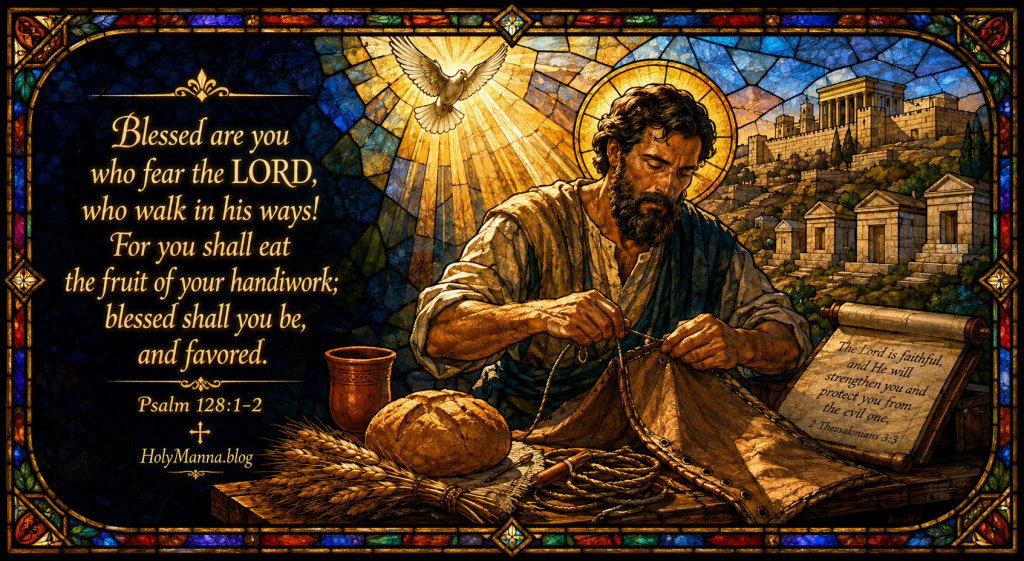
Wednesday of the Twenty-first Week in Ordinary Time – Lectionary: 427
A Faith With Nothing to Hide
Everyone knows what it feels like to clean the living room before guests arrive while the closets stay a disaster. Today’s readings, for Wednesday of the Twenty-first Week in Ordinary Time, are about the closets. In the First Reading, Saint Paul reminds the Thessalonians that he did not simply preach the Gospel to them; he worked with his own hands, night and day, so that his life would say the same thing his mouth was saying. The Responsorial Psalm sings the blessing that follows that kind of person, the one who fears the Lord and eats the fruit of honest labor. Then the Gospel gives the mirror image. Jesus stands in the Temple during the last week of His earthly life and calls the scribes and Pharisees whitewashed tombs, lovely on the outside and full of death within.
The central theme is integrity, in the oldest sense of the word: wholeness, a life in which the visible and the invisible agree. Paul embodies it. The psalmist blesses it. Jesus exposes its opposite. The background matters here. Thessalonica was a bustling port where some new Christians had stopped working, convinced the Lord’s return was imminent, and were quietly living off others. Jerusalem’s tombs were freshly limed each spring so Passover pilgrims would not brush against corruption without knowing it. Both settings turn on the same question. What is a person actually made of underneath the presentation? The Church has always insisted that grace does not stop at the surface. It sinks into the hands, the schedule, the bank account, and the hidden corners, until the whole person becomes a single, honest witness to Christ.
First Reading — 2 Thessalonians 3:6-10, 16-18
The Apostle Who Refused to Be Fed for Free
Paul wrote this letter from Corinth around the years 51 or 52, only months after his first letter to the same community. Thessalonica was the capital of Roman Macedonia, a wealthy harbor city where the Church had been born under persecution and had grown fast, and fast growth brought a problem. A rumor was circulating, apparently even under Paul’s name, that the Day of the Lord had already come, and some believers concluded that work no longer mattered. They stopped earning, leaned on generous brothers and sisters, and, as Paul notes a few verses later, filled their free time by meddling in everyone else’s business. Paul responds like a father setting a household in order, appealing to what they had watched him do with his own hands and closing with peace, a personal signature, and grace. This reading fits the day’s theme because it shows a preacher whose life could be inspected from any angle without embarrassment.
2 Thessalonians 3:6-10, 16-18
We instruct you, brothers and sisters,
in the name of our Lord Jesus Christ,
to shun any brother
who walks in a disorderly way
and not according to the tradition they received from us.
For you know how one must imitate us.
For we did not act in a disorderly way among you,
nor did we eat food received free from anyone.
On the contrary, in toil and drudgery, night and day we worked,
so as not to burden any of you.
Not that we do not have the right.
Rather, we wanted to present ourselves as a model for you,
so that you might imitate us.
In fact, when we were with you, we instructed you that
if anyone was unwilling to work, neither should that one eat.May the Lord of peace himself
give you peace at all times and in every way.
The Lord be with all of you.This greeting is in my own hand, Paul’s.
This is the sign in every letter; this is how I write.
The grace of our Lord Jesus Christ be with all of you.
Detailed Exegesis
Verse 6: We instruct you, brothers and sisters, in the name of our Lord Jesus Christ, to shun any brother who walks in a disorderly way and not according to the tradition they received from us.
The Greek word for “disorderly” was a military term for a soldier who breaks rank. Paul is not attacking the poor but baptized people who could work and chose not to. The instruction comes “in the name of our Lord Jesus Christ” and is measured against “the tradition they received from us.” Before a single Gospel was written, apostolic teaching was already handed on by word and example, which is exactly what the Catechism describes in CCC 83: The first generation of Christians did not yet have a written New Testament, and the New Testament itself demonstrates the process of living Tradition. To “shun” is a disciplined distance meant to wake the brother up, not an act of hatred.
Verse 7: For you know how one must imitate us. For we did not act in a disorderly way among you.
Christian leadership has never been a matter of credentials alone but of a visible life worth copying, which is why Paul can say elsewhere, Be imitators of me, as I am of Christ (1 Corinthians 11:1).
Verse 8: Nor did we eat food received free from anyone. On the contrary, in toil and drudgery, night and day we worked, so as not to burden any of you.
Acts 18 records that Paul’s trade was tentmaking, hard leatherwork done in a cramped shop between Sabbath sermons in the synagogue. The words “toil and drudgery” are not glamorous on purpose; holiness in Paul’s life looked like sore hands.
Verse 9: Not that we do not have the right. Rather, we wanted to present ourselves as a model for you, so that you might imitate us.
Paul defends the right of preachers to live by the Gospel, a right Jesus Himself established when He said the laborer deserves his payment (Luke 10:7). Yet he set that right aside for love of this particular community. This is Christian freedom in action, giving up what one is owed for another’s good.
Verse 10: In fact, when we were with you, we instructed you that if anyone was unwilling to work, neither should that one eat.
The key word is “unwilling.” Paul is not speaking of those who cannot work but of those who will not. The Church quotes this very verse in CCC 2427 when she teaches that work is a duty. Refusing to contribute while consuming the fruits of others’ labor wounds the whole body.
Verse 16: May the Lord of peace himself give you peace at all times and in every way. The Lord be with all of you.
After discipline comes benediction, because peace is what correction is for. Saint Augustine defined peace as the tranquility of order, and a community where everyone pulls his weight is a community at rest.
Verse 17: This greeting is in my own hand, Paul’s. This is the sign in every letter; this is how I write.
Because a forged letter had already caused confusion, Paul signs personally, and there is a lovely irony in the man who praised working hands proving his authenticity with his handwriting.
Verse 18: The grace of our Lord Jesus Christ be with all of you.
The letter that opened by invoking the Lord’s name closes by invoking His grace, and everything in between, including the hard sayings, sits inside it.
Teachings
The Church treats work as far more than a way to pay bills. The Catechism teaches, Human work proceeds directly from persons created in the image of God and called to prolong the work of creation by subduing the earth, both with and for one another. Hence work is a duty: “If any one will not work, let him not eat.” Work honors the Creator’s gifts and the talents received from him. It can also be redemptive (CCC 2427). The next paragraph guards the other side of the truth: Work is for man, not man for work. Everyone should be able to draw from work the means of providing for his life and that of his family, and of serving the human community (CCC 2428).
Paul’s willingness to correct a brother is itself an act of love. The Catechism lists among the fruits and demands of charity that charity demands beneficence and fraternal correction (CCC 1829). Saint John Chrysostom, preaching on this letter, warned that idleness slowly corrupts the soul and praised the apostle for teaching with his hands as much as with his tongue. Saint Augustine wrote an entire treatise, On the Work of Monks, to insist that consecrated men could not hide behind prayer to escape Paul’s rule. Saint Benedict opened his chapter on daily labor with a line that has shaped Western civilization: Idleness is the enemy of the soul (Rule of Saint Benedict, chapter 48). Finally, the Catechism’s teaching on peace illuminates verse 16: Peace is “the tranquillity of order.” Peace is the work of justice and the effect of charity (CCC 2304).
Reflection
It is tempting to hear this reading as a scolding aimed at somebody else. Try hearing it as an invitation instead, because Paul is describing a life so consistent that people could learn the Gospel simply by watching how he earned his lunch. Consider your own workweek, because your desk, job site, kitchen, or classroom is where your faith either becomes visible or stays theoretical. Show up on time this week as an act of worship. Do the unglamorous task without complaint, and if you are supporting someone who could be working and is choosing not to, ask whether your generosity is helping or enabling, and pray for the courage to have an honest conversation. And if you are the one who has been coasting, take Paul’s words as a father’s hand on your shoulder rather than a slap.
Where in your life is there a gap between what you profess and how you actually spend your hours? Who has watched your ordinary work closely enough to imitate it, and what would they learn?
Responsorial Psalm — Psalm 128:1-2, 4-5
The Blessing of a Table You Earned
Psalm 128 is one of the fifteen Songs of Ascents, the pilgrim hymns sung by families climbing the road to Jerusalem for the great feasts. It is a wisdom psalm, short and domestic, and it has been sung at Jewish weddings for millennia and at Catholic nuptial Masses to this day. The Church places it beside Paul’s letter for an obvious reason. Paul says the one who will not work should not eat; the psalmist blesses the one who fears the Lord and eats the fruit of his own hands. The two texts are one teaching from two directions. Fear of the Lord, in the biblical sense, is not terror. It is the reverent awe of a child who loves a good father too much to grieve him, and Scripture calls it the beginning of wisdom (Proverbs 9:10). This psalm shows what that reverence looks like at a dinner table.
Psalm 128:1-2, 4-5
R. (1) Blessed are those who fear the Lord.
Blessed are you who fear the LORD,
who walk in his ways!
For you shall eat the fruit of your handiwork;
blessed shall you be, and favored.
R. Blessed are those who fear the Lord.
Behold, thus is the man blessed
who fears the LORD.
The LORD bless you from Zion:
may you see the prosperity of Jerusalem
all the days of your life.
R. Blessed are those who fear the Lord.
Detailed Exegesis
Verse 1: Blessed are you who fear the LORD, who walk in his ways!
The psalm opens like the Beatitudes. Notice that fear of the Lord is immediately defined by action: those who fear Him “walk in his ways.” Reverence that never reaches the feet is not reverence.
Verse 2: For you shall eat the fruit of your handiwork; blessed shall you be, and favored.
Here is the hinge with the First Reading. Eating what your own hands produced is named as a blessing, not a burden. In the ancient world, where conquest and injustice often meant others ate your harvest, this promise of a just order was deeply consoling.
Verse 4: Behold, thus is the man blessed who fears the LORD.
The psalmist pauses to point, almost like a friend nudging you: look at that life. That is what blessing looks like. The verses omitted from today’s selection describe the wife and children around the table; verse 4 sums it all up as the fruit of holy fear.
Verse 5: The LORD bless you from Zion: may you see the prosperity of Jerusalem all the days of your life.
The blessing widens from the household to the holy city. Personal integrity and the common good are never separate in Scripture. A home that fears the Lord is a gift to the whole people of God, and the Church Fathers read Zion here as the Church herself and, beyond her, the heavenly Jerusalem.
Teachings
The Catechism counts fear of the Lord among the gifts of the Holy Spirit: The seven gifts of the Holy Spirit are wisdom, understanding, counsel, fortitude, knowledge, piety, and fear of the Lord. They belong in their fullness to Christ, Son of David. They complete and perfect the virtues of those who receive them (CCC 1831). Saint Thomas Aquinas, in the Summa Theologiae, distinguishes servile fear, which dreads punishment, from filial fear, which dreads offending the Beloved, and he teaches that only filial fear grows as charity grows. That is the fear this psalm celebrates. The Catechism also names the home as the place where this blessing takes flesh: Thus the home is the first school of Christian life and “a school for human enrichment” (CCC 1657).
Reflection
Try praying this psalm before your next meal, especially one you cooked or paid for with your own labor. Let gratitude for ordinary bread become an act of reverence. Then let it widen, as verse 5 does: pray for your parish and your city as you would pray for your own kitchen. Fear of the Lord grows quietly, in the decision to be honest on a timesheet, in a kind word to a difficult coworker, in the refusal to cut a corner nobody would notice.
Do you experience your daily work as a curse to endure or as a place where God’s blessing can rest? What is one small way to “walk in his ways” at your job this week?
Holy Gospel — Matthew 23:27-32
Beautiful Stone, Rotten Bones
This scene takes place in the Temple courts on Tuesday of Holy Week, three days before the Crucifixion. Jesus has just entered Jerusalem in triumph and cleansed the Temple, and now He delivers seven “woes” against the scribes and Pharisees, the sixth and seventh of which are read today. The imagery is drawn from real life. Every spring, before Passover, Jerusalem’s tombs were freshly coated with lime so that the tens of thousands of pilgrims would see them clearly and avoid touching a grave, since contact with the dead made a person ritually unclean, as Numbers 19 required. The whitewash was, quite literally, a warning label. Jesus takes this familiar sight and turns it into a portrait of a soul: dazzling white on the outside, death within. It is the sharpest possible contrast to Paul’s honest hands and the psalmist’s blessed household, and it completes the day’s theme by showing what happens when religion becomes a surface.
Matthew 23:27-32
Jesus said,
“Woe to you, scribes and Pharisees, you hypocrites.
You are like whitewashed tombs, which appear beautiful on the outside,
but inside are full of dead men’s bones and every kind of filth.
Even so, on the outside you appear righteous,
but inside you are filled with hypocrisy and evildoing.“Woe to you, scribes and Pharisees, you hypocrites.
You build the tombs of the prophets
and adorn the memorials of the righteous,
and you say, ‘If we had lived in the days of our ancestors,
we would not have joined them in shedding the prophets’ blood.’
Thus you bear witness against yourselves
that you are the children of those who murdered the prophets;
now fill up what your ancestors measured out!”
Detailed Exegesis
Verse 27: Woe to you, scribes and Pharisees, you hypocrites. You are like whitewashed tombs, which appear beautiful on the outside, but inside are full of dead men’s bones and every kind of filth.
The Greek word for hypocrite originally meant a stage actor, someone speaking from behind a mask. A whitewashed tomb was meant to keep people from being defiled; Jesus says these men, by their inner corruption, are the very thing the whitewash was warning about. Beauty that conceals death is not beauty.
Verse 28: Even so, on the outside you appear righteous, but inside you are filled with hypocrisy and evildoing.
Jesus names the two layers plainly. He is not against outward righteousness; He is against outward righteousness that does not correspond to anything inside. This is the same principle the Lord gave through Samuel: Not as man sees does God see, because man sees the appearance but the LORD looks into the heart (1 Samuel 16:7).
Verse 29: Woe to you, scribes and Pharisees, you hypocrites. You build the tombs of the prophets and adorn the memorials of the righteous.
Herod the Great and the leaders of Jesus’ day did in fact beautify monuments to Israel’s holy dead. Honoring the prophets was a good thing. The problem was that they honored dead prophets while rejecting the living Word standing in front of them.
Verse 30: And you say, “If we had lived in the days of our ancestors, we would not have joined them in shedding the prophets’ blood.”
Everyone believes they would have been on the right side of history. Jesus exposes that confidence as a mask. It is easy to admire the saints of the past and resist the saints, and the Savior, of the present.
Verse 31: Thus you bear witness against yourselves that you are the children of those who murdered the prophets.
By calling the prophets’ killers “our ancestors,” they have unintentionally testified to their own lineage, and Jesus means far more than biology. He means a spiritual family resemblance, the same heart that resists God’s messengers.
Verse 32: Now fill up what your ancestors measured out!
This is prophetic irony, and it points straight to the Cross. Within days these same men will hand over the greatest of the prophets. Jesus is not commanding sin; He is unmasking a plan already forming and reminding them that God’s judgment is patient but not blind.
Teachings
The Catechism is careful about the Pharisees. It notes that their principle of integral observance of the Law not only in letter but in spirit was admirable, and that this zeal were it not to lapse into “hypocritical” casuistry, could only prepare the People for the unprecedented intervention of God (CCC 579). Their tragedy was not that they cared too much about holiness but that their holiness stayed on the surface. The Catechism also recalls that Jesus confronted those among them “who trusted in themselves that they were righteous and despised others” (CCC 588). Against every form of religious performance, the Gospel does not add new external precepts, but proceeds to reform the heart, the root of human acts, where man chooses between the pure and the impure (CCC 1968).
Saint Thomas Aquinas defines the sin here with surgical clarity: hypocrisy is a form of simulation, and simulation is a lie told by the signs of outward deeds (Summa Theologiae II-II, q. 111, a. 1). The Catechism gives the virtue that answers it: Truth or truthfulness is the virtue which consists in showing oneself true in deeds and truthful in words, and in guarding against duplicity, dissimulation, and hypocrisy (CCC 2468). Saint John Chrysostom, preaching on this passage, observed that the Lord aimed His woes not at zeal for the Law but at the desire to seem holy while refusing to become holy, a warning he directed squarely at his own Christian congregation.
Reflection
The whitewashed tomb is a mirror, not a museum piece. Ask where the whitewash is in your own life. Perhaps it is the polished social media presence over a neglected prayer life, the reputation for generosity that no one at home would recognize, or the strong opinions about the Church’s enemies that never turn into examination of conscience. Jesus is not asking you to tear down the beautiful exterior; He is asking you to make the inside match. The most practical step is the sacrament of Reconciliation, the one place where the tomb is opened, the bones are named, and the Lord Himself does the cleaning. Go this week. Then choose one hidden virtue, a kindness or an honesty no one will ever see, and practice it in secret.
If someone could see the inside of your soul as clearly as your outward reputation, what would surprise them? Which “prophet” of the present, a person or a teaching that challenges you, are you quietly resisting while admiring the saints of the past?
Let the Whitewash Come Off
Put the three readings side by side and a single portrait emerges. In Thessalonica, a tentmaker bends over a workbench at night so no one can accuse his Gospel of being cheap. In a pilgrim family’s song, a father sits at a table full of bread he earned and blesses the God he fears. In Jerusalem, men in fine robes stand before gleaming monuments, and the Son of God tells them the paint is hiding a grave. Two lives are whole. One is split down the middle. Today the Lord asks every reader which one he or she is becoming.
The good news is that Christ does not merely condemn the whitewashed tomb; He does something about it. On the Cross He fills up the measure the Pharisees were pouring out and turns it into mercy. In Baptism He raises the dead bones. In the confessional He opens the sealed door and walks in with a broom. In the Eucharist He feeds those who fear Him with bread they could never earn, and then sends them out to work with honest hands. Integrity is not a personality trait some people are born with. It is a grace, received day by day, that slowly makes the outside and the inside agree.
So take one honest step today. Do your work as if Paul were watching over your shoulder. Bless your table like the psalmist. Let Jesus name whatever is dead inside and give it to Him. The Lord of peace Himself wants to give you peace at all times and in every way, and He will, as soon as there is nothing left to hide.
Engage With Us!
The conversation does not end here. Share your reflections in the comments below and let this community learn from your honesty. Here are a few questions to get you started.
- In 2 Thessalonians 3:6-10, 16-18, Saint Paul refuses free food so his life will match his preaching. Where is your daily work becoming a witness, and where has it become an excuse?
- In Psalm 128:1-2, 4-5, the one who fears the Lord eats the fruit of his handiwork. How can gratitude at your table this week become an act of reverence toward God?
- In Matthew 23:27-32, Jesus exposes the whitewashed tomb. What outward appearance in your life most needs the inside to catch up, and what is one concrete step toward that?
- Taking all three readings together, what would it look like for your visible life and your hidden life to become one honest witness to Christ this week?
Do not be discouraged if the mirror is uncomfortable. The Lord who spoke the woes is the same Lord who died to make you whole. Live this day with the love and mercy Jesus taught us, work with honest hands, and let His grace reach every hidden corner. Blessed are those who fear the Lord and walk in His ways.
Sacred Heart of Jesus, we trust in You!
Immaculate Heart of Mary, pray for us!
Saint Michael the Archangel, defend us in battle!
Follow us on YouTube, TikTok, Instagram and Facebook for more insights and reflections on living a faith-filled life.


Leave a Reply