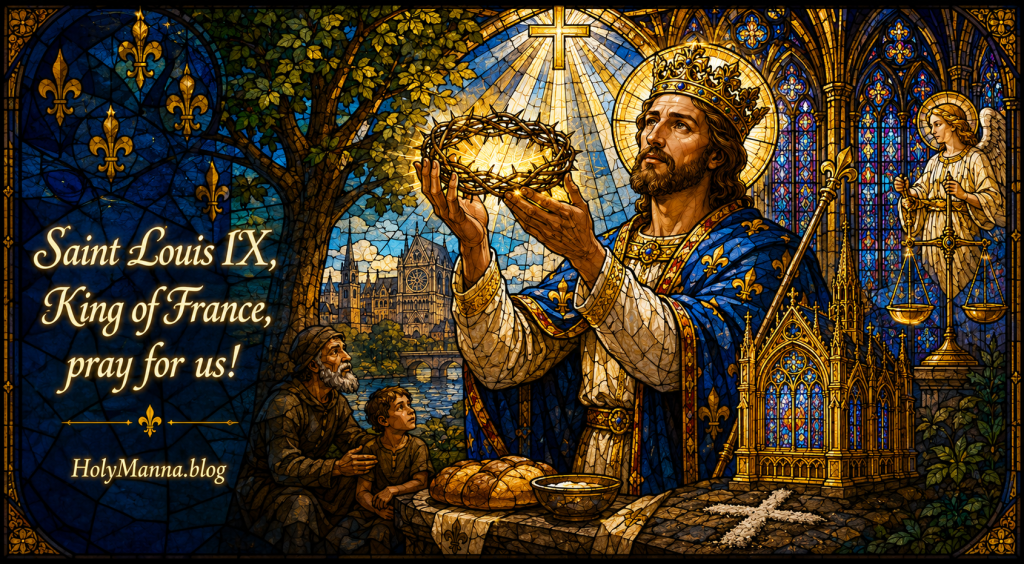
The King Who Knelt Before the Crown of Thorns
Every August 25th the Church remembers a man who wore a real crown for forty-four years and never once mistook it for the one that mattered. Saint Louis IX became King of France at twelve years old, ruled one of the most powerful kingdoms in Europe, built cathedrals of glass, made peace between warring kings, and died of dysentery in a crusader camp outside Tunis on this day in 1270. He is the only King of France the Church has ever raised to the altars, and he got there not by being royal but by hearing Mass every day, by feeding beggars with his own hands, by washing the feet of the poor, by insisting that the poor be believed before the rich in his courts, and by teaching his son that the first duty of any life is to love God.
Louis matters because he answers a question a lot of people quietly ask: can a person hold real power and real wealth and still be a saint? His life says yes, but only if the power is treated as a loan from God and the poor are treated as Christ. The Catechism teaches that authority does not derive its moral legitimacy from itself. It must not behave in a despotic manner, but must act for the common good (CCC 1902). Louis believed that with his whole heart, and his kingdom felt the difference.
He is the formally recognized patron of the Secular Franciscan Order, alongside Saint Elizabeth of Hungary, and the patron of the Archdiocese of St. Louis in Missouri, a city that carries his name. Longer lists of patronages circulate online, from barbers to builders to prisoners, but they rest on popular devotion more than on formal decree and are mentioned here only with that caution.
The Boy King and the Mother Who Feared Sin More Than Death
Louis was born on April 25th, 1214, at Poissy, a royal town on the Seine west of Paris, and was baptized in the collegiate church there. Later he liked to sign himself Louis of Poissy, and biographers have long reported that he considered his baptism greater than his coronation, because baptism made him a child of God while the crown only made him a king. That preference is reported by tradition rather than by a document in his own hand, but it fits everything else known about him. The Catechism would agree with his ranking: Holy Baptism is the basis of the whole Christian life, the gateway to life in the Spirit, and the door which gives access to the other sacraments (CCC 1213).
His father was Louis VIII, called the Lion, a warrior king who reigned only three years. His mother was Blanche of Castile, granddaughter of Eleanor of Aquitaine and Henry II of England, and one of the most formidable women of the medieval world. When Louis VIII died in November 1226, the boy was twelve. He was crowned at Reims on November 29th, and Blanche ruled as regent, facing down rebellious barons who thought a woman and a child could be pushed aside. She held the kingdom together, and she held her son’s soul together at the same time.
Blanche’s approach to raising a king is preserved in the memoir of Jean de Joinville, the seneschal of Champagne who knew Louis for decades and wrote The Life of Saint Louis around 1309. Joinville records that Louis himself told him what his mother used to say to him as a child. In the words most often quoted in English, she told him: I love you, my dear son, as much as a mother can love her child; but I would rather see you dead at my feet than that you should ever commit a mortal sin. The exact wording differs slightly across translations of Joinville, but the substance is documented, and Louis carried it as the compass of his life. That is a hard saying for modern ears, but it is simply The Catechism spoken by a mother: Mortal sin is a radical possibility of human freedom, as is love itself. It results in the loss of charity and the privation of sanctifying grace (CCC 1861). Blanche understood that the worst thing that could happen to her son was not losing his life or his throne, but losing God. Parents who wonder whether it is worth insisting on the faith at home should notice that parents have the first responsibility for the education of their children (CCC 2223), and that one mother’s insistence produced a saint on a throne.
Louis was never converted in the dramatic sense, because he never left. His conversion was the slow, steady deepening of a boy who was taught to pray and who kept praying. In 1234 he married Margaret of Provence at Sens, and the marriage produced eleven children, among them his heir Philip III and Robert of Clermont, ancestor of the Bourbon kings. Even after he took full control of the government, Blanche remained his closest counselor until her death in 1252.
Justice Beneath the Oak and Mercy at the Table
What did the reign of a saint actually look like on an ordinary Tuesday? His confessor Geoffrey of Beaulieu, his chaplain William of Chartres, the friar William of Saint-Pathus, and Joinville all wrote accounts of his life, and they agree on the shape of his days. He heard Mass daily, often two Masses, and recited the Divine Office with his chaplains. He wore a hair shirt under his royal robes. He confessed frequently and had himself scourged with a small discipline as penance, a practice recorded by his confessor and by later witnesses. He fasted on Fridays and through Advent and Lent, and he refused to laugh on Fridays out of reverence for the Passion. None of this was for show; much of it was discovered only after his death.
Then there was the way he treated the poor. He kept a daily table for beggars in his own hall, served them himself, and washed their feet, especially on Holy Thursday. He visited hospitals and lepers, tending to men whose sores repelled everyone else. Joinville, a soldier and not a mystic, was frankly uncomfortable with some of this, and he admits it. He records the day Louis asked him whether he would rather be a leper or commit a mortal sin. Joinville answered that he would rather commit thirty mortal sins than be a leper. Louis waited until they were alone and then corrected him firmly, telling him that there is no leprosy so hideous as being in mortal sin, because the soul in mortal sin is like the devil, while the leper’s body will be healed at the resurrection. That exchange, preserved by the man who was rebuked, is one of the most trustworthy windows into Louis’s mind that exists.
His charity had structure. He founded the Quinze-Vingts in Paris, a hospice for three hundred blind men that survives today as a hospital for the eyes. He founded and endowed the Cistercian abbey of Royaumont, where he is said to have carried stones alongside the workmen and where he cared for the sick monks personally. He built hospitals, supported the mendicant friars, and gave his backing to a young chaplain named Robert de Sorbon, whose college for poor theology students, founded in 1257, became the Sorbonne. Franciscan tradition holds that Louis joined the Third Order of Saint Francis; historians debate whether that is literally true, but the Secular Franciscan Order honors him as its patron to this day, and his life certainly looked like the life of a penitent in the world.
Louis is best remembered for the Crown of Thorns. In 1239 the Latin Emperor of Constantinople, Baldwin II, deep in debt, had pawned the relic to Venetian bankers, and Louis redeemed it. When it reached France, the King of France walked into Paris barefoot, in a plain tunic, carrying the crown that had been pressed onto the head of Christ. To house it and the other Passion relics he acquired, he built the Sainte-Chapelle in the heart of his palace between 1242 and 1248, a chapel whose walls are almost entirely stained glass and which still leaves visitors speechless. It was built as a reliquary, and every window of it points to the cross.
His justice was as famous as his piety. Joinville describes the king sitting under an oak in the wood of Vincennes after Mass, letting anyone with a grievance come and speak to him directly, and settling their cases without lawyers or delay. He sent royal investigators throughout the kingdom from 1247 onward to hear complaints against his own officials, and in 1254 he issued the Great Ordinance regulating how those officials could behave. He abolished trial by combat in the royal courts and pushed his justice toward evidence and testimony instead. In the written instructions he left for his son Philip, he told him plainly: be so just as to deviate in nothing from justice, whatever may befall thee. If a poor man have a quarrel with a rich man, sustain the poor rather than the rich, until the truth is made clear. That is the virtue The Catechism describes as the moral virtue that consists in the constant and firm will to give their due to God and neighbor (CCC 1807), practiced from a throne.
He was also the peacemaker of Europe. He signed the Treaty of Corbeil with Aragon in 1258 and the Treaty of Paris with Henry III of England in 1259, giving up disputed lands to secure peace, a decision his own barons thought foolish. In 1264 the English king and his rebellious barons both asked Louis to arbitrate their quarrel. Kings rarely ask other kings to judge them; they asked Louis because everyone believed he would tell the truth.
Honesty requires one more paragraph. Louis was a thirteenth-century Christian king, and he enacted measures against the Jews of France that the Church today looks upon with sorrow. He permitted the Disputation of Paris in 1240 and the burning of the Talmud in 1242, he issued ordinances against Jewish moneylending, and he enforced distinctive dress. He also pursued heresy and blasphemy with severity. None of this is hidden by his Catholic biographers, and none of it should be. The Church now teaches that the Jewish faith, unlike other non-Christian religions, is already a response to God’s revelation in the Old Covenant (CCC 839), and Catholics honor Louis for his heroic virtue while recognizing that heroic virtue in one age can coexist with blindness in another.
Chains in Egypt and Ashes in Tunis
Louis was not a martyr, but his life was full of suffering, most of it chosen. In 1244 he fell gravely ill, so ill that at one point his attendants thought he was dead. When he recovered, he vowed to take the cross and go to the Holy Land, over the tearful objections of Blanche, who knew what crusades did to kings. He spent four years preparing, then sailed in 1248 with his wife, his brothers, and a great army. The Seventh Crusade opened well. Damietta, at the mouth of the Nile, fell in June 1249. Then it collapsed. At Mansurah in February 1250 his brother Robert of Artois led a reckless charge into the town and was killed with most of the Templars. Disease swept the camp. During the retreat in April 1250 the king, himself sick with dysentery, was captured at Fariskur, along with the flower of the French nobility.
His captors threatened him with torture, and he answered that he was their prisoner and could do with him as they wished; he would not swear an oath his conscience rejected. When the ransom was set, most sources put it at 400,000 livres tournois, and Louis insisted the full amount be paid honestly, refusing to profit from a miscount in his favor. Released after roughly a month, he did not sail home in humiliation but stayed in the Holy Land for four years, spending his own treasury to rebuild the walls of Acre, Caesarea, Jaffa, and Sidon, ransoming Christian captives, and holding what was left of the crusader states together. Only the news of his mother’s death, in November 1252, drew him back to France in 1254.
Something changed in him after Egypt. Geoffrey of Beaulieu records that the king lived more austerely than before, wearing plain clothes, giving more alms, and treating the failure of the crusade as a judgment on his own sins rather than anyone else’s. He never blamed his men. That is the disposition The Catechism describes when it says that conversion is accomplished in daily life by gestures of reconciliation, concern for the poor, the exercise and defense of justice and right (CCC 1435).
In 1267, aging and unwell, he took the cross a second time. His nobles, including Joinville, thought it was a mistake, and Joinville says so bluntly, refusing to go. Louis sailed anyway in the summer of 1270, and for reasons still debated by historians, the fleet landed not in Egypt or Palestine but at Carthage, near Tunis. The heat was brutal and disease broke out at once. His son John Tristan, born in Damietta during the first crusade, died in the camp. Then the king fell ill.
The accounts of his death, written by men who were in the tent, are precise. Louis called his son Philip and gave him the written instructions he had prepared, telling him to love God above all things, to keep the kingdom’s good customs and mend the bad ones, and to be a father to the poor. He received the last sacraments. As the end drew near, he asked to be laid on a bed of ashes spread on the floor in the shape of a cross, and he lay there with his arms extended, praying. His confessor records that he prayed the words of the psalm: But as for me in the multitude of thy mercy, I will come into thy house; I will worship towards thy holy temple, in thy fear (Ps 5:8). Tradition also holds that he sighed the words Jerusalem, Jerusalem near the end, though the exact final words are reported differently by different witnesses. He died at three in the afternoon on August 25th, 1270, the hour of the Lord’s own death. The Catechism says that the Church encourages us to prepare ourselves for the hour of our death (CCC 1014), and Louis, who had prepared for it his whole life, died like a man arriving home.
Sixty-Five Miracles and a Heart in Sicily
Because Louis died so far from home, his body was prepared in the manner medieval kings sometimes were, with the flesh separated from the bones for the long journey. His heart and entrails were given to his brother Charles of Anjou and enshrined in the cathedral of Monreale in Sicily, where they remain. His bones traveled back to France with the army, and the cortege was met with reverence in every town it passed. Tradition holds that healings occurred along the route, at places where the bier rested for the night, and pilgrims later marked those places. Those roadside cures are reported by later devotion rather than by the formal inquiry, and they cannot be verified. The bones were laid to rest at the abbey of Saint-Denis, the burial place of the kings of France, in 1271.
Almost immediately the sick began coming to his tomb. In 1282 and 1283 a formal inquiry was held at Saint-Denis under papal authority, and hundreds of witnesses were examined. William of Saint-Pathus, who had been confessor to Queen Margaret, later compiled the results in a work called The Miracles of Saint Louis, and it preserves roughly sixty-five cases that the investigators found credible. They read like the Gospels: people crippled by paralysis who walked away from the tomb, the blind who received sight, the deaf who heard, sufferers from fistulas and wasting fevers who were cured, children thought to be dead who revived. The witnesses were ordinary Parisians and villagers, questioned one by one, and their names and parishes are recorded. Individual cases lie beyond what can be checked here, but the inquiry and its outcome are solidly documented.
On August 11th, 1297, Pope Boniface VIII canonized Louis with the bull Gloria, laus, twenty-seven years after his death. The Catechism explains what that act means: By canonizing some of the faithful, i.e., by solemnly proclaiming that they practiced heroic virtue and lived in fidelity to God’s grace, the Church recognizes the power of the Spirit of holiness within her and sustains the hope of believers by proposing the saints to them as models and intercessors (CCC 828). His feast was fixed on August 25th, the day of his death, and it remains on the General Roman Calendar as an optional memorial today.
His relics had a hard history. His skull was enshrined at the Sainte-Chapelle and his bones venerated at Saint-Denis for five centuries, until the French Revolution emptied the royal tombs in 1793 and scattered them. Some fragments survived; small relics are kept at Saint-Denis and elsewhere, and the treasury of Notre-Dame de Paris holds his tunic and the small discipline he used for penance. The Crown of Thorns itself survived the Revolution and, in April 2019, was carried out of the burning Notre-Dame by the cathedral chaplain and firefighters. The Sainte-Chapelle still stands and still draws millions.
His name went around the world. The city of St. Louis, Missouri, was named for him by French settlers in 1764, and its Cathedral Basilica is one of the great churches of North America. St. Louis Cathedral in New Orleans, the oldest cathedral in continuous use in the United States, bears his name, as do San Luis Potosí in Mexico, Saint-Louis in Senegal, and hundreds of parishes and schools. At Carthage, near where he died, a cathedral of Saint Louis was built in the nineteenth century, and pilgrims still visit Poissy to see his baptismal font and Royaumont to see the abbey he built. In France he became the model of Christian kingship for every generation that followed.
Ruling the Small Kingdom of Your Own Heart
Very few readers of this post are going to inherit a throne. Every one of them, though, has a kingdom of some size: a household, a classroom, a team at work, a schedule, a bank account, a reputation. Louis’s life is a lesson in how to govern whatever has been handed over, and the lesson is simple enough to fit in one of his own sentences to his son: the first thing I would teach thee is to set thine heart to love God; for unless he love God none can be saved. Everything else he did flowed from that ordering. The Mass came first in his day because God came first in his life. The Catechism puts the same truth this way: Prayer is the raising of one’s mind and heart to God or the requesting of good things from God (CCC 2559), and a king who raised his mind to God every morning found it easier to keep his hands off what belonged to his people.
What sits first in your day, before the phone, before the news, before the to-do list? Louis did not have more hours than anyone else; he ruled France in the same twenty-four hours everyone gets. He simply refused to let God be the thing squeezed in at the end.
Then there is the poor man’s quarrel with the rich man. Louis told his son to lean toward the poor until the truth was clear, not to be unfair to the wealthy but because the world already leans the other way, and a Christian should push back. The Catechism teaches that the works of mercy are charitable actions by which we come to the aid of our neighbor in his spiritual and bodily necessities (CCC 2447), and it lists feeding the hungry, sheltering the homeless, and visiting the sick, all things Louis did with his own hands while wearing a crown. Is there someone in your life whose complaint you have been quietly discounting because they have less power than the person they are complaining about? Louis would sit under the oak and hear them out.
His mother’s saying deserves an honest look too. Most people would rather sin than die and would not think twice about it. Louis thought twice about it every day. He was not scrupulous or grim; Joinville describes a warm, humorous, sometimes exasperating man. But he never confused a comfortable life with a saved one. When was the last time a sin felt like the serious thing it is, rather than a small inconvenience to be waved off? The Lord himself said, seek first his kingdom and his righteousness, and all these things shall be yours as well (Mt 6:33), and Louis, who had all these things, took the first half of the verse seriously.
Practical steps are not complicated. Go to Mass on a weekday this week. Give money or time to someone who cannot repay it, without telling anyone. Confess a sin that has been sitting untouched. Read the Book of Wisdom’s address to rulers: Listen therefore, O kings, and understand; learn, O judges of the ends of the earth. For your dominion was given you from the Lord, and your sovereignty from the Most High (Wis 6:1, 3), and then ask what small dominion has been given to you and how you have been ruling it. When suffering comes, as it came to Louis in an Egyptian prison and a Tunisian tent, remember that he treated it as a purification rather than a punishment, and never let defeat turn him bitter toward God.
The Catechism promises that the saints do not cease to intercede with the Father for us (CCC 956). Louis spent his life interceding for the poor before his own courts. There is no reason to think he has stopped.
Engage With Us!
Saint Louis had every excuse to coast and never used one. Share your thoughts and reflections in the comments below; the community here at HolyManna.blog is stronger for every honest voice.
- Blanche of Castile told her son she would rather see him dead than in mortal sin. How seriously do you treat sin in your own life, and what would change if you took it as seriously as she did?
- Louis served the poor at his own table and washed their feet. What is one concrete work of mercy you could do this week with your own hands rather than through a donation?
- In his instructions to his son, Louis said to lean toward the poor man in a dispute until the truth is clear. Where in your life do you tend to give the benefit of the doubt to whoever has more power?
- Louis carried the Crown of Thorns into Paris barefoot. When have you been embarrassed to show your faith publicly, and what would it take to walk barefoot, so to speak?
- After the failure of his first crusade, Louis blamed only himself and grew more humble rather than bitter. How do you respond to failure, and does it draw you closer to God or push you away?
Saint Louis wore a crown and knelt anyway. Whatever crown you carry, however small, carry it kneeling. Put God first in the day, put the poor first in the queue, and put your own sins first in the confessional line, and do it all with the love and mercy that Jesus taught to everyone who follows him.
Saint Louis IX, King of France, pray for us!
Follow us on YouTube, TikTok, Instagram and Facebook for more insights and reflections on living a faith-filled life.

 Holy Manna!
Leave a comment