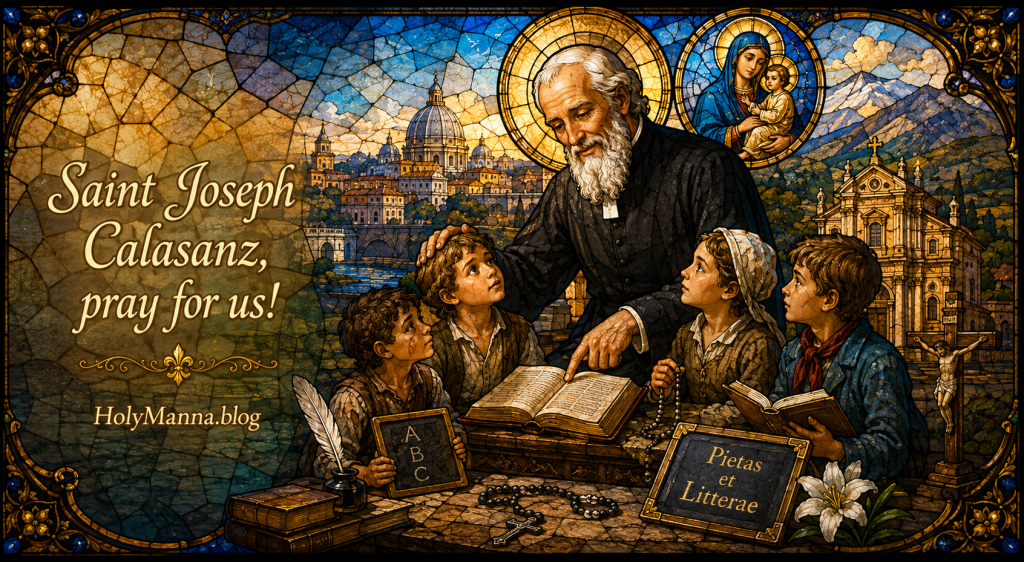
The Priest Who Opened School Doors to the Poor
Every school day, somewhere in the world, a child from a family with nothing walks into a classroom, sits down, and learns to read for free. Most of those children have never heard the name Joseph Calasanz, and that is exactly how he would have wanted it. He is the Aragonese priest who, in a cramped sacristy in Rome in 1597, opened what Church historians regard as the first free public school in Europe. From that small room grew the Piarists, the first religious order in the history of the Church founded entirely for the education of the young. Calasanz took a doctorate in law, held positions of real influence, and could have lived comfortably. Instead he spent more than fifty years teaching poor boys to read, write, count, and pray, and he ended his life stripped of authority, betrayed by his own men, and still at peace. The Church recognizes his enduring gift by honoring him as the patron of Christian popular schools, a title given by Pope Pius XII in 1948, along with patronage of Catholic schools, students, and teachers. His memorial falls on August 25th, the day of his death, and his story matters more now than ever in an age that argues loudly about what education is for.
The Church has never treated the education of children as a side project. The Catechism teaches that parents hold the first responsibility for the education of their children, and that this right and duty are primordial and inalienable (CCC 2221). It adds that “the home is well suited for education in the virtues” (CCC 2223), and it reminds every Christian that “the family is the community in which, from childhood, one can learn moral values, begin to honor God, and make good use of freedom” (CCC 2207). Calasanz saw with painful clarity what happens when poverty crushes a family’s ability to carry out that mission. He decided the Church herself would step in and stand beside those families. That decision changed the West.
The Youngest Son of a Forge in Aragon
Joseph Calasanz was born at Peralta de la Sal, a village in the county of Ribagorza in the Kingdom of Aragon, in the diocese of Urgell in northeastern Spain. Sources conflict on the year: most Piarist sources give September 11th, 1557, while Butler’s Lives of the Saints and other older sources give 1556. What is not in dispute is the family. His father, Pedro Calasanz, was an infanzón, a member of the minor Aragonese nobility, who owned a forge and served as the local bailiff. His mother, María Gastón, gave him a thoroughly Catholic upbringing. Joseph was the youngest of eight children.
Early biographers record a childhood story that has been repeated for centuries. As a small boy, having heard that the devil was the enemy of God, Joseph took a knife and set out to find the devil and kill him. The story is charming and it fits the fierce single-mindedness of the man he became, but it rests on early hagiography and cannot be independently verified.
His formation was serious. He studied grammar and humanities at Estadilla under the Trinitarian friars, then philosophy and law at Lérida, where he earned a doctorate in law. He went on to theology at Valencia and finished at Alcalá de Henares, the great university founded by Cardinal Cisneros. A documented episode from Valencia reveals his character: when a noblewoman in the household where he lodged made unwanted advances toward him, he simply left the city rather than expose himself to temptation. That kind of clean, unhesitating choice would mark his whole life.
God’s call came through suffering. After the death of his older brother, his father wanted Joseph to marry so that the family line would continue, and the young man’s plans for the priesthood seemed to be slipping away. Around 1582 he fell gravely ill and came close to death. He vowed that if he recovered he would become a priest. He recovered. His father relented, and on December 17th, 1583, Joseph Calasanz was ordained by Bishop Hugo Ambrosio de Moncada. He was about twenty-six years old.
The next several years look, on paper, like the résumé of a rising Church administrator. He served as secretary and confessor to bishops in Lérida, Barbastro, and Urgell. He was named vicar general for the district of Tremp in the Pyrenees, where lawlessness and clerical laxity had taken root, and he restored order and discipline with a firmness that people remembered. He was offered rich benefices and turned them down. When his father died, he inherited a comfortable estate, and he had every reason to settle into a respected career in Spain. Instead, in early 1592, feeling an interior pull he could not fully explain, he set out for Rome.
The School in the Sacristy of Santa Dorotea
Calasanz went to Rome hoping for a canonry, the sort of position that would suit a doctor of laws. Instead he was taken into the household of Cardinal Marcantonio Colonna as theologian and tutor to the cardinal’s nephew, and he did what he had always done: he threw himself into serving people who had nothing. He joined the Confraternity of the Twelve Apostles and the Confraternity of Christian Doctrine, walking the alleys of Trastevere, visiting the sick, feeding the hungry, and teaching catechism. During the great Tiber flood of December 1598 he and Saint Camillus de Lellis were seen wading through the water pulling people from collapsing houses.
What broke his heart was the children. Rome was full of them, ragged, hungry, running the streets, growing up without letters and without prayer, easy prey for every kind of ruin. Tradition holds that one day, walking through Trastevere, he heard an interior voice say, “Joseph, give yourself to the poor, teach the little ones.” Early biographers report this, and it captures the turn his life took, but it cannot be verified as historical fact.
What can be verified is what he did next, because it was recorded in sworn testimony. He went to the schoolmasters of Rome and asked them to accept poor children without charge. They refused. He went to the city officials and the confraternities and asked for help. Nothing came of it. So in November 1597, with the parish priest of Santa Dorotea in Trastevere, Fr. Antonio Brendani, Joseph Calasanz opened a school in two rooms attached to the sacristy. Tuition was free. Any boy could come. Within a very short time there were a hundred pupils, then hundreds, then more than a thousand.
This is the moment the reader should hold onto. In 1597, the idea that the poor should be schooled at all, let alone for free, at every level from letters to mathematics, was radical. Calasanz did not simply hand out alms. He gave the poor the tools to stand on their own two feet, and he did it because he understood the dignity of every human person, a dignity the Catechism grounds in humanity’s creation “in the image of God” (CCC 1700). His motto for the schools was Pietas et Litterae, piety and letters, because he refused to separate the formation of the mind from the formation of the soul. He was, in the truest sense, a catechist, and the Catechism describes that vocation as bringing people “into communion with Jesus Christ” so that “only he can lead us to the love of the Father in the Spirit” (CCC 426).
The schools were innovative in ways that would take the rest of the world centuries to catch up with. Classes were graded by ability. Instruction was in the vernacular so that poor boys could actually understand it, with Latin added as they progressed. Mathematics and the sciences were taught, not just grammar and rhetoric. Calasanz admired Galileo Galilei and sent Piarists to study under him; one of his priests, Fr. Clemente Settimi, served as Galileo’s assistant and secretary in the astronomer’s final years at Arcetri, and Piarist schools taught Galileo’s mathematics. Calasanz also gave hospitality at Frascati to the philosopher Tommaso Campanella. None of this made him popular with the suspicious, and all of it would later be used against him.
The work grew because the Church backed it. Pope Clement VIII granted an annual subsidy. The school moved to Sant’Andrea della Valle in 1602 and to the church and house of San Pantaleo in 1612, which remains the Piarist mother house today. In 1617 Pope Paul V erected the Pauline Congregation of the Poor of the Mother of God of the Pious Schools. On November 18th, 1621, Pope Gregory XV raised it to a full religious order with solemn vows, the Order of the Poor Clerics Regular of the Mother of God of the Pious Schools, and in 1622 Calasanz became its first superior general. Its members took the three vows every religious takes and a fourth vow, unique at the time, dedicating themselves to the education of youth. Schools spread through Italy and into Central Europe: Moravia, Bohemia, Poland, Hungary.
Stories of the miraculous during his lifetime cluster around exactly this work. Testimony gathered for his cause records healings of the sick through his blessing, and accounts of food multiplied when the school kitchens ran empty and the poor boys had nothing to eat. These accounts appear in the process documents and early biographies, though the specific details vary from telling to telling and cannot be verified with certainty. The best loved tradition of all holds that while Calasanz knelt praying the Rosary with a group of children in one of his schools, the Blessed Virgin appeared holding the Child Jesus and blessed the boys. The scene has been painted countless times and is beloved by Piarist students, but it is a tradition and cannot be verified. What is beyond doubt is the source of it all: a man who prayed constantly, celebrated Mass with visible devotion, and confessed poor children with a patience that seemed to have no bottom.
His own words about that patience survive in the passage the Church reads at the Office of Readings on his memorial. He wrote: “All who undertake to teach must be endowed with deep love, the greatest patience, and, most of all, profound humility. They must perform their work with earnest zeal. Then, through their humble prayers, the Lord will find them worthy to become fellow workers with him in the cause of truth. He will console them in the fulfillment of this most noble duty, and finally will enrich them with the gift of heaven.” In a letter he put it more simply: “In Rome I have found the best way to serve God, by helping poor children, and I will not leave it for anything in the world.”
Arrested at Eighty-Five and Stripped of His Own Order
Saint Joseph Calasanz was never martyred. What he suffered instead was slower and in some ways harder, because the wounds came from inside his own house.
The order grew fast, and growth brought in men who did not share the founder’s heart. Chief among them was Fr. Mario Sozzi, an ambitious and unstable priest who secured the protection of officials at the Holy Office and began denouncing the founder and the order. Enemies of the Piarist schools were already grumbling. Some resented that poor boys were being educated at all, since an educated peasant class threatened the social order. Some were scandalized by the order’s connection to Galileo, whose work had been condemned. Rival religious congregations resented the competition. Sozzi gave those resentments a channel.
In August 1642, on the strength of Sozzi’s accusations, Joseph Calasanz, then about eighty-five years old, was arrested and led on foot through the streets of Rome to the Holy Office like a criminal. He was released the same day after Cardinal Cesarini intervened, but the humiliation was public and complete. Worse followed. Sozzi was placed in effective charge of the order over the head of its founder. When Sozzi died in 1643, another ambitious priest, Fr. Stefano Cherubini, took control. Piarist archival research has since established, and the order today acknowledges, that Cherubini had earlier been credibly accused of abusing pupils and had been moved rather than removed. Calasanz was aware of the accusations, and the handling of the case is a real stain on the history of the period. The reader should know it plainly, because honesty about the failures around a saint does not diminish the saint; it makes his fidelity in the middle of it more astonishing.
A papal commission investigated. Its recommendations were devastating. In March 1646, by the brief Ea quae pro felici, Pope Innocent X reduced the Pious Schools to a mere congregation of secular priests without vows, subject to local bishops. Novices were dismissed. Members were free to leave. The order that Calasanz had built over fifty years was, in effect, dissolved while he was still alive to watch it happen.
Witnesses recorded his response. He gathered his sons and repeated the words of Job: “The LORD gave and the LORD has taken away; blessed be the name of the LORD” (Job 1:21). He did not attack the pope. He did not organize resistance. He submitted to the Church, kept praying, kept confessing children, and kept telling his men to trust God. That is not weakness. The Catechism explains that obedience of faith means to “submit freely to the word that has been heard, because its truth is guaranteed by God, who is Truth itself” (CCC 144), and it teaches that in the sacrament of Holy Orders a priest is configured to Christ, who was obedient unto death (CCC 1548). Calasanz lived that configuration to the end. He also modeled a virtue the Catechism names directly: fortitude, “the moral virtue that ensures firmness in difficulties and constancy in the pursuit of the good” (CCC 1808).
He died at San Pantaleo on August 25th, 1648, about ninety years old, surrounded by a handful of loyal Piarists and the poor children he had loved. His order was, on paper, finished.
It was not finished. Eight years later, in 1656, Pope Alexander VII restored the Pious Schools as a congregation with simple vows. In 1669, Pope Clement IX restored it fully to the status of a religious order with solemn vows. Everything Calasanz had built came back, exactly as he had trusted it would, and it came back stronger.
The Incorrupt Heart at San Pantaleo
The Church did not forget him. Miracles through his intercession were reported soon after his death, and the cause moved forward through the eighteenth century. When his body was exhumed in 1748, his heart and his tongue were found incorrupt. Both are still venerated today in the church of San Pantaleo in Rome, along with his body, which lies beneath the altar in the chapel dedicated to him. Pope Benedict XIV beatified him on August 7th, 1748. Pope Clement XIII canonized him on July 16th, 1767, in a great ceremony that also raised to the altars Saint Jane Frances de Chantal, Saint Jerome Emiliani, Saint John Cantius, Saint Joseph Cupertino, and Saint Seraphinus. The canonization miracles involved physical healings attributed to his intercession, examined and approved by the Church; the Bollandist and Piarist sources record them, though the details vary in the retelling and the reader should treat specific popular accounts of them as stories rather than settled fact.
On August 13th, 1948, in the brief Providentissimus Deus, Pope Pius XII proclaimed Saint Joseph Calasanz the heavenly patron of all Christian popular schools throughout the world. In 1969, when the calendar was reformed, his memorial was moved from August 27th to August 25th, the actual day of his death.
His cultural footprint is enormous and mostly invisible, which is fitting. The Piarist Fathers today run schools and parishes across Europe, the Americas, Africa, and Asia, including in the United States. In Spain the Escuelas Pías educated generations, and the great painter Francisco de Goya, who had studied at a Piarist school in Zaragoza, painted his haunting Last Communion of Saint Joseph Calasanz in 1819 for the Escuelas Pías de San Antón in Madrid, where it hangs today; the dying old man kneels to receive the Eucharist while his priests and boys look on. Peralta de la Sal, his birthplace, keeps a sanctuary and a Piarist community and draws pilgrims, especially in centenary years, when the order celebrates a Calasanctian Year. The tomb at San Pantaleo remains a place of pilgrimage for teachers, students, and Piarist families. His method, in its essentials of free universal schooling for the poor with graded classes and vernacular instruction, was copied so widely that most people who benefit from it have no idea it began with a Spanish priest kneeling on the floor of a Roman sacristy.
What a Ninety-Year-Old Schoolteacher Can Teach You
It is easy to admire Joseph Calasanz from a distance and miss how uncomfortable his example is up close. He was brilliant, well connected, and set up for a comfortable ecclesiastical career, and he threw all of it away for children nobody else wanted. He was right about education, right about Galileo’s mathematics, right about the dignity of the poor, and he was still humiliated, arrested, and dismantled by his own brothers. And he did not become bitter. That last part is the hardest.
Start with his vocation. Calasanz did not have a plan for his life; he had a series of yeses. Yes to the priesthood on what looked like his deathbed. Yes to Rome when a canonry made more sense than a sacristy. Yes to teaching poor boys when every respectable person told him no. The Catechism teaches that “the vocation of humanity is to show forth the image of God” (CCC 1877), and that image is found not by grasping but by giving. Where in your own life is God asking for a yes that does not make sense on paper? What comfortable plan might you need to release in order to say it?
Then look at his understanding of the poor. He did not romanticize poverty. He saw exactly what it did to children and refused to accept it. The Catechism speaks of “a preferential love” for the poor and insists that this love “is a part of the Church’s constant tradition” (CCC 2444). Calasanz translated that love into a curriculum. When you encounter someone in need, do you offer only what is easy to give, or do you look for what would actually change their life?
Then sit with his patience. The Office of Readings passage is worth reading again slowly, because he wrote about patience and humility as the essential equipment of a teacher long before he was tested by Sozzi and the Holy Office. Every parent, every catechist, every teacher, every boss, every older sibling is a teacher. Do you teach with love, patience, and humility, or with impatience and the need to be seen as right?
Finally, look at how he suffered. He was arrested and shamed at eighty-five, and he responded with Job’s prayer. He watched the Church suppress his own order and did not rebel. That is not resignation. He was making a real act of faith that God’s Church, even in a moment of terrible misjudgment, was still God’s Church, and that God’s plan would outlast the mistakes of men. Twenty-one years after his death, he was proven right. The Catechism teaches that “faith is certain” and that “the certainty that the divine light gives is greater than that which the light of natural reason gives” (CCC 157). When the Church, or your family, or your friends have failed you, do you walk away, or do you stay and pray and trust?
There are practical ways to let Saint Joseph Calasanz shape your week. Pray for teachers by name, especially the ones in Catholic schools who are underpaid and overworked. If you have children, take his conviction seriously that the Christian formation of the young is your first duty, and read a page of the Catechism to them or with them. Volunteer to teach catechism at your parish; most parishes are desperate for adults willing to teach children. Support a Catholic school scholarship fund, because free education for the poor was his whole life. And when you are wronged, before you speak, try praying Job’s words. They are short enough to remember and hard enough to matter.
Engage With Us!
Saint Joseph Calasanz would have loved a conversation about how faith and learning meet in real life, so please share your thoughts and reflections in the comments below. Consider these questions as you pray with his story:
- Calasanz vowed to become a priest during a near fatal illness. Has suffering ever clarified God’s call in your life, and how did you respond?
- He opened his school only after every official channel refused to help. Where might God be asking you to stop waiting for permission and simply start serving?
- He insisted that piety and letters, faith and learning, belong together. How do you keep your intellectual life and your prayer life from drifting apart?
- He was arrested and shamed at eighty-five and answered with Job’s prayer. What would it take for you to respond to injustice with trust rather than resentment?
- Pius XII named him patron of Christian schools. Who taught you the faith, and have you ever thanked them or prayed for them?
- The order he founded was suppressed during his lifetime and restored after his death. Is there something you have built or hoped for that seems lost, and can you entrust it to God the way he did?
Saint Joseph Calasanz gave fifty years to children who could give him nothing back, and he gave his final years to a God who seemed, for a time, to have taken everything away. He never stopped teaching, never stopped forgiving, and never stopped trusting. Take one small step this week to teach someone the faith, whether a child, a coworker, or a friend, and do it with the love and mercy that Jesus taught us.
Saint Joseph Calasanz, patron of Christian schools, pray for us!
Follow us on YouTube, TikTok, Instagram and Facebook for more insights and reflections on living a faith-filled life.


Leave a Reply