Tuesday of the Twenty-first Week in Ordinary Time – Lectionary: 426
When the Ground Feels Shaky, Look at the Cup
Some seasons of life feel like the floor is tilting. Rumors fly, headlines shout, and even faithful people start wondering whether everything is about to come apart. The Church answers that mood today with three readings that steady the heart rather than stoke the panic.
Saint Paul writes to a young community in Thessalonica that had been rattled by a claim, possibly even a forged letter, announcing that the day of the Lord had already arrived. His counsel is bracing and calm: do not be shaken, hold fast to what was handed on, and let God Himself strengthen your hearts. The Responsorial Psalm then lifts the eyes above the anxiety and sings of a Lord who reigns, who has made the world firm, and who comes to judge with justice. Finally, the Gospel shows what that Judge is actually looking for. Jesus rebukes scribes and Pharisees who tithe their kitchen herbs with precision while neglecting judgment, mercy, and fidelity, and who scrub the outside of the cup while the inside stays full of greed.
The thread tying the day together is this: the Lord who is coming wants steady, cleansed hearts, not panicked religion and not performed religion. Standing firm on Tradition and cleansing the inside of the cup are two sides of one interior fidelity. Both readings speak into a first-century world of intense expectation, where communities argued about the end of the age and about ritual purity, and both land squarely on a heart that trusts God enough to be honest with Him. That is the invitation of Tuesday of the Twenty-first Week in Ordinary Time: less noise, more substance, and a heart ready for the King who is already reigning.
First Reading — 2 Thessalonians 2:1-3a, 14-17
Steady Hearts in a Rattled Church
Thessalonica was the capital of Roman Macedonia, a busy port on the Via Egnatia, where Saint Paul planted a church around the year 50 before riots forced him out. His first letter to that community had comforted them about believers who had died before the Lord’s return. The second letter, written not long afterward, faces a different problem. Someone was insisting, whether through a claimed prophecy, a rumor, or a letter passed off as Paul’s own, that the day of the Lord had already come. Imagine the anxiety. The lectionary skips the middle of the chapter, with its mysterious “lawless one,” and lets the pastoral heart of the passage stand on its own. Paul does not calm the community with new predictions. He points them back to their calling, to what was handed on, and to the God who strengthens hearts, a fitting first word on a day about interior firmness before the coming Judge.
2 Thessalonians 2:1-3a, 14-17
We ask you, brothers and sisters,
with regard to the coming of our Lord Jesus Christ
and our assembling with him,
not to be shaken out of your minds suddenly,
or to be alarmed either by a “spirit,” or by an oral statement,
or by a letter allegedly from us
to the effect that the day of the Lord is at hand.
Let no one deceive you in any way.To this end he has also called you through our Gospel
to possess the glory of our Lord Jesus Christ.
Therefore, brothers and sisters, stand firm
and hold fast to the traditions that you were taught,
either by an oral statement or by a letter of ours.May our Lord Jesus Christ himself and God our Father,
who has loved us and given us everlasting encouragement
and good hope through his grace,
encourage your hearts and strengthen them
in every good deed and word.
Detailed Exegesis
Verse 1: “We ask you, brothers and sisters, with regard to the coming of our Lord Jesus Christ and our assembling with him,”
Paul names two realities in one breath: the parousia, the royal arrival of Christ, and the “assembling,” a word that in Greek shares its root with the synagogue. In 1 Thessalonians 4:17 he had described believers being caught up together to meet the Lord. The coming of Christ is a gathering, not a scattering, and the Catechism links these events plainly: “Indeed, the resurrection of the dead is closely associated with Christ’s Parousia” (CCC 1001). Paul begins by naming the end of the story as a homecoming.
Verse 2: “not to be shaken out of your minds suddenly, or to be alarmed either by a ‘spirit,’ or by an oral statement, or by a letter allegedly from us to the effect that the day of the Lord is at hand.”
The verb translated “shaken” pictures a boat tossed by waves. Paul lists three channels of misinformation: a supposed prophetic utterance, a spoken report, and a forged letter. That last detail explains why he closes the letter by signing it in his own hand. The Greek phrase behind “is at hand” can mean that the day has already arrived, which is exactly the panic he is deflating. Fear about the end times spreads fastest when it comes with a claim of authority, so Paul teaches the community to test the source before surrendering their peace.
Verse 3a: “Let no one deceive you in any way.”
Deception is the oldest enemy of faith, and Paul knows that spiritual anxiety leaves people wide open to it. The Church later teaches that a final trial will involve exactly this kind of confusion: “Before Christ’s second coming the Church must pass through a final trial that will shake the faith of many believers” (CCC 675). Vigilance, not panic, is the Christian posture.
Verse 14: “To this end he has also called you through our Gospel to possess the glory of our Lord Jesus Christ.”
Here is the positive foundation. God has called the Thessalonians, and the instrument of that call was “our Gospel,” the apostolic preaching. The destination is not survival but glory, a sharing in the very glory of Christ. This is vocation language for every baptized person. The Church puts it this way: “All Christians in any state or walk of life are called to the fullness of Christian life and to the perfection of charity” (CCC 2013).
Verse 15: “Therefore, brothers and sisters, stand firm and hold fast to the traditions that you were taught, either by an oral statement or by a letter of ours.”
This is the hinge of the reading and one of the great Scriptural witnesses to Sacred Tradition. Paul speaks of “traditions,” in Greek paradoseis, meaning what has been handed over, and he explicitly says some came by word of mouth and some by letter. Both carry apostolic authority, and Saint John Chrysostom, preaching on this very verse, drew the obvious conclusion: “Hence it is manifest, that they did not deliver all things by Epistle, but many things also unwritten, and in like manner both the one and the other are worthy of credit. Therefore let us think the tradition of the Church also worthy of credit. It is a tradition, seek no farther” (Homily 4 on Second Thessalonians).
Verse 16: “May our Lord Jesus Christ himself and God our Father, who has loved us and given us everlasting encouragement and good hope through his grace,”
Paul turns from instruction to blessing, naming the Son before the Father, and in the Greek the verbs that follow are singular, a quiet grammatical witness that Father and Son act as one. The gifts named are “everlasting encouragement” and “good hope,” both flowing “through his grace.” Encouragement here comes from the same word family as the Paraclete, the Comforter.
Verse 17: “encourage your hearts and strengthen them in every good deed and word.”
The prayer lands on the heart, the biblical center of the person, and then moves outward to deeds and words. Grace does not stop at inner comfort; it produces a life. That is the arc of the passage: from shaken minds to strengthened hearts to good works.
Teachings
The Church’s teaching on Tradition grows straight out of this reading. The Catechism explains that the Church “does not derive her certainty about all revealed truths from the holy Scriptures alone. Both Scripture and Tradition must be accepted and honored with equal sentiments of devotion and reverence” (CCC 82, quoting Dei Verbum 9). It further clarifies what is meant: “The Tradition here in question comes from the apostles and hands on what they received from Jesus’ teaching and example and what they learned from the Holy Spirit” (CCC 83). The Council of Trent, in its Fourth Session in 1546, used this same language of equal reverence for the written books and the unwritten traditions.
On the anxiety Paul addresses, the Church holds a balanced posture. Christ’s return is always near and never to be scheduled: “Since the Ascension Christ’s coming in glory has been imminent, even though ‘it is not for you to know times or seasons which the Father has fixed by his own authority’” (CCC 673). Readiness, not calculation, is the Christian response.
Reflection
Every generation has its version of the forged letter: a viral video, a breathless prophecy, a headline insisting the end is here. Paul’s advice is practical: test the source, and return to what has been handed on. The Creed, the sacraments, the Rosary, and the daily readings keep a heart from being tossed around.
Try a concrete step this week. When something alarming lands in your feed, pause before sharing it and ask whether it comes from the Church’s living voice or from noise. Then pray verses 16 and 17 as a blessing over someone you love, and notice how the prayer moves from the heart outward to deeds.
What is currently shaking your peace, and where is it coming from? Which of the traditions you were taught do you need to hold more firmly right now?
Responsorial Psalm — Psalm 96:10-13
The Whole Creation Sings for Its Judge
Psalm 96 belongs to a family of songs sometimes called enthronement psalms, alongside Psalms 93 and 97 through 99, each built around the cry that the LORD is king. Nearly the whole psalm appears again in 1 Chronicles 16:23-33, sung when David brought the ark into Jerusalem, so it carries the memory of God’s presence arriving among His people. The Church sings this psalm at the Christmas Mass during the Night, because the King who comes to judge first came as a child. Today its final verses answer Paul’s anxious Thessalonians and prepare for the Gospel. Judgment in this psalm is not a threat that makes creation cower. It is the news that sets the heavens, the sea, the fields, and the forests singing, because the world is finally going to be set right. That is the mood of the day: firmness, joy, and trust in the Judge.
Psalm 96:10-13
R. (13b) The Lord comes to judge the earth.
Say among the nations: The LORD is king.
He has made the world firm, not to be moved;
he governs the peoples with equity.
R. The Lord comes to judge the earth.
Let the heavens be glad and the earth rejoice;
let the sea and what fills it resound;
let the plains be joyful and all that is in them!
Then shall all the trees of the forest exult.
R. The Lord comes to judge the earth.
Before the LORD, for he comes;
for he comes to rule the earth.
He shall rule the world with justice
and the peoples with his constancy.
R. The Lord comes to judge the earth.
Detailed Exegesis
Verse 10: “Say among the nations: The LORD is king. He has made the world firm, not to be moved; he governs the peoples with equity.”
The command goes to the nations, not just to Israel. God’s kingship is universal. The word “firm” is the same idea Paul reached for in the First Reading. Because God reigns, the world will not tip over, however it feels. Ancient Christian tradition, witnessed in Saint Justin Martyr and in the sixth-century hymn Vexilla Regis, knew a reading of this verse as “the Lord has reigned from the tree,” and heard in it a prophecy of the Cross, the throne from which Christ governs with equity.
Verse 11: “Let the heavens be glad and the earth rejoice; let the sea and what fills it resound; let the plains be joyful and all that is in them!”
The psalmist calls the whole cosmos to worship, from sky to sea to farmland. This is not decoration. Scripture consistently teaches that creation itself waits for God’s justice; Paul says in Romans 8:19 that creation awaits the revelation of the children of God. When the King comes, everything He made will recognize its Maker.
Verse 12: “Then shall all the trees of the forest exult.”
Saint Augustine, commenting on this psalm, read the trees of the forest as the nations, once wild and unfruitful, now made joyful in Christ. Whatever the layers of meaning, the image is tender. Even the wild places, the parts of life that seem untamed and beyond hope, are invited to the celebration.
Verse 13: “Before the LORD, for he comes; for he comes to rule the earth. He shall rule the world with justice and the peoples with his constancy.”
The repetition, “for he comes; for he comes,” is the heartbeat of the psalm. The Hebrew verb behind “rule” is the word for judging, which is why the refrain sings, “The Lord comes to judge the earth.” His judgment is marked by justice and by “constancy,” a word for faithfulness that echoes the “fidelity” Jesus will name in the Gospel. God’s judgment is not arbitrary. It is the faithful God being true to Himself.
Teachings
The Church confesses the kingship this psalm proclaims: “Jesus Christ is Lord: he possesses all power in heaven and on earth” (CCC 668). She also confesses the judgment: “The Last Judgment will come when Christ returns in glory. Only the Father knows the day and the hour; only he determines the moment of its coming” (CCC 1040). And she explains why this is good news rather than dread: “The message of the Last Judgment calls men to conversion while God is still giving them ‘the acceptable time, … the day of salvation’” (CCC 1041). The trees exult because the coming of the Judge means the end of injustice, and every day before that coming is a gift for conversion.
Reflection
Many people hear the word judgment and brace themselves. The psalm invites a different reflex: rejoicing that wrongs will be righted and that the One judging is faithful. Try singing or praying this refrain when the news feels heavy: the Lord comes to judge the earth. Let it be a statement of hope, not fear.
Do you experience God’s coming judgment as a threat or as a promise, and why? Where in your life do you need the world to be made firm again?
Holy Gospel — Matthew 23:23-26
Mint, Dill, and the Weight of a Heart
The scene is Jerusalem during the final week of Jesus’ earthly life, and Matthew 23 records His most searing public words, the seven woes against the scribes and Pharisees. Two of them fall on today’s Gospel. To understand them, it helps to know that tithing was commanded by God in Leviticus 27:30 and Deuteronomy 14:22-23, and that some devout teachers extended the tithe even to garden herbs, a scrupulous practice recorded in later rabbinic tradition. Likewise, the ritual cleanliness of cups and dishes was a live debate in the first century, as Mark 7:4 notes in passing. Jesus is not mocking Jewish piety. The Catechism observes that the “principle of integral observance of the Law not only in letter but in spirit was dear to the Pharisees” (CCC 579). His quarrel is with a religion that has become all surface. Coming right after a psalm about the Judge who comes with justice and fidelity, this Gospel reveals what that Judge actually weighs.
Matthew 23:23-26
Jesus said:
“Woe to you, scribes and Pharisees, you hypocrites.
You pay tithes of mint and dill and cummin,
and have neglected the weightier things of the law:
judgment and mercy and fidelity.
But these you should have done, without neglecting the others.
Blind guides, who strain out the gnat and swallow the camel!“Woe to you, scribes and Pharisees, you hypocrites.
You cleanse the outside of cup and dish,
but inside they are full of plunder and self-indulgence.
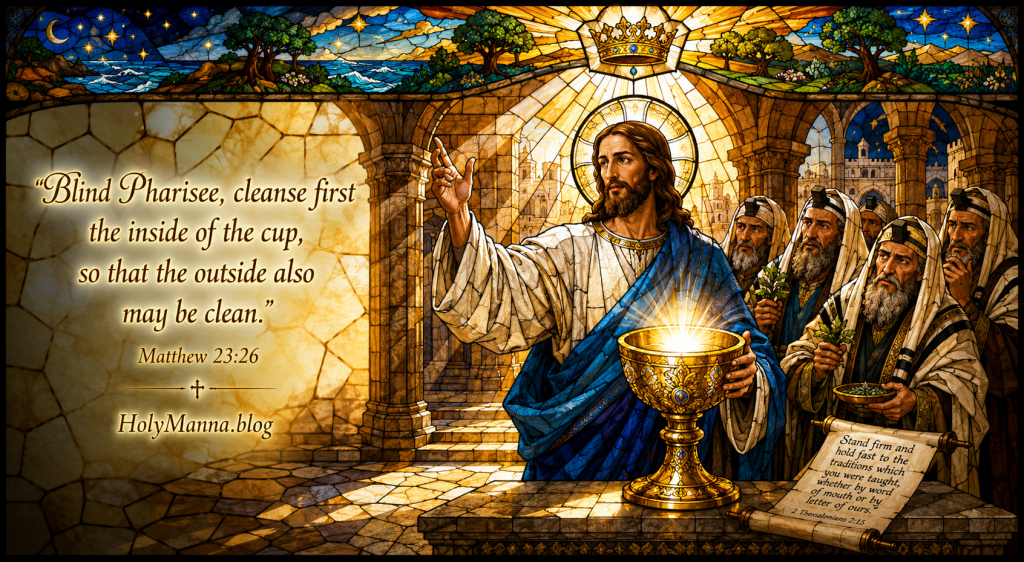
Blind Pharisee, cleanse first the inside of the cup,
so that the outside also may be clean.”
Detailed Exegesis
Verse 23: “Woe to you, scribes and Pharisees, you hypocrites. You pay tithes of mint and dill and cummin, and have neglected the weightier things of the law: judgment and mercy and fidelity. But these you should have done, without neglecting the others.”
The word hypocrite originally meant a stage actor, someone speaking from behind a mask. The herbs are deliberately tiny; a tithe of cumin seeds is a pinch. Jesus contrasts that precision with the “weightier things,” and His list echoes the prophet: “You have been told, O mortal, what is good, and what the LORD requires of you: Only to do justice and to love goodness, and to walk humbly with your God” (Micah 6:8). Then comes the crucial balance: “without neglecting the others.” He does not abolish tithing. He restores proportion.
Verse 24: “Blind guides, who strain out the gnat and swallow the camel!”
Devout Jews would strain wine through cloth to avoid swallowing an insect, since even a gnat was ritually unclean. The camel is the largest unclean animal named in Leviticus 11. In Aramaic the two words rhyme, qalma and gamla, so the line lands as a joke with an edge. A guide who cannot see the difference between a gnat and a camel is dangerous precisely because others are following him.
Verse 25: “Woe to you, scribes and Pharisees, you hypocrites. You cleanse the outside of cup and dish, but inside they are full of plunder and self-indulgence.”
The vessel is scrubbed, but the contents are stolen. The Greek word behind “plunder” means seizure or extortion, and “self-indulgence” means lack of self-control. The point is unsettling: the outer polish is not neutral. It is a way of hiding what the cup is actually holding.
Verse 26: “Blind Pharisee, cleanse first the inside of the cup, so that the outside also may be clean.”
Notice the order. Jesus does not say the outside is unimportant. He says the inside comes first, and when the interior is clean the exterior follows naturally. This is the New Law in a single sentence: grace reforming the heart, and holiness flowing outward.
Teachings
The Catechism describes exactly this movement from inside to outside: “It does not add new external precepts, but proceeds to reform the heart, the root of human acts, where man chooses between the pure and the impure” (CCC 1968, on the Law of the Gospel). Outward practices remain good, but they must express something real: “Outward sacrifice, to be genuine, must be the expression of spiritual sacrifice” (CCC 2100). Saint John Chrysostom, in his homilies on Matthew, insists that Christ is not condemning the tithe but the neglect of what matters more, and that mercy toward one’s neighbor is the surest evidence of interior cleanliness.
The Church still asks for the tithe’s modern cousin: “The fifth precept (‘You shall help to provide for the needs of the Church’) means that the faithful are obliged to assist with the material needs of the Church, each according to his own ability” (CCC 2043). And she names the weightier things by name: “The works of mercy are charitable actions by which we come to the aid of our neighbor in his spiritual and bodily necessities” (CCC 2447). Generosity to the Church and mercy to the poor were never meant to compete.
Reflection
Everyone has a few herbs they tithe with precision: a devotion never skipped, a rule never bent, a preference defended fiercely. Jesus asks whether judgment, mercy, and fidelity are receiving the same energy. The examination is worth doing without self-loathing. He said to keep the small things and add the great ones.
The Church gives one clear way to cleanse the inside of the cup. The Catechism teaches that “the whole power of the sacrament of Penance consists in restoring us to God’s grace and joining us with him in an intimate friendship” (CCC 1468). A concrete step: schedule Confession this week, and before going, name one camel you have been swallowing while straining out gnats.
Which small practices do you keep carefully, and which weightier matters have quietly slipped? What is inside your cup right now that you would rather no one see?
A Firm World, a Clean Cup, a Steady Heart
Picture the day’s readings as one story. A young church in Thessalonica is trembling over a rumor that the end has come, and an apostle writes back with calm authority: do not be shaken, hold fast to what you were taught, and let God Himself strengthen your hearts. Then a psalm rises over the anxiety like a sunrise, announcing that the Lord is king, that He has made the world firm, and that His coming judgment is reason for the trees themselves to dance. Finally, the King steps into the Temple courts and tells the most religious people of His day what He is really looking for: not spotless cups and tithed cumin, but judgment, mercy, and fidelity poured out from a cleansed heart.
The message could not be more relevant. Modern life is full of forged letters, loud claims, and polished exteriors. The Lord offers a different way to live: anchored in Sacred Tradition, unafraid of His coming, and honest about the inside of the cup. He is not looking for panic and He is not looking for performance. He is looking for a heart He can strengthen.
So take the invitation. Hold fast to what the Church has handed on. Sing the refrain, “The Lord comes to judge the earth,” as a promise rather than a threat. And let Him cleanse the inside first, in prayer and in the confessional, so that everything on the outside becomes clean by consequence. The King who reigns already is coming to gather His people. May He find hearts that are steady, honest, and full of mercy.
Engage With Us!
Please share your reflections in the comments below. The HolyManna community grows stronger when readers bring their own experiences of standing firm, rejoicing in God’s justice, and letting the Lord cleanse the heart.
- In 2 Thessalonians 2:1-3a, 14-17, Paul urges the community not to be shaken and to hold fast to the traditions handed on. What “forged letters” of alarm or misinformation shake your peace today, and which traditions of the Church anchor you most?
- In Psalm 96:10-13, all creation rejoices because the Lord comes to judge the earth with justice and constancy. How would your daily life change if you welcomed God’s judgment as a promise that wrongs will be made right?
- In Matthew 23:23-26, Jesus warns against straining out gnats while swallowing camels and cleaning only the outside of the cup. Which small practices do you keep meticulously, and which weightier matters of judgment, mercy, and fidelity need more of your attention?
- Taken together, these readings call for steady, cleansed hearts before the coming King. What is one concrete step you can take this week to hold fast to Tradition and to let Christ cleanse the inside of your cup?
Living a life of faith is not about looking clean; it is about becoming clean by grace and letting that grace overflow into judgment, mercy, and fidelity toward everyone. Go into this week steady, unshaken, and generous, doing everything with the love and mercy Jesus taught.
Sacred Heart of Jesus, we trust in You!
Immaculate Heart of Mary, pray for us!
Saint Michael the Archangel, defend us in battle!
Follow us on YouTube, TikTok, Instagram and Facebook for more insights and reflections on living a faith-filled life.


Leave a Reply