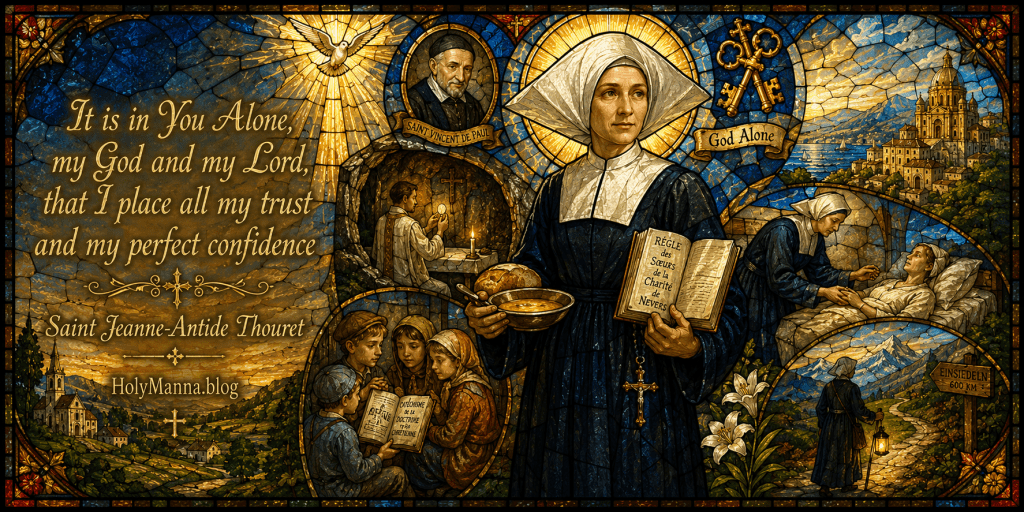
God Alone Was Enough
Saint Jeanne-Antide Thouret is remembered for something quieter than visions or public wonders, and in its own way harder. She refused to stop serving the poor when the state made it illegal, and she refused to stop trusting God when the Church itself, through one stubborn archbishop, shut a door in her face. Born in a farming village in eastern France in 1765 and dying in Naples on August 24th, 1826, she lived through the French Revolution, the Napoleonic wars, and the restoration of the old order, and through all of it she held onto a two word motto that became her whole spirituality: God Alone.
She founded the Sisters of Charity of Saint Jeanne-Antide Thouret, a congregation that began with a free school for poor girls in Besançon on April 11th, 1799 and grew, under her hand and after her death, into a family of thousands of sisters serving on five continents. Pope Pius XI beatified her on May 23rd, 1926 and canonized her on January 14th, 1934. The Roman Martyrology keeps her memory on August 24th, the day she went home to God, while her spiritual daughters and the pilgrims of her home village also gather on May 23rd, the anniversary of her beatification. This year, 2026, marks two hundred years since her death.
The Church holds up saints like Jeanne-Antide because their lives prove that holiness is possible for ordinary people in impossible circumstances. The Catechism teaches that the canonized saints are proposed as models and intercessors precisely because they practiced heroic virtue and lived in fidelity to God’s grace (CCC 828). Her heroism looked like a young woman in peasant clothes carrying bread to priests hiding in caves, and an aging superior general standing outside a convent she had founded, choosing obedience over her own rights.
A Mother at Sixteen and a Bride Who Refused a King
Jeanne-Antide Thouret was born in Sancey-le-Long, a village in the Doubs region of Franche-Comté, in November of 1765. Sources disagree on the exact day: her congregation and most French records give November 27th, while a few devotional sites give November 17th. What is not in doubt is that she was baptized the same day she was born, that she was named after her godmother, and that she was the fifth child of Jean-François Thouret and Jeanne-Claude Labbé, farming people of deep Christian faith. She had three older brothers, and the family would grow larger still. She learned to pray from her mother, helped with the household, watched the flocks, and went to the village school.
That childhood ended when she was about sixteen. Her mother died, and her father made a decision that surprised the family: he entrusted the running of the house and the raising of the younger children not to a relative but to Jeanne-Antide herself. An aunt objected strongly. Jeanne-Antide took up the burden anyway and, by every account, carried it well. Later tradition records that she asked the Blessed Virgin to take the place of the mother she had lost.
Around 1786 the parish priest of Sancey, Abbé Ligier, noticed this capable young woman and asked her to open a small school of catechism and reading in the presbytery. There she taught the village children the Gospel and the basics of French. Long before she wore a habit, she was already doing what she would do for the rest of her life: putting the Word of God and the tools of dignity into the hands of poor children.
A story from the older biographies fills in the family drama. When she was about seventeen, her father is said to have told her that a wealthy young man had asked for her hand, and Jeanne-Antide is said to have answered without hesitation that she would refuse the hand of a king. The story comes from later devotional accounts and cannot be verified as a verbatim exchange, but it captures what all the sources agree on: her family wanted her married and settled, and she wanted something else entirely.
That something else was the Daughters of Charity of Saint Vincent de Paul. In 1787, at twenty-two, over the objections of her family, she left home to enter the Company in Paris, serving first at Langres and then in the capital. By her own later account she encountered Saint Vincent spiritually during those years and regarded him as her father ever after, and when everything else was taken from her, his spirit was the one thing she managed to keep.
A Life of Hidden Charity
The Revolution came for the religious orders quickly. In 1793 the Daughters of Charity were suppressed, and sisters across France were ordered to swear the constitutional oath or return to secular life. Jeanne-Antide refused the oath. By May of 1794 she was back in Sancey, dressed as a laywoman.
She taught children the Gospel in secret, nursed the sick, and supplied the refractory priests, the ones who would not swear the oath, as they hid in the woods and caves around Sancey and Surmont, and she organized the clandestine Masses they celebrated. Sisters who make pilgrimage there today still celebrate Mass in front of the cave refuge called La Baume, where priests sheltered from the revolutionary authorities. Tradition preserves the words of Abbé Pourcelot, the parish priest of Sancey, who told her, Miss Antide, I have very great obligations towards you; you have done an admirable job in my parish, you carried out the functions of both priest and vicar. The words are handed down through the congregation’s memory of that period and cannot be verified beyond that tradition.
The Catechism is direct about what she was doing and why it was right. A citizen is obliged in conscience not to follow the directives of civil authorities when they are contrary to the demands of the moral order, to the fundamental rights of persons, or to the teachings of the Gospel (CCC 2242). She simply kept doing the works of mercy, teaching the ignorant, feeding the hungry, and visiting the sick, all of which the Church names as charitable actions by which one comes to the aid of a neighbor in bodily and spiritual need (CCC 2447). She just did them under a regime that had made them crimes.
Then came a detour that tested her discernment. On August 15th, 1795 she left France with the Solitaries of Father Antoine-Sylvestre Receveur, a penitential community that emigrated through Switzerland and into Germany. Over time she recognized that this was not her call, and in April of 1797 she left the community at Wiesent, in Bavaria, and set out alone. Her congregation records that she walked roughly six hundred kilometers, without money, without a passport, and without knowing where God was leading her, until she reached the great Marian shrine of Einsiedeln in Switzerland. It was a physical journey, but above all an interior one, and it is where God Alone stopped being a pious sentiment and became the only thing she had.
At Le Landeron in Switzerland she met the exiled Vicar General of Besançon, Abbé de Chaffoy, and he gave her a mission: go back to Besançon, in the middle of a Revolution that had not yet calmed, and open a school. She obeyed. On April 11th, 1799, in a house on the rue des Martelots in Besançon, Jeanne-Antide Thouret opened a free school for poor girls with a handful of companions. That date is the birthday of the Sisters of Charity. There was no Rule in hand, no motherhouse, and no money, only obedience to the Church and abandonment to Providence.
What followed over the next decade was grace poured into hard work. In 1800 she began the bouillon, a soup kitchen distributing broth to the poorest of the city. She and her sisters nursed the sick in their homes and in hospitals. She went into the prison of Bellevaux, ministered to the inmates, and organized paid work for them so that they could earn something with dignity. She formed young sisters and cooperated with the civil prefects in caring for the poor, which won recognition first from local authorities and eventually from Napoleon himself.
She also had to write a Rule, and how she did it says everything about her. She had no printed or manuscript copy of the Rule of Saint Vincent, so she wrote it out from memory. She later explained, By God’s grace I have always remained faithful to the practices and spirit of that Company. I have copied out the Rule word for word, by the light of God alone. I had no access to any manuscript or printed version of this Rule. It, however, turned out to be in conformity with the customs and primitive spirit laid down by St Vincent de Paul. She made him, in her words, Institutor, Founder, Father, Patron, Protector, Model, of our community. Cardinal Fesch settled the congregation’s name as the Sisters of Charity of Besançon to avoid confusion with the Paris Daughters, and in 1807 Archbishop Le Coz of Besançon formally approved the Rule. Houses opened in Switzerland and Savoy. In May of 1810 she went to Thonon in Savoy, and in November of that same year an appeal came from Naples that would define the second half of her life.
Why should you remember and emulate her? Because she shows that a vocation is not derailed by catastrophe. The Revolution destroyed her community; she rebuilt it from memory. The state threw her out of her convent and a bishop later kept her out of her own motherhouse; she simply kept serving. The Catechism teaches that love for the poor is part of the Church’s constant tradition, inspired by the Gospel of the Beatitudes, by the poverty of Jesus, and by his concern for the poor (CCC 2444). Jeanne-Antide is what that paragraph looks like with a broom in one hand and a soup ladle in the other.
The Door That Closed
The appeal from Naples came through Letizia Bonaparte, mother of the emperor, on behalf of Joachim Murat, Napoleon’s brother-in-law and the newly installed king of Naples. Jeanne-Antide went south with eight of her sisters, and the king gave them the enormous convent of Santa Maria Regina Coeli. There she took charge of the health care of the Hospital of the Incurables, roughly twelve hundred sick people, opened two schools beside the convent, established a pharmacy inside it, and sent her sisters out into the parishes of the city to visit the poor and the sick in their homes. Naples was a great city, rich in history and rich in poverty, and she gave herself to it completely.
She was, from the beginning, a woman of the Church, and that meant a woman of Rome. In 1818 she asked Pope Pius VII to approve her community and its Rule, and on July 23rd, 1819 he did, giving it the name Daughters of Charity under the protection of Saint Vincent de Paul. The papal brief made a modest change to the government of the congregation, placing the houses under the authority of their local bishops rather than exclusively under the Archbishop of Besançon.
The Archbishop of Besançon at that time was Gabriel Cortois de Pressigny, a man of the old regime, Gallican in outlook and deeply suspicious of Roman intervention in French dioceses. He refused to accept the brief. He declared the French houses independent of the foundress and placed them under his own direction, and he forbade the sisters in his diocese to receive their own superior general. The congregation she had built out of nothing was split down the middle, and the papal approval she had sought for its stability became the occasion of its division.
She did what an obedient daughter of the Church would do. In a circular of April 11th, 1820 she told them, I am a daughter of the Church, you be also with me. Her fidelity to the See of Peter in that crisis earned her, in the memory of her congregation, the title Filia Petri, daughter of Peter. The Catechism teaches that the Roman Pontiff, by reason of his office as Vicar of Christ and pastor of the whole Church, has full, supreme, and universal power over the whole Church, a power he can always exercise unhindered (CCC 882). She did not pit Rome against her bishop out of stubbornness; she simply refused to pretend that a papal approval could be set aside because it was inconvenient.
In 1821 she traveled to France and spent about eighteen months in Paris trying to reconcile the two branches, all in vain. As a last resort she went to Besançon. Here the sources part ways, and it is only fair to say so. Older lives, including the accounts that passed into the devotional traditions, report that she presented herself at the motherhouse she had founded and that the sisters, under orders, refused to receive her. A more recent historian argues that she never actually stood knocking at a locked door, and that she pushed obedience, renunciation, and abandonment so far that she chose not to set foot in the house at all rather than force a confrontation with her archbishop’s orders. Both versions agree on the essential thing: the foundress did not enter her own motherhouse, and she did not fight to. It was a humiliation few founders have had to swallow.
She left France in August of 1823 and never saw it again. She returned to Naples and to the poor of Regina Coeli. Her prayer from those years survives, and it reads like the prayer of someone stripped of everything except God. O my God, Sovereign Lord of heaven and earth, Alone Great, Alone Holy and Alone Omnipotent, whom no one can resist, arise, show forth your goodness and your former mercies. And in the same prayer she wrote, It is in You Alone, my God and my Lord, that I place all my trust and my perfect confidence.
She was not a martyr, but she endured what The Catechism describes when it speaks of the fortitude that enables one to conquer fear, even fear of death, and to face trials and persecutions, and that disposes one even to renounce and sacrifice one’s life in defense of a just cause (CCC 1808). She sacrificed not her life but her reputation, her authority, and her right to be welcomed by her own daughters, without bitterness. In one of her last letters, in 1826, she wrote that she would have crossed the seas and gone to the end of the world if she believed that God wanted it for his glory. She died in Naples on August 24th, 1826, at the age of sixty, one source attributing the immediate cause to a crisis of the diabetes she had suffered for some time. She was buried in the church of Santa Maria Regina Coeli with the wound of Besançon still open.
Wheelchairs Left Behind and Ears Opened
The reunification she prayed for did happen, though she did not live to see it. Roughly a century after her death the two branches of her congregation were reconciled, and by the time Pope Pius XI beatified her on May 23rd, 1926 the family was one again. Her sisters made a solemn act of reparation for the exclusion of their foundress, and one account records them singing the Miserere with all their souls.
The miracles accepted for her canonization are striking because both happened inside her own family. On the very day of her beatification, May 23rd, 1926, Sister Paola Alieri, who had been confined to a wheelchair for some time by severe heart failure, was gathered with the community in chapel to give thanks for their new Blessed. She rose from the wheelchair and never returned to it; her heart had resumed a strength the doctors could not explain. The following year, in 1927, Sister Cecilia Pastena was instantly cured of a severe ear infection and deafness that were at that time incurable. She had entrusted her hearing to Blessed Jeanne-Antide so that she might listen again to the voice of God and the voice of the least. Her congregation reports that both cures were examined and attested by the Vatican’s medical commission, and they cleared the way for the canonization on January 14th, 1934. Her sisters still ask her intercession for sensitive ears and a courageous heart.
The Catechism explains why a saint’s intercession after death is not a pious fiction. The saints in heaven, being more closely united to Christ, do not cease to intercede with the Father for the faithful, and their fraternal concern is a great help to human weakness (CCC 956).
Her body rests in the church of Santa Maria Regina Coeli in Naples, still in the care of her sisters, and pilgrims venerate her relics there; relics are also honored in France. In her home village, now simply called Sancey, a neo-Romanesque basilica was built in her honor in 1928, only two years after her beatification. Its stained glass windows carry coats of arms tied to her story, and its apse is painted with ten angels representing the principal virtues. Her birthplace stands nearby with a statue in front of it. The basilica welcomes two principal pilgrimages each year, on May 23rd and on the last Sunday of August, and on May 31st, 2026, in this bicentenary year, sisters and pilgrims from around the world carried her relic in solemn procession from the parish church, past her birthplace and her godmother’s house, to the basilica, closing with Gregorian Vespers.
Besançon has not forgotten her either. The motherhouse of the Sisters of Charity stands on the Grande-Rue, and the city that once shut her out now has a street and even a bus stop named for her. Her congregation, the Sisters of Charity of Saint Jeanne-Antide Thouret, numbers in the thousands and serves in roughly thirty countries across Europe, Africa, Asia, and the Americas, running schools, hospitals, prison ministries, and works for the poorest. Community life, the Eucharist, and the Paschal Mystery remain the three pillars of their life, exactly as they were for her.
What God Alone Looks Like on a Tuesday
It would be easy to file Jeanne-Antide under heroic saints from turbulent centuries.. She was not a mystic and she was not a scholar. She was a woman who kept doing the next right thing, and who trusted God when every human support fell away. That is a spirituality you can live in an office, a classroom, a hospital ward, or a kitchen.
Start with her motto. God Alone is not a rejection of people or of the world. Her whole life was spent among the poor and the sick. It is a statement about where your security comes from. She lost her mother, her community, her homeland, and finally the trust of her own daughters, and none of it broke her, because none of it was the foundation. The Catechism teaches that faith is a personal adherence of the whole person to God who reveals himself, and that hope keeps the believer from discouragement and sustains him in times of abandonment (CCC 176, CCC 1818). Where is your foundation really laid, and what would be left standing if the props you lean on were pulled away?
Then look at her obedience, because it is the hardest part of her story and the most countercultural. When her archbishop refused the papal brief and forbade his sisters to receive her, she did not launch a campaign, publish a defense, or split the congregation further. She wrote to her daughters that she was a daughter of the Church, and she asked them to be daughters of the Church with her. Obedience to legitimate authority in the Church is not weakness; The Catechism teaches that the faithful are to adhere with religious docility to the authentic teaching of their bishops in communion with the Pope (CCC 87), and she showed how to hold that docility even when the bishop was, in her judgment, wrong about her. When you are treated unjustly by someone in authority, do you reach first for your rights, or for your trust in God’s providence?
And look at her practicality. She never waited for ideal conditions. She taught catechism in a presbytery before she was a nun. She organized secret Masses in lay clothes. She opened a school in a city still shaking from the Terror. She started a soup kitchen the year after that. She got prisoners paid for their labor. She opened a pharmacy inside a Neapolitan convent. There was always something concrete to be done for someone in front of her, and she did it. The Catechism teaches that giving alms to the poor is one of the chief witnesses to fraternal charity (CCC 2447). What is one concrete work of mercy within your reach this week that you have been postponing until conditions improve?
Finally, remember her walk from Wiesent to Einsiedeln. Six hundred kilometers, alone, without money or papers, without knowing the destination. Nearly everyone has to walk that road spiritually at some point, leaving a situation that was not God’s will and setting out before the next thing is clear. She wrote in 1813 that when God calls and is listened to, He gives all that is necessary. She wrote it after living it. Is there a road God has been asking you to start walking, and what would it look like to take the first step this week?
Engage With Us!
Saint Jeanne-Antide Thouret’s story is one of quiet courage, stubborn charity, and radical trust. Please share your thoughts and reflections in the comments below; your experience of trusting God when the supports fell away may be exactly what another reader needs to hear today.
- Jeanne-Antide became mother of her household at sixteen and never asked for that role. When has God handed you a responsibility you did not choose, and how did it shape your faith?
- During the Revolution she served priests, children, and the sick under threat of arrest. Where in your own life does faithfulness to the Gospel cost you something socially, professionally, or personally, and how do you respond?
- She rebuilt her Rule from memory when every written copy was gone. What has your faith formation put so deep in you that no crisis could take it away, and what still needs to be put there?
- When her archbishop shut her out of her own motherhouse, she answered with fidelity rather than rebellion. How do you handle being wronged by people in authority, especially within the Church, without losing either your peace or your integrity?
- Her motto was God Alone. If you wrote your actual, lived motto on a card today, what would it honestly say, and what would it take to make it God Alone?
- The miracles for her canonization were a courageous heart and opened ears. Which of those two do you need more right now, and will you ask her intercession for it?
Saint Jeanne-Antide walked six hundred kilometers with no map because she trusted that God was already at the destination. You do not need to know where the road ends to take the next step on it. Feed someone, teach someone, visit someone, forgive someone, and do it all in the love and mercy that Jesus taught us, trusting, as she did, that when God calls and is listened to, He gives all that is necessary.
Saint Jeanne-Antide Thouret, daughter of the Church, pray for us!
Follow us on YouTube, TikTok, Instagram and Facebook for more insights and reflections on living a faith-filled life.

 Holy Manna!
Leave a comment