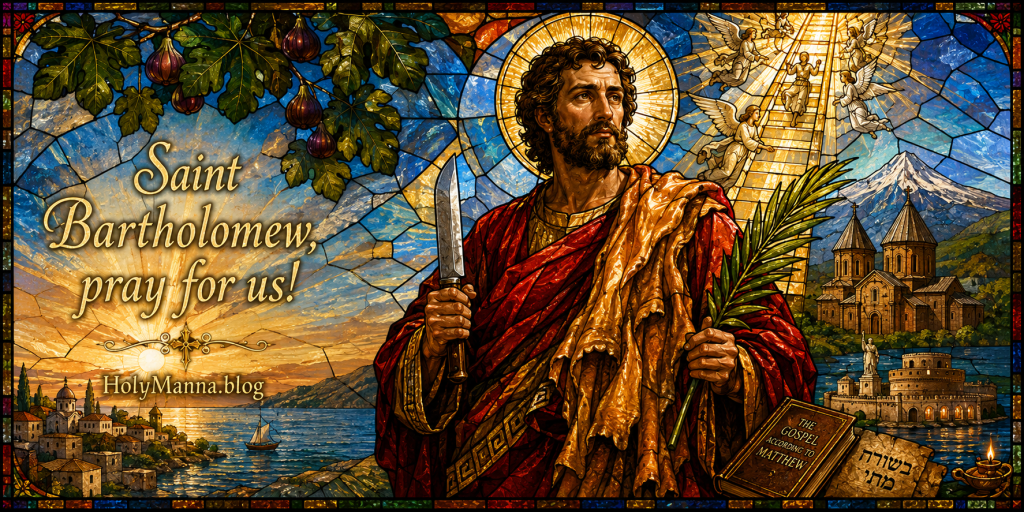
The Man Without Guile
Every August 24th the Church honors a man who is famous for saying almost nothing. Saint Bartholomew is named in every list of the Twelve Apostles that Scripture provides, in Matthew 10:3, Mark 3:18, Luke 6:14, and Acts 1:13, and yet under that name he never speaks a single recorded word. Latin tradition has long identified him with Nathanael of Cana in Galilee, and if that identification holds, then his one great conversation with Jesus in The Gospel of John is among the most beautiful call stories in the whole New Testament. It is the story of a skeptic who becomes a believer in the space of a few sentences, because he discovers that he was already known and loved before he ever opened his mouth.
Bartholomew matters to the Church for three reasons. First, he is an Apostle, one of the foundation stones on which Christ built His Church; the Catechism teaches that Jesus “chose the Twelve, whom he named apostles” and sent them out to continue His own mission (CCC 858). Second, tradition holds that he carried the Gospel farther east than almost anyone in the first generation, into Armenia and toward India, and that he sealed his preaching with martyrdom by flaying, which is why artists have shown him for centuries holding his own skin. Third, his character, as sketched by Jesus Himself, is one of transparent honesty, a man “in whom is no guile” (John 1:47), and honesty is a virtue the modern world badly needs.
Saint Bartholomew is the patron of Armenia, whose ancient Church honors him and Saint Jude Thaddeus as its apostolic founders. Because of the tradition of his flaying, he is also patron of tanners, leatherworkers, bookbinders, butchers, plasterers, and shoemakers, and he has long been invoked against nervous and twitching disorders. The island of Lipari, the city of Benevento, and the city of Frankfurt count him as their patron as well.
A Fig Tree in Cana
Almost nothing about Bartholomew’s early life is documented, and honesty demands that this be said plainly. Even his name is not really a name. “Bartholomew” comes from the Aramaic bar Tolmai, “son of Tolmai,” a patronymic, the way someone in Galilee might be known simply as “Simon’s boy.” So the Gospels preserve his father’s name and not his own. This is exactly why the identification with Nathanael is so attractive. In the three synoptic Gospels, Bartholomew is always paired with Philip; in The Gospel of John, which never mentions a Bartholomew, it is Philip who finds Nathanael and brings him to Jesus, and Nathanael later turns up among the Apostles fishing on the Sea of Tiberias (John 21:2). John never mentions Bartholomew; the synoptics never mention Nathanael. Putting the two together, the Church has commonly concluded that Nathanael, “God has given,” was his personal name and Bartholomew his family name.
That said, the identification is a tradition and not a dogma. Saint Augustine, preaching on the first chapter of John, assumed Nathanael was not one of the Twelve at all, and the current Roman Martyrology says carefully that Bartholomew is thought by many to be Nathanael, born at Cana in Galilee. HolyManna will follow the common tradition here while being upfront that it is a tradition.
If Nathanael, then Bartholomew came from Cana, the little Galilean village where Jesus turned water into wine (John 2:1 to 11). He was, on the evidence of his own words, a devout Israelite steeped in the Law and the Prophets and waiting for the Messiah. That is where his conversion begins.
The Gospel of John tells the story in John 1:45 to 51. Philip, having just been called by Jesus, goes and finds his friend: “We have found him of whom Moses in the law and also the prophets wrote, Jesus of Nazareth, the son of Joseph.” Nathanael’s reply is the most honest line in the chapter: “Can anything good come out of Nazareth?” Nazareth was a nothing town, never mentioned in the Old Testament, and Nathanael knew his Scriptures well enough to know that the Messiah was expected from Bethlehem. His skepticism is not cynicism; it is the caution of a man who takes the promises seriously and does not want to be fooled. Philip does not argue. He simply says, “Come and see.”
What follows is pure grace. As Nathanael approaches, Jesus says of him, “Behold, an Israelite indeed, in whom is no guile!” Nathanael, startled, asks, “How do you know me?” and Jesus answers, “Before Philip called you, when you were under the fig tree, I saw you.” No one knows for certain what happened under that fig tree. Devout Jews associated the fig tree with peace and with the study of Torah; the prophets had promised a day when “they shall sit every man under his vine and under his fig tree” (Micah 4:4). Pope Benedict XVI, in a General Audience on this saint in 2006, suggested that Nathanael may have been praying or meditating on the Scriptures there. Whatever it was, it was private, and Jesus had seen it. That is the moment Nathanael breaks open. “Rabbi, you are the Son of God! You are the King of Israel!” In a single sentence the skeptic makes a confession of faith that the other disciples would take chapters to reach.
Jesus’ response looks forward: “Because I said to you, I saw you under the fig tree, do you believe? You shall see greater things than these.” And then, “Truly, truly, I say to you, you will see heaven opened, and the angels of God ascending and descending upon the Son of man.” Any Israelite would have caught the reference to Jacob’s ladder in Genesis 28:12. Jesus was telling Nathanael that He Himself was the ladder, the meeting place of heaven and earth. The Catechism describes exactly this kind of faith, born of encounter, when it teaches that “faith is first of all a personal adherence of man to God” (CCC 150). Nathanael did not adhere to an argument. He adhered to a Person who already knew him.
Called, Sent, and Silent
After that first meeting, Bartholomew disappears into the group. That silence is itself a lesson. Pope Benedict XVI put it memorably: “the figure of St Bartholomew stands before us to tell us that attachment to Jesus can also be lived and witnessed to without performing sensational deeds.” For three years he walked with Jesus, heard the Sermon on the Mount, watched the loaves multiply, was sent out with the Twelve to preach and heal (Matthew 10:1 to 8), fled at the Passion, and was there in the upper room at Pentecost. He was among the seven Apostles who went fishing on the Sea of Tiberias and saw the risen Lord on the shore (John 21:2). All of this is what it means to be one of the Twelve, and the Catechism insists that the Twelve are not interchangeable with anyone else: “the whole Church is apostolic, in that she remains, through the successors of St. Peter and the other apostles, in communion of faith and life with her origin” (CCC 863). Every bishop in the world today, and every priest who acts with him, stands in a line that runs back to men like Bartholomew.
Why should you remember him and imitate him? Because the Gospel gives you his defining virtue in Jesus’ own mouth: no guile. The Catechism calls this “truthfulness, sincerity, or candor” and says that by it a person “shows himself true in deeds and truthful in words, and guards against duplicity, dissimulation, and hypocrisy” (CCC 2468). Bartholomew was honest enough to say the doubtful thing out loud, and honest enough to surrender the moment he saw the truth. That combination is rare. Most people manage one or the other.
As for what he did after Pentecost, the historical record thins to tradition, and the post will say so. The earliest and best witness is Eusebius of Caesarea, writing in the early fourth century, who reports that when the Christian scholar Pantaenus of Alexandria traveled to “India” around the year 180, he found Christians there who possessed a copy of The Gospel of Matthew in Hebrew letters, said to have been left with them by the Apostle Bartholomew. What Eusebius meant by “India” is debated; ancient writers used the word for Arabia Felix, Ethiopia, and Persia as well as the subcontinent. Other traditions place him in Mesopotamia, Lycaonia, Phrygia, and Persia. The strongest and most enduring tradition places him in Greater Armenia, where together with Saint Jude Thaddeus he is venerated as the founder of the Church that would make Armenia the first Christian nation in the year 301.
The apocryphal Passion of Bartholomew, later retold in Jacobus de Voragine’s Golden Legend, supplies miracle stories from this mission. According to this account, Bartholomew arrived in a kingdom whose people worshiped an idol called Astaroth, and the idol fell silent as soon as the Apostle came near. When the king, named Polymius, brought his daughter, who was tormented by a demon, Bartholomew freed her, and the king was baptized along with his household and many of his people. The story goes on to say that the Apostle commanded the demon in the idol to reveal itself and then to shatter its own image. It is a vivid story and it is very old, but it comes from an apocryphal text and cannot be verified.
Flayed for the Truth
Tradition is unanimous that Bartholomew died a martyr, and nearly unanimous that he died in Armenia. Beyond that the sources disagree, and you deserve to know that. The older editions of the Roman Martyrology stated it this way: “At Albanopolis in Armenia, the birthday of the blessed Apostle Bartholomew, who preached the Gospel of Christ in India. Thence he went into Greater Armenia, and after converting many people to the faith, was flayed alive by the barbarians, and by command of King Astyages completed his martyrdom by beheading.” The current 2004 edition of the Martyrology is more restrained, recording that he is said to have preached the Gospel and suffered martyrdom in the East. Some ancient accounts say he was crucified head downward; others that he was simply beheaded; the dominant tradition, and the one that shaped his image in Christian art, is that he was flayed alive and then beheaded.
The apocryphal Passion fills in the story. King Polymius’ brother Astyages, enraged that the Apostle had emptied the temples and converted the royal family, had Bartholomew arrested and beaten, then flayed, then beheaded. Whether the details are exact cannot be known, and the story cannot be verified. What can be said with confidence is that the Church has honored Bartholomew as a martyr from the earliest centuries, and that the place name Albanopolis, sometimes identified with Baku on the Caspian Sea, sometimes with a site in historic Armenia, points consistently to the far east of the Roman world.
Consider what flaying means. It is the slow removal of a person’s outer self, the very surface by which he is recognized. There is something almost unbearably fitting in the fact that the man Jesus praised for having nothing hidden, no guile, no double layer, should have been made to bear witness with the very skin torn from him. Bartholomew had no second face. In the end he had no first one either, only Christ.
The Catechism teaches that martyrdom is “the supreme witness given to the truth of the faith,” and that the martyr “bears witness to Christ who died and rose, to whom he is united by charity” (CCC 2473). It adds that the Church has preserved the memory of the martyrs “with the greatest care” because their acts “form the archives of truth written in letters of blood” (CCC 2474). Bartholomew’s archive is thin on paper. It is written instead in the memory of the Armenian people, who have counted him their father in the faith for nearly two thousand years, and in the bodies of countless Christians who have suffered since and looked to him.
From Lipari to the Tiber
Tradition holds that after his martyrdom Bartholomew’s body was buried at Albanopolis and later carried to Dara in Mesopotamia. Around the sixth century, the relics are said to have arrived at Lipari, the largest of the Aeolian Islands off Sicily. A story told in Lipari says that the Apostle’s sarcophagus came ashore there miraculously, borne across the sea, and was received by the bishop and people as a gift from heaven. This story cannot be verified.
In 838, after Saracen raiders had sacked Lipari, Prince Sicard of Benevento had the relics translated to his city, where they were enshrined in the basilica that still bears the saint’s name. Another Lipari story tells that when the Saracens scattered the Apostle’s bones, a monk was directed in a vision to gather them and recognized the true relics because they glowed in the darkness. This story cannot be verified either. In 983, the Holy Roman Emperor Otto III brought relics of Bartholomew to Rome and placed them on the Tiber Island, in a church built over the ruins of the ancient temple of Aesculapius, the pagan god of healing. That church, San Bartolomeo all’Isola, still holds a porphyry basin beneath its high altar said to contain the Apostle’s body, and in modern times it has become the Roman shrine of the martyrs of the twentieth century. Benevento continues to maintain that it holds the true body, and the two claims have coexisted for a thousand years. Frankfurt Cathedral, formally the Kaiserdom Sankt Bartholomäus, has venerated a skull relic since 1239, and it was there that the Holy Roman Emperors were crowned for centuries. Canterbury received an arm relic in the eleventh century through the generosity of Queen Emma.
The Catechism explains why the faithful have always treasured such relics: popular piety, including “the veneration of relics, visits to sanctuaries, pilgrimages, processions,” extends the sacramental life of the Church and expresses the religious sense of the People of God (CCC 1674). Relics are not magic. They are the bodies of those who will rise, and honoring them is a confession of faith in the resurrection.
Lipari has never let go of its Apostle. Its cathedral is dedicated to him, and its feast on August 24th remains the great day of the island’s year. A story from the twentieth century relates that during the Fascist period officials sought to remove the cathedral’s silver statue of Saint Bartholomew to melt it down, and found that the statue, ordinarily light enough for a few men to carry, had become impossibly heavy and could not be moved. The islanders took this as their patron’s refusal to leave. This story cannot be verified.
Benevento holds its own celebrations in the saint’s honor, and the Armenian Apostolic Church continues to venerate him with Jude Thaddeus as the “First Illuminators” of Armenia. In England, Saint Bartholomew’s Hospital in London, founded in 1123 by a courtier named Rahere after a vision during a pilgrimage to Rome, has been treating the sick for nine centuries; the medieval Bartholomew Fair held beside it at Smithfield every August 24th ran from 1133 until 1855 and became one of the great fixtures of London life. Sadly the saint’s name is also attached to one of Christian history’s darkest days, the Saint Bartholomew’s Day Massacre of Huguenots in Paris in 1572, a tragedy that has nothing to do with the Apostle and everything to do with the sinfulness of those who forget the Gospel he died for.
Art has given Bartholomew his most unforgettable afterlife. In the Last Judgment on the wall of the Sistine Chapel, Michelangelo painted him at the feet of Christ, a powerful old man holding a flaying knife in one hand and his own empty skin in the other; the sagging face on that skin is commonly understood to be Michelangelo’s self-portrait, a confession of the artist’s own unworthiness before the Judge. In Milan Cathedral stands Marco d’Agrate’s marble Saint Bartholomew Flayed of 1562, an anatomically exact figure wearing his skin over his shoulders like a stole. Both works say the same thing the Gospel says: here is a man with nothing left to hide.
Nothing to Hide
What does the Church want you to take from a man about whom so little is certain? Perhaps exactly that. Bartholomew’s life is a lesson in being fully known by God and being at peace with it.
Start with the fig tree. Before Nathanael had said a word to Jesus, Jesus had already seen him in a private moment, and instead of exposing him, Jesus praised him. The Catechism teaches that “God calls man first,” and that “man may forget his Creator or hide far from his face,” yet God “never ceases to call every man to seek him” (CCC 2567). When was the last time you let yourself be seen by God without arranging your face first? Prayer, at bottom, is sitting under the fig tree and letting Him look. You might spend five minutes today in silence, not asking for anything, simply aware that you are already seen and already loved.
Then take his honesty. Nathanael did not pretend to believe before he believed. He said the doubtful thing out loud, and it was that very honesty that Philip could work with. Too many people, inside and outside the Church, hide their real questions because they think doubt is a sin. It is not. Refusing to look is the sin. Nathanael looked. What is the honest objection you have been carrying about the faith that you have never said aloud to anyone? Say it. Then do what Nathanael did: come and see. Read the Gospel passage that troubles you. Bring the question to a priest or a solid Catholic friend. Sit before the Blessed Sacrament and say it to Jesus directly. The Catechism promises that “faith seeks understanding” and that “the grace of faith opens the eyes of your hearts” (CCC 158).
Then take his surrender. Once Nathanael saw the truth, he did not haggle. “Rabbi, you are the Son of God! You are the King of Israel!” He gave the whole confession at once and then followed for the rest of his life without, so far as anyone can tell, ever asking for a spotlight. Most of the Christian life is like that: unrecorded fidelity. Where in your life is God asking you for a quiet, unspectacular yes that no one will ever notice? Bartholomew’s silence in the Gospels is not emptiness; it is the sound of a man doing his job.
Finally, take his witness. He was stripped of his skin for the truth. You will almost certainly never be asked for that, but you will be asked, probably this week, to say something true when a lie would be easier, or to admit you are Catholic when the room would prefer you did not. The Catechism is blunt: “The disciple of Christ must not only keep the faith and live on it, but also profess it, confidently bear witness to it, and spread it” (CCC 1816). What is one place, at work, online, or at the family table, where you can be an Israelite without guile this week? Ask Saint Bartholomew to pray for you there. He knows what it costs. He also knows it is worth it.
Engage With Us!
Saint Bartholomew was a man who asked hard questions and then followed the answer all the way to Armenia and all the way to heaven. HolyManna would love to hear how his story lands with you. Please share your thoughts, your own fig tree moments, and your questions in the comments below.
- Nathanael’s first reaction to Jesus was skepticism, and Philip’s answer was simply “Come and see.” Who has been a Philip for you, and to whom could you be a Philip this month?
- Jesus said He saw Nathanael under the fig tree before Philip ever called him. What is your fig tree, the private place where God has already been meeting you, perhaps without your noticing?
- Bartholomew is remembered as a man without guile. Where do you find yourself wearing a second face, and what would it look like to lay it down?
- Tradition says the Apostle was flayed for the faith, and Michelangelo painted himself in that empty skin. What would you have to let God strip away for you to stand before Him honestly?
- Bartholomew’s mission is known mostly from tradition, and his words are barely recorded. How does his hidden fidelity encourage you in the parts of your own life that no one sees?
Whatever your answers, take heart. The Lord who saw Nathanael under the fig tree sees you now, and He is not disappointed by what He finds; He is calling. Come and see. Live this day without guile, do the ordinary things with love, and let everything you say and do carry the mercy that Jesus taught.
Saint Bartholomew, Apostle and Martyr, pray for us!
Follow us on YouTube, TikTok, Instagram and Facebook for more insights and reflections on living a faith-filled life.


Leave a Reply