Feast of Saint Bartholomew, Apostle – Lectionary: 629
Come and See
Every great building starts with someone deciding where to lay the first stone. On August 24th the Church celebrates Saint Bartholomew, one of the Twelve, and the readings for his feast quietly reveal where God chose to lay His. Scripture tells surprisingly little about Bartholomew himself. The first three Gospels list him beside Philip, while The Gospel of John never uses his name at all but pairs Philip with a man called Nathanael. Because “Bartholomew” is a family name meaning “son of Tolmai,” the Church has long held the tradition that Nathanael and Bartholomew are the same person, which is why the story of Nathanael under the fig tree is proclaimed today. Tradition, recorded in the Roman Martyrology, adds that he preached the Gospel in India and Armenia and died a martyr, and that his death came by flaying, which is why Michelangelo painted him holding his own skin in the Sistine Chapel.
The central theme running through today’s readings is this: God builds His eternal city on ordinary people He has first seen, called, and made His friends. The Book of Revelation shows the New Jerusalem resting on twelve foundation stones inscribed with the names of the Apostles. Psalm 145 sings that it is God’s friends who make His Kingdom known. And The Gospel of John takes readers back to the very moment one of those friends was seen by Jesus before he ever saw Jesus, skeptical, honest, and sitting under a fig tree. The feast of a little-known Apostle turns out to be a feast about how much God knows each person, and what He is willing to build on that knowledge.
First Reading — Revelation 21:9b-14
The City Whose Foundations Bear Human Names
The Book of Revelation was written, according to the testimony of Saint Irenaeus, toward the end of the reign of the Emperor Domitian, when the Church in Asia Minor was under pressure to conform to a culture that demanded worship of the empire. John’s visions gave persecuted Christians a view of history from heaven’s side. Chapters 21 and 22 form the final vision, and today’s passage opens it. The angel who shows John the Bride is one of the seven angels who carried the bowls of God’s wrath, and the wording deliberately mirrors Revelation 17:1, where a bowl angel had shown John the harlot Babylon. Two cities are being placed side by side: the counterfeit city built on power and the true city built by God. The “great, high mountain” recalls Ezekiel 40:2, and the twelve gates named for the tribes recall Ezekiel 48:30-35. What is entirely new is what John sees carved into the foundations. On the feast of an Apostle, the Church wants its people to notice that the eternal city rests on the names of twelve very human men, one of them Bartholomew.
Revelation 21:9b-14
The angel spoke to me, saying,
“Come here.
I will show you the bride, the wife of the Lamb.”
He took me in spirit to a great, high mountain
and showed me the holy city Jerusalem
coming down out of heaven from God.
It gleamed with the splendor of God.
Its radiance was like that of a precious stone,
like jasper, clear as crystal.
It had a massive, high wall,
with twelve gates where twelve angels were stationed
and on which names were inscribed,
the names of the twelve tribes of the children of Israel.
There were three gates facing east,
three north, three south, and three west.
The wall of the city had twelve courses of stones as its foundation,
on which were inscribed the twelve names
of the twelve Apostles of the Lamb.
Detailed Exegesis
Verse 9b: “Come here. I will show you the bride, the wife of the Lamb.”
The city is introduced not as architecture but as a person in love. Israel had long been called the bride of the Lord, as in Isaiah 54:5 and Hosea 2:21-22, and here that covenant image reaches its fulfillment. The Lamb is Christ, slain and standing, and His bride is the Church made perfect. The invitation “come here” is the same kind of summons Philip will give Nathanael in today’s Gospel, and it sets the tone for the whole feast. God’s mysteries are seen by those willing to move toward them.
Verse 10: “He took me in spirit to a great, high mountain and showed me the holy city Jerusalem coming down out of heaven from God.”
Ezekiel had been set on a high mountain to see a rebuilt temple; John is set on one to see a city that needs no temple. The direction of travel matters enormously. The city comes down. Humanity does not climb up to God by achievement, as at Babel; God descends to dwell with His people. This is the Incarnation carried through to the end of history.
Verse 11: “It gleamed with the splendor of God. Its radiance was like that of a precious stone, like jasper, clear as crystal.”
The city’s light is not its own. In Revelation 4:3 the One seated on the throne had looked like jasper, so the city now shines with the very appearance of God. Crystal clarity speaks of purity with nothing hidden, a fitting backdrop for a Gospel that will praise a man in whom there is no duplicity.
Verse 12: “It had a massive, high wall, with twelve gates where twelve angels were stationed and on which names were inscribed, the names of the twelve tribes of the children of Israel.”
The wall speaks of security and holiness, and the gates speak of access. Angels stand at each gate not to keep people out but as guardians of a city that will never again be breached. The tribes of Israel are inscribed on the gates because entry into God’s people has always been through the covenant God made with Abraham’s descendants. The Church does not replace Israel; she is grafted into its promises.
Verse 13: “There were three gates facing east, three north, three south, and three west.”
The gates open in every direction. No compass point is left without a way in. This is the catholicity of the Church expressed in stone: the Gospel is for the whole world, and the invitation reaches every nation, as Isaiah 2:2-3 had foretold.
Verse 14: “The wall of the city had twelve courses of stones as its foundation, on which were inscribed the twelve names of the twelve Apostles of the Lamb.”
Here is the heart of today’s feast. Beneath the tribes on the gates lie the Apostles in the foundations. Twelve gates and twelve foundations bind Old and New Covenant into a single structure. The Apostles are called “of the Lamb” because their authority is entirely derived from Him. Bartholomew’s name, whatever obscurity surrounds his life, is written where the whole city rests.
Teachings
Saint Paul had already described the Church in these terms: “So then you are no longer strangers and sojourners, but you are fellow citizens with the holy ones and members of the household of God, built upon the foundation of the apostles and prophets, with Christ Jesus himself as the capstone” (Ephesians 2:19-20). The Catechism gathers this imagery together when it teaches that the Church as God’s temple “is compared in the liturgy to the Holy City, the New Jerusalem” and that “As living stones we here on earth are built into it” (CCC 756).
The Church’s apostolic character is not a slogan but a structural fact. “The Church is apostolic because she is founded on the apostles, in three ways: she was and remains built on ‘the foundation of the Apostles,’ the witnesses chosen and sent on mission by Christ himself” (CCC 857). The Catechism goes further and locates the whole meaning of the Church in this vision: “The Church is ultimately one, holy, catholic, and apostolic in her deepest and ultimate identity, because it is in her that ‘the Kingdom of heaven,’ the ‘Reign of God,’ already exists and will be fulfilled at the end of time” (CCC 865). What John saw coming down from heaven is already present in seed in every parish where the apostolic faith is preached and the sacraments are celebrated. Every Catholic bishop stands in a line that runs back to twelve names on twelve stones.
Reflection
It is easy to feel like a spare brick in the Church, unnoticed and interchangeable. Revelation says otherwise. The city God is building rests on the names of specific people, and Bartholomew’s story shows that a name can be inscribed in the foundations even when history records little else about it. What matters is not being remembered by the world but being known by the Lamb.
Two practices flow from this reading. First, pray for your bishop and for the Holy Father by name this week, since apostolic succession is a living gift and not merely a doctrine. Second, look at the gates: three in every direction. Ask whether there is someone in your life you have quietly assumed could never walk through them, and consider being the one who says “come here.”
When you picture the Church, do you see a building of institutions or a bride coming to meet her Lord? Whose name would you thank God for placing in the foundation of your own faith?
Responsorial Psalm — Psalm 145:10-13, 17-18
The Friends Who Cannot Stop Talking About the King
Psalm 145 is one of the most beloved prayers of Israel. It is an alphabetic acrostic, each verse beginning with the next letter of the Hebrew alphabet, as though the psalmist wanted to praise God with everything from A to Z. It is also the only psalm in the Psalter whose title is simply “Tehillah,” a praise, and it gave its name to the entire book of Psalms, the Tehillim. Jewish tradition holds it in such honor that the Talmud, in Berakhot 4b, says whoever recites it three times a day is assured of a share in the world to come, and it remains part of daily Jewish prayer to this day. The Church prays it on the feasts of the Apostles because of the response chosen from verse 12. Where the NABRE reads “faithful ones,” the Lectionary response says “friends,” a rendering the Church loves because it recalls Jesus telling the Twelve, “I have called you friends” (John 15:15). On Bartholomew’s feast the psalm becomes a portrait of what an Apostle is: a friend of the King who cannot help making the King’s splendor known.
Psalm 145:10-13, 17-18
R. (12) Your friends make known, O Lord, the glorious splendor of your Kingdom.
Let all your works give you thanks, O LORD,
and let your faithful ones bless you.
Let them discourse of the glory of your Kingdom
and speak of your might.
R. Your friends make known, O Lord, the glorious splendor of your Kingdom.
Making known to men your might
and the glorious splendor of your Kingdom.
Your Kingdom is a Kingdom for all ages,
and your dominion endures through all generations.
R. Your friends make known, O Lord, the glorious splendor of your Kingdom.
The LORD is just in all his ways
and holy in all his works.
The LORD is near to all who call upon him,
to all who call upon him in truth.
R. Your friends make known, O Lord, the glorious splendor of your Kingdom.
Detailed Exegesis
Verse 10: “Let all your works give you thanks, O LORD, and let your faithful ones bless you.”
Creation itself is invited to give thanks, but the psalmist singles out the faithful ones for something more: blessing. To bless God is to speak well of Him deliberately, with knowledge and love. All things reflect God’s glory; His friends choose to proclaim it.
Verse 11: “Let them discourse of the glory of your Kingdom and speak of your might.”
The friends of God are talkative about Him. The Hebrew implies ongoing conversation, not a single announcement. Apostolic preaching is precisely this: people who have seen the King’s glory and cannot keep the conversation to themselves.
Verse 12: “Making known to men your might and the glorious splendor of your Kingdom.”
This is the verse the Church places on the lips of the faithful today. The purpose of the friends’ speech is to make God known to others. Bartholomew carrying the Gospel to distant lands, according to tradition, is verse 12 lived out.
Verse 13: “Your Kingdom is a Kingdom for all ages, and your dominion endures through all generations.”
Empires rise and fall, and John’s readers in Asia Minor knew Rome’s power well. The psalm reminds them that only one Kingdom lasts. This is the same eternal city Revelation just described.
Verse 17: “The LORD is just in all his ways and holy in all his works.”
God’s greatness is never separated from His goodness. His power is exercised in justice and holiness, which is why His Kingdom can be trusted and not merely feared.
Verse 18: “The LORD is near to all who call upon him, to all who call upon him in truth.”
The psalm ends today’s selection with tenderness. The transcendent King is near, and the condition for that nearness is truth. Nathanael, praised by Jesus for having no duplicity, is the model of one who calls upon God in truth.
Teachings
The Catechism describes prayer with words from Saint John Damascene: “Prayer is the raising of one’s mind and heart to God or the requesting of good things from God” (CCC 2559). Psalm 145 is the first kind, and the Catechism explains why praise stands at the summit: “Praise is the form of prayer which recognizes most immediately that God is God. It lauds God for his own sake and gives him glory, quite beyond what he does, but simply because HE IS” (CCC 2639). The psalmist praises God’s Kingdom, might, justice, and holiness for their own sake, and the friends who do so become witnesses almost without trying.
The Church has always understood that the Apostles’ friendship with Christ was the source of their mission. “From the beginning of his public life Jesus chose certain men, twelve in number, to be with him and to participate in his mission” (CCC 551). Being with Him came first; making Him known followed. That order is the whole logic of Psalm 145.
Reflection
Most people talk freely about what they love: a sports team, a new restaurant, a friend’s good news. Psalm 145 asks a simple question: does God make that list? The friends of the King “discourse” of His glory as naturally as anyone else discusses the weekend.
Try one concrete step this week. In an ordinary conversation, mention something God has done in your life without apology or preamble, the way you would mention any other piece of good news. Then pray verse 18 slowly each night, asking to call upon the Lord “in truth,” with nothing hidden and nothing performed.
When was the last time you spoke of God’s goodness to someone simply because you could not keep it to yourself? What would it look like to call upon Him in truth today?
Holy Gospel — John 1:45-51
Seen Before He Ever Looked Up
The Gospel of John opens with a week of encounters. Day by day, John the Baptist points to Jesus, Andrew brings Peter, and Jesus finds Philip. Today’s passage is the last link in that chain, and it is the reason this Gospel is read on Bartholomew’s feast: the tradition of the Church identifies Nathanael with the Apostle Bartholomew, since John never mentions Bartholomew and the other evangelists never mention Nathanael, and Philip stands beside each of them. The scene is thick with the Old Testament. Nazareth appears nowhere in the Hebrew Scriptures, which explains Nathanael’s skepticism. The fig tree was the image of messianic peace in Micah 4:4 and Zechariah 3:10, and in later rabbinic tradition a favored place to study the Law. Jesus’ words about a “true child of Israel” without duplicity point back to Jacob, who received the name Israel but won his blessing by trickery. And the promise of angels ascending and descending rewrites Jacob’s dream at Bethel. In one short conversation, Jesus reveals that He knows Nathanael completely and that He Himself is the stairway between heaven and earth. God builds His city on people He has already seen.
John 1:45-51
Philip found Nathanael and told him,
“We have found the one about whom Moses wrote in the law,
and also the prophets, Jesus son of Joseph, from Nazareth.”
But Nathanael said to him,
“Can anything good come from Nazareth?”
Philip said to him, “Come and see.”
Jesus saw Nathanael coming toward him and said of him,
“Here is a true child of Israel.
There is no duplicity in him.”
Nathanael said to him, “How do you know me?”
Jesus answered and said to him,
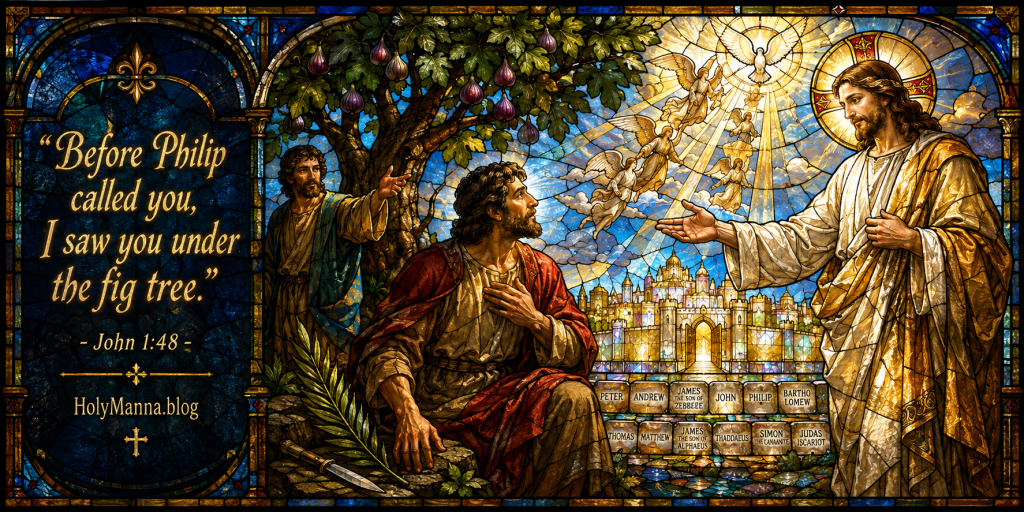
“Before Philip called you, I saw you under the fig tree.”
Nathanael answered him,
“Rabbi, you are the Son of God; you are the King of Israel.”
Jesus answered and said to him,
“Do you believe
because I told you that I saw you under the fig tree?
You will see greater things than this.”
And he said to him, “Amen, amen, I say to you,
you will see heaven opened and the angels of God
ascending and descending on the Son of Man.”
Detailed Exegesis
Verse 45: “Philip found Nathanael and told him, ‘We have found the one about whom Moses wrote in the law, and also the prophets, Jesus son of Joseph, from Nazareth.’”
Philip’s witness is exuberant and slightly imprecise. He names Jesus by His legal father and His hometown, both true at the human level and both incomplete. Evangelization does not wait for perfect theology; it starts with someone who has met Jesus telling someone who has not.
Verse 46: “But Nathanael said to him, ‘Can anything good come from Nazareth?’ Philip said to him, ‘Come and see.’”
Nathanael’s question is honest prejudice. Nazareth was tiny and unmentioned in prophecy, and Micah 5:1 pointed to Bethlehem. Philip does not argue. He repeats the very words Jesus used with Andrew in John 1:39. The Church has never won hearts primarily by debate but by invitation to an encounter.
Verse 47: “Jesus saw Nathanael coming toward him and said of him, ‘Here is a true child of Israel. There is no duplicity in him.’”
The Greek word for duplicity is dolos, guile. Jacob was told by his father Isaac, “Your brother came here by a ruse and carried off your blessing” (Genesis 27:35). Jacob became Israel despite his guile; Nathanael is called a true Israelite because he has none. Even his skepticism was spoken openly, and Jesus counts that honesty as praise.
Verse 48: “Nathanael said to him, ‘How do you know me?’ Jesus answered and said to him, ‘Before Philip called you, I saw you under the fig tree.’”
This is the hinge of the passage. Nathanael has not yet done anything for Jesus, and Jesus already knows him. What happened under the fig tree is not recorded, and the text leaves it as a private moment between the two of them. Saint Augustine, in his Tractates on the Gospel of John, saw in the fig tree an image of the shade of sin, recalling the fig leaves of Adam, and read the scene as Christ seeing and loving a man before that man was ready to be seen. Whatever the exact meaning, the point is clear: Christ’s knowledge comes first.
Verse 49: “Nathanael answered him, ‘Rabbi, you are the Son of God; you are the King of Israel.’”
The skeptic becomes the confessor in a single sentence. His two titles echo Psalm 2:6-7, where God’s anointed King is called His son. Nathanael does not yet grasp the full divinity these words will come to mean, but he has recognized in Jesus the one Israel was waiting for.
Verse 50: “Jesus answered and said to him, ‘Do you believe because I told you that I saw you under the fig tree? You will see greater things than this.’”
Jesus receives the confession and immediately raises the horizon. Faith that begins with a small personal sign will be led into far greater mysteries. This is a promise to every believer whose faith started with something modest.
Verse 51: “And he said to him, ‘Amen, amen, I say to you, you will see heaven opened and the angels of God ascending and descending on the Son of Man.’”
Jacob had dreamed at Bethel: “a stairway rested on the ground, with its top reaching to the heavens; and God’s angels were going up and down on it” (Genesis 28:12). Jesus now says the angels ascend and descend on Him. He is the stairway, the meeting place of heaven and earth. Nathanael, the true Israelite, will see what Israel only dreamed.
Teachings
The virtue Jesus praises in Nathanael has a name in the Catechism. “Truth or truthfulness is the virtue which consists in showing oneself true in deeds and truthful in words, and in guarding against duplicity, dissimulation, and hypocrisy” (CCC 2468). The Church holds up this transparency before God as the soil in which real faith grows.
The promise of verse 51 rests on who Jesus is. “Jesus Christ is true God and true man, in the unity of his divine person; for this reason he is the one and only mediator between God and men” (CCC 480). Jacob’s stairway was a vision; Christ is the reality. Every sacrament is a place where angels, so to speak, ascend and descend on the Son of Man.
Pope Benedict XVI, reflecting on this Apostle in his General Audience of 4 October 2006, drew a lesson from how little is known about him: Saint Bartholomew “stands before us to tell us that attachment to Jesus can also be lived and witnessed to without performing sensational deeds.” The Church did not need Bartholomew’s biography to place his name in the foundations. She needed his friendship with Christ.
Reflection
Nathanael’s story belongs to anyone who has ever been skeptical about religion, been invited by a friend, and discovered that Jesus already knew everything about them. The fig tree is different for everyone. It might be a hospital waiting room, a college dorm, a car in a parking lot at the end of a bad day. Christ was already there.
Two steps follow. First, be Philip for someone. Do not argue; simply say “come and see,” and invite one person to Mass, adoration, or a conversation about faith this month. Second, be Nathanael before God. In your next Confession or examination of conscience, bring your honest objections and doubts to Him openly, because He praises the one in whom there is no duplicity.
Where was your fig tree, the place where Jesus saw you before you saw Him? Is there a “Nazareth” in your life, a person or place you have written off, that God may be asking you to reconsider?
The King Who Knew Your Name First
Today’s readings tell one story from three angles. Revelation ends where history ends, with a radiant city descending from God, its gates open to every direction and its foundations bearing the names of twelve Apostles. Psalm 145 explains how that city fills up: the friends of the King go out and make His splendor known. And the Gospel rewinds to the beginning, to a skeptical man under a fig tree who learned that the King already knew him, already loved him, and had already decided to build on him.
Saint Bartholomew left almost no words behind. Tradition says he carried the Gospel far from home and gave his life for it, but even that is known only in outline. What is certain is that his name is inscribed in the foundations of the eternal city, and that his story began not with anything he did but with something Jesus saw. That is how the Kingdom always begins. God does not wait for people to become impressive; He sees them under their fig trees and calls them friends.
So take Philip’s invitation personally today. Come and see. Bring your honest questions the way Nathanael did, and let Jesus answer them with His gaze. Then go and be one of the friends who make His splendor known, in the office, at the dinner table, in the small conversations where the Kingdom quietly spreads. Heaven has been opened over the Son of Man, and the angels are still ascending and descending. Saint Bartholomew, Apostle of the Lamb, pray for all who are still learning to look up.
Engage With Us!
Please share your reflections in the comments below. Which reading spoke most to you today, and how do you sense the Lord calling you through the witness of Saint Bartholomew? Take a moment to pray with the following questions and let them guide your response.
- In Revelation 21:9b-14, the New Jerusalem rests on foundation stones bearing the names of the Apostles. How does knowing that the Church is built on real, chosen, imperfect people change the way you belong to her?
- In Psalm 145:10-13, 17-18, God’s friends make His Kingdom known. What is one concrete way you can speak of God’s goodness this week to someone who needs to hear it?
- In John 1:45-51, Jesus tells Nathanael that He saw him under the fig tree before Philip called him. Where in your own life has Jesus seen you first, and how might you respond with the honesty He praised in Nathanael?
- Taken together, today’s readings show that God builds His eternal city on friends He has already seen and known. What would change in your daily life if you truly believed your name mattered in that building?
Live this feast with courage and simplicity. Be a Philip who invites, a Nathanael who is honest, and a Bartholomew whose whole story is friendship with Christ. Do everything with the love and mercy Jesus taught, and trust that the King who knew your name first is still building something beautiful on it.
Sacred Heart of Jesus, we trust in You!
Immaculate Heart of Mary, pray for us!
Saint Michael the Archangel, defend us in battle!
Follow us on YouTube, TikTok, Instagram and Facebook for more insights and reflections on living a faith-filled life.


Leave a Reply