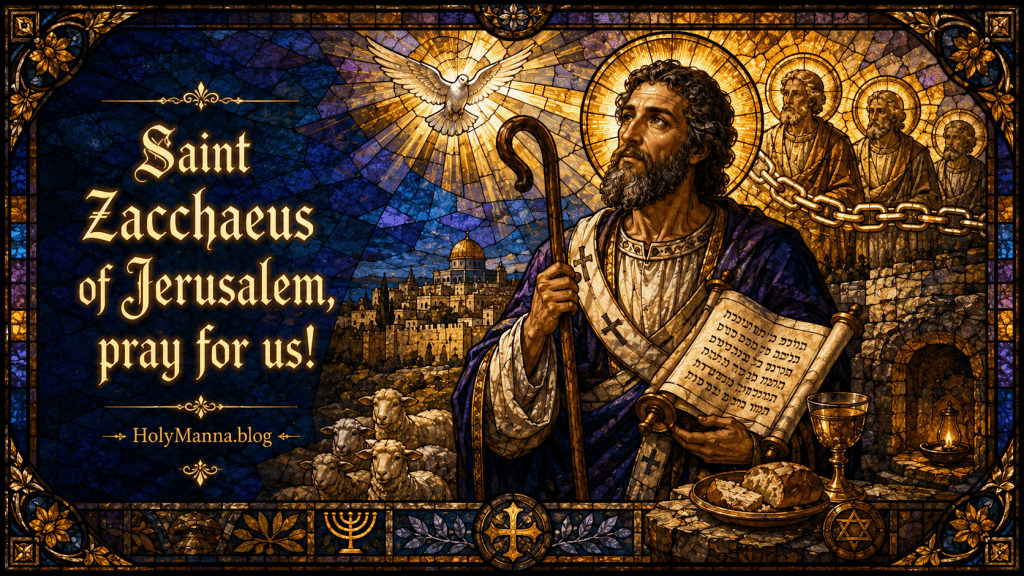
The Hidden Shepherd
Some saints leave behind cathedrals, mystical treatises, or stories so vivid that children act them out at parish festivals. Others leave behind a single line in a very old book. Saint Zacchaeus of Jerusalem, whom the Church also calls Zacharias, belongs to that second group. He was the fourth bishop of Jerusalem, the mother church of all Christianity, and he governed that Church roughly a lifetime after the Resurrection, in the years around 112 to 116. His name survives because Eusebius of Caesarea, the great historian of the early Church, wrote it down in the succession of bishops who followed James the brother of the Lord. Beyond that, the historical record falls silent.
That silence is worth sitting with rather than rushing past. The Church honors Zacchaeus on August 23rd not because it possesses a thick file on his miracles or his sermons, but because it knows exactly what he was: a successor of the Apostles, entrusted with the flock in the very city where Christ died and rose. The Catechism teaches that the bishops, as successors of the Apostles, receive from Christ the mission of teaching, sanctifying, and governing the People of God, so that the Gospel entrusted to the Apostles might be handed on intact to the end of time (CCC 77, CCC 861 to 862). Zacchaeus stood in that line at its very root, when the ink on the Gospels was barely dry and living memory of the Apostles had not yet faded.
He is a saint of hiddenness, of fidelity in a place of ruin, and of the quiet strength that keeps a Church alive when there is nothing glamorous about the work. The Roman Martyrology gives him one sentence, and that sentence says everything the Church needs to say: At Jerusalem, Saint Zacchaeus, bishop, who governed the church of that city the fourth after the blessed Apostle James. For anyone who has ever wondered whether faithful, unremarkable service matters to God, Zacchaeus is the answer written in the Church’s calendar.
Born of the Hebrews, Formed by the Mother Church
Almost nothing is known about the birthplace, family, or early years of Saint Zacchaeus, and honesty requires saying so plainly. What can be said with confidence comes from Eusebius, who describes the first fifteen bishops of Jerusalem as men of Hebrew descent who received the knowledge of Christ in purity (Ecclesiastical History IV.5). Zacchaeus, therefore, was a Jewish Christian, a son of Israel who recognized in Jesus of Nazareth the Messiah promised to Abraham and David. He was formed within a community that prayed the Psalms, kept the memory of the Temple, and confessed the crucified and risen Lord.
His very name points to that heritage. Zacchaeus comes from the Hebrew Zakkai, meaning pure or innocent, and the alternate form Zacharias, which Saint Epiphanius uses for him in the Panarion, means the Lord remembers. Whether he was born under one name and known by the other, or whether the two forms simply reflect different manuscript traditions, cannot be determined. Both names, however, capture something true about him: a bishop remembered by the Lord even when history forgot, shepherding a Church that Eusebius says held the faith in purity.
The community that formed him was the most remarkable local Church in history. It had been born at Pentecost, when the Holy Spirit descended and Peter preached to the crowds in Jerusalem (Acts 2). It had been governed by James, the brother of the Lord, who was hurled from the Temple pinnacle and clubbed to death for confessing Christ around the year 62. It had fled, according to Eusebius, to the town of Pella across the Jordan before the Roman legions destroyed Jerusalem in the year 70, obeying what the historian calls a revelation given to its leaders (Ecclesiastical History III.5). It had returned to a ruined city and regathered around Symeon, a kinsman of the Lord, who led the Church for decades until he was denounced under the Emperor Trajan and crucified at a great age, sometime around the year 107.
Zacchaeus grew up in this world, or at least came to maturity within it. He would have known people who remembered James. He may well have known Symeon personally. The Gospels and letters that Christians now read in the New Testament were still being copied and circulated as fresh documents in his day. When the Catechism speaks of Sacred Tradition as the living transmission of the apostolic preaching, accomplished in the Holy Spirit and preserved through the continuous line of succession (CCC 77 to 78), it is describing exactly the kind of Church in which Zacchaeus was formed and which he would one day lead.
No conversion story survives for Zacchaeus, and none should be invented. He was likely raised in the faith by believing Hebrew parents, or he embraced it as a young man in a Church that still bore the wounds of the year 70. What the record shows is the outcome: a man judged worthy of the episcopate by those, in Eusebius’s words, who were able to judge of such matters, and chosen to succeed Justus as shepherd of the Church of Jerusalem.
Governing the Church of the Apostles
The office Zacchaeus received was not a ceremonial honor. Jerusalem in the early second century was a city of ruins and Roman garrisons, its Temple gone, its population scattered and diminished. The Christian community there was small, poor, and Jewish, worshipping in a place the wider empire regarded with suspicion after two generations of revolt. To be its bishop was to be responsible for the survival of the faith in the very soil where it had been planted.
The Catechism teaches that each bishop is the visible principle and foundation of unity in his particular Church, and that the particular Churches, gathered around their bishops, are formed in the image of the universal Church (CCC 833, CCC 886). Zacchaeus held that role in the Church that had been, quite literally, the first image of the universal Church, the community described in Acts 2: They devoted themselves to the apostles’ teaching and fellowship, to the breaking of bread and the prayers. His task was to keep that pattern alive: to teach the apostolic doctrine faithfully, to preside at the Eucharist, to care for the poor and the widows, to ordain presbyters and deacons, and to guard the flock against error.
Eusebius records no miracles worked by Zacchaeus during his life, and no Catholic source preserves any. It is better to say this openly than to borrow wonders from other saints. What Eusebius does say about the whole succession of Hebrew bishops applies to him: they received the knowledge of Christ in purity and were deemed worthy of the episcopate (Ecclesiastical History IV.5). In a period when heresies were already circulating, when Gnostic teachers were beginning to reinterpret Christ as a spiritual phantom, and when Judaizing sects were denying the divinity of the Lord, purity of doctrine was no small achievement. It meant that the Church of Jerusalem under Zacchaeus continued to hand on the faith it had received from James, from Peter, and from the Lord Himself.
There is another form of miracle to consider here, the kind Saint Paul describes when he tells the Corinthians that God chose what is weak in the world to shame the strong (1 Corinthians 1:27). The mere fact that a Christian bishop was governing a living community on the ruins of Jerusalem, forty years after the Romans had flattened the city, is a work of grace. Eusebius says plainly that tradition held these bishops to be short lived, and the succession list bears that out: fifteen bishops in roughly seventy years. Zacchaeus governed for perhaps four years, and every one of them was a year in which the Church of the Apostles did not die out. The Catechism teaches that the Church’s holiness is not primarily the achievement of her members but the gift of Christ, who loved the Church and gave himself up for her so that she might be holy (CCC 823). That gift was at work in the hidden ministry of Zacchaeus.
Why should anyone remember him, and why should anyone try to imitate a man about whom so little is known? Because his life makes visible a truth that noisier saints can sometimes obscure. Holiness does not require an audience. Faithfulness does not require a chronicler. Zacchaeus received the deposit of faith, guarded it, and handed it on. That is precisely what Saint Paul instructed Timothy to do: what you have heard from me before many witnesses entrust to faithful men who will be able to teach others also (2 Timothy 2:2). Every Catholic who has ever received the Creed and passed it on to a child, a friend, or a stranger stands in that same chain, and Zacchaeus is one of its earliest links.
Shepherding a Church Under Trajan’s Shadow
The years of Zacchaeus’s episcopate fell in the reign of the Emperor Trajan, and they were not peaceful years for the Church of Jerusalem. To understand the weight he carried, it helps to remember what happened immediately before he took office.
Hegesippus, an early Christian writer whom Eusebius quotes at length, tells how certain heretics denounced Symeon, the second bishop of Jerusalem, to the Roman authorities as both a descendant of David and a Christian (Ecclesiastical History III.32). Under Trajan, either charge could be dangerous; together they were fatal. Symeon was tortured for many days and then crucified, at an age Hegesippus gives as one hundred and twenty. Eusebius records that Symeon’s constancy under torment astonished the Roman governor and the onlookers alike. This was the immediate inheritance of Zacchaeus’s Church: its beloved patriarch, a kinsman of the Lord, had died on a cross like his Master, and the community knew that informers were watching.
Justus followed Symeon briefly, and then Zacchaeus took up the staff. He governed a Church that was doubly vulnerable. As Jews, its members lived under Roman suspicion in a province that had rebelled once already and would rebel again. As Christians, they faced the possibility of denunciation under a legal climate that Trajan himself had clarified in his famous correspondence with Pliny the Younger around the year 112: Christians were not to be sought out, but if accused and unrepentant, they were to be punished. Meanwhile, from about 115 to 117, Jewish communities across Egypt, Cyrene, Cyprus, and Mesopotamia rose in a series of violent revolts that Rome crushed with enormous bloodshed. Whether the unrest touched Judea directly is debated by historians, but no bishop of Jerusalem could have been unaware that the ground beneath his people was shifting.
Within a generation of his death, the Bar Kokhba revolt of 132 to 135 would end Jewish Jerusalem entirely. Hadrian would rebuild the city as Aelia Capitolina, forbid Jews to enter it, and the succession of Hebrew bishops would give way to Gentile ones beginning with Marcus. Zacchaeus did not live to see this catastrophe, but he shepherded the Church in the tense years leading toward it. He was one of the last bishops of the Jerusalem Church in its original Jewish Christian form.
There is no record that Zacchaeus was martyred. Some later writers assume it, given the fate of Symeon before him and the violence of the age, but Eusebius, who is careful to record martyrdoms, does not describe one. The Roman Martyrology honors him as a bishop and confessor, not as a martyr, and the Church’s calendars, both East and West, follow suit. Honesty demands that his hardships be described as what they were: the daily labor of holding together a small, grieving, threatened Church in a ruined city under an empire that regarded both his religion and his ancestry with hostility.
The Catechism teaches that bishops, as vicars and legates of Christ, govern their Churches by their counsels, exhortations, and example, but over and above that also by the authority and sacred power which they must exercise in a spirit of service (CCC 894 to 895). Zacchaeus exercised that authority in conditions where the exercise itself was a risk. Every Eucharist he offered, every catechumen he baptized, every ordination he performed was an act of quiet defiance against the powers that had crucified his predecessor. He carried the cross of leadership without the consolation of a dramatic ending. His hardship was endurance itself.
Saint Peter, writing to the elders of the early Church, could have been describing Zacchaeus directly: Tend the flock of God that is your charge, not by constraint but willingly, not for shameful gain but eagerly, not as domineering over those in your charge but being examples to the flock. And when the chief Shepherd is manifested you will obtain the unfading crown of glory (1 Peter 5:2 to 4). That unfading crown, not a martyr’s palm, is what the Church confesses Zacchaeus received.
A Memory Kept in the Calendar of the Church
When Zacchaeus died, probably around the year 116, the Church of Jerusalem passed to Tobias, and the succession continued. No miracles are recorded at his tomb. No relics are known to have been preserved or translated. No shrine bears his name, and no pilgrimage route leads to his grave. It is more honest to state this plainly than to gesture vaguely at wonders that no source describes. His body, like the bodies of most of the early Jerusalem bishops, was almost certainly lost in the upheavals of 135, when Hadrian’s forces remade the city.
What survives is his place in the memory of the Church, and that memory is itself a kind of miracle. Eusebius, writing in the early fourth century, tells his readers that he nowhere found preserved in writing the chronology of the Jerusalem bishops, yet the names had been kept, passed from generation to generation in a community that had been scattered, persecuted, and rebuilt. Somebody remembered Zacchaeus. Somebody made sure the list was complete. When Eusebius sat down to write, the fourth name was there.
Saint Epiphanius of Salamis, writing later in the fourth century, preserved the same succession in his Panarion, calling the fourth bishop Zacharias. In the ninth century, the Frankish archbishop Ado of Vienne entered Zacchaeus into his martyrology on August 23rd, and from Ado the entry passed to Usuard, and from Usuard into the Roman Martyrology compiled under Cardinal Baronius in the sixteenth century. The Church of the East, the Oriental Orthodox Churches, and the Eastern Orthodox Churches all keep his memory on the same day. Across every ancient division of Christendom, this obscure Jewish bishop is honored as a saint. Few figures in Church history unite East and West so completely, precisely because there is nothing about him to argue over.
The Catechism explains why the Church bothers to remember such a man. It teaches that the communion of saints binds the pilgrim Church on earth to those who have died in Christ’s grace, that the saints in heaven do not cease to intercede with the Father for us, and that their fellowship brings us closer to Christ (CCC 956 to 957). It also teaches that when the Church keeps the memorials of the saints, she proclaims the Paschal mystery as accomplished in them, and holds them up as examples who draw all to the Father through Christ (CCC 1173). Zacchaeus’s feast is not a history lesson. It is a proclamation that Christ’s victory was real in the life of a hidden bishop, and that this bishop now stands before God praying for the Church he once shepherded on earth.
One further tradition should be mentioned and carefully distinguished. Because the name is the same, some medieval writers and later synaxaria blended the fourth bishop of Jerusalem with Zacchaeus the tax collector of The Gospel of Luke, the small man who climbed the sycamore tree to see Jesus (Luke 19:1 to 10). Early Christian literature such as the Clementine Recognitions made the Gospel Zacchaeus the first bishop of Caesarea, and a French tradition identified him with Saint Amadour of Rocamadour. None of these traditions connects the Gospel Zacchaeus with the see of Jerusalem, and Eusebius gives no hint that his fourth bishop was the man from Jericho. The identification is a story born of a shared name, and it cannot be verified. The Church of Jerusalem’s Zacchaeus should also be distinguished from Saint Zacchaeus the martyr of Caesarea, who died with Saint Alphaeus in 303 and is honored on November 18th. These are three different men, and the Church honors each in his own place.
The Book of Sirach contains a passage the Church reads at the feasts of holy men and women, and it seems written for Zacchaeus. After praising the famous heroes of Israel, the sage turns to the forgotten: And there are some who have no memorial, who have perished as though they had not lived. But these were men of mercy, whose righteous deeds have not been forgotten. Their posterity will continue for ever, and their glory will not be blotted out (Sirach 44:9 to 10, 13). Zacchaeus has almost no memorial, and yet his glory has not been blotted out. His posterity is every Catholic who receives the faith through the unbroken succession of bishops he helped preserve.
What the Hidden Bishop Teaches
Most people will never have a biographer. Most Catholics will live and die without anyone writing down their sermons, cataloguing their good deeds, or preserving their sayings. Saint Zacchaeus of Jerusalem is the patron, in spirit if not in formal title, of that ordinary and unrecorded fidelity. His life poses a quiet challenge: If no one ever knew what you did for Christ, would you still do it?
The first lesson of his life is that the deposit of faith is a treasure to be guarded and handed on, not improved upon or abandoned when it becomes inconvenient. Zacchaeus received the Gospel from a Church that had known James and Symeon and Peter, and he passed it on unchanged. The Catechism teaches that the task of giving an authentic interpretation of the Word of God belongs to the Magisterium, and that this Magisterium is not superior to the Word of God, but is its servant (CCC 85 to 86). Zacchaeus was a servant of the Word in the most literal sense: he had nothing to add and everything to protect. In an age that prizes originality, his witness suggests that the deepest creativity of the Christian life is fidelity. What part of the faith have you received that you are tempted to edit rather than to hand on?
The second lesson concerns endurance without applause. Zacchaeus governed a Church that had just watched its bishop crucified, in a city that had been leveled within living memory, under an empire that would soon erase Jewish Jerusalem entirely. He did not save the city. He did not turn back the empire. He simply kept the flock together, day after day, in conditions that no one would choose. Saint Paul told the Galatians, Let us not grow weary in well-doing, for in due season we shall reap, if we do not lose heart (Galatians 6:9). Zacchaeus did not lose heart, and the Church of Jerusalem survived to become the mother of Christian pilgrimage, the see of Cyril and of the great councils. Anyone who is exhausted by caring for aging parents, holding a struggling parish together, teaching a catechism class that seems to bear no fruit, or simply staying faithful in a marriage or vocation through a long dry season can look to Zacchaeus. Where in your life is God asking for endurance rather than results?
The third lesson is about the communion of saints and the freedom it offers from the need to be remembered. The Catechism teaches that in the communion of saints, a perennial link of charity exists between the faithful who have already reached their heavenly home, those who are expiating their sins in purgatory and those who are still pilgrims on earth (CCC 1475). Zacchaeus is part of that link. He prays for the Church of Jerusalem, for every bishop who bears the weight of office, and for every Christian who labors unseen. Because his name is on the Church’s calendar, no Christian ever has to fear that hidden fidelity is wasted fidelity. God remembers, and that is exactly what the name Zacharias means. Do you trust that God sees and remembers your quiet acts of faith, or do you find yourself needing others to notice?
Practically speaking, this feast invites a few concrete steps. Pray for the bishop of your own diocese by name, and for the Latin Patriarch of Jerusalem, whose see Zacchaeus once held. Pray for the Christians of the Holy Land, who still live as a small and threatened flock in the land of the Resurrection. Take some hidden act of service this week, something no one will thank you for, and offer it to God in the spirit of Zacchaeus. Read Acts 2:42 to 47 and ask whether your own parish still looks like the Church that Zacchaeus inherited. And when you say the Creed on Sunday and profess belief in the one, holy, catholic, and apostolic Church, remember that the word apostolic is not an abstraction. It means that real men, most of them forgotten, guarded the faith and passed it on, so that it could reach you (CCC 857, CCC 863).
Engage With Us!
Saint Zacchaeus of Jerusalem left almost no words behind, so today the conversation belongs to you. Please share your thoughts, reflections, and questions in the comments below. HolyManna.blog is a community of friends who want to know Christ better through the lives of His saints, and every honest voice makes that community richer.
- Saint Zacchaeus governed the mother Church of Christianity in a ruined city under a hostile empire, and history preserved only his name. What does his hidden fidelity teach you about how God measures a life?
- Eusebius says the early bishops of Jerusalem received the knowledge of Christ in purity. In what areas of your own faith are you tempted to water down or reshape what the Church actually teaches?
- Zacchaeus took office right after his predecessor Symeon was crucified. Have you ever had to step into a role or responsibility right after a loss or a failure? How did faith sustain you?
- The Church honors Zacchaeus without a single recorded miracle, quotation, or relic. Why do you think the Church insists on remembering saints like this, and what would be lost if she stopped?
- The name Zacharias means the Lord remembers. Where in your life do you most need to trust that God remembers you and your labor, even when no one else does?
The saints are not a museum of exceptional people. They are a family, and Zacchaeus proves that the family has room for the quiet, the hidden, and the forgotten. Take heart from him. Guard the faith you have received. Serve the flock God has placed in front of you, whether that flock is a diocese or a single struggling friend. And do everything with the love and mercy that Jesus taught, trusting that the chief Shepherd sees, remembers, and rewards.
Saint Zacchaeus of Jerusalem, pray for us!
Follow us on YouTube, TikTok, Instagram and Facebook for more insights and reflections on living a faith-filled life.


Leave a comment