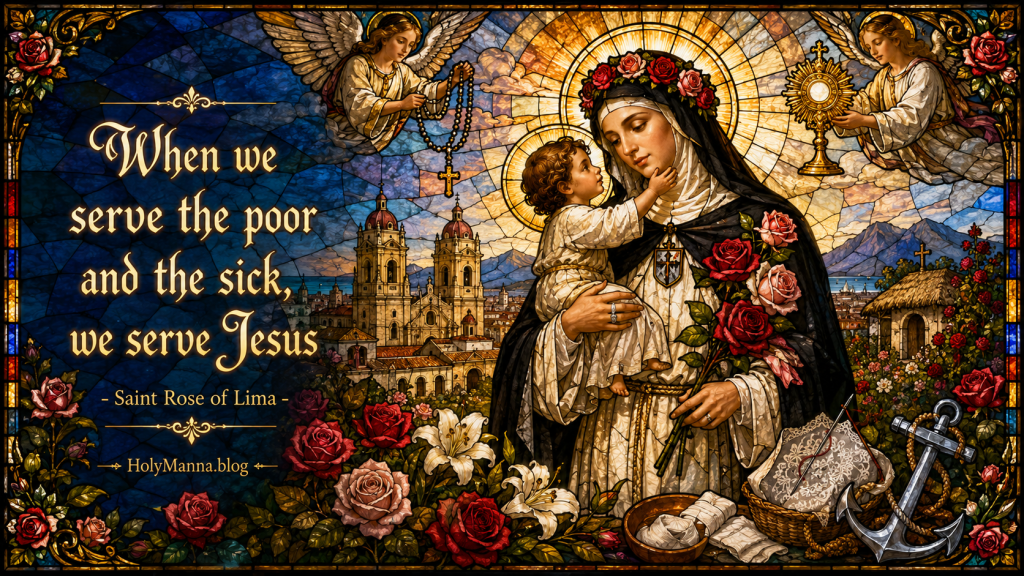
A Rose Planted in the New World
Every August 23rd, the Church pauses to honor a young woman who never left her home city, never founded an order, never wrote a treatise, and yet became the first canonized saint of the Americas. Saint Rose of Lima lived only thirty one years, almost all of them within a few blocks of the same house in colonial Peru. Her days were spent in a garden hut, at a sickbed, or on her knees. Nothing about it looks impressive on paper, and still, within a generation of her death, popes were naming her patroness of an entire hemisphere.
What made her matter was the intensity and purity of her love for Jesus Christ. Rose took the Gospel at its word. When Jesus said, “If any man would come after me, let him deny himself and take up his cross and follow me” (Matthew 16:24), she believed He meant her personally, and she organized her whole existence around that call. She embraced voluntary poverty, tireless service to the poor and sick, and penances so severe that her own confessors had to restrain her. She also received extraordinary mystical graces that the early witnesses described in detail.
The Church honors her formally with a wide set of patronages. She is the principal patroness of Peru and of Lima, and Pope Clement X declared her patroness of all of the Americas, of the Philippines, and of the Indies. She is also the patroness of the Peruvian National Police. Popular devotion has long invoked her as well as a patroness of gardeners and florists, of embroiderers and lacemakers, and of people who are ridiculed for their piety, since each of those touches something real about how she lived. In Lima itself, her feast still brings the city to a stop.
What would it look like to take Jesus completely at His word? That question is the heart of Rose’s story, and it is worth carrying through everything that follows.
Isabel Becomes Rose
She was born Isabel Flores de Oliva on April 20, 1586, in Lima, the capital of the Spanish Viceroyalty of Peru. Her father, Gaspar Flores, was a soldier, a harquebusier in the viceroy’s guard, whose family roots were in Spain by way of Puerto Rico. Her mother, María de Oliva, was a native of Lima. The household was large; sources give different counts of the children, somewhere between ten and thirteen, and it was never wealthy. The family’s fortunes rose and fell, at one point taking them to the mining town of Quives in the Andes before they returned to Lima.
The name Rose came early. A story preserved by her first biographers holds that a household servant, gazing at the infant Isabel in her cradle, saw her face take on the beauty of a rose, and the nickname stuck. It became the name by which everyone knew her. Tradition holds that when she was confirmed, the archbishop who laid hands on her was none other than Saint Turibius of Mogrovejo, the great missionary bishop of Lima, and that the name Rose was confirmed with the sacrament. Some accounts add that she was troubled by the vanity of the name until she was reassured in prayer that Rose was pleasing to Our Lord and Our Lady. That reassurance rests on her own testimony and cannot be independently verified.
Two things shaped Rose’s early piety more than any others. The first was the example of Saint Catherine of Siena. Rose read about the fourteenth century Dominican tertiary and took her as a model in almost every particular: the early vow of virginity, the life of penance in her family home, the intense contemplative prayer, and the works of charity that flowed from it. The second was the atmosphere of Lima itself. The city was barely fifty years old and full of religious houses, saintly figures, and enormous social suffering; Rose grew up where holiness and misery stood side by side, and she noticed both.
Her early years were marked by a striking seriousness about the faith. She fasted from childhood, spent long hours in prayer, and, according to the witnesses at her beatification process, made a private vow of virginity while still very young. She was also, by every account, strikingly beautiful, and that beauty became a battleground. Her parents hoped for a good marriage that would help the family, and Rose wanted no such thing. In one of the most famous and best attested episodes of her youth, when people began to praise her looks, she rubbed her face with pepper to blister it and cut off her hair. Her mother was furious. Rose remained perfectly calm. She had already given herself to Christ and had no intention of taking that gift back.
The Church has always taught that a life of consecrated virginity, freely chosen out of love, is a genuine and beautiful vocation. The Catechism puts it plainly: “From the very beginning of the Church there have been men and women who have renounced the great good of marriage to follow the Lamb wherever he goes, to be intent on the things of the Lord, to seek to please him, and to go out to meet the Bridegroom who is coming” (CCC 1618). Rose belonged to that line, and she knew it. Because her parents refused permission for her to enter a convent, and because she would not disobey them, she chose the path her model Catherine had chosen. In 1606, at the age of twenty, she received the habit of the Third Order of Saint Dominic and became a Dominican tertiary living at home. It was the decisive turning point in her life. She would never marry, never leave Lima, and never stop giving.
The Garden Hut and the Infirmary
After she became a tertiary, Rose’s life took on a shape it kept until the end. She built, or had built for her, a small hermitage in the garden behind her family’s house, a hut of a few square meters where she prayed, slept, and worked. Her days were divided with monastic regularity: many hours of prayer, hours of manual work, and hours of service to the poor. She supported her family with her hands. She grew flowers and vegetables in the garden, sold the flowers in the market, and produced fine embroidery and lace that fetched a good price. The image of Rose working through the night with a needle to help her aging parents is not pious decoration; it is the daily reality her family and neighbors testified to.
She also turned part of her parents’ house into something Lima had never quite seen. She set aside a room where she took in the sick and the destitute, especially the indigenous and African poor whom colonial society mostly ignored, and nursed them herself. She washed wounds, fed the hungry, and prayed with the dying, and Peruvian Church writers have often called her a founder of social service in Peru. She saw Christ in the poor with a directness that shocked people, and she served them because she believed she was serving Him.
This is exactly what the Church means when it speaks of the works of mercy. The Catechism teaches that “The works of mercy are charitable actions by which we come to the aid of our neighbor in his spiritual and bodily necessities” (CCC 2447), and it names feeding the hungry, sheltering the homeless, and visiting the sick among them. Rose never read those words, since The Catechism did not yet exist, but she lived them so thoroughly that her life reads like a commentary on that paragraph.
Alongside the work came the penances, and they were extreme. She wore a heavy iron chain around her waist. She slept on a bed she had made herself from rough boards, broken pottery, and pieces of glass, and only for a few hours a night. She fasted constantly. Most famous of all, she wore a circlet of silver, studded on the inside with sharp points, hidden beneath a crown of roses so that no one would see it. Her confessors, alarmed, ordered her repeatedly to moderate these practices, and she obeyed when told to, though she found new ways to suffer within the limits they set.
Modern readers, including many devout Catholics, find this the hardest part of her life to understand, and it deserves an honest word. The Church has never taught that pain is good in itself. What it teaches is that interior conversion must be expressed outwardly, and that “Interior repentance is a radical reorientation of our whole life” which “is accompanied by a salutary pain and sadness which the Fathers called animi cruciatus (affliction of spirit) and compunctio cordis (repentance of heart)” (CCC 1431). Rose’s penances were an attempt, sometimes clumsy and always sincere, to give that reorientation a body. The Church, through her confessors then and through her canonization later, both restrained the excess and honored the love behind it.
Rose was also a mystic in the fullest sense. Witnesses testified to long ecstasies, to visions of the Child Jesus, of Our Lady, and of her guardian angel, and to a mystical espousal with Christ. One tradition tells that on Palm Sunday, when a sacristan failed to hand her a palm, she went in tears to the altar of Our Lady of the Rosary in the church of Santo Domingo, and there heard the Christ Child say to her that she was to be His spouse. She took to wearing a ring afterward as a sign of it. This story is deeply loved in Lima and appears in the early biographies, but it rests on her own private testimony and cannot be independently verified.
She also knew spiritual darkness, long stretches when God seemed absent and she was tormented by scruples and desolation. That is part of why the Church trusts her mysticism; it was a road through the desert, not a stream of pleasant experiences. She was examined more than once by theologians and physicians who wanted to know whether her experiences were authentic, and their verdict, preserved in the process, was that they were.
Rose belonged to a remarkable circle. Saint Martin de Porres, the Dominican brother whose charity toward the poor mirrored her own, was her friend, Saint John Macías lived in the same city at the same time, and Saint Turibius and Saint Francis Solano were both active during her early years. Lima in that generation was, quite literally, a city of saints, and Rose sat at its heart.
Whether Rose worked miracles in the ordinary sense during her life is less clear than for many saints. There are stories, some of which appear in the beatification process, of sick people restored in the room she kept for them, of her knowing things at a distance, and of her prophecies, including the prophecy of her own death, being fulfilled. The most famous is a story about her prayer for the city. In 1615, a Dutch fleet under Joris van Spilbergen appeared off the coast of Peru and Lima braced for attack. Rose is said to have gone to the church of Santo Domingo, taken her place before the Blessed Sacrament, and prepared to defend it with her own body if the raiders came ashore, praying all the while. The fleet withdrew without landing. Lima has always credited her prayer. That the fleet came and left is a matter of historical record; that Rose prayed as described is attested by witnesses; that her prayer caused the withdrawal is a matter of faith and cannot be verified.
The Cross She Chose and the Cross She Was Given
Rose’s hardships came from two directions. Some she took upon herself, as described above; others came to her, and she bore them with the same steadiness.
The first was her family. Her parents did not understand her. Her mother in particular resented her refusal to marry, resented the pepper and the shorn hair, and resented the hut in the garden. The neighbors gossiped about her. There was real conflict in that house for years, and Rose endured it without leaving and without rebelling. She kept obeying her parents in everything that did not violate her conscience, kept supporting them with her work, and slowly, over time, won them over. By the end of her life, both parents honored her vocation, and her mother would later testify at the process for her beatification.
The second was suspicion. A young laywoman in seventeenth century Lima who claimed visions was bound to attract the attention of Church authorities, and the Inquisition in Peru took a close interest in alleged mystics. Rose was questioned by learned priests who wanted to know whether her experiences were from God, from her imagination, or from something worse. She submitted to every examination. She never asserted her own authority, never claimed special status, and never resisted correction. That humility, more than any argument, convinced her examiners.
The third was her body. Years of fasting and penance took a heavy toll, and Rose’s health broke down. In the last three years of her life she lived not in her family’s house but in the home of Don Gonzalo de la Maza, an official of the royal treasury, and his wife María de Uzátegui, who had befriended her and effectively adopted her. In the summer of 1617 she fell gravely ill, and by all accounts suffered intensely. She had long ago prayed for exactly this. In a passage preserved from her own words to her physician, Dr. Castillo, she wrote of what Christ had taught her about suffering, and the Church still reads it in the Liturgy of the Hours on her feast: “Let all men know that grace comes after tribulation. Let them know that without the burden of afflictions it is impossible to reach the height of grace. Let them know that the gifts of grace increase as the struggles increase” (Office of Readings, Memorial of Saint Rose of Lima). The same passage ends with a line that sums up her whole life: “This is the only true stairway to paradise, and without the cross they can find no road to climb to heaven” (Office of Readings, Memorial of Saint Rose of Lima).
Rose died on August 24, 1617, at the age of thirty one. Some early accounts say she predicted the date and hour. What is certain is that she died as she had lived, in prayer, and that her final breath was an act of love for Jesus.
She was not a martyr in the strict sense; no one killed her for the faith. But the Church has always recognized that “The way of perfection passes by way of the Cross. There is no holiness without renunciation and spiritual battle” (CCC 2015), and Rose walked that way as far as it goes. Her cross was the daily, hidden, unglamorous kind, and she carried it to the end.
A City in Mourning and a Hemisphere in Prayer
The moment Rose died, Lima erupted. Word spread through the city that the young penitent everyone knew by sight, the one who sold flowers and nursed the poor, was gone, and the crowds that gathered were so vast that her burial had to be postponed. People pressed forward to touch her body, and pieces of her habit were torn away as relics. She was buried in the cloister of the Dominican convent of Santo Domingo, and within a few years her remains were moved inside the church, where her skull, crowned with roses, is venerated to this day alongside those of Saint Martin de Porres and Saint John Macías.
The process for her beatification began almost immediately, and it gathered testimony from dozens of witnesses who had known her personally, including her mother, her confessors, and the family who had cared for her at the end. Miracles were reported at her tomb: healings of the sick, relief for the dying, and answered prayers of every kind. The formal process examined and approved specific cures, as the Church requires, though the detailed records are held in the archives rather than in popular circulation, and the individual cases are not easily verified from public sources. What can be verified is that the Church was satisfied.
Pope Clement IX beatified her; sources give the year as 1667, with the solemn ceremony recorded in April 1668, and the discrepancy reflects the gap between the decree and the celebration. Pope Clement X canonized her on April 12, 1671. She was the first person born in the Americas to be raised to the altars. Clement X also confirmed her as patroness of Peru and Lima, and then extended her patronage to all the Americas, to the Philippines, and to the Indies. Her feast was originally set on August 30 in the universal calendar, and Peru and several other countries still celebrate her on that day as a national holiday, while the reform of the General Roman Calendar in 1969 moved her memorial to August 23, the eve of the anniversary of her death.
Devotion to her took physical form. The site of her family home in Lima became the Sanctuary of Santa Rosa de Lima, where visitors can still see the small hermitage in the garden and the well into which, tradition says, she threw the key of the chain she wore. That detail comes from popular tradition and cannot be verified. Pilgrims today drop written petitions into that well by the thousands, especially on her feast. Every August 30, a great procession carries her image through the streets of Lima, escorted by the national police who claim her as their own. Her name marks Santa Rosa in California and Argentina, towns in the Philippines, and countless parishes, schools, and hospitals.
Stories of favors received continue to circulate. Peruvians tell of healings, of families reconciled, of employment found and dangers averted through her intercession. Such stories are told in good faith and are part of the living devotion of the people, but they are private and cannot be verified. The Church encourages the confidence behind them. It teaches that the saints “contemplate God, praise him and constantly care for those whom they have left on earth” and that “Their intercession is their most exalted service to God’s plan” (CCC 2683). Rose spent her life caring for the people of Lima, and there is no reason to think she stopped.
What a Rose Teaches
It would be easy to admire Saint Rose from a safe distance, as an exotic figure from a very different age, and to leave it there. That would waste her. Her life poses questions to anyone who takes the Gospel seriously, and they are worth sitting with.
The first is about single mindedness. Rose knew what she wanted, which was Jesus, and she arranged everything else, her appearance, her marriage prospects, her comfort, her time, and her health, around that one desire. Most people live the other way around, fitting God into the spaces left over. What would change in your week if Christ were the organizing principle rather than one item on the list? You might only need to look honestly at your calendar and your spending.
The second is about the poor. Rose did not treat charity as a hobby. She brought the sick into her own home and cared for them with her own hands, and she believed that in doing so she was serving Christ Himself. The Church continues to teach that “Love for the poor is incompatible with immoderate love of riches or their selfish use” (CCC 2445). Who are the people in your own city that everyone else steps around, and what would it cost you to stop? The answer might be small, and Rose would tell you that small is where it starts.
The third is about suffering. Rose’s penances are not a model to copy literally, and no wise spiritual director today would tell you to sleep on broken glass. But her conviction that suffering, accepted in love, becomes a ladder to God is not medieval superstition; it is Catholic doctrine. The Catechism teaches that Christ “calls his disciples to ‘take up [their] cross and follow [him]’” and that the possibility of sharing in His paschal mystery “is offered to all men” (CCC 618). Illness, loss, humiliation, and grief come to everyone. Rose’s gift is the reminder that none of it need be wasted. When suffering comes to you, do you fight it, numb it, or offer it?
The fourth is about hiddenness. Rose did nothing the world calls significant. She stayed at home, embroidered lace, weeded her garden, and sat with dying strangers, and God made her the patroness of a hemisphere. Most of your life will be hidden too, and that is where sanctity usually happens. What is the ordinary, unglamorous work God has actually given you, and are you doing it with love?
Practically, a few habits fit her spirit well. Set aside a fixed daily time for prayer, even if it is short, and guard it the way she guarded her hours in the hut. Choose one work of mercy and do it regularly rather than occasionally. Take on one small, private penance during the week, a fast from something you enjoy, and offer it for someone who is suffering. When the world laughs at your faith, remember that Rose treated ridicule as a small price for a great love.
Engage With Us!
Saint Rose of Lima has been loved for four hundred years by people who never met her, in cities she never visited, and that love has changed lives. Please share your thoughts and reflections in the comments below. Have you visited her shrine in Lima? Does her example of hidden holiness speak to your own situation? Are there ways her devotion to the poor challenges you? Your story may be exactly what another reader needs.
Here are some questions to pray with this week:
- Rose gave up marriage, comfort, and even her own beauty for the sake of Christ. What is one thing you are holding on to that you sense He is asking you to release?
- She turned a room in her house into an infirmary for the poor. What concrete space, time, or resource in your life could you set apart for the works of mercy?
- Rose believed that grace comes after tribulation. Where in your own life has suffering, in hindsight, opened a door to God?
- Her family did not understand her vocation for years, and she stayed faithful without rebelling. How do you respond when the people closest to you do not understand your faith?
- Rose’s whole life was hidden and ordinary, and God made her a saint. What hidden work has He entrusted to you, and how might you do it with greater love?
Saint Rose of Lima did not become holy by doing extraordinary things. She became holy by loving Jesus extraordinarily in ordinary things: a garden, a needle, a sickroom, a hut. That same path is open to you today, right where you are. Go and live it, and do everything, the great and the small, with the love and mercy that Jesus taught us.
Saint Rose of Lima, pray for us!
Follow us on YouTube, TikTok, Instagram and Facebook for more insights and reflections on living a faith-filled life.


Leave a Reply