Twenty-first Sunday in Ordinary Time – Lectionary: 121
An Office, a Key, and a Question by the Cliffs
There are moments in Scripture when heaven quietly hands someone a key. On this Twenty-first Sunday in Ordinary Time, the Church places two of those moments side by side, separated by more than seven centuries. The central theme of the day is this: authority in the Kingdom of God is never seized or earned. It is entrusted, freely and personally, by God Himself, and He entrusts it in order to serve and protect His people.
In the First Reading, the prophet Isaiah announces that the Lord will strip a corrupt royal steward of his office and place “the key of the House of David” on the shoulder of a faithful servant named Eliakim. In the Gospel, Jesus stands beneath the pagan cliffs of Caesarea Philippi and gives Simon a new name, a new office, and “the keys to the kingdom of heaven.” The parallel is deliberate, because the ancient office of the royal steward becomes the pattern for the office Christ establishes for Peter and his successors.
Between these two readings, the Responsorial Psalm and Saint Paul supply the posture that makes such trust possible. Psalm 138 sings of a God who is exalted yet sees the lowly, and Romans 11 erupts in wonder before the unsearchable wisdom of His plan. Palace officials rise and fall, but the psalmist insists that God never abandons what He builds, and that confidence holds every reading of this Sunday together.
First Reading — Isaiah 22:19-23
A Steward Falls, a Father Rises
This oracle comes from Jerusalem in the late eighth century before Christ, during the reign of King Hezekiah, when the Assyrian empire loomed over Judah. The target is Shebna, the royal steward who governed the king’s household and, in practice, much of the kingdom. Earlier in this same chapter, Isaiah condemns Shebna for carving himself a grand tomb while the city faced danger. The steward’s office was a real institution of the Davidic monarchy, a kind of prime minister who acted with the king’s own authority, which means it could be vacated and refilled. That is exactly what God announces here, and it establishes the pattern the Gospel will fulfill: a kingdom, a king, a steward, and a key.
Isaiah 22:19-23
Thus says the LORD to Shebna, master of the palace:
“I will thrust you from your office
and pull you down from your station.
On that day I will summon my servant
Eliakim, son of Hilkiah;
I will clothe him with your robe,
and gird him with your sash,
and give over to him your authority.
He shall be a father to the inhabitants of Jerusalem,
and to the house of Judah.
I will place the key of the House of David on Eliakim’s shoulder;
when he opens, no one shall shut,
when he shuts, no one shall open.
I will fix him like a peg in a sure spot,
to be a place of honor for his family.”
Detailed Exegesis
Verse 19: “I will thrust you from your office and pull you down from your station.”
God Himself speaks, and the verbs are His. Shebna did not lose his post to palace intrigue but to divine judgment. Every office of authority, sacred or civil, is held on loan from God and remains accountable to Him.
Verse 20: “On that day I will summon my servant Eliakim, son of Hilkiah;”
The replacement is not a schemer but a “servant,” a title of honor Scripture reserves for figures like Moses and David. Eliakim does not campaign for the office; he is summoned. Vocation always moves in this direction, from God’s initiative to man’s response.
Verse 21: “I will clothe him with your robe, and gird him with your sash, and give over to him your authority. He shall be a father to the inhabitants of Jerusalem, and to the house of Judah.”
The robe and sash are the insignia of investiture. Most striking is the title “father,” because the true steward does not dominate the people; he fathers, protects, and provides for them. Catholics will hear an echo of the very word “pope,” which comes from the affectionate word for father.
Verse 22: “I will place the key of the House of David on Eliakim’s shoulder; when he opens, no one shall shut, when he shuts, no one shall open.”
Here is the heart of the oracle. The great key of the palace, carried visibly on the shoulder as a sign of office, gave the steward authority to admit or exclude in the king’s name. The Book of Revelation later applies this very verse to the risen Christ, who holds “the key of David” (Revelation 3:7), and Christ in turn hands keys to Peter in today’s Gospel.
Verse 23: “I will fix him like a peg in a sure spot, to be a place of honor for his family.”
A peg driven into solid wall holds the weight of whatever hangs upon it. The image promises stability, an office fixed firmly enough that others can depend on it, because when God establishes an office He fixes it in a sure spot.
Teachings
The Church has long read this passage as the Old Testament background for the Petrine office. The Catechism of the Catholic Church draws the connection through the symbol of the keys: “The ‘power of the keys’ designates authority to govern the house of God, which is the Church” (CCC 553). Just as Eliakim’s key gave him authority over the house of David, Peter’s keys give him authority within the house of God. The steward was never the king, and the pope is never the Lord; both act only in the name of the sovereign who appointed them. Shebna also stands as a sober warning, because a man can hold a divinely sanctioned office and still betray it through pride. That is why the office itself, not the personal merit of the officeholder, is what God fixes in a sure spot. The stability belongs to God’s promise.
Reflection
Every believer holds some stewardship, whether over a family, a classroom, a team at work, or simply over time, talent, and treasure. Shebna treated his office as a monument to himself, while Eliakim received his as a summons to fatherly service. When you examine the authority you hold this week, does it look more like a tomb you are carving for your own name, or a key you are carrying for someone else’s good? A concrete step is to choose one responsibility and perform it this week deliberately as quiet service, without seeking credit, and to pray by name for those who hold the keys in the Church today, especially the Holy Father. Who has been a true Eliakim in your life, a person whose authority felt like protection rather than power?
Responsorial Psalm — Psalm 138:1-3, 6, 8
A Song for the God Who Stoops
Psalm 138 is a thanksgiving psalm attributed to David, the very king whose “House” gave its name to the key in the First Reading. It breathes the confidence of someone who has tested God’s faithfulness and found it solid. Placed on this Sunday, the psalm supplies the interior disposition the readings demand. Eliakim was chosen because he was a servant, Peter will be blessed because his knowledge came from the Father, and the psalmist declares the principle behind both: the exalted Lord sees the lowly. The refrain, “Lord, your love is eternal; do not forsake the work of your hands,” becomes almost prophetic when sung beside the Gospel, because the Church herself is the work of God’s hands, and Christ promises she will never be forsaken.
Psalm 138:1-3, 6, 8
R. (8bc) Lord, your love is eternal; do not forsake the work of your hands.
I will give thanks to you, O LORD, with all my heart,
for you have heard the words of my mouth;
in the presence of the angels I will sing your praise;
I will worship at your holy temple.
R. Lord, your love is eternal; do not forsake the work of your hands.
I will give thanks to your name,
because of your kindness and your truth:
When I called, you answered me;
you built up strength within me.
R. Lord, your love is eternal; do not forsake the work of your hands.
The LORD is exalted, yet the lowly he sees,
and the proud he knows from afar.
Your kindness, O LORD, endures forever;
forsake not the work of your hands.
R. Lord, your love is eternal; do not forsake the work of your hands.
Detailed Exegesis
Verse 1: “I will give thanks to you, O LORD, with all my heart, for you have heard the words of my mouth; in the presence of the angels I will sing your praise;”
Gratitude here is total, engaging the whole heart, and it is public, sung “in the presence of the angels.” The psalmist understands what the Mass makes explicit, that earthly worship joins the liturgy of heaven.
Verse 2: “I will worship at your holy temple. I will give thanks to your name, because of your kindness and your truth: “
The words kindness and truth translate the Hebrew pair hesed and emet, God’s covenant love and His utter reliability. The psalmist thanks God not first for gifts received but for who God is, and worship that begins with God’s character survives seasons when the gifts seem delayed.
Verse 3: “When I called, you answered me; you built up strength within me.”
The answer to prayer described here is not a change of circumstances but a change within the one praying. God often responds to a cry for rescue by building strength in the heart that cries, and that interior fortification is often the more lasting answer.
Verse 6: “The LORD is exalted, yet the lowly he sees, and the proud he knows from afar.”
This is the theological hinge of the whole Sunday. God’s exaltation does not distance Him from the small; it enables Him to see them. The proud are known only “from afar,” not because God cannot reach them but because pride holds Him at arm’s length. Shebna was known from afar, while Eliakim and Peter were seen.
Verse 8: “Your kindness, O LORD, endures forever; forsake not the work of your hands.”
The psalm ends with confidence and petition intertwined, for because God’s covenant love is eternal, the psalmist dares to ask Him to finish what He began. Every believer is unfinished work in the hands of a faithful craftsman, and so is the Church.
Teachings
The Catechism teaches that the disposition praised in this psalm is the doorway to all prayer: “humility is the foundation of prayer” (CCC 2559). The lowly one whom the Lord sees in verse 6 is precisely the one whose prayer rises, because humility makes room for God’s initiative. Scripture states this pattern repeatedly, and it flows most movingly from the pen of the very apostle who receives the keys in today’s Gospel. Peter learned lowliness through boasts, failures, and tears, and the man who once insisted he would never fall later wrote to the whole Church that God “gives grace to the humble” (1 Peter 5:5). The psalm’s closing plea also shapes the Church’s confidence in her own endurance. She does not trust her members’ virtue; she trusts that God does not forsake the work of His hands.
Reflection
Modern culture trains people to project competence and hide need, yet the psalm insists that God sees the lowly and knows the proud only from afar. When you pray, do you present a polished version of yourself to God, or the real one He already sees? A practical step this week is to begin each day of prayer with one honest sentence of thanksgiving and one honest admission of weakness, and to make the psalm’s refrain a personal aspiration in moments of discouragement. What is one area of your life that feels incomplete, and can you entrust it to the God who never walks away from His own workmanship?
Second Reading — Romans 11:33-36
When Theology Turns to Song
These four verses close the most demanding stretch of Saint Paul’s letters, chapters 9 through 11 of Romans, where the apostle wrestles with the mystery of Israel, election, and God’s plan to show mercy to all. Paul has argued, quoted the prophets, and pressed his reasoning as far as reason can go. Then, at the summit, argument gives way to adoration. Writing from Corinth around the year 57, Paul ends not with a conclusion but with a doxology, a hymn of praise woven from Isaiah 40 and the Book of Job. Between Isaiah’s oracle and Peter’s confession, the Church pauses to admit that no human mind could have designed this plan, in which keys pass from stewards to fishermen. Wonder, not mastery, is the right response to such a God.
Romans 11:33-36
Oh, the depth of the riches and wisdom and knowledge of God!
How inscrutable are his judgments and how unsearchable his ways!
For who has known the mind of the Lord
or who has been his counselor?
Or who has given the Lord anything
that he may be repaid?
For from him and through him and for him are all things.
To him be glory forever. Amen.
Detailed Exegesis
Verse 33: “Oh, the depth of the riches and wisdom and knowledge of God! How inscrutable are his judgments and how unsearchable his ways!”
Paul piles up three treasures, riches, wisdom, and knowledge, and then confesses that their depth cannot be sounded. “Inscrutable” and “unsearchable” are not counsels of despair but of proportion, because God’s judgments can be trusted precisely when they exceed human audit.
Verse 34: “For who has known the mind of the Lord or who has been his counselor?”
Paul quotes Isaiah 40:13, the prophet’s own hymn to God’s incomparable wisdom, and the question expects the answer that no one has counseled God. Every generation is tempted to imagine it could have advised the Almighty toward a better plan, and every generation must learn this humility.
Verse 35: “Or who has given the Lord anything that he may be repaid?”
This echoes the Lord’s challenge to Job, because no creature has ever placed God in its debt. Everything, from existence itself to the gift of faith Peter receives in the Gospel, comes first from God, unearned and unowed.
Verse 36: “For from him and through him and for him are all things. To him be glory forever. Amen.”
Three small prepositions carry an entire theology, for all things come from God as their source, exist through Him as their sustainer, and are ordered to Him as their goal. Paul’s “Amen” invites every reader to sign the hymn personally.
Teachings
The Catechism gives this doxology its doctrinal frame in a single luminous line: “Even when he reveals himself, God remains a mystery beyond words: ‘If you understood him, it would not be God’” (CCC 230), quoting Saint Augustine’s preaching in his Sermons. Augustine’s point is not that God is unknowable but that He is inexhaustible. Revelation gives true knowledge, real enough to build a Church on, yet never exhaustive knowledge, and the difference between the two is where worship lives. Paul’s doxology also guards the Gospel reading from misunderstanding, because Peter’s authority does not domesticate the mystery of God. The steward serves a plan he did not design and could not have imagined, and the Church teaches with real authority precisely while bowing before judgments she calls inscrutable.
Reflection
There is a quiet relief hidden in this reading. If God’s ways were small enough to be fully audited, they would be too small to save anyone. Where in your life are you demanding an explanation from God as a condition for trusting Him? A concrete practice this week is to take one unresolved suffering or delay and, instead of interrogating it, to pray verse 36 over it slowly, surrendering it as something “from him and through him and for him.” Can you praise God for the parts of His plan you cannot yet see, the way Paul praised Him at the very point where his own arguments ran out?
Holy Gospel — Matthew 16:13-20
The Question at the Rock Face
Caesarea Philippi sat north of the Sea of Galilee, at the foot of Mount Hermon, where springs pour from the base of a massive rock cliff. In Jesus’ day it was thoroughly pagan ground. A grotto there had long been dedicated to the god Pan, pagans associated the cavern’s depths with the underworld, and temples honoring Caesar stood nearby. Jesus deliberately chose this place to ask the question on which history turns, and against a literal wall of rock crowded with dead gods He announces a living rock, a Church, and keys. Every thread of the day gathers here, as Isaiah’s key finds its steward, the psalm’s lowly one is seen and blessed, and Paul’s unsearchable plan takes visible shape in a fisherman with a new name.
Matthew 16:13-20
Jesus went into the region of Caesarea Philippi and
he asked his disciples,
“Who do people say that the Son of Man is?”
They replied, “Some say John the Baptist, others Elijah,
still others Jeremiah or one of the prophets.”
He said to them, “But who do you say that I am?”
Simon Peter said in reply,
“You are the Christ, the Son of the living God.”
Jesus said to him in reply,
“Blessed are you, Simon son of Jonah.
For flesh and blood has not revealed this to you, but my heavenly Father.
And so I say to you, you are Peter,
and upon this rock I will build my church,
and the gates of the netherworld shall not prevail against it.
I will give you the keys to the kingdom of heaven.
Whatever you bind on earth shall be bound in heaven;
and whatever you loose on earth shall be loosed in heaven.”
Then he strictly ordered his disciples
to tell no one that he was the Christ.
Detailed Exegesis
Verse 13: “Jesus went into the region of Caesarea Philippi and he asked his disciples, ‘Who do people say that the Son of Man is?’”
Jesus opens with the crowd’s opinion, using His favorite self-designation, “the Son of Man,” drawn from the heavenly figure of Daniel 7. The question clears the ground of secondhand answers before requiring a firsthand one.
Verse 14: “They replied, ‘Some say John the Baptist, others Elijah, still others Jeremiah or one of the prophets.’”
The crowd’s answers are generous and entirely inadequate, fitting Jesus into existing prophetic categories, honoring Him while missing Him. Public opinion, then as now, can admire Christ without ever confessing Him.
Verse 15: “He said to them, ‘But who do you say that I am?’”
The question turns personal, aimed at the disciples themselves. No one can answer it by survey, and it is the one question in the Gospels that every human being must eventually answer alone.
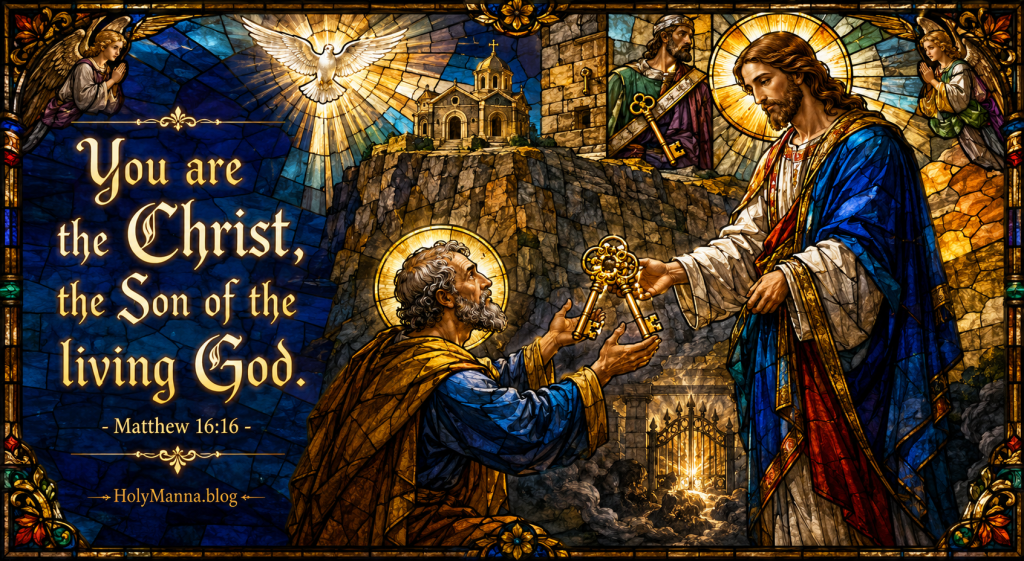
Verse 16: “Simon Peter said in reply, ‘You are the Christ, the Son of the living God.’”
Simon confesses both the messianic office and the divine sonship, and the phrase “living God” rings out deliberately in a valley of lifeless idols. This confession is the bedrock content of Christian faith, and every creed since is its expansion.
Verse 17: “Jesus said to him in reply, ‘Blessed are you, Simon son of Jonah. For flesh and blood has not revealed this to you, but my heavenly Father.’”
Jesus declares the confession a gift, not an achievement, for unaided human reasoning did not produce it; the Father revealed it. Here the psalm’s promise is fulfilled, as the exalted Lord sees a lowly fisherman and entrusts him with heaven’s secret.
Verse 18: “And so I say to you, you are Peter, and upon this rock I will build my church, and the gates of the netherworld shall not prevail against it.”
Jesus renames Simon with a word, Kepha in Aramaic, that simply means rock, and the wordplay would have been unmistakable in His own tongue. Standing before a cliff the pagans linked to the underworld, He vows that “the gates of the netherworld” will not prevail against the Church He builds on this rock. Death itself will lay siege and fail.
Verse 19: “I will give you the keys to the kingdom of heaven. Whatever you bind on earth shall be bound in heaven; and whatever you loose on earth shall be loosed in heaven.’”
The promise of the keys reaches directly back to Isaiah 22. As Eliakim received the key of David’s house to govern in the king’s name, Peter receives the keys of the kingdom to govern in Christ’s name. Binding and loosing were rabbinic terms for authoritative teaching and discipline, and heaven itself stands behind the steward’s exercise of them.
Verse 20: “Then he strictly ordered his disciples to tell no one that he was the Christ.”
The command for silence, often called the messianic secret, protects the truth from distortion. Israel expected a political and military Messiah, and until the Cross and Resurrection redefined the title, proclaiming it would have ignited the wrong revolution.
Teachings
The Catechism states the meaning of this scene with precision: “Simon Peter holds the first place in the college of the Twelve; Jesus entrusted a unique mission to him. Through a revelation from the Father, Peter had confessed: ‘You are the Christ, the Son of the living God.’ Our Lord then declared to him: ‘You are Peter, and on this rock I will build my Church, and the gates of Hades will not prevail against it.’ Christ, the ‘living Stone,’ thus assures his Church, built on Peter, of victory over the powers of death” (CCC 552). It adds that “the power to ‘bind and loose’ connotes the authority to absolve sins, to pronounce doctrinal judgments, and to make disciplinary decisions in the Church” (CCC 553), and that “the Lord made Simon alone, whom he named Peter, the ‘rock’ of his Church” (CCC 881). Pope Saint Leo the Great, preaching in the fifth century on the anniversary of his own election, taught that this office endures beyond Peter’s lifetime: “The dispensation of Truth therefore abides, and the blessed Peter persevering in the strength of the Rock, which he has received, has not abandoned the helm of the Church, which he undertook” (Sermon 3). Nearly two thousand years later, that peg still holds in its sure spot.
Reflection
The most important sentence any person will ever speak is an answer to the question Jesus asked at Caesarea Philippi. If Jesus turned to you today and asked that same question, what would your honest, unrehearsed answer be? A concrete step this week is to write that answer down in plain words, compare it with Peter’s confession, and ask the Holy Spirit to close whatever gap appears. Another is to thank God before receiving the Eucharist this Sunday for the gift of a Church that death cannot conquer. When the gates of the netherworld seem to be prevailing in the news, in the culture, or in your own family, do you live as someone who actually believes Christ’s promise that they shall not?
The Peg Still Holds
Taken together, the readings of this Twenty-first Sunday tell a single story about a God who keeps handing His keys to the humble. In Isaiah, He strips a proud steward and clothes a servant with the key of David’s house. In the psalm, He reveals why, because the exalted Lord sees the lowly and never forsakes the work of His hands. In Romans, Paul surveys the whole sweep of salvation history and can only sing, because no human counselor could have drafted such a plan. And at Caesarea Philippi, the plan becomes flesh-and-blood reality when a Galilean fisherman, moved by the Father’s own revelation, confesses “You are the Christ, the Son of the living God” and receives the keys of a kingdom that death cannot breach.
That promise was not made to a golden age. It was made beneath pagan cliffs, to a man who would soon deny his Lord, and it has held through persecutions, scandals, and every century’s confident prediction of the Church’s collapse. The peg still sits in its sure spot, not because the stewards have always been worthy, but because the King who appointed them is faithful forever.
The invitation this week is simple and searching. Answer the question of Caesarea Philippi personally, with a whole heart, in the presence of the angels. Trust the Church Christ built, receive the mercy her keys unlock in Confession, and let the God who never abandons His handiwork continue His patient work in every unfinished soul. His love is eternal, and He is not finished yet.
Engage With Us!
The conversation continues in the comments below, and every reflection shared there becomes an encouragement to other readers walking the same road of faith. These questions can help prayer go deeper this week.
- In Isaiah 22:19-23, God removes Shebna for pride and installs Eliakim as a father to Jerusalem. What authority or responsibility in your life needs to be converted from self-promotion into fatherly or motherly service?
- In Psalm 138:1-3, 6, 8, the psalmist sings that the exalted Lord sees the lowly. When has God answered your prayer not by changing your circumstances but by building up strength within you?
- In Romans 11:33-36, Saint Paul responds to God’s unsearchable ways with a hymn of praise. What unresolved situation in your life can you surrender this week with the words “from him and through him and for him”?
- In Matthew 16:13-20, Jesus asks the question on which everything depends. Who do you say that Jesus is, and how does your daily life confirm or contradict your answer?
- Considering the message that unites all the readings, where is God asking you to trust that He will not forsake the work of His hands, in the Church and in your own soul?
Faith grows when it is spoken, shared, and lived. May this week be marked by humble confidence in the God who hands keys to fishermen, and may every word and action carry the love and mercy Jesus taught us.
Sacred Heart of Jesus, we trust in You!
Immaculate Heart of Mary, pray for us!
Saint Michael the Archangel, defend us in battle!
Follow us on YouTube, TikTok, Instagram and Facebook for more insights and reflections on living a faith-filled life.


Leave a Reply