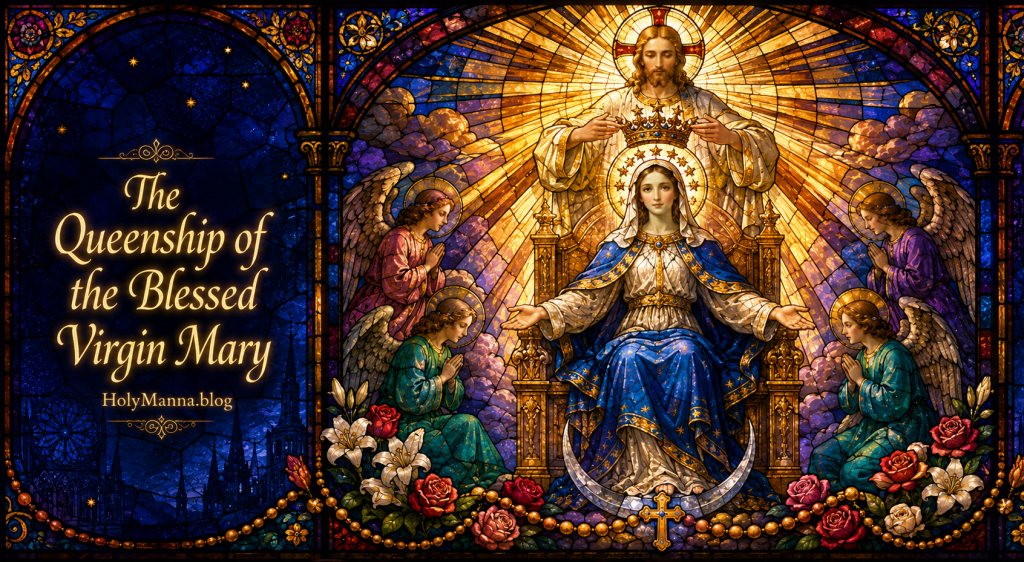
The Crown After the Cross
Every August 22nd, exactly 1 week after the Solemnity of the Assumption, the Church pauses to look up at heaven one more time. On the 15th, the faithful celebrated Mary being taken up, body and soul, into glory. On the 22nd, they celebrate what happened next. The Memorial of the Queenship of the Blessed Virgin Mary is the Church’s way of finishing the sentence that the Assumption begins. The Mother of God did not simply arrive in heaven; she was crowned there. The Catechism of the Catholic Church puts it plainly when it teaches that the Immaculate Virgin was “taken up body and soul into heavenly glory, and exalted by the Lord as Queen over all things, so that she might be the more fully conformed to her Son, the Lord of lords” (CCC 966, quoting Lumen Gentium 59).
That word, queen, can land strangely on modern ears. Royalty today tends to mean either fairy tales or tabloid headlines, and neither one comes close to what the Church means when she calls Mary Queen. Mary’s crown is not a prize for celebrity or a symbol of raw power. It is the natural consequence of her motherhood. She is Queen because her Son is King, and in the family of David, from which Jesus descends, the mother of the king held a throne beside him. Her queenship is entirely relative to Christ, entirely dependent on Christ, and entirely at the service of Christ’s brothers and sisters. Pope Pius XII, who gave the Church this feast in 1954, taught that Mary “reigns with a mother’s solicitude over the entire world” (Ad Caeli Reginam, 1). A queen whose reign is solicitude, whose scepter is intercession, whose court is every soul that calls on her: that is the woman this Memorial honors.
For Catholics between busy commutes, group chats, and endless scrolling, this celebration matters more than it might first appear. It answers a quiet but persistent question: is anyone in heaven actually paying attention? The Queenship of Mary says yes. Someone is enthroned beside the King of the universe whose entire occupation is to mother his people. This post walks through where the feast came from, what Scripture and Tradition say about Mary’s crown, why the theology matters, and how believers across the world have loved this truth for centuries.
How a Wounded Century Asked for a Queen
The feast itself is young, but the faith behind it is ancient. Christians have addressed Mary as Queen since the early centuries of the Church. Pius XII opens Ad Caeli Reginam by observing that from the earliest ages, Christian people in times of triumph and especially in times of crisis have directed prayers and hymns “to the Queen of Heaven” (Ad Caeli Reginam, 1). The Salve Regina, sung since roughly the 11th century, greets her as holy Queen and Mother of mercy. The Regina Caeli has rung out every Easter season for centuries. The Litany of Loreto, approved in 1587, piles queenly invocation upon queenly invocation: Queen of Angels, Queen of Patriarchs, Queen of Apostles, Queen of Martyrs, Queen of Peace. The Fifth Glorious Mystery of the Rosary, prayed by countless generations, is nothing other than the Coronation of Mary as Queen of Heaven and Earth. In art, from the glittering apse mosaics of Rome’s Santa Maria Maggiore to the carved tympana of Gothic cathedrals, the coronation of the Virgin became one of the most beloved images in all of Christian iconography.
So why did it take until 1954 for a liturgical feast? The 20th century supplied the urgency. Beginning around 1900, Marian congresses and bishops from around the world began formally petitioning the Holy See to establish a feast of Mary’s Queenship. Then came 2 world wars, the rise of atheistic regimes, and the open persecution of the Church in many nations. Pius XII, who had personally witnessed cities reduced to rubble, saw in Mary’s Queenship a truth the age desperately needed. In 1946, through his legate, he crowned the image of Our Lady of Fatima and honored her as Queen of the world; the Fatima apparitions themselves had been approved by the Bishop of Leiria in 1930 and remain, like all private revelation, non-binding on the faithful (CCC 67).
The decisive moment arrived on October 11th, 1954, at the close of the Marian Year commemorating the 100th anniversary of the definition of the Immaculate Conception. With the encyclical Ad Caeli Reginam, Pius XII formally instituted the feast of the Queenship of Mary and assigned it to May 31st. He was careful to insist that he was proposing nothing new, since the royal dignity of Mary was already “to be found in the documents of the Church, which have been handed down from ancient times” (Ad Caeli Reginam, 6). In 1969, Saint Paul VI reformed the General Roman Calendar and moved the celebration to August 22nd, the octave day of the Assumption, so that the link between Mary’s glorification and her crowning would be unmistakable. Readers with older prayer books may notice the earlier date; the switch is real and intentional. August 22nd had previously belonged to the Immaculate Heart of Mary, which now falls on the Saturday after the Solemnity of the Sacred Heart, while May 31st became the feast of the Visitation.
The Queen Mother of the New David
Because this Memorial celebrates a title rather than an apparition, its deepest foundations are scriptural. And the scriptural case for Mary’s queenship is far stronger than many people, including many Catholics, realize. It begins not in the Gospels but in the throne room of ancient Israel. In the kingdom of David, the woman honored beside the king was not his wife but his mother, the Gebirah, the great lady or queen mother. 1 Kings 2:19 shows the pattern vividly: when Bathsheba approaches her son King Solomon, he rises to meet her, bows down to her, and has a throne brought for the king’s mother, seating her at his right hand. The queen mother held a recognized office of honor and intercession; petitioners brought requests to the king through her.
Now open The Gospel of Luke with that picture in mind. The angel Gabriel announces to Mary that her Son will receive “the throne of his father David” and that “of his kingdom there will be no end” (Luke 1:32-33). Jesus is proclaimed the definitive Davidic King before he is even conceived. If the Son is the everlasting King in David’s line, then his mother steps into the role of the Gebirah, the queen mother of the everlasting kingdom. Elizabeth, filled with the Holy Spirit, senses it immediately when she cries out, “Why is this granted me, that the mother of my Lord should come to me?” (Luke 1:43). In the court language of Israel, the mother of the Lord is a royal title. Even the wedding at Cana echoes the pattern: petitioners bring a need to the mother, the mother brings it to the King, and the King acts.
Scripture closes with the image the Church has contemplated ever since. The Book of Revelation describes “a woman clothed with the sun, with the moon under her feet, and on her head a crown of twelve stars” (Revelation 12:1), a woman who gives birth to the male child destined to rule all nations. The Church has long seen in this crowned woman both an image of the Church herself and of Mary, the mother of the Messiah. Tradition carried the thread forward without interruption. After the Council of Ephesus in 431 solemnly confirmed Mary as Theotokos, Mother of God, devotion to her royal dignity flourished across East and West. In Ad Caeli Reginam, Pius XII gathers the witnesses: Saint Ephrem addressing Mary in royal terms, Saint Gregory Nazianzen and Saint John Damascene honoring her as Lady and Queen, and the ancient liturgies of both East and West singing to her under the same title. The feast of August 22nd did not invent a crown for Mary. It simply gave a fixed liturgical home to a truth the Church had been singing for well over a millennium.
Why Her Crown Points to His Throne
Here is where the celebration becomes more than beautiful imagery and turns into serious, life-shaping theology. On what basis is Mary Queen? Pius XII gives 2 principal reasons, and the Catechism confirms both. The first is her divine motherhood. Mary is truly the Mother of God because the Son she conceived by the Holy Spirit is truly God (CCC 495). The mother of the King of kings shares, by that very motherhood, in his royal dignity, exactly as the Gebirah shared in Solomon’s. The second is her singular association with Christ’s redemptive work. The Catechism teaches that “she cooperated by her obedience, faith, hope, and burning charity in the Savior’s work of restoring supernatural life to souls” (CCC 968). As the New Eve joined to the New Adam, she was united with her Son’s saving sacrifice from the Annunciation to the foot of the Cross (CCC 964). Just as Christ is King both as God and as Redeemer, Mary is Queen both as Mother of God and as the one most intimately united to the Redeemer’s victory.
The Second Vatican Council placed this teaching at the summit of its treatment of Mary. Lumen Gentium, chapter VIII, concludes her earthly story with her heavenly exaltation as Queen over all things, precisely so that she might be more fully conformed to her Son (Lumen Gentium 59; CCC 966). Notice the logic: her crown does not compete with Christ’s; it conforms her to Christ. Everything Mary has, she has from him and for him. That is why the Council and the Catechism insist that her role “in no way obscures or diminishes this unique mediation of Christ, but rather shows its power” (CCC 970, quoting Lumen Gentium 60).
What does a Queen like this actually do? Saint Paul VI answered in Marialis Cultus when he explained why the Queenship follows the Assumption by 7 days: on this Memorial the Church contemplates her who, “seated beside the King of ages, shines forth as Queen and intercedes as Mother” (Marialis Cultus, 6). Her reign is intercession. Taken up to heaven, she did not lay aside her saving office but continues, by her constant intercession, to bring the faithful the gifts of eternal salvation, which is why the Church invokes her as Advocate, Helper, Benefactress, and Mediatrix, titles always understood in complete subordination to the one mediation of Christ (CCC 969). Saint John Paul II drew out the final paradox in Redemptoris Mater when he taught that Mary’s queenship is glorious precisely because it is service, mirroring the Son who came not to be served but to serve (Redemptoris Mater, 41). The Queen of Heaven is, gloriously and forever, the handmaid of the Lord (CCC 967 presents her as the Church’s model of faith and charity for exactly this reason).
Crownings, Beads, and the Roads That Lead to Her
Doctrine this rich never stays on the page; it spills into devotion. The most universal devotion to Mary’s queenship is one many Catholics already hold in their hands: the Rosary. The Fifth Glorious Mystery invites the faithful to contemplate the Coronation of the Blessed Virgin as Queen of Heaven and Earth, which means that every complete praying of the Glorious Mysteries ends at the exact truth this Memorial celebrates. The Salve Regina, traditionally sung at the end of the Rosary and at Compline, has taught the faithful for nearly 1,000 years to greet Mary as Queen and Mother of mercy in the same breath. The Litany of Loreto does the same, and the Church attaches such importance to these prayers that the Catechism names the Rosary among the expressions of piety that extend the liturgical life of the Church (CCC 971).
Then there are the crownings themselves. For centuries the Church has practiced the canonical coronation of venerated images of Our Lady, a formal papal act by which a crown is solemnly placed on an image as a public recognition of Mary’s queenship and of the devotion of the people who honor her there. Crowned images draw pilgrims by the millions: Our Lady of Fatima in Portugal, crowned in 1946 by the legate of Pius XII; Our Lady of Częstochowa in Poland, whose icon was crowned in the early 1700s; Our Lady of Guadalupe in Mexico, crowned in 1895. Alongside these solemn papal coronations stands the humbler, beloved custom of May crownings, in which parishes and schools crown a statue of Mary with flowers. There is no single mother shrine for the Queenship as there is for Lourdes or Fatima, and that is fitting. A queen whose realm is the whole Church is honored everywhere her children gather. Pilgrims who travel to any major Marian shrine on August 22nd will typically find the Memorial kept with special Masses, Rosary processions, and the singing of the great queenly antiphons, each practice quietly forming pilgrims in the confidence that their petitions have a royal advocate.
A Crown Recognized on Every Continent
Few truths of the faith have shaped culture as visibly as Mary’s queenship. Walk into almost any historic Catholic church on earth and the evidence hangs on the walls. Byzantine mosaics enthrone the Theotokos in imperial gold. Medieval West portals carve Christ placing a crown on his mother’s head. Renaissance and Baroque masters returned to the coronation scene again and again, and colonial artists carried it to the Americas and Asia, where it took root in local styles. Music tells the same story. The 4 great Marian antiphons, the polyphonic settings of the Salve Regina by composers across the centuries, and the beloved hymn “Hail, Holy Queen Enthroned Above” have kept the doctrine singable for ordinary believers.
The celebration takes on distinct local flavors. In Poland, devotion to Mary as Queen carries national weight, since King John Casimir solemnly entrusted the nation to her protection in 1656, and Our Lady of Częstochowa has been honored as Queen of Poland ever since, a devotion Saint John Paul II carried from his homeland to the universal Church. In the Philippines, grand Marian processions feature crowned images borne through the streets amid flowers and song. Across Latin America, patronal fiestas for crowned advocations of the Virgin gather entire towns, blending Mass, procession, music, and festival into a single act of filial love. In Italy and Spain, confraternities have carried crowned images in procession for centuries, handing the custom from grandparents to grandchildren. Even the calendar of 2026 adds a quiet grace note: August 22nd falls on a Saturday, the day the Church has dedicated to Our Lady since the early Middle Ages, so the Queen is honored on her own day of the week. None of this is nostalgia. It is what happens when a doctrine becomes a mother, and a mother becomes a queen, in the lived imagination of a people. Cultures do not build processions for abstractions. They build them for someone they love.
Living Under a Gentle Reign
So what does the Queenship of Mary ask of you on an ordinary Saturday in August? Start with the question underneath the feast: who actually reigns over your life? Everyone is ruled by something. For some it is a career, for others an anxiety, an algorithm, an addiction, or simply the exhausting project of self-invention. The Memorial of the Queenship proposes a different arrangement. It invites you to live as a subject of a kingdom whose King is your brother and whose Queen is your mother. That is not a loss of freedom; it is the end of orphanhood.
Begin with the Rosary, and pray the Glorious Mysteries with fresh attention on the Fifth. When you reach the Coronation, do not rush it. Picture the throne room of Revelation 12, and then remember that the crowned woman knows your name. Bring her something specific: the job situation, the strained friendship, the habit you cannot break, the faith of someone you love who has drifted. The Gebirah of the new Israel exists to carry petitions to the King, and the Catechism teaches that the Church loves to pray in communion with the Virgin Mary because of her singular cooperation with the Holy Spirit (CCC 2679).
Then imitate her, because a true subject grows to resemble the throne he serves. Mary reigns because she served; she is exalted because she humbled herself. Choose one hidden act of service this week that nobody will see or repost. Answer one of God’s promptings with her fiat instead of your usual negotiation. Practice her kind of resilience, the kind that stood at the Cross without walking away, by staying faithful in the one situation you are most tempted to abandon. If you want a concrete anchor, pray the Salve Regina each night before bed until the Memorial comes around again, and let its closing plea, to be shown the fruit of her womb, Jesus, become the honest ambition of your life. A queen whose whole reign is solicitude for you deserves at least that much of your attention in return.
Engage With Us!
The conversation does not end here, and every reader is warmly invited to share thoughts, experiences, and reflections in the comments below. How has Our Lady’s queenship touched your own walk with Christ? Consider these questions:
- When you hear Mary called Queen, what image comes to mind first, and how does the biblical picture of the queen mother deepen or correct it?
- The Church teaches that Mary reigns by interceding as a mother. What is one specific intention you can entrust to her this week?
- Mary was crowned because she served. Where in your daily life is God inviting you to reign the same way, through hidden, faithful service?
- The Assumption and the Queenship are 7 days apart on purpose. What does Mary’s crowning tell you about your own hope of heaven?
- Which devotion from this post, the Fifth Glorious Mystery, the Salve Regina, or a Marian pilgrimage, could you realistically build into your routine before next August 22nd?
May the Queen of Heaven, who never stops being a mother, gather every reader closer to her Son. Keep praying, keep serving, and keep showing up, one faithful day at a time, and let us grow together in faith under the guidance of our Blessed Mother.
Most Blessed Virgin Mary, Queen of Heaven & Earth, pray for us!
Follow us on YouTube, TikTok, Instagram and Facebook for more insights and reflections on living a faith-filled life.

 Holy Manna!
Leave a comment