When a Lie Swallowed a Kingdom
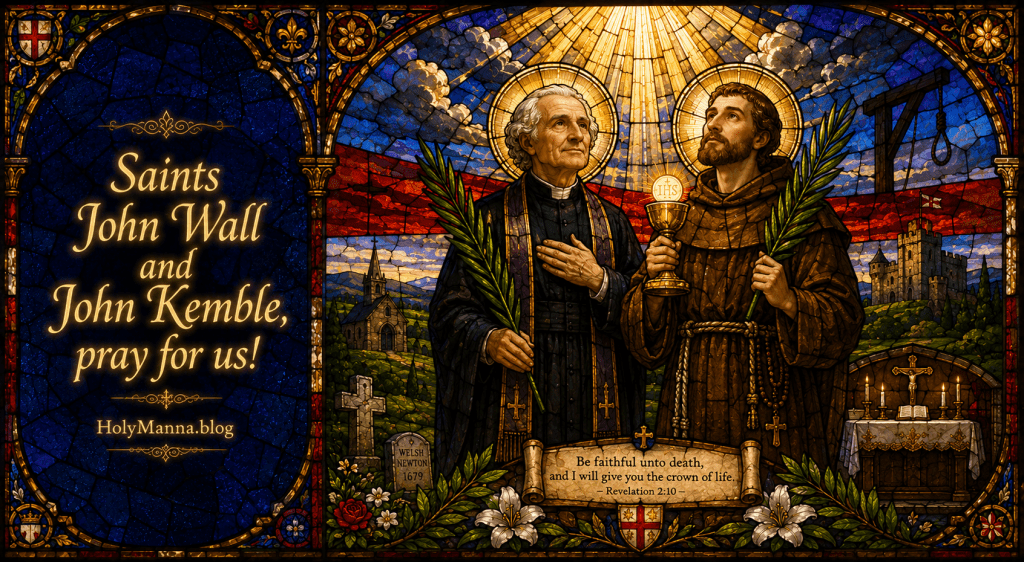
On the same summer day, August 22, 1679, in two English cities forty miles apart, two Catholic priests climbed two scaffolds and gave their lives for the same reason. Neither man had plotted anything. Neither man had harmed anyone. One was an eighty-year-old country pastor who had quietly served his people for fifty-three years. The other was a Franciscan friar who had spent more than two decades bringing the sacraments to hidden Catholics in the English countryside. Saint John Kemble died at Widemarsh Common outside Hereford, and Saint John Wall died at Red Hill overlooking Worcester, and both died for one crime only: they were priests of the Roman Catholic Church.
Their deaths came in the final convulsion of England’s long persecution of Catholics, a national panic known as the Popish Plot. A disgraced clergyman named Titus Oates invented a story that Catholics were conspiring to assassinate King Charles II, and the lie spread through England like fire through dry grass. Innocent men were arrested, tried, and executed on the strength of perjured testimony. Kemble and Wall were among the last to die for it, and within a few years even the courts that condemned them recognized the whole affair as a fraud. Yet the blood spilled in those years was not wasted. The Church teaches that “Martyrdom is the supreme witness given to the truth of the faith: it means bearing witness even unto death” (CCC 2473). On December 15, 1929, Pope Pius XI beatified both men, and on October 25, 1970, Pope Paul VI canonized them together among the Forty Martyrs of England and Wales. By canonizing them, the Church did exactly what The Catechism describes: “By canonizing some of the faithful, i.e., by solemnly proclaiming that they practiced heroic virtue and lived in fidelity to God’s grace, the Church recognizes the power of the Spirit of holiness within her and sustains the hope of believers by proposing the saints to them as models and intercessors” (CCC 828).
These two men never ministered side by side, so far as history records. They belonged to different generations, different regions, and different vocations within the priesthood. What binds them together is the day of their birth into eternal life, and the witness they gave in an hour when it would have been so easy, and so richly rewarded, to walk away.
A Farm in Herefordshire and a Hall in Lancashire
John Kemble came into the world around 1599 at Rhydicar Farm in the parish of Saint Weonard’s, Herefordshire, near the Welsh border. Some records place his birth in 1600, and the exact year cannot be fixed with certainty. His father was John Kemble, of a family with roots in Wiltshire, and his mother was Anne Morgan of Skenfrith in Monmouthshire. The Kembles were a sturdy recusant family, the kind of quietly faithful Catholic household that kept the old religion alive in the border country through decades of penal laws. Vocations ran deep in the family, and John felt the call early. Because seminaries were illegal in England, he was smuggled abroad to the English College at Douai in northern France, the great training ground of missionary priests for the persecuted English Church. There he was ordained on February 23, 1625, and by June 4 of that same year he was back in England, sent home to his native district to begin a hidden ministry that would last more than half a century. On the mission he used the alias John Holland, one of the many small deceptions that kept hunted priests alive.
John Wall was born a generation later, in 1620, at Preston in Lancashire. His family was wealthy, and they were staunch Catholics; tradition holds that they had come north from Norfolk to escape the sharper persecution there, and one local tradition names Chingle Hall as his birthplace, though this detail rests on local memory rather than settled documentation. Some accounts record something remarkable about his infancy: he is said to have been baptized by Father Edmund Arrowsmith, himself later martyred and canonized. If accurate, a future saint poured the waters of Baptism over the head of another future saint. As a boy of about thirteen, John was sent to Douai, the same college that formed Kemble. He continued to the English College in Rome in 1641 under the alias John Marsh and was ordained a priest on December 3, 1645. He returned briefly to the English mission in 1648, but God was drawing him toward something more. On January 1, 1651, he received the habit of Saint Francis at Saint Bonaventure’s Friary in Douai, and at his profession a year later he took the religious name Joachim of Saint Anne. His gifts were evident quickly. He was made novice master, entrusted with forming the next generation of friars, and he held that office until 1656, when his superiors judged him ready for the most dangerous assignment the English Franciscans could give: the Mission itself. He crossed back into England under the name Francis Webb and settled in Worcestershire.
Neither man experienced a dramatic conversion, because neither man ever left the faith. Their story is the quieter and in some ways harder one: fidelity from childhood, deepened year by year, in a country where that fidelity was a capital crime. The Catechism teaches that “The disciple of Christ must not only keep the faith and live on it, but also profess it, confidently bear witness to it, and spread it” (CCC 1816). Both men spent their whole lives doing exactly that, long before it cost them everything.
Fifty-Three Years in the Shadows
The heart of both men’s holiness was not spectacle but perseverance. History records no miracles worked by either priest during his lifetime, and honesty requires saying so plainly. What history does record is something that should stir the heart just as deeply: decades of faithful, hidden, dangerous priestly service, carried out one Mass, one confession, one sickbed at a time.
Father Kemble made his base at Pembridge Castle near Welsh Newton, the home first of his brother George and later of his nephew, Captain Richard Kemble. From there he rode the lanes of Herefordshire and Monmouthshire for fifty-three years. Working alongside the Jesuits, who maintained a college at Cwm near Welsh Newton, he helped establish a network of mission centers throughout the region, quiet houses where Mass could be offered and the sacraments given. The surviving records tell little of his daily labors, which is itself a testimony, because a hunted priest survives by leaving no trace. What the records do show is the fruit: by the end of his life, Father Kemble was loved not only by his Catholic flock but by his Protestant neighbors as well. His family had even rendered the Crown an extraordinary service, for his nephew Richard saved the life of King Charles II at the Battle of Worcester in 1651. The old priest lived openly enough that the local authorities surely knew what he was, and for decades nobody moved against him.
Father Wall’s ministry in Worcestershire lasted more than twenty years and centered on the country houses that sheltered the faith, above all Harvington Hall with its famous hiding places for priests. He served the scattered Catholics of the region under his aliases, celebrating Mass in secret, instructing children, reconciling sinners, and burying the dead. He even served as a governor of the Royal Grammar School in Worcester, hidden in plain sight. Like Kemble, he earned the respect of Protestants around him. The priesthood these two men exercised in barns and back rooms was no lesser thing than the priesthood exercised in cathedrals, for as The Catechism teaches, “In the ecclesial service of the ordained minister, it is Christ himself who is present to his Church as Head of his Body, Shepherd of his flock, high priest of the redemptive sacrifice, Teacher of Truth” (CCC 1548). Every hidden Mass they offered brought Christ Himself to a people the law had tried to starve of Him.
Why should the reader remember these two men? Because most Christian lives look far more like theirs than like the lives of famous preachers and wonder-workers. They show that decades of unglamorous fidelity are the ordinary soil of heroic sanctity. When the great test finally came, neither man had to become someone new. Each simply remained, one last time, what he had been every day for decades.
The Plot That Never Was
In the autumn of 1678, Titus Oates began naming names, and England lost its mind. Warrants went out across the country for priests and prominent Catholics accused of a conspiracy that existed only in the mouths of perjurers.
Father Kemble was warned that arrest was coming and urged to flee. His answer has been preserved, and it deserves to be read slowly: “According to the course of nature, I have but a few years to live. It will be an advantage to suffer for my religion and, therefore, I will not abscond.” He stayed with his flock. On December 7, 1678, Captain John Scudamore of Kentchurch came to Pembridge Castle and arrested him. The bitter irony was that Scudamore’s own wife and children were members of Father Kemble’s flock. The old priest was locked in Hereford Gaol, and at the spring assizes of 1679 he was condemned to death under the Elizabethan statute that made it high treason simply to be ordained a Catholic priest abroad and to minister in England. No one, even at the height of the hysteria, seriously accused him of plotting anything.
In April 1679 the authorities ordered him to London for examination, together with his kinsman Saint David Lewis. Kemble was suffering from a painful ailment that made riding agony, yet the eighty-year-old was strapped to a horse like baggage for the journey. In London he was interrogated by Oates, Bedloe, and Dugdale, the chief inventors of the plot, and they could pin nothing on him. He was offered his life and liberty if he would reveal details of the conspiracy. He could not reveal what did not exist, and he would not lie. Some accounts say he was made to return much of the long road to Hereford on foot, a detail reported in later retellings that cannot be confirmed with certainty. He then spent his final months in gaol, where his warmth won over even his jailers, and the prison governor sketched his portrait.
Father Wall’s arrest was almost accidental. In December 1678 the sheriff’s man came to Rushock Court near Bromsgrove looking for a debtor and found a priest instead. When his identity came to light, Wall was tendered the Oath of Supremacy, which no faithful Catholic could swear, and upon refusing it he was committed to Worcester Gaol. He spent five months in prison, and he did not waste them; he received a number of his fellow prisoners into the Catholic Church. The sources differ on the exact chronology of his condemnation. The older Catholic Encyclopedia places his trial at the assizes on April 25, 1679, where a man whose vices he had once reproved testified to his priesthood, while the New Catholic Encyclopedia records his formal condemnation at the summer assizes on August 17, 1679, five days before his death. What all sources agree upon is what happened in between: he was taken to London and examined four times by Oates, Bedloe, and their associates, who hoped to tie him to the plot. They could not. He was formally declared innocent of all plotting, and then came the offer that revealed what the persecution was really about: his life would be spared if he would abjure the Catholic religion. He refused, and he was sent back to Worcester to die.
The two martyrdoms unfolded within hours of each other. At Hereford, when the under-sheriff arrived on the morning of August 22 to take Father Kemble to execution, the old man asked for time to finish his prayers, and then to smoke one last pipe and share one last drink. Astonishingly, the under-sheriff and the gaol governor sat down and joined him. To this day in Herefordshire, a parting pipe or a parting cup is called a Kemble pipe or a Kemble cup. Drawn on a hurdle to Widemarsh Common, the old priest addressed the crowd from the scaffold and declared that the failure of the authorities in London to connect him to any plot “makes it evident that I die only for profession of the Roman Catholic religion, which was the religion that first made this Kingdom Christian.” Accounts of the execution also relate that he comforted his own distressed hangman, whispering, “Honest Anthony, my friend Anthony, be not afraid; do thy office. I forgive thee with all my heart. Thou wilt do me a greater kindness than discourtesy.” That tender word to Anthony comes down to us as reported tradition from the accounts of his death rather than as a certainty. Out of the deep respect the whole region held for him, he was permitted to hang until he was dead before the sentence of quartering was carried out, sparing him its full horror, though even the hanging was botched, and accounts say the old man took half an hour to die.
At Worcester that same day, Father Wall was brought to Red Hill overlooking the city. He had been well prepared. The day before, a priest named Father William Levison had heard his confession and given him Holy Communion, and at the moment of execution the same priest pronounced final absolution over him. Wall died the full traitor’s death, hanged, drawn, and quartered. The crowd, made up mostly of Protestants, wept openly for him, and the sheriff is reported to have cried out in exasperation, “End Popery? This is the way to make us all Papists!” That cry, too, is reported in the accounts rather than verified beyond doubt, but it captures what everyone present could see: the persecution had killed an innocent and holy man, and the people knew it.
Green Grass, a Preserved Hand, and Four Centuries of Pilgrims
The veneration of both martyrs began almost immediately. Father Kemble’s body was claimed by his nephew, Captain Richard Kemble, and buried by night in the churchyard of Saint Mary the Virgin at Welsh Newton, beside the churchyard cross. His gravestone bears the simple inscription J K Dyed the 22 of August Anno Do 1679. Pilgrimage to that grave from Saint Mary’s in Monmouth is believed to have begun soon after his death, and it continues to this day, held each year on the Sunday nearest his feast of August 22. One of the martyr’s hands was preserved and is kept at the church of Saint Francis Xavier in Hereford, where the faithful still venerate it.
Healings were attributed to Saint John Kemble very quickly, and they touched, of all families, the household of the man who arrested him. Early accounts relate that Captain Scudamore’s daughter was cured of a grave throat ailment, which some sources describe as throat cancer, through the martyr’s intercession, and that Scudamore’s wife recovered her hearing while praying at his grave. These healings are consistently reported in Catholic sources from the period after his death, though they were never subjected to a formal canonical process, and they cannot be verified beyond those accounts. A more recent story holds that a man’s life was saved through the intercession associated with the hand relic as recently as 1995. That story circulates in devotional retellings and cannot be verified. What can be verified is the meaning the faithful have always drawn from these accounts: the martyr interceded for the family of the very man who delivered him to death. The Catechism teaches of the saints in glory that “They do not cease to intercede with the Father for us, as they proffer the merits which they acquired on earth through the one mediator between God and men, Christ Jesus” (CCC 956).
Father Wall’s friends were given his quartered body, and they buried it in the churchyard of Saint Oswald’s at Worcester. Father Levison secured the martyr’s head, which was carried to the Franciscan friary at Douai and treasured there until the French Revolution scattered the community; what became of it afterward is not known. The Franciscan nuns at Taunton preserve a tooth and a bone of the martyr. A tradition arose among the Catholics of Worcester that the grass around his grave always appeared green while the rest of the churchyard was bare, and they took it as a quiet sign of his sanctity. That account is a devotional story handed down among the faithful, and it cannot be verified. A large memorial crucifix was later raised in the little Catholic churchyard at Harvington, the heart of his old mission territory, in memory of the saintly son of Saint Francis. In 1999, Worcester Cathedral itself, once the seat of the establishment that condemned him, unveiled a new stained glass window that includes a depiction of John Wall, a remarkable gesture of reconciliation across the centuries. Within the Franciscan Order his feast has been kept on July 12, shared with the earlier Franciscan martyr John Jones, while the Archdiocese of Birmingham commemorates him near the anniversary of his death, and he is honored with his companions among the Forty Martyrs on October 25.
The canonization of the Forty Martyrs in 1970 gave both men to the universal Church. Their story helped a modern generation understand that the English Reformation was not a bloodless administrative change but a persecution that faithful men and women resisted at the cost of their lives, and their witness remains a cornerstone of Catholic identity in England and Wales.
What Two Old Priests Teach a Restless Age
It would be easy to file these two martyrs away as figures from a distant and safely finished past. That would waste the gift of their witness. Consider instead what their lives actually looked like from the inside. For decades, nothing about their fidelity was dramatic. Kemble rode the same muddy lanes for fifty-three years. Wall heard confessions in hidden rooms for twenty-two. Their sanctity was built out of repetition, the daily choice to show up for God and for His people when no one was applauding and discovery meant death. The Catechism calls every Christian to this same steady witness, teaching that conversion “is accomplished in daily life by gestures of reconciliation, concern for the poor, the exercise and defense of justice and right, by the admission of faults to one’s brethren, fraternal correction, revision of life, examination of conscience, spiritual direction, acceptance of suffering, endurance of persecution for the sake of righteousness” (CCC 1435).
Notice, too, what both men were offered at the end. Not merely mercy, but reward, if only they would deny the faith. Kemble could not invent a plot, and Wall would not renounce his religion. Their firmness was not stubbornness; it was the settled fruit of lives in which Christ had long since become more real than fear. When the reader faces smaller versions of the same test, the pressure to soften a moral conviction at work, the temptation to stay quiet about the faith among friends, the cost of honesty when a lie would be easier, the same grace that steadied them is available in the same sacraments they died to provide. When the moment comes to choose between comfort and Christ, what does your track record of small daily choices suggest you will do?
There is also the astonishing matter of forgiveness. Kemble shared a pipe with the men taking him to die and consoled his own hangman. His first reported miracles blessed the family of the man who arrested him. Is there anyone you are refusing to forgive, and what would it look like to hand that person over to God’s mercy today? Finally, both men remind the reader to love the priesthood and the Mass. Every Mass now attended in freedom was purchased, in England and in many places, by men like these. When was the last time you thanked God, and thanked a priest, for the gift of the sacraments?
Engage With Us!
HolyManna would love to hear from you. Share your thoughts and reflections on Saints John Wall and John Kemble in the comments below, and consider these questions as a starting point for prayer and discussion.
- Saints John Wall and John Kemble served faithfully for decades before their final witness. What one small, repeatable act of fidelity could you commit to this week?
- Both men were offered their lives if they would compromise the faith. Where in your own life are you most tempted to trade conviction for comfort?
- Saint John Kemble forgave and even consoled the men who executed him. Who in your life is God inviting you to forgive?
- Father Wall received fellow prisoners into the Church while awaiting his own death. How can you share the faith in the difficult season you are in right now?
- These martyrs died so that others could receive the sacraments. How might you deepen your own reverence for the Mass and for the priests who serve you?
The story of these two priests is not a museum piece. It is an invitation. The same Lord who steadied an eighty-year-old pastor on a hurdle and a Franciscan friar on a hill above Worcester is alive in the Eucharist today, waiting to steady you. Live this day, and every day, with courage, with forgiveness, and with the love and mercy that Jesus taught us.
Saints John Wall and John Kemble, pray for us!
Follow us on YouTube, TikTok, Instagram and Facebook for more insights and reflections on living a faith-filled life.


Leave a Reply