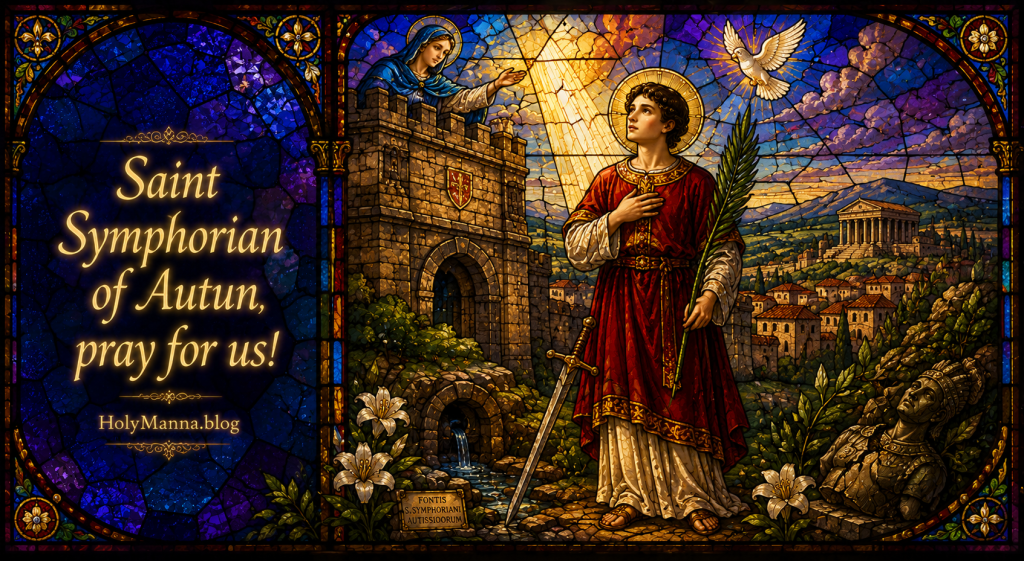
A Young Voice Against an Ancient Idol
Every August 22nd, while the universal Church celebrates the Queenship of the Blessed Virgin Mary, the Roman Martyrology also quietly remembers a young man from Roman Gaul who chose Christ over the crowd. Saint Symphorian of Autun was, by every surviving account, barely more than a boy when he was led outside the walls of his city and executed for refusing to bow to a pagan goddess. He left behind no writings, founded no order, and governed no diocese. What he left behind was something arguably harder to produce: a single, luminous act of fidelity, and a mother’s cry from the city wall that has echoed across eighteen centuries.
Symphorian is the patron saint of Autun, the ancient city in Burgundy, France, where he lived and died. In the centuries after his martyrdom, his tomb became one of the great pilgrimage sites of Gaul, his cult spread across the whole Frankish world, and his name still marks villages, parishes, and streets throughout France to this day. He was once honored as something close to a national saint of the Franks, and for a long time he was popularly called the first martyr of Gaul, an honorific that is not strictly accurate, since the martyrs of Lyon preceded him, but one that shows how deeply his story shaped the Christian imagination of an entire people.
The Catechism teaches that “Martyrdom is the supreme witness given to the truth of the faith: it means bearing witness even unto death” (CCC 2473). Symphorian’s whole legacy is that single sentence lived out in full. His story matters not because it is long, but because it is complete.
Born of Faith in a City of Temples
Symphorian was born in the second century in Augustodunum, the Roman city known today as Autun, in the region of Burgundy in eastern France. Autun was no backwater. Founded under the Emperor Augustus and named in his honor, it was a proud provincial capital, famous for its schools of rhetoric, its theaters, its temples, and its thoroughly Roman civic life. To be a Christian there, in an age when Christians in Gaul were few and largely unknown, was to stand visibly apart from nearly everything the city celebrated.
According to the tradition preserved in his ancient Passio, Symphorian came from precisely the class of people who had the most to lose by standing apart. His father, Faustus, is described as a man of senatorial rank, and the family was both noble and Christian. His mother is traditionally known as Augusta, and later generations honored her memory alongside her son’s; even her name, however, rests on the later tradition rather than on contemporary records, and the honest reader should hold it with that awareness. Symphorian was educated in Autun, and the tradition presents him as a young man of unusual purity and seriousness. Butler’s Lives of the Saints preserves the touching detail that he was so innocent that he was said to converse with the holy angels. That detail comes from pious tradition rather than documented history, and it cannot be verified.
Here a word of honesty is owed, because this blog does not trade in false confidence. The oldest surviving account of Symphorian’s life, his Passio, was written down in the early fifth century, roughly three hundred years after his death. The core facts are historically solid: a martyr named Symphorian died at Autun, his tomb was venerated from ancient times, and his cult is among the oldest in Gaul. The narrative details, the dialogue, and the dramatic scenes come down through that fifth-century text and must be received as venerable tradition rather than as a court transcript. Even the date of his death is disputed. The traditional chronology places his martyrdom on August 22nd in the year 178, during the reign of the Emperor Marcus Aurelius, only a year after the famous persecution that claimed the martyrs of Lyon in the neighboring city. The Roman Martyrology, however, records that he suffered in the time of the Emperor Aurelian, which would move his death to the 270s. The sources genuinely conflict, and no one today can resolve the question with certainty. What no source disputes is the shape of the story itself: a young Christian, an idol, a refusal, and a crown.
There was no dramatic conversion in Symphorian’s life, and that is itself worth noticing. He did not come to Christ out of a dissolute youth, as Augustine did, nor through a thunderbolt on the road, as Paul did. He received the faith at home, from believing parents, in a household where Christ was known and loved before Symphorian could even speak. The Catechism teaches that “Through the grace of the sacrament of marriage, parents receive the responsibility and privilege of evangelizing their children” (CCC 2225), and that parents are to initiate their children into the mysteries of the faith from their tenderest years, for “Parents have the mission of teaching their children to pray and to discover their vocation as children of God” (CCC 2226). Faustus and Augusta did exactly that, and everything that follows in this story is the fruit of it.
A Witness Formed Before the Trial
It is tempting to think of martyrdom as a single heroic moment, a flash of courage summoned out of nowhere. The tradition of Symphorian teaches the opposite. The young man who stood firm before a Roman governor had been formed, prayer by prayer and day by day, long before the procession ever turned down his street. His courage was not improvised. It was inherited, cultivated, and practiced in a thousand small fidelities that no chronicler bothered to record.
No miracles are recorded of Symphorian during his lifetime, and this blog will not invent any. His witness during life was of a quieter kind, the kind the Church says is asked of every baptized person. The Catechism teaches that “The duty of Christians to take part in the life of the Church impels them to act as witnesses of the Gospel and of the obligations that flow from it. This witness is a transmission of the faith in words and deeds” (CCC 2472). Before Symphorian ever confessed Christ with his neck under the sword, he confessed Christ with his ordinary life, in a city where doing so made him a marked man.
Why should a reader in the twenty-first century remember a teenager from second-century Gaul? Because Symphorian’s situation is quietly becoming familiar again. He lived as a serious believer in a sophisticated, prosperous, pluralistic society that tolerated nearly everything except a refusal to join its public worship. The gods of Autun demanded very little: a gesture, a nod, a moment of outward conformity as the procession passed. Everyone around him understood that the demand was small. That was exactly the trap. The Catechism is unsparing on this point: “Idolatry not only refers to false pagan worship. It remains a constant temptation to faith. Idolatry consists in divinizing what is not God” (CCC 2113). Symphorian understood, with the clarity that sometimes belongs especially to the young, that a small act of worship offered to a false god is not a small thing at all.
The Road Outside the Walls
The tradition preserved in the Passio tells the story this way. On a festival day in Autun, a great procession moved through the streets in honor of the goddess Cybele, the eastern mother-goddess whom the Gauls called Berecynthia, whose image was carried in state while the whole city offered its reverence. Butler’s later retelling names the goddess as Ceres instead, a discrepancy among the sources worth noting, but the older tradition names Cybele. As the idol passed, one young man in the crowd did not bow, did not salute, and did not pretend.
He was seized at once and dragged before Heraclius, the provincial governor, accused of sacrilege and sedition. Asked to identify himself, the young man gave the answer that the Passio has made famous, an answer echoed by martyrs across the centuries: “My name is Symphorian; I am a Christian.” The governor, knowing that Christians in Autun were few and obscure, could hardly believe the youth was serious. He had the imperial laws commanding pagan worship read aloud and waited for the boy to come to his senses. Symphorian answered that he must obey the laws of the King of kings, and then, according to the tradition, he went considerably further: “Give me a hammer, and I will break your idol in pieces.” These words come down through the fifth-century Passio as preserved in Butler’s Lives of the Saints, and while they cannot be verified as a verbatim transcript, they have carried the fire of his witness for fifteen centuries.
For this he was scourged and thrown into prison. Because he came from a noble family, Heraclius made a final attempt at persuasion rather than proceeding straight to execution, offering the young man advancement and favor if he would simply conform. It was the same bargain the world always offers, comfort in exchange for a small betrayal, and Symphorian refused it. Days later he was brought out of the dungeon, worn and haggard from his imprisonment, still unshaken, and was condemned to death. The dominant tradition holds that he was beheaded outside the city walls, though at least one strand of the tradition describes him being beaten to death; the beheading is the account the Church’s memory has preserved most firmly.
Then comes the moment for which Symphorian is remembered above all else, and it does not belong to him. As the soldiers led him along the road out of the city, his mother climbed the ramparts to see her son one last time. She did not wail, and she did not beg the governor for mercy. Instead, according to the tradition preserved in the Passio and handed down through Butler, she called down to him: “My son, my son, Symphorian: remember the living God, and be of good courage. Raise your heart to Heaven, and consider him that reigns there. Fear not death which leads to eternal life.” With those words ringing in his ears, the young man went to his death.
Here history preserves an astonishing gift. The oldest manuscripts of the Passio do not record the mother’s cry in polished Latin. They preserve it in the vernacular speech of Gaul, introduced with the note that she spoke “uoce Gallica”, in the Gaulish tongue: “Nate, nate Symphoriane, mentobeto to diuo”, which means, “Son, son, O Symphorian, remember your God.” Scholars still debate whether the sentence represents late Gaulish or the very earliest ancestor of French, and later medieval copyists, no longer understanding it, smoothed it into Latin. Either way, it stands among the oldest recorded sentences of the common speech of ancient France, and it is not a tax record or a curse tablet. It is a Christian mother telling her son to hold on to God. The earliest surviving whisper of that language is the sound of the faith being handed from one generation to the next.
The significance of the martyrdom itself is best stated by the Church. The Catechism teaches that the martyr “bears witness to Christ who died and rose, to whom he is united by charity. He bears witness to the truth of the faith and of Christian doctrine. He endures death through an act of fortitude” (CCC 2473). It adds that “The Church has painstakingly collected the records of those who persevered to the end in witnessing to their faith. These are the acts of the Martyrs. They form the archives of truth written in letters of blood” (CCC 2474). The Passio of Symphorian, for all the historical caution it demands, belongs to those archives.
A Tomb by the Fountain
According to the tradition, after the execution a devout person carried Symphorian’s body away and buried it in a cave near a fountain outside Autun. The grave did not stay hidden. The tradition holds that the tomb soon became famous for miracles, drawing the faithful of the region to pray there, and while the individual healings and favors of those early centuries were not recorded in detail that survives, the verdict of the ancient Church was unambiguous: this was a place where God answered prayer. That general tradition of miracles at the tomb, though impossible to verify in its particulars today, is precisely what built everything that followed.
In the middle of the fifth century, a priest named Euphronius, who would later become Bishop of Autun, built a handsome church over the grave. A monastery grew up beside it, the great Abbey of Saint-Symphorian of Autun, which endured for well over a thousand years and belonged in its final era to the Congregation of Sainte-Geneviève, from 1656 until the French Revolution suppressed it in 1791. One of the abbey’s early abbots, Germanus, went on to become Bishop of Paris; he is known to history as Saint Germain of Paris, one of the towering figures of the sixth-century Church in Gaul, and he dedicated a chapel to Symphorian in his new city. When a future saint of that stature carries your devotion to the capital, your cult has arrived.
And arrive it did. Symphorian’s veneration spread at an early date throughout the empire of the Franks. It became especially popular at Tours, the city of Saint Martin, and Saint Gregory of Tours, the great sixth-century bishop and historian, relates a miracle wrought through Symphorian’s intercession. The details of that miracle account survive in Gregory’s writings rather than in the popular tradition, but the fact of it reveals something important: within four centuries of his death, one of the most careful Christian writers of the age considered Symphorian a proven intercessor. In the Merovingian era, the young martyr of Autun was honored as something like a national saint, in the manner of Saint Denis of Paris. This is the communion of saints working exactly as the Church describes it, for the Catechism teaches that the saints “do not cease to intercede with the Father for us, as they proffer the merits which they acquired on earth through the one mediator between God and men, Christ Jesus” (CCC 956).
The cultural footprint remains visible today. Across France and into Belgium, villages, parishes, and streets named Saint-Symphorien preserve his memory in the ordinary geography of daily life, so that French children still grow up saying his name without knowing they are pronouncing a martyrology. His feast stood on the universal Roman calendar, shared with the martyrs Timothy and Hippolytus, from at least the Tridentine calendar of 1568 until the calendar reform of 1969, and he remains in the Roman Martyrology on August 22nd to this day. In the nineteenth century his story received one of its most famous artistic monuments: the painter Jean-Auguste-Dominique Ingres labored for years over his monumental canvas The Martyrdom of Saint Symphorian, completed in 1834 for the cathedral of Autun, a work that provoked such a storm of divided criticism at the Paris Salon that Ingres renounced the Salon altogether. The painting shows the young saint on the road to execution, his eyes lifted, while his mother leans from the wall above him with her arm outstretched. The artist understood what the Church has always understood: the mother on the wall is not a detail of the story. She is half of it.
When the Church venerates a saint like Symphorian, she is doing far more than preserving folklore. The Catechism teaches that “By canonizing some of the faithful, i.e., by solemnly proclaiming that they practiced heroic virtue and lived in fidelity to God’s grace, the Church recognizes the power of the Spirit of holiness within her and sustains the hope of believers by proposing the saints to them as models and intercessors” (CCC 828). Symphorian was never formally canonized in the modern sense; his cult, like that of the other early martyrs, arose from the acclamation of the ancient Church and was confirmed by centuries of liturgical veneration. He belongs to that first generation of saints whose holiness was recognized not by a tribunal but by the instinct of a praying people.
Standing Still When the Crowd Moves
What does a second-century teenager from Burgundy have to say to a reader scrolling on a phone in 2026? More than almost anyone else on the calendar this month.
Symphorian’s test did not look like a test. It looked like a parade. Nobody asked him to renounce Christ in so many words; the crowd simply expected him to do what everyone does, honor what everyone honors, and keep any private convictions politely invisible. His martyrdom began not with a sword but with a social expectation. That is precisely the shape that pressure on faith takes today. Few people will ever be dragged before a governor, but nearly everyone will face the moment when the procession passes, when the room expects a nod of agreement with something a Christian cannot agree with, and when going along would cost nothing but a sliver of the soul. When the procession passes through your life, what do you do with your head? The Catechism leaves no room for a purely private faith: “The duty of Christians to take part in the life of the Church impels them to act as witnesses of the Gospel” (CCC 2472), and it warns that idolatry “remains a constant temptation to faith” (CCC 2113). The idols of the modern procession are not carved from wood; they are carved from status, comfort, approval, and fear.
Then there is Augusta, and honestly, she may be the more urgent lesson. She had one moment left with her son, and she spent it on his eternity rather than on her own grief. Her cry from the wall is what handing on the faith actually looks like when the stakes are highest, and it only worked because she had been saying quieter versions of the same thing for his entire life. A single sentence at the city wall carries eighteen years of bedtime prayers inside it. Parents, godparents, grandparents, and mentors should take this to heart. The Catechism teaches that the family is the domestic church where “parents receive the responsibility and privilege of evangelizing their children” (CCC 2225). Who stood on the wall for you, and whose wall are you standing on now?
There are practical ways to weave Symphorian’s witness into an ordinary week. A believer can identify one setting, at work, online, or among friends, where faith is usually kept invisible, and resolve to let it be quietly visible there, without aggression and without apology. A parent can steal thirty seconds at bedtime to say to a child some version of Augusta’s words, reminding them to remember the living God and to fear nothing that leads to eternal life. Anyone can adopt the practice of the brief interior refusal, a silent act of loyalty to Christ made in the very moment when the crowd bows to something unworthy. And everyone can ask Symphorian’s intercession for young people, since he proves that sanctity does not wait for gray hair. What would it change in your Monday if you truly believed that death leads to life?
Engage With Us!
The story of Saint Symphorian belongs to the whole family of faith, so share your thoughts, your questions, and your reflections in the comments below. Whether this is the first time hearing his name or he has been a companion for years, someone else in this community will be strengthened by what you have to say. To help the conversation begin, here are some questions to pray with this week.
- Symphorian’s test arrived disguised as an ordinary social expectation. Where in your daily life does the “procession” pass by, and what would quiet fidelity to Christ look like in that moment?
- His mother used her final seconds with her son to point him toward Heaven. Who has stood on the wall for you in your life, and have you ever thanked God for them by name?
- Symphorian refused an offer of comfort and advancement in exchange for a small compromise. Is there any place in your life right now where you are being offered that same trade?
- He was young, unknown, and unimportant by every worldly measure, yet the Church still speaks his name eighteen centuries later. What does his story teach you about the value of a single hidden act of faithfulness?
- Augusta told her son to fear not death which leads to eternal life. How would your choices this week change if that truth sat at the front of your mind?
Saint Symphorian was not given a long life, a great platform, or an easy road; he was given one moment, and he gave that moment entirely to God. The same God who steadied a young man on the road outside Autun is present in every small crossroads of an ordinary Tuesday. So live this week with your heart raised to Heaven, remember the living God in the moments when remembering costs something, and do everything, the brave things and the hidden things alike, with the love and mercy that Jesus taught us.
Saint Symphorian of Autun, pray for us!
Follow us on YouTube, TikTok, Instagram and Facebook for more insights and reflections on living a faith-filled life.

 Holy Manna!
Leave a comment