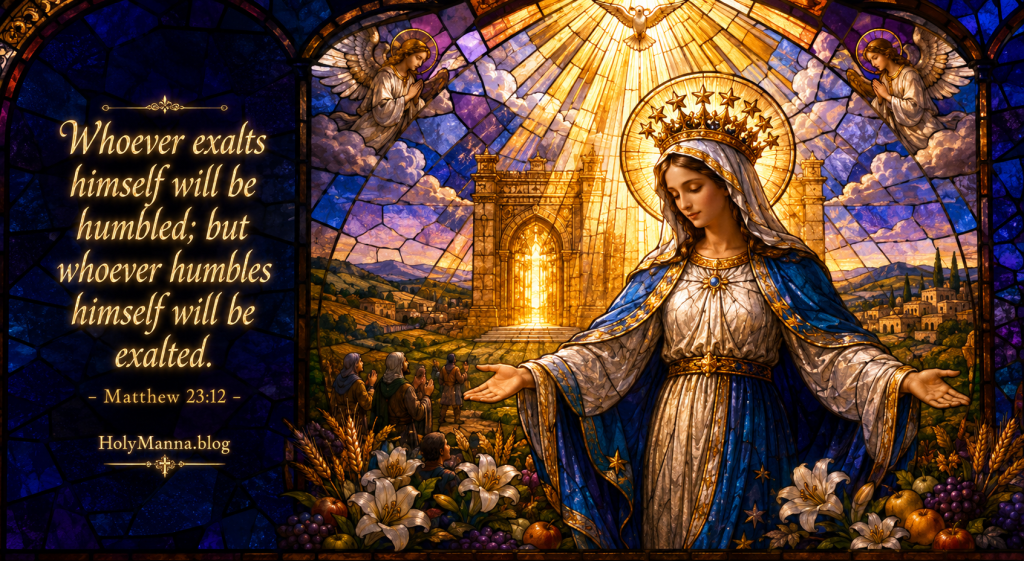
Memorial of the Queenship of the Blessed Virgin Mary – Lectionary: 424
When the King Brings a Crown for His Mother
Everyone knows the feeling of waiting for someone to come home. The porch light stays on, the door stays unlocked, and the heart stays restless until the sound of familiar footsteps finally arrives. Today, on the Memorial of the Queenship of the Blessed Virgin Mary, the Church hands us readings about the greatest homecoming ever promised: God returning to dwell among His people. The prophet Ezekiel, exiled in Babylon and haunted by the memory of God’s glory abandoning the temple, is given a vision of that same glory thundering back through the east gate with a promise to stay forever. The psalmist sings that the glory of the Lord will dwell in our land, that kindness and truth will meet, and that justice and peace will kiss. Then Jesus, teaching in the temple courts during His final week, reveals the surprising rule of the household God is building: “Whoever exalts himself will be humbled; but whoever humbles himself will be exalted.”
This memorial, celebrated exactly one week after the Assumption, exists because of that rule. Venerable Pope Pius XII established the feast in 1954 with the encyclical Ad Caeli Reginam, and Pope Saint Paul VI later placed it on August 22 to crown the octave of the Assumption. The girl from Nazareth who called herself the handmaid of the Lord became the living temple where the glory of God dwelt for nine months, the land where truth sprang from the earth. Because she took the lowest place, God gave her the highest one. Every reading today points to the same stunning truth: God does not rent space in the proud. He builds His palace in the humble, and He crowns the ones who never asked for a throne.
First Reading — Ezekiel 43:1-7ab
The Glory Comes Back Through the East Gate
To feel the weight of this passage, a reader has to know what Ezekiel had already seen. Ezekiel was a priest carried off to Babylon in 597 BC, and in the early chapters of his book he received the most heartbreaking vision in the Old Testament: the glory of the LORD, the visible cloud of God’s presence that had filled the temple since Solomon, rising up and departing through the east gate before Jerusalem’s destruction. God’s people had driven Him out of His own house through idolatry and injustice. Then, in the twenty fifth year of exile, around 573 BC, God gave His prophet a new vision of a restored temple, measured wall by wall and gate by gate across chapters 40 through 42. Today’s reading is the moment the entire vision was building toward. The glory comes home, and it comes home through the very gate it left. On a Marian memorial, the Church invites us to see in this returning glory a preview of the Incarnation, when God took up His dwelling not in a building of stone but in the womb of a humble virgin.
Ezekiel 43:1-7ab
The angel led me to the gate which faces the east,
and there I saw the glory of the God of Israel
coming from the east.
I heard a sound like the roaring of many waters,
and the earth shone with his glory.
The vision was like that which I had seen
when he came to destroy the city,
and like that which I had seen by the river Chebar.
I fell prone as the glory of the LORD entered the temple
by way of the gate which faces the east,
but spirit lifted me up and brought me to the inner court.
And I saw that the temple was filled with the glory of the LORD.
Then I heard someone speaking to me from the temple,
while the man stood beside me.
The voice said to me:
Son of man, this is where my throne shall be,
this is where I will set the soles of my feet;
here I will dwell among the children of Israel forever.
Detailed Exegesis
Verse 1: “The angel led me to the gate which faces the east, and there I saw the glory of the God of Israel coming from the east.” The east gate is not a random detail. It is the gate of the rising sun and, more importantly, the gate through which the glory departed in Ezekiel 11:23. God reverses His exit step by step. Grace retraces the path of loss.
Verse 2: “I heard a sound like the roaring of many waters, and the earth shone with his glory.” The glory does not tiptoe back. It arrives with the overwhelming sound of a flood and light that fills the whole earth. Saint John borrows this exact image for the voice of the risen Christ in Revelation 1:15, quietly telling us who this returning glory truly is.
Verse 3: “The vision was like that which I had seen when he came to destroy the city, and like that which I had seen by the river Chebar.” Ezekiel recognizes the glory because he has met it twice before, at his call by the river Chebar in Ezekiel 1 and at the temple’s abandonment. The same God who judges is the God who restores. His justice and His mercy are not two different faces.
Verse 4: “I fell prone as the glory of the LORD entered the temple by way of the gate which faces the east.” The only proper posture before the glory of God is worship flat on the ground. Ezekiel does not negotiate or narrate. He falls. Later tradition attached deep meaning to this east gate, because in the verses that immediately follow today’s passage, in Ezekiel 44:1-2, God declares that this gate shall remain shut since the LORD has entered by it. The Fathers of the Church, in both East and West, read that shut gate as a symbol of Mary, the one through whom God alone entered the world and who remained ever virgin. This is a tradition of interpretation held with remarkable unanimity across centuries.
Verse 5: “But spirit lifted me up and brought me to the inner court. And I saw that the temple was filled with the glory of the LORD.” Ezekiel cannot bring himself into God’s presence. The spirit must lift him. Every approach to God begins with God’s own initiative, which is precisely how the Church describes grace.
Verse 6: “Then I heard someone speaking to me from the temple, while the man stood beside me.” The glory is not an impersonal light show. It speaks. The God of Israel is a God who addresses His people personally, by name, from within His dwelling.
Verse 7ab: “Son of man, this is where my throne shall be, this is where I will set the soles of my feet; here I will dwell among the children of Israel forever.” Here is the promise the whole vision exists to deliver. Throne, feet, dwelling, forever. God does not want a vacation home among His people. He wants a permanent residence. Saint John announces the fulfillment in John 1:14, where the Word became flesh and made His dwelling among us, and the flesh He took was given to Him by Mary.
Teachings
The Catechism teaches that this longing of God to dwell with humanity reaches its goal in Christ. CCC 593 states plainly, “Jesus venerated the Temple by going up to it for the Jewish feasts of pilgrimage, and with a jealous love he loved this dwelling of God among men. The Temple prefigures his own mystery. When he announces its destruction, it is as a manifestation of his own execution and of the entry into a new age in the history of salvation, in which his Body would be the definitive Temple.” The temple of stone was always a rehearsal for the temple of flesh. Saint Gregory the Great, a Doctor of the Church, devoted an entire series of homilies to Ezekiel’s temple vision, teaching that the restored temple signifies the Church and the faithful soul in which God chooses to dwell. On today’s memorial, the Church applies this dwelling theme to Mary in a singular way. Venerable Pope Pius XII opened Ad Caeli Reginam with these words: “From the earliest ages of the Catholic Church a Christian people, whether in time of triumph or more especially in time of crisis, has addressed prayers of petition and hymns of praise and veneration to the Queen of Heaven.” The one in whom the glory dwelt bodily now reigns beside that glory eternally.
Reflection
Ezekiel’s vision asks each believer a piercing question about occupancy. God announces where His throne shall be, and since Baptism, that address includes the human heart. Yet hearts, like temples, can crowd out the glory with idols that seem harmless until the light grows dim. A practical way to live this reading is to perform a nightly examination of the interior temple, asking what occupied the throne today: a grudge, a screen, an ambition, or the Lord Himself. Another concrete step is to spend fifteen minutes this week before the tabernacle, where the glory of the Lord dwells in the Eucharist, simply keeping Him company as Ezekiel stood in the inner court. When the glory of God looks for a permanent dwelling in your life, does He find the east gate open? What would need to leave your inner temple for His presence to fill it completely?
Responsorial Psalm — Psalm 85:9-14
The Song of a Land Where Glory Dwells
Psalm 85 was born from disappointment. The exiles had returned from Babylon, but the homecoming looked nothing like the glowing prophecies. The land was poor, the temple unfinished, the neighbors hostile. So the community prayed a psalm that begins in lament and ends, in the verses the Church sings today, with one of the most beautiful bursts of hope in the entire Psalter. The psalmist chooses to listen for what God proclaims rather than rehearse what Israel lacks, and what God proclaims is peace, salvation near at hand, and glory dwelling in the land. The Fathers of the Church heard in these verses a prophecy of Christmas morning, and on this memorial the Church hears something more intimate still. Before glory dwelt in our land, it dwelt in our Lady.
Psalm 85:9-14
R. (see 10b) The glory of the Lord will dwell in our land.
I will hear what God proclaims;
the LORD–for he proclaims peace.
Near indeed is his salvation to those who fear him,
glory dwelling in our land.
R. The glory of the Lord will dwell in our land.
Kindness and truth shall meet;
justice and peace shall kiss.
Truth shall spring out of the earth,
and justice shall look down from heaven.
R. The glory of the Lord will dwell in our land.
The LORD himself will give his benefits;
our land shall yield its increase.
Justice shall walk before him,
and salvation, along the way of his steps.
R. The glory of the Lord will dwell in our land.
Detailed Exegesis
Verse 9: “I will hear what God proclaims; the LORD, for he proclaims peace.” The psalmist’s first act is not speaking but listening. Faith begins in receptive silence, the very posture Mary models in Luke 2:19 when she keeps all these things in her heart.
Verse 10: “Near indeed is his salvation to those who fear him, glory dwelling in our land.” Salvation is not a distant policy but a nearness, and the sign of that nearness is glory taking up residence. This is Ezekiel’s promise compressed into a single line of song, and the refrain the Church repeats today.
Verse 11: “Kindness and truth shall meet; justice and peace shall kiss.” Four great attributes of God, seemingly in tension, embrace like reunited friends. Mercy does not cancel truth, and justice does not exclude peace. Only in God’s saving plan, and finally in the Cross, do all four hold together without compromise.
Verse 12: “Truth shall spring out of the earth, and justice shall look down from heaven.” Saint Augustine, in his Christmas Sermon 185, still prayed by the Church in the Liturgy of the Hours, applied this verse directly to the Nativity, teaching, “Truth has sprung from the earth: Christ who said, I am the Truth, was born of a Virgin.” The earth from which Truth sprang, in Augustine’s reading, is the Virgin Mary herself.
Verse 13: “The LORD himself will give his benefits; our land shall yield its increase.” Grace comes first, fruitfulness follows. The land does not produce the harvest and then earn God’s favor. God gives, and the giving makes the land fruitful, exactly as grace made the Virgin fruitful beyond nature.
Verse 14: “Justice shall walk before him, and salvation, along the way of his steps.” The psalm ends with God on the move, justice as His herald and salvation as His footprints. Wherever this King walks, the ground itself is changed.
Teachings
The Catechism sees in Mary the place where the psalm’s promises landed. CCC 721 teaches, “Mary, the all-holy ever-virgin Mother of God, is the masterwork of the mission of the Son and the Spirit in the fullness of time. For the first time in the plan of salvation and because his Spirit had prepared her, the Father found the dwelling place where his Son and his Spirit could dwell among men.” The psalmist longed for glory dwelling in our land, and the Father answered by preparing a dwelling in a daughter of that land. Venerable Pope Pius XII drew out the royal consequence in Ad Caeli Reginam, teaching that the faithful have always believed “that Mary, the Virgin Mother of God, reigns with a mother’s solicitude over the entire world, just as she is crowned in heavenly blessedness with the glory of a Queen.” Her crown is not a reward she seized but the fruit of glory having dwelt in her first. The kindness and truth that met in her womb now meet in her queenship, where royal power and maternal tenderness are the same thing.
Reflection
This psalm trains believers to hope in the gap between promise and experience. The returned exiles saw rubble and sang about glory, and their song proved more accurate than their circumstances. A concrete way to live this psalm is to begin each morning this week with the psalmist’s opening move, praying the words I will hear what God proclaims before checking any headline or notification, letting God’s voice set the day’s tone. Another step is to become a meeting place in miniature, choosing one relationship where kindness and truth need to meet, and speaking a hard truth with genuine gentleness or offering genuine gentleness without abandoning the truth. Where in your life does the promise of God seem contradicted by what you can see, and can you keep singing anyway? What would it look like for justice and peace to kiss in your home this week?
Holy Gospel — Matthew 23:1-12
The Kingdom Where the Servant Wears the Crown
It is Holy Week in Jerusalem, and Jesus is teaching in the temple courts for the last time. The crowds are thick, the authorities are circling, and the Cross is days away. In that charged atmosphere, Jesus delivers a teaching that distinguishes with surgical precision between office and example. The scribes and Pharisees sit on the chair of Moses, a real seat of teaching authority in the synagogue, and Jesus tells the crowd to observe what that office legitimately teaches. Then He forbids them to imitate the men who hold it, because they preach without practicing, burden without helping, and perform without loving. The whole passage builds toward a single law of gravity in the Kingdom of God: the way up is down. On the memorial of Mary’s Queenship, the Church could not have chosen a sharper Gospel, because Mary is the one human person who never once climbed, and she is the one whom God raised highest.
Matthew 23:1-12
Jesus spoke to the crowds and to his disciples, saying,
“The scribes and the Pharisees
have taken their seat on the chair of Moses.
Therefore, do and observe all things whatsoever they tell you,
but do not follow their example.
For they preach but they do not practice.
They tie up heavy burdens hard to carry
and lay them on people’s shoulders,
but they will not lift a finger to move them.
All their works are performed to be seen.
They widen their phylacteries and lengthen their tassels.
They love places of honor at banquets, seats of honor in synagogues,
greetings in marketplaces, and the salutation ‘Rabbi.’
As for you, do not be called ‘Rabbi.’
You have but one teacher, and you are all brothers.
Call no one on earth your father;
you have but one Father in heaven.
Do not be called ‘Master’;
you have but one master, the Christ.
The greatest among you must be your servant.
Whoever exalts himself will be humbled;
but whoever humbles himself will be exalted.”
Detailed Exegesis
Verses 1 and 2: “Jesus spoke to the crowds and to his disciples, saying, ‘The scribes and the Pharisees have taken their seat on the chair of Moses.’” The chair of Moses represented authoritative teaching succession. Jesus acknowledges the office as real, a striking affirmation that legitimate religious authority can exist even when its holders fail.
Verse 3: “Therefore, do and observe all things whatsoever they tell you, but do not follow their example. For they preach but they do not practice.” Jesus separates the teaching from the teacher. The truth of doctrine does not depend on the virtue of the one proclaiming it, a principle the Church would later defend against the Donatists, who claimed sacraments from sinful ministers were invalid.
Verse 4: “They tie up heavy burdens hard to carry and lay them on people’s shoulders, but they will not lift a finger to move them.” Religion twisted by pride adds weight; religion in the hands of Jesus lifts it. He says in Matthew 11:30 that His yoke is easy and His burden light. The difference is love.
Verse 5: “All their works are performed to be seen. They widen their phylacteries and lengthen their tassels.” Phylacteries were small boxes containing Scripture, worn in obedience to Deuteronomy 6:8, and tassels were commanded in Numbers 15:38. The practices were holy. The enlargement was advertising. Piety became costume.
Verses 6 and 7: “They love places of honor at banquets, seats of honor in synagogues, greetings in marketplaces, and the salutation ‘Rabbi.’” The verb love is the indictment. The seats and greetings were not sinful in themselves; the hunger for them was. What a heart loves reveals whom it worships.
Verse 8: “As for you, do not be called ‘Rabbi.’ You have but one teacher, and you are all brothers.” Among disciples, no one owns the truth; all receive it from the same Teacher. Every human teaching in the Church is stewardship, never possession.
Verse 9: “Call no one on earth your father; you have but one Father in heaven.” The Church has never read this as banning a word, since Saint Paul tells the Corinthians in 1 Corinthians 4:15 that he became their father in Christ Jesus through the Gospel. Jesus condemns the craving to be a source and center that belongs to God alone. All true fatherhood, natural and spiritual, is borrowed light.
Verse 10: “Do not be called ‘Master’; you have but one master, the Christ.” Christ names Himself the one Master days before He kneels to wash feet. The title and the towel belong to the same Person, which is the entire point.
Verse 11: “The greatest among you must be your servant.” Greatness is not abolished in the Kingdom; it is redefined. The ladder still exists, but it is climbed downward, toward the towel, the basin, and the hidden act of love.
Verse 12: “Whoever exalts himself will be humbled; but whoever humbles himself will be exalted.” This is the sentence today’s memorial exists to celebrate. It is the law Mary sang in Luke 1:52, that God casts down the mighty from their thrones and lifts up the lowly, and it is the law God applied to Mary herself.
Teachings
The Catechism places this Gospel’s final verse at the very foundation of the spiritual life. CCC 2559 teaches, “Prayer is the raising of one’s mind and heart to God or the requesting of good things from God. But when we pray, do we speak from the height of our pride and will, or ‘out of the depths’ of a humble and contrite heart? He who humbles himself will be exalted; humility is the foundation of prayer.” The Church also speaks honestly about the failures Jesus condemned, acknowledging in CCC 1550 that the presence of Christ in ordained ministers does not preserve them from human weakness or sin, which is why Christ’s instruction to honor the office while imitating only holiness remains permanently relevant. The Queenship of Mary is heaven’s public demonstration of verse 12. CCC 966, quoting the Second Vatican Council in Lumen Gentium 59, teaches, “Finally the Immaculate Virgin, preserved free from all stain of original sin, when the course of her earthly life was finished, was taken up body and soul into heavenly glory, and exalted by the Lord as Queen over all things, so that she might be the more fully conformed to her Son, the Lord of lords and conqueror of sin and death.” And Venerable Pope Pius XII, in Ad Caeli Reginam, described what kind of queen the humble handmaid became: “Let all Christians, therefore, glory in being subjects of the Virgin Mother of God, who, while wielding royal power, is on fire with a mother’s love.”
Reflection
This Gospel reads hearts uncomfortably well in an age of platforms and profiles, where widening phylacteries has never been easier. The examination it invites is simple and searching: how much of today’s goodness would survive if no one ever saw it? A concrete practice is to perform one deliberate act of service this week that cannot be discovered, whether an anonymous gift, a hidden chore, or a prayer for someone who will never know. Another is to fast from self-reference in one conversation each day, asking questions and giving honor rather than collecting it. Praying a decade of the Rosary while meditating on the Coronation of Mary connects the practice to the memorial, letting the Queen who never sought a crown teach the heart to stop seeking one. Which places of honor do you quietly love, and what would it cost you to give one up? If God exalts the humble, what is one hidden act of service you can offer Him before Sunday?
The Crown That Waits at the Bottom of the Ladder
Step back and watch how today’s readings tell one story. Ezekiel, face down in the dust of a vision, watches the glory of God roar back through the east gate with a promise to dwell among His people forever. The psalmist, standing in a disappointing land, sings that the glory will dwell there anyway, that kindness and truth will meet, and that truth will spring from the very earth. Then Jesus, days from the Cross, hands His disciples the key to the whole Kingdom: “Whoever humbles himself will be exalted.” God is looking for a dwelling, and He moves into the lowly.
Mary is the proof that every word of it is true. The glory that filled Ezekiel’s temple filled her womb. The truth that sprang from the earth sprang from her flesh. The handmaid who claimed the lowest place in Israel now wears the highest crown in heaven, not because she reached for it, but because her Son keeps His own promise. Her Queenship, celebrated today, is not a fairy tale ending pasted onto the Gospel. It is the Gospel, displayed in a single human life brought to completion.
The invitation is wonderfully practical. Open the east gate of the heart in prayer and let the glory come home. Sing the psalm of hope over whatever rubble life currently offers. Take the lowest seat on purpose, serve where no one is watching, and trust the law of the Kingdom to do its slow, certain work. The Queen of Heaven is not a distant monarch but a mother with a mother’s heart, and she is praying for every soul that dares to climb downward toward her Son. Ask her today for one gift above all: her humility. The crown takes care of itself.
Engage With Us!
Readers are warmly invited to share their reflections in the comments below, because every story of grace encourages the whole community, and someone may need exactly the insight God has given another this very day.
- In Ezekiel 43:1-7ab, the glory of the LORD returns through the same east gate by which it once departed. Is there an area of your life where God’s presence once departed, and what would it mean to open that gate to Him again?
- In Psalm 85:9-14, the psalmist chooses to hear what God proclaims and sings of glory dwelling in a struggling land. Where do you need to keep singing God’s promises over circumstances that seem to contradict them?
- In Matthew 23:1-12, Jesus teaches that the greatest must be the servant and that whoever humbles himself will be exalted. What is one place of honor you secretly love, and what hidden act of service could you offer this week instead?
- Considering all of today’s readings together on the Memorial of the Queenship of the Blessed Virgin Mary, how does Mary’s path from handmaid to Queen change the way you think about greatness, and what one step downward is God inviting you to take?
May every reader walk through this week with the confidence that God still seeks a dwelling in humble hearts, and may everything done in word or deed be done with the love and mercy Jesus taught us, under the gentle reign of a Queen who is, before all else, our Mother.
Sacred Heart of Jesus, we trust in You!
Immaculate Heart of Mary, pray for us!
Saint Michael the Archangel, defend us in battle!
Follow us on YouTube, TikTok, Instagram and Facebook for more insights and reflections on living a faith-filled life.


Leave a Reply