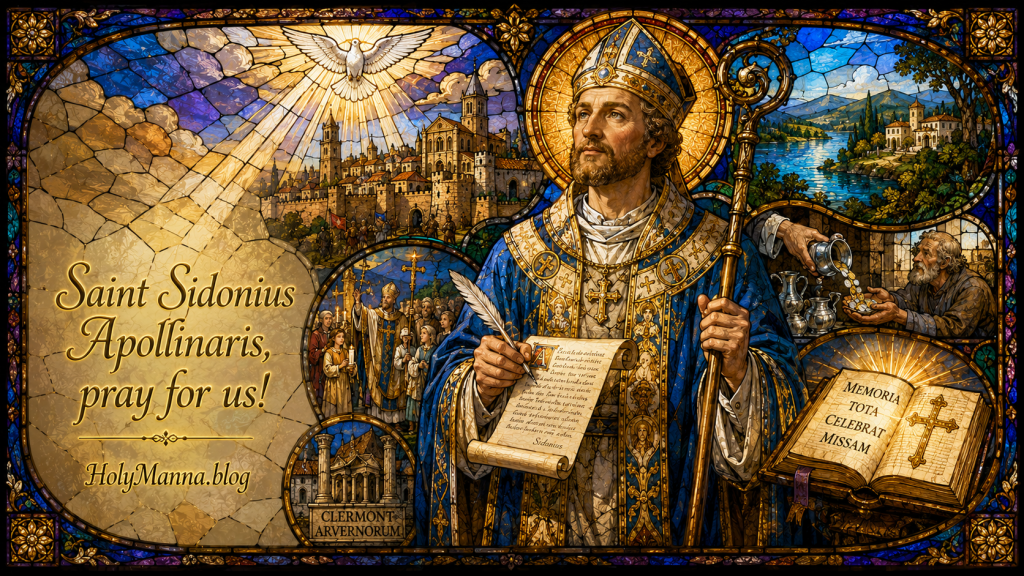
How a Poet of Empire Became a Shepherd of Souls
Some saints are born in obscurity and rise to glory. Saint Sidonius Apollinaris did the opposite, and that is exactly what makes him so compelling. He was born into everything the ancient world could offer: nobility, wealth, education, political power, literary fame, and even an emperor for a father-in-law. Then, at the height of his career, as the Western Roman Empire crumbled beneath his feet, God called him to lay all of it down and become a bishop. He answered that call so completely that within a generation his people were venerating him as a saint.
Sidonius Apollinaris, Bishop of Clermont in Gaul, is celebrated in the Roman Martyrology on August 21st. He lived from around the year 430 into the 480s, and he stands at one of the great hinges of history, the moment when Roman civilization gave way to the new barbarian kingdoms of Europe. In that chaos, when armies besieged his city and Rome itself abandoned his people, Sidonius held his flock together with prayer, courage, and astonishing personal charity. He is also, in the judgment of modern scholarship, the single most important surviving author of fifth-century Gaul, a man whose letters and poems preserve for us an irreplaceable picture of the early Church at worship and a civilization in its twilight.
The Church teaches that “By canonizing some of the faithful, i.e., by solemnly proclaiming that they practiced heroic virtue and lived in fidelity to God’s grace, the Church recognizes the power of the Spirit of holiness within her” (CCC 828). Sidonius was never formally canonized in the modern sense, because he lived a thousand years before that process existed. Instead, his sanctity was recognized the ancient way: by the acclamation of the people who knew him, by a feast kept at Clermont soon after his death, and by the enduring witness of the Roman Martyrology, which has carried his name across fifteen centuries. His life poses a question that has never stopped being relevant. When the world you have built your life on begins to fall apart, what will you hold onto?
Born Between Two Worlds
Sidonius was born on November 5th, around the year 430, in Lugdunum, the city we know today as Lyon, France. His full name was Gaius Sollius Modestus Apollinaris Sidonius, and that string of names tells you everything about his pedigree. His family belonged to the highest rank of the Gallo-Roman aristocracy. Both his father and his grandfather, each named Apollinaris, had served as Praetorian Prefect of Gaul, one of the most powerful civil offices in the Western Empire. His family was also Christian; his father and grandfather professed the faith at a time when much of the Roman elite still clung to the old paganism, and Sidonius would later write with pride of his grandfather’s baptism.
He received the finest classical education Gaul could offer, steeped in rhetoric, poetry, and the great Latin authors. Around the year 452 he married Papianilla, the daughter of a powerful senator named Avitus. It was a happy and fruitful marriage that gave them a son, also named Apollinaris, and daughters named in his letters as Severina and Roscia; the later historian Gregory of Tours also mentions a daughter called Alcima. As part of Papianilla’s dowry, Sidonius received a lovely lakeside villa called Avitacum on Lac d’Aydat in the Auvergne, a place he described tenderly in his writings and a place that would matter to his story long after his death.
Then history came knocking. In 455, his father-in-law Avitus was proclaimed Roman Emperor. On January 1st, 456, the young Sidonius delivered a formal panegyric, a grand poem of praise, before the Senate in honor of the new emperor. The performance was such a triumph that a bronze statue of Sidonius was erected in the Forum of Trajan in Rome. Imagine that for a moment: a young man in his mid-twenties, honored with a statue in the Eternal City. Avitus soon fell from power, and Sidonius, ever the survivor, went on to compose panegyrics for the emperors Majorian and Anthemius as well. In 468, Anthemius rewarded him with the office of Urban Prefect of Rome, making him effectively the chief magistrate of the ancient capital.
By any worldly measure, Sidonius had reached the summit. And this is where God intervened in the most unexpected way. Around the year 470, when the bishop’s chair of Clermont in the Auvergne fell vacant, the people chose Sidonius, a married layman and career politician, to be their bishop. Selecting a proven aristocratic leader was not unheard of in that desperate age; Saint Ambrose of Milan had been elevated in a similar way a century earlier. But for Sidonius it demanded a true conversion of life. He accepted, and he changed. He gave up writing secular poetry entirely, judging that frivolous verse no longer suited a man consecrated to God. The celebrated author of imperial panegyrics turned his pen to letters of pastoral encouragement and to the composition of prayers for the Mass. From then on he lived in continence, poured out his wealth, and belonged wholly to his people. The Church teaches that the bishop receives the fullness of the sacrament of Holy Orders and is made a true shepherd who acts in the person of Christ the Head (CCC 1557 to 1558). Sidonius took that identity seriously enough to let it remake him.
The Bishop Who Prayed From Memory
Why should you remember Sidonius Apollinaris? Because he shows what fidelity looks like when everything is collapsing, and because his charity was so concrete that it caused problems at home.
The most beloved story of his generosity comes from Saint Gregory of Tours, the great historian bishop who wrote about a century later in his Historia Francorum. Gregory tells us that Sidonius would quietly slip away with the silver vessels of his own household and give them to the poor, without telling his wife. When Papianilla discovered what had happened, she would grumble at him and then buy the silver back from the poor to restore the household, at which point, one gathers, the cycle could begin again. Gregory records that she found fault with him for parting with his plate, yet Sidonius simply could not look at hungry people while owning silver. This account comes to us through Gregory’s hagiographical history rather than through documents from Sidonius’s own hand, so it is best received as the cherished testimony of the early Church about him; it cannot be independently verified, though Gregory wrote within living memory of Clermont’s traditions. What is beyond dispute from Sidonius’s own letters is his constant, practical concern for the poor, for exiles, and for refugees displaced by the wars of his day. Our Lord’s words could have been written over the door of his house: “Do not lay up for yourselves treasures on earth, where moth and rust consume and where thieves break in and steal, but lay up for yourselves treasures in heaven… For where your treasure is, there will your heart be also” (The Gospel of Matthew, Mt 6:19 to 21). The Catechism echoes this when it teaches that love for the poor is “a part of her constant tradition” and that it is inspired by the Gospel of the Beatitudes and the example of Jesus in His poverty (CCC 2444).
Gregory of Tours also preserves a marvel that reveals both the mind and the holiness of the man. Sidonius, he tells us, could celebrate the entire Mass from memory, without a sacramentary, the book containing the prayers, and could preach beautifully without any preparation. In Gregory’s account this gift was put to the test when someone maliciously removed the liturgical book just as Sidonius was to celebrate a feast. Sidonius proceeded without hesitation, praying the whole sacred liturgy from memory with such grace that those present marveled and perceived that the bishop spoke as one filled by God. This story likewise reaches us through Gregory’s telling and stands as tradition rather than court-verified fact, and it cannot be independently verified. Yet it rings true to what we know for certain: Sidonius really did compose liturgical prayers, and Gregory himself knew a collection of Masses written by Sidonius, for which Gregory wrote a preface. The prayer of the Church had so soaked into this man that it lived in him. The Catechism reminds us that the liturgy is “the summit toward which the activity of the Church is directed” and “the font from which all her power flows” (CCC 1074). Sidonius carried that font within his own memory and heart.
His greatest work during life, however, was not literary but pastoral. From about 471 to 475, the armies of Euric, King of the Visigoths, besieged Clermont again and again, determined to swallow the Auvergne into the expanding Visigothic kingdom. Euric was not only a conqueror; he was an Arian, an adherent of the heresy that denied the full divinity of Christ, and his advance threatened the Catholic faith of the region as much as its liberty. Sidonius became the soul of the resistance. His brother-in-law Ecdicius led the fighting men, at one point performing feats of arms that became famous throughout Gaul, while Sidonius led the prayer. Drawing on the Rogation days recently instituted by Saint Mamertus, Bishop of Vienne, Sidonius had his hungry, frightened people process and fast and beg God’s mercy together. He describes this in his own letters, which survive to this day. A starving city, walls battered, harvests burned, holding on year after year with public prayer at the center of its life: that was Clermont under Bishop Sidonius. Faith, for him, was not a private consolation. It was the load-bearing wall of an entire community.
Siege, Exile, and Betrayal
Sidonius was not a martyr. He was a confessor, a saint who suffered greatly for the faith without being put to death for it, and his sufferings were heavy indeed.
The first blow was betrayal on an imperial scale. In 475, after Clermont had endured years of siege and starvation for the sake of Rome, the imperial government struck a treaty with Euric and handed the Auvergne to the Visigoths in exchange for peace elsewhere. The city that had bled to remain Roman was signed away at a negotiating table. Sidonius’s anguish survives in one of the most famous sentences he ever wrote, in a letter to Bishop Graecus of Marseilles, one of the treaty’s negotiators: “Our slavery has become the price of the security of others” (Epistulae 7.7). It is a cry every generation has recognized, the voice of a faithful man watching the powerful trade away his people. Yet notice what Sidonius did not do. He did not apostatize, he did not flee, and he did not despair. He stayed with his flock under their new Arian ruler.
The second blow was exile. Euric resented the bishop who had organized such stubborn resistance, and after the city’s surrender Sidonius was taken from Clermont and held near the fortress of Livia, close to Carcassonne. Even here his letters keep their humanity and even their humor; he complains that he could not sleep at night because of two quarrelsome old Gothic women lodged too near his room. After a time, through the good offices of Leo, a Catholic minister at Euric’s court, Sidonius was released and restored to his see, around 476 or 477. He returned to a diocese now permanently under barbarian rule and served it faithfully, revising his letters for publication and shepherding his people through the new order.
The third blow came from within his own house, and it must have hurt the most. Gregory of Tours relates that in Sidonius’s later years two priests of his own diocese rose against him, stripped him of control over the church’s affairs, and reduced their own bishop to humiliating poverty. Gregory does not give their names; the names sometimes attached to them in later writing rest on no cited ancient authority, so honesty requires leaving them unnamed. Some historians suspect the pair sympathized with the Arianism of the new rulers. Gregory recounts that one of the two conspirators died suddenly and shamefully on the very day he planned to complete the bishop’s overthrow, a death Gregory pointedly compares to the end of the heresiarch Arius, and that afterward Sidonius was restored to his rightful place. That account of divine judgment is Gregory’s story, told a century after the events, and it cannot be verified. What can be said with confidence is that Sidonius suffered real opposition and real poverty at the hands of his own clergy, and that he endured it without abandoning his post.
Then came the end, and it is one of the most beautiful death scenes in the early history of the Church in Gaul. Struck by a fever, Sidonius asked to be carried into the church of Saint Mary in Clermont. There, surrounded by his people, he spoke words of love and farewell and indicated Aprunculus, the exiled Bishop of Langres, as the man who should succeed him. Gregory of Tours records the cry that went up from the crowd around their dying shepherd: “Why do you desert us, good shepherd? To whom do you leave us, your orphans?” (Historia Francorum 2.23). It is impossible to hear that cry without thinking of the Lord’s own words: “I am the good shepherd. The good shepherd lays down his life for the sheep” (The Gospel of John, Jn 10:11). Sidonius had laid down his life for his sheep one day at a time, through siege, exile, betrayal, and poverty, and his sheep knew it. He died on an August 21st in the 480s; the sources honestly disagree on the exact year, offering dates from about 480 to 489, and a careful telling admits that uncertainty rather than papering over it.
A Voice That Still Speaks
Sidonius was venerated as a saint almost immediately. Butler’s Lives of the Saints records that his festival was kept with solemnity at Clermont soon after his death, where his memory was held in great veneration. His body was laid first in the old church of Saint Saturninus in Clermont and was later translated to the church of Saint Genesius, a translation that itself testifies to the honor his relics received. His name was inscribed in the ancient martyrology attributed to Saint Jerome, one of the oldest calendars of saints in the Western Church, and it was retained in the Roman Martyrology, where it remains today under August 21st.
His cult also flourished in a place he had loved in life. At Aydat, the site of his cherished villa Avitacum by the lake, the faithful venerated Saint Sidonius for centuries, and that local devotion remained active all the way up to the French Revolution, some thirteen hundred years after his death. There is something touching in that: the country place where a young aristocrat once wrote poetry and entertained friends became, through his sanctity, a place of prayer for generations of ordinary believers.
Unlike many early saints, Sidonius did not leave behind a catalog of recorded healing miracles at his tomb. The early sources praise his holiness, his charity, and the marvels of his life recorded by Gregory of Tours, but they do not hand down lists of posthumous cures, and it would be dishonest to invent any. One curious later tradition does attach to his name: in Provence, a much later story identified Sidonius with the man born blind whom Christ healed in the Gospels. Since Sidonius lived more than four centuries after Our Lord walked the earth, that identification is historically impossible, a confusion of names in popular devotion, and it cannot be verified; it is mentioned here only so that readers who encounter it know to set it aside.
His truest relics, in a sense, are his writings. One hundred forty-seven of his letters survive, gathered into nine books, along with twenty-four poems. Through them, historians can watch the Roman world end in real time and the medieval Christian world begin. Through them, liturgists learn how fifth-century Christians worshiped, and what their churches looked like, for Sidonius described sacred buildings and ceremonies with a poet’s eye. The Church teaches that the communion of saints means the holy ones in heaven do not cease to care for those on earth but intercede for us and share with us their witness (CCC 956 to 957). Sidonius intercedes for the Church he served, and he still teaches her through every page he left behind.
When Your World Falls Apart
What does a fifth-century Gallo-Roman bishop have to say to you, living in the twenty-first century? More than you might expect, because Sidonius lived through something everyone eventually faces: the collapse of the world he had counted on.
He had built his life on Rome, on family prestige, on literary fame, on a brilliant career. One by one, all of it failed. The empire abandoned his city. His fame could not lift a siege. His rank could not prevent his exile. Even his own priests turned on him. And at every collapse, Sidonius did not cling to the wreckage; he went deeper into Christ. He traded panegyrics for prayers, silver for the poor, and security for solidarity with his suffering people. The Catechism calls this poverty of heart, teaching that “the Lord grieves over the rich, because they find their consolation in the abundance of goods” and that abandonment to the providence of the Father frees us from anxiety (CCC 2547). Sidonius learned that freedom the hard way, and it made him a saint.
Consider your own anchors for a moment. What in your life plays the role that Rome played in his: the thing you assume will always hold, the source of your security and identity? Careers end, health falters, institutions disappoint, and even good things pass away. Sidonius’s witness is that none of this needs to be the end of the story, because the one anchor that held for him, Jesus Christ and His Church, is available to you in exactly the same way.
His life also speaks to anyone tempted to believe that faith and excellence cannot coexist. Sidonius did not become holy by becoming mediocre. He brought every gift he had, his education, his eloquence, his leadership, his connections, and placed them at the service of the Gospel. When his people needed a defender, his political skill held a city together. When they needed prayers, his literary genius composed them. What talent are you holding back from God because you have filed it under “secular”? The Catechism teaches that lay people and clergy alike are called to sanctify the world from within, like leaven, by engaging temporal affairs and ordering them according to God’s will (CCC 898 to 899, CCC 2044). Your spreadsheet, your classroom, your kitchen, and your group chat are all territory for holiness.
Finally, there is his charity, so concrete that it emptied his cupboards. It is easy to love humanity in the abstract. Sidonius loved the actual poor people in front of him, at real cost, over the objections of his own household budget. This week, let his example provoke something specific: a real donation that pinches a little, a meal for someone who cannot repay you, time given to a person the world has abandoned the way Rome abandoned Clermont. Who has been signed away at the negotiating tables of our own day, and what would it cost you to stand with them?
Engage With Us!
Saint Sidonius Apollinaris took a life built for the history books and turned it into a life built for eternity, and his story deserves to be talked about. Share your thoughts and reflections in the comments below; this community grows richer every time someone speaks up. To help the conversation along, here are some questions to pray with and to answer:
- Sidonius watched the empire he loved abandon his people, and he responded with deeper faith instead of despair. When an institution or person you trusted has failed you, how did you respond, and what would responding like Sidonius look like?
- He gave up writing secular poetry when he became a bishop, sacrificing something good for something better. Is there something good in your life that God may be asking you to set down for the sake of something greater?
- His charity was so concrete that he gave away the family silver. What is one specific, costly act of generosity you could carry out this week?
- Sidonius endured betrayal from within his own church community and stayed faithful anyway. How do you keep your eyes on Christ when fellow believers wound or disappoint you?
- His people cried out, “Why do you desert us, good shepherd?” Who looks to you as a shepherd, at home, at work, or among your friends, and how are you laying down your life for them?
Whatever is collapsing or flourishing in your life right now, remember that Saint Sidonius Apollinaris walked through the literal end of his world and came out a saint, because he held onto the one Kingdom that cannot fall. Ask for his intercession, bring your gifts to God without holding anything back, and go into this day determined to do everything, from the smallest chore to the greatest sacrifice, with the love and mercy that Jesus taught us.
Saint Sidonius Apollinaris, pray for us!
Follow us on YouTube, TikTok, Instagram and Facebook for more insights and reflections on living a faith-filled life.


Leave a Reply