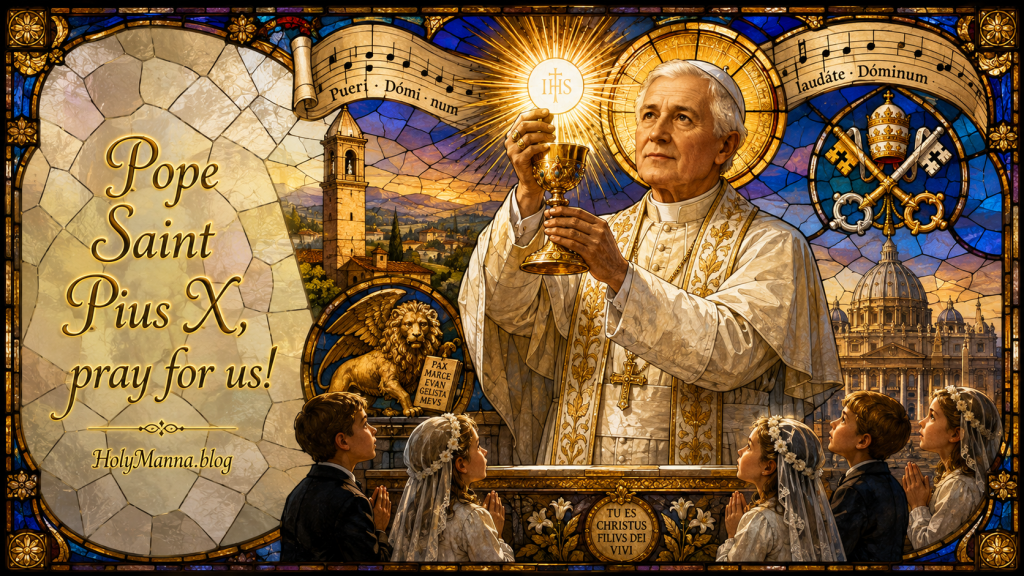
The Barefoot Boy Who Gave the Bread of Heaven Back to the World
Every so often God reaches into a forgotten village and pulls out a soul who will change the whole Church. Pope Saint Pius X, celebrated each year on August 21st, is one of those souls. Born Giuseppe Melchiorre Sarto to a poor postman and a seamstress in northern Italy, he climbed no ladder and sought no office, yet he became the Successor of Peter and one of the most consequential popes in modern history. The Church remembers him above all as the Pope of the Eucharist, the shepherd who flung open the doors of the tabernacle and invited everyone, including small children, to receive Jesus in Holy Communion often. The Catechism teaches that the Eucharist is “the source and summit of the Christian life” (CCC 1324), and no pope of the modern era did more to place that truth at the center of ordinary Catholic living. He restored Gregorian chant to the Church’s worship, mandated catechism classes in every parish, began the codification of canon law, and stood like a wall against the theological confusion of his age. His papal motto, drawn from Ephesians 1:10, said everything about him: Instaurare Omnia in Christo, to restore all things in Christ. He is the patron saint of first communicants and of pilgrims, and every child who receives First Holy Communion around the age of seven owes that gift, humanly speaking, to him. He was never a martyr; he was a confessor, a man who bore witness to Christ through a long life of labor, humility, and sorrow. His story is proof that sanctity does not require spectacle. It requires love, and Pius X loved greatly.
Barefoot on the Road to Castelfranco
Giuseppe Sarto was born on June 2, 1835, in Riese, a small farming village in the Veneto region of northern Italy, which at that time lay under Austrian rule as part of the Kingdom of Lombardy-Venetia. He was the second of ten children born to Giovanni Battista Sarto, the village cursore, a municipal messenger and postman, and Margherita Sanson, a seamstress who took in work to help feed the family. The Sartos were poor in the plainest sense of the word. They were also profoundly Catholic, and the faith young Giuseppe learned at his mother’s knee never left him. The most beloved account from his childhood tells that he walked several miles each day to school in the town of Castelfranco Veneto, often barefoot, carrying his shoes slung over his shoulder so the leather would not wear out before he arrived. This account comes down through family and local testimony gathered by his Catholic biographers rather than through official documents, so it is best received as a well attested story of his youth; it cannot be verified in the strict documentary sense. What is beyond question is the poverty it describes and the determination it reveals.
His talent and his piety caught the attention of his parish priest, and through the help of the Patriarch of Venice, Jacopo Monico, himself a son of little Riese, Giuseppe received a scholarship to the seminary of Padua. There he excelled in his studies while never losing the plain manners of a village boy. On September 18, 1858, he was ordained a priest at Castelfranco Veneto by Bishop Giovanni Antonio Farina of Treviso, a holy man whom the Church would herself later canonize; the saint who ordained a saint. There was no dramatic conversion moment in the life of Giuseppe Sarto, and that is precisely the lesson of his early years. His was the steady deepening of a faith received in childhood and never squandered, the kind of quiet fidelity the Catechism describes when it teaches that conversion is “an uninterrupted task for the whole Church” and for every member of it (CCC 1428). Grace built patiently on the foundation his poor and prayerful parents laid, and God did the rest.
From Village Altar to the Altars of Saint Peter’s
Father Sarto spent nine years as a curate in the farming town of Tombolo, where he taught himself theology by candlelight, trained the people to sing sacred chant, and gave away nearly everything he owned. From 1867 to 1875 he served as archpriest of Salzano, and when cholera swept through the region in 1873 he nursed the sick with his own hands and buried the dead when others fled. He then served the Diocese of Treviso for nine years as cathedral canon, chancellor, and spiritual director of the seminary, forming the next generation of priests. In 1884 Pope Leo XIII named him Bishop of Mantua, a discouraged diocese that he revived by pouring himself into its seminary and its parishes, and in 1893 the same pope made him a cardinal and Patriarch of Venice. The anticlerical Italian government contested the appointment, and the humble patriarch had to wait roughly eighteen months before he could even enter his see. He used the time as he used all things, in prayer and in work.
When Leo XIII died in 1903, the cardinals gathered in conclave, and something happened that changed history. The Emperor of Austria invoked an ancient claimed privilege to veto the leading candidate, Cardinal Rampolla. In the shifting votes that followed, the cardinals turned to the tearful Patriarch of Venice, who begged to be passed over. He was elected on August 4, 1903, and took the name Pius X. One of his early acts as pope, in the 1904 document Commissum Nobis, was to abolish forever any secular veto in papal elections, under pain of excommunication. Never again would an emperor reach into a conclave. In his first encyclical, E Supremi, he announced the single program of his pontificate, declaring his aim “to restore all things in Christ.”
What followed was a pontificate of astonishing energy. In 1903, within months of his election, he issued Tra le Sollecitudini, his instruction on sacred music, restoring Gregorian chant to pride of place and teaching that the faithful acquire the true Christian spirit “from its foremost and indispensable font, which is the active participation in the most holy mysteries and in the public and solemn prayer of the Church.” That phrase, active participation, would echo through the entire twentieth century, and the Catechism still teaches that the liturgy demands the full, conscious sharing of all the faithful (CCC 1141). In 1905 he issued Acerbo Nimis, requiring systematic catechism instruction in every parish on earth, and he gave the Church the beloved Catechism of Pius X, teaching the faith in questions and answers so plain a child could learn them. The Catechism of the Catholic Church echoes his conviction when it calls catechesis an education in the faith intended to make disciples (CCC 5).
Then came the reforms closest to his heart. In the decree Sacra Tridentina Synodus of 1905, he urged all the faithful in a state of grace to receive Holy Communion frequently, even daily, sweeping away the lingering fog of rigorism that had kept ordinary Catholics from the altar rail for centuries. The Church continues to encourage exactly this, teaching that the faithful should receive the Eucharist “on Sundays and feast days, or more often still, even daily” (CCC 1389). And in 1910, with Quam Singulari, he lowered the age of First Holy Communion from roughly twelve to the age of discretion, about seven years old. He grounded the decision in the words of the Lord Himself in The Gospel of Mark, where Jesus says, “Let the children come to me; do not prevent them, for the kingdom of God belongs to such as these” (Mk 10:14). The Catechism preserves his legacy here as well, noting that children must come to the Sacrament of Penance before receiving Holy Communion for the first time upon reaching the age of discretion (CCC 1457). Beyond all this, he reorganized the Roman Curia in Sapienti Consilio (1908), reformed the Breviary and the Psalter in Divino Afflatu (1911), founded the Pontifical Biblical Institute in 1909, and in 1904 launched the first complete codification of canon law in the Church’s history, a labor finished after his death in 1917.
Was he a wonder worker? He would have laughed at the word, and then changed the subject. Yet the testimony gathered by his contemporaries and later by the Church for his cause records numerous accounts of healings associated with his blessing during papal audiences. The sick were carried into the Vatican halls, and there are accounts of people, including children, who recovered after the pope embraced or blessed them, while Pius X himself deflected every whisper of holiness and insisted that God alone heals. These accounts of miracles during his lifetime come from testimony rather than from any formal judgment of the Church, and they cannot be verified in the strict sense. What is documented fact is this: long before he died, the people of Rome were already calling him a saint.
The Sorrows of a Shepherd
Pope Saint Pius X was a confessor, not a martyr, and his sufferings were the slow, grinding kind that never make for dramatic paintings but that hollow out a heart and fill it with God. The first great trial came from France. In 1905 the French government passed the Law of Separation, seizing control of Church property and demanding that Catholic worship be administered through state sanctioned lay associations. Pius X saw clearly that accepting the arrangement would place the Church of France under the thumb of a hostile state. In the 1906 encyclical Vehementer Nos he refused, and the Church in France lost churches, seminaries, residences, and revenues on a staggering scale rather than surrender her freedom. Critics called it folly. He called it fidelity, and history vindicated him, for the Church in France emerged poorer and freer.
The second trial was the crisis the Church calls Modernism, a current of thought spreading through seminaries and universities that treated dogma as a changeable product of human religious feeling and Scripture as a merely human book. Pius X judged it a mortal threat to the faith of ordinary believers. In 1907 he condemned its propositions in Lamentabili Sane and analyzed the whole system in the encyclical Pascendi Dominici Gregis, where he famously called Modernism “the synthesis of all heresies.” In 1910 he required clergy and teachers to take the Oath Against Modernism. These were heavy measures, and even Catholic historians acknowledge the era was painful for many scholars; yet his intention was the one the Catechism assigns to the Church’s teaching office, which exists so that the faithful may hold the faith “without error” (CCC 890), for the Magisterium serves the Word of God and teaches only what has been handed on (CCC 86). He saw himself as a father guarding his children’s inheritance, and he bore the resentment that guardianship earned him.
Through it all he lived like the village priest he never stopped being. He refused to ennoble his family, and his sisters kept house for him simply. A cherished account relates that when courtiers pressed him to grant his sisters titles of nobility, he answered that the Lord had made them sisters of the pope, and that this was sufficient. This account is widely repeated in his biographies and reflects his documented refusal to enrich his family, though the exact words cannot be verified. Another famous story tells that when asked to bless the arms of an empire preparing for war, he replied that he blesses peace, not war. This story circulates widely and matches everything known of his heart, but it cannot be verified from primary documents.
His final agony was the First World War. Pius X had spent years pleading for peace among the powers of Europe, and when the guns of August 1914 finally sounded, those closest to him testified that grief overwhelmed him. Contemporaries reported him saying that he would gladly give his life to save his poor children from the ghastly scourge of the war; the sentiment is reported testimony from those around him rather than a documented text, and it should be received as such. Whether or not those exact words fell from his lips, the reality is documented beyond doubt. Weakened by bronchitis and heartbreak, he died in the early hours of August 20, 1914, less than a month after the war began. In his will he left the world a single sentence that summarizes his entire life: “I was born poor, I have lived poor, and I wish to die poor.”
The Whole World Watched a Pope Become a Saint
Devotion to Pius X began at his tomb almost immediately, and petitions for his canonization poured into Rome within years of his death. When his body was exhumed in 1944 for the canonical examination required by his cause, it was found remarkably well preserved, despite the fact that, in keeping with his humility, he had asked not to be embalmed. This preservation is recorded in the documents of his cause, and while the Church draws no doctrinal conclusion from the state of a saint’s body, the faithful received it as one more sign of God’s favor toward His humble servant.
The Church then did what she always does, slowly and carefully weighing the evidence of miracles, for the Catechism teaches that the saints in heaven “do not cease to intercede with the Father for us” (CCC 956). For his beatification in 1951, the Sacred Congregation of Rites recognized two cures. The first was granted to Sister Marie-Françoise Deperras, a Visitation nun of Dole in France, who suffered from bone cancer in her left femur that her doctors declared incurable. Her community placed a relic of Pius X on her and prayed a novena; her condition worsened, they began a second novena, and on December 7, 1928, she was suddenly and completely cured. The second beatification miracle involved an Italian religious sister, Benedetta De Maria, cured of cancer through his intercession. For his canonization, two further miracles were recognized. Francesco Belsani, a lawyer of Naples, lay dying of a grave lung abscess in 1951 when a picture of the newly beatified pope was placed on his chest; left alone one night by his physician, he suddenly found himself cured, instantaneously and completely. And Sister Maria Ludovica Scorcia, a Daughter of Charity, was cured in 1952 of a severe viral inflammation of the brain and spinal column after her community’s novenas to the Blessed. On May 29, 1954, before an enormous crowd at Saint Peter’s, Pope Pius XII canonized him, making Pius X the first pope raised to the altars in over two centuries, since the canonization of Pope Saint Pius V.
His body now rests beneath the altar of the Presentation Chapel in Saint Peter’s Basilica, where pilgrims from every nation pray before him daily. In 1959, Pope Saint John XXIII, who venerated him deeply, had his body carried in solemn procession to Venice, where the former patriarch was venerated by his old flock for a month before returning to Rome. His birthplace honored him in the most permanent way an Italian town can, renaming itself Riese Pio X; his humble childhood home there is a place of pilgrimage to this day. Around the world, countless parishes, schools, and seminaries bear his name, and every year, in every country, children in white dresses and small suits walk to the altar for their First Holy Communion under the patronage of the barefoot boy from Riese. Such veneration of the saints, the Catechism reminds us, is a treasured expression of the piety of the People of God (CCC 1674), and few saints are woven so quietly into the ordinary life of the Church.
The Greatness of Doing Small Things for God
The life of Pope Saint Pius X dismantles every excuse a person can make about holiness. He had no money, no connections, and no ambition, and God used him to renew the entire Church. His secret was not brilliance, though he was intelligent; it was fidelity in small things over a long time. He sang chant with farmers in Tombolo before he restored it for the world. He taught catechism to village children before he mandated it for every parish on earth. He loved the Eucharist as a poor curate before he opened the tabernacle to every child in the Church. The Catechism teaches that all the faithful, whatever their state in life, are called to the fullness of the Christian life and to the perfection of charity (CCC 2013). Pius X believed that with his whole being, and he proved it can be done from a dirt road in the Veneto.
His life asks something of everyone who reads it. When was the last time you received Holy Communion with real hunger, the way Pius X begged the whole Church to receive? He fought so that frequent Communion would be normal; the question is whether it has become routine instead of frequent. Is there one small, unglamorous duty in your life, at home, at work, in your parish, that you could begin doing with the great love Pius X brought to teaching children their catechism? His path to sainthood was paved with such duties. And when fidelity to Christ costs you something, comfort, approval, even property, as it cost the Church of France everything, are you willing to pay it? Consider keeping a copy of his motto somewhere visible this week, to restore all things in Christ, and letting it judge one decision each day. Consider also his poverty of spirit; a man who ruled the universal Church and still wished only to die poor has something to say to every soul drowning in wants. Let him say it.
Engage With Us!
The story of Pope Saint Pius X belongs to the whole family of God, so share your thoughts and reflections in the comments below; every voice enriches the conversation. Here are some questions to pray with and to discuss.
- Pius X walked miles to school barefoot to protect his only pair of shoes. What sacrifice is God asking of you right now in order to reach something worth reaching?
- He urged all the faithful to receive Holy Communion frequently and worthily. What would need to change in your week for the Eucharist to truly become the source and summit of your life?
- He taught catechism to children his entire life, from village curate to pope. Who in your life is waiting, perhaps without knowing it, for you to share the faith with them simply and patiently?
- He accepted enormous loss in France rather than compromise the freedom of the Church. Where might you be tempted to trade fidelity for comfort or approval?
- His will declared that he was born poor, lived poor, and wished to die poor. What one possession or attachment could you loosen your grip on this month for the love of God?
Pope Saint Pius X spent his whole life restoring all things in Christ, one soul, one child, one Communion at a time, and he now intercedes for all who ask. Take his example into the week ahead; do the small things with great love, receive Jesus often and worthily, and let the faith you have been given overflow to the people around you. Live boldly, live simply, and do everything with the love and mercy that Jesus taught us.
Pope Saint Pius X, pray for us!
Follow us on YouTube, TikTok, Instagram and Facebook for more insights and reflections on living a faith-filled life.


Leave a Reply