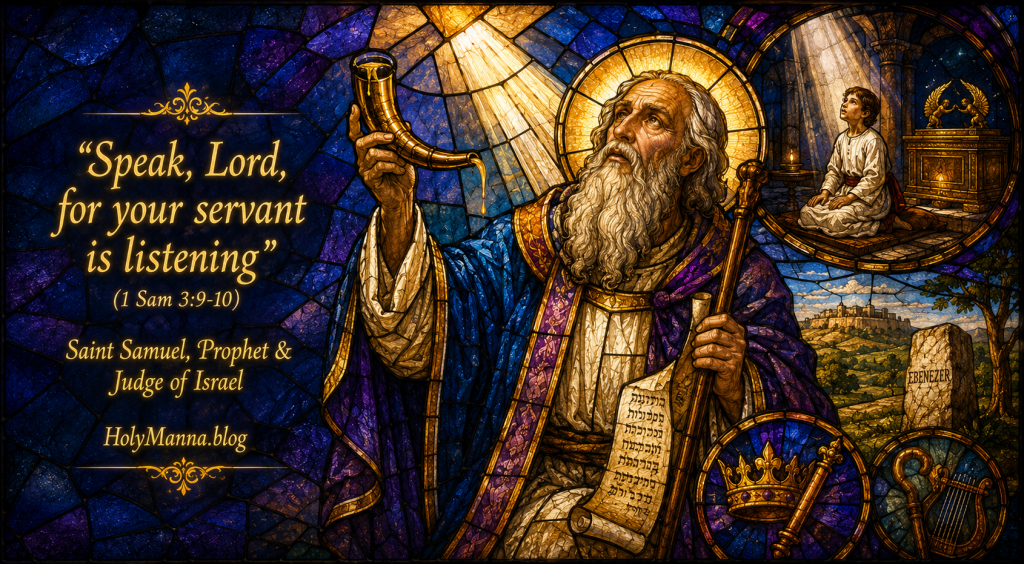
The Boy Who Learned to Listen
Every August 20th, the Roman Martyrology pauses to honor a man who never saw a church, never heard the name of Jesus spoken aloud, and yet belongs to the communion of saints as surely as any martyr of Rome. The Church’s official register of saints commemorates him with these words: “The commemoration of Saint Samuel, prophet, who, called by God as a child, later fulfilled the office of judge in Israel, and, by the command of God, anointed Saul as king over the people; but when Saul was later rejected by the Lord for his unfaithfulness, he also conferred the royal anointing upon David, from whose seed Christ was to be born.” That single sentence carries an astonishing weight. It tells the reader that this man, born roughly three thousand years ago in the hill country of Ephraim, stands in the direct line that leads to Bethlehem.
Some readers may be surprised to find an Old Testament figure on the Church’s calendar at all. The Catechism settles the question plainly: “The patriarchs, prophets and certain other Old Testament figures have been and always will be honored as saints in all the Church’s liturgical traditions” (CCC 61). Samuel is one of the brightest of these figures. He was the last of the Judges who governed Israel and the first of the great prophets after Moses. He was a priest who offered sacrifice, a judge who governed with clean hands, and a prophet who spoke the word of God without flinching, and for that threefold ministry the tradition of the Church has long seen in him a foreshadowing of Christ, who is Priest, Prophet, and King. His feast on August 20th is shared by the Byzantine East, a quiet sign that the whole Church honors this man who learned as a child how to listen to God.
A Son Born of Tears and a Vow
Samuel’s story begins not with him but with a woman weeping in a sanctuary. His father was Elkanah of Ramathaim-Zophim, usually shortened to Ramah, a town in the hill country of Ephraim; the genealogies of 1 Chronicles 6 place the family within the tribe of Levi. Elkanah’s beloved wife Hannah was barren, and year after year, when the family went up to worship at Shiloh, where the Ark of the Covenant then rested, she endured the taunts of her rival Peninnah, who had children.
One year Hannah broke. 1 Samuel 1 describes her weeping and praying so intensely, her lips moving without sound, that the old high priest Eli mistook her for a drunkard. She was pouring out her soul, vowing that if the Lord gave her a son, she would give that son back to the Lord for all the days of his life. God heard her. When the child was born she named him Samuel, a name Scripture connects to her own words: “I have asked him of the Lord” (1 Sam 1:20). The Church has never forgotten this mother. The Catechism names Hannah among the holy women of Israel through whom, “against all human expectation,” God kept His promise alive and prepared the way for the mission of Mary (CCC 489). Hannah’s canticle of thanksgiving in 1 Samuel 2 echoes so strongly in Our Lady’s Magnificat that the two songs read like a mother and daughter singing across the centuries.
Hannah kept her vow. When the boy was weaned, likely around the age of three, she brought him to Shiloh and placed him in the care of Eli. Imagine that scene for a moment. A small child, left in a sanctuary far from home, given entirely to God because his mother had promised him before he was ever conceived. Scripture says simply that “the boy ministered to the Lord, in the presence of Eli the priest” (1 Sam 2:11), wearing a little linen ephod his mother made larger each year when she came up for the annual sacrifice. In a house whose own sons, Hophni and Phinehas, were scandalously corrupt, this borrowed child grew “in stature and in favor with the Lord and with men” (1 Sam 2:26), words the reader will recognize because The Gospel of Luke uses nearly the same phrase of the child Jesus in Lk 2:52.
Then came the night that defines him. 1 Samuel 3 opens with one of the saddest lines in the Old Testament: “the word of the Lord was rare in those days; there was no frequent vision” (1 Sam 3:1). Into that silence, God spoke. The boy Samuel, asleep near the Ark, heard his name called and ran to Eli, assuming the old man had summoned him. Three times this happened before Eli understood that the Lord was calling the child, and he gave Samuel the instruction that would shape the rest of his life: when the voice comes again, answer, “Speak, Lord, for your servant is listening” (1 Sam 3:9). The Lord came and stood there, calling as before, and Samuel answered as he had been taught. What he received that night was a hard word, a judgment against the house of Eli for the sins Eli had failed to restrain. In the morning the boy was afraid to repeat it, but Eli insisted on hearing everything, and Samuel told him everything, holding nothing back. That courage to speak the whole truth, even to someone he loved, marked him forever after. The Catechism treasures this scene as a school of prayer, teaching that Samuel “must have learned from his mother Hannah how ‘to stand before the Lord’ and from the priest Eli how to listen to his word” (CCC 2578). From that night onward, Scripture says, “Samuel grew, and the Lord was with him and let none of his words fall to the ground” (1 Sam 3:19), and all Israel from Dan to Beersheba knew that a prophet had been established at Shiloh.
The Judge with Clean Hands and the Voice That Called Down Thunder
Samuel came of age in a national catastrophe. Israel went to war with the Philistines, foolishly carried the Ark of the Covenant into battle like a talisman, and lost everything. The Ark was captured, Hophni and Phinehas were killed, and old Eli, hearing the news, fell backward from his seat and died. The word Samuel had received as a boy was fulfilled to the letter. In the wreckage of Shiloh, Samuel became the leader of a broken people.
What he did next reveals the heart of his ministry. He did not raise an army first; he called for repentance first. Gathering all Israel at Mizpah, he commanded them to put away their foreign gods and return to the Lord with all their heart, and the people fasted and confessed, “We have sinned against the Lord” (1 Sam 7:6). While they were assembled, the Philistines attacked, and here Scripture records a miracle wrought through Samuel’s intercession. As he offered a lamb in sacrifice and cried out to God for Israel, “the Lord thundered with a mighty voice that day against the Philistines and threw them into confusion; and they were routed before Israel” (1 Sam 7:10). The prophet who listened to God’s voice as a child now heard that voice thunder from heaven in answer to his prayer. Samuel set up a memorial stone and named it Ebenezer, saying, “Hitherto the Lord has helped us” (1 Sam 7:12), a phrase Christians still sing today in the old hymn “Come, Thou Fount of Every Blessing.”
For the rest of his active years Samuel judged Israel, riding an annual circuit through Bethel, Gilgal, and Mizpah before returning home to Ramah, where he built an altar to the Lord. His record as a public man was spotless, and he knew it. At the end of his judgeship he stood before the whole nation and dared anyone to name an ox he had taken, a person he had defrauded or oppressed, or a bribe he had accepted: “Testify against me and I will restore it to you” (1 Sam 12:3). The people answered with one voice that he had wronged no one. In an age when public office and private corruption so often travel together, that scene alone would make Samuel worth remembering.
Yet his greatest work was still ahead, and it began with a heartbreak. The elders of Israel came to Ramah and demanded a king, “like all the nations” (1 Sam 8:5). Samuel was displeased, and he prayed, as he always did when wounded. The Lord’s answer to him is one of the most piercing sentences in the Old Testament: “Hearken to the voice of the people in all that they say to you; for they have not rejected you, but they have rejected me from being king over them” (1 Sam 8:7). Samuel warned the people honestly about everything a king would take from them, their sons, their daughters, their fields, their harvests, and when they insisted anyway, he obeyed God and gave them what they asked. He anointed Saul, a tall and striking young man of Benjamin, pouring oil on his head and kissing him, and later presented him to the nation at Mizpah.
This act of anointing is where Samuel’s life reaches forward and touches ours. In Israel, kings, priests, and prophets were consecrated with oil for their God-given missions, and the very title “Christ” comes from the Greek translation of the Hebrew “Messiah,” which means “Anointed” (CCC 436). Every time a Catholic speaks the name Jesus Christ, that person is standing, whether aware of it or not, in the stream that began flowing when Samuel lifted a flask of oil. And Samuel confirmed his God-given authority with a second public miracle. At his farewell assembly, during the wheat harvest, when rain in that season was practically unheard of, he called on the Lord as a sign, “and the Lord sent thunder and rain that day; and all the people greatly feared the Lord and Samuel” (1 Sam 12:18). When the terrified people begged him to pray for them, his answer became one of the most beautiful promises of intercession in all of Scripture: “Moreover as for me, far be it from me that I should sin against the Lord by ceasing to pray for you” (1 Sam 12:23). Notice what he calls the failure to intercede: sin. The Catechism cites exactly this moment when it teaches that Samuel learned “the cost and consequence of intercession” (CCC 2578). For Samuel, praying for the people who had rejected him was not a nice extra; it was a sacred duty he refused to abandon.
There was one more anointing to perform, and it was the one that changed the world. After Saul’s failures, the Lord sent Samuel to Bethlehem, to the house of a man named Jesse. Seven impressive sons passed before the old prophet, and about the eldest Samuel was certain he was looking at the next king. God corrected him with words every generation needs tattooed on its heart: “Do not look on his appearance or on the height of his stature, because I have rejected him; for the Lord sees not as man sees; man looks on the outward appearance, but the Lord looks on the heart” (1 Sam 16:7). The youngest son was summoned from the sheep pasture, and Samuel anointed David in the midst of his brothers, “and the Spirit of the Lord came mightily upon David from that day forward” (1 Sam 16:13). The Martyrology itself draws the line straight from that moment to the manger: David, “from whose seed Christ was to be born.” Samuel also gathered around himself at Naioth in Ramah a company of prophets, and tradition has long seen in this community the root of the prophetic schools of Israel, making Samuel a spiritual father not only of kings but of prophets.
The Grief of a Faithful Man in an Unfaithful Time
Samuel was never martyred, and no one ever drew a sword against him, yet his hardships were real and they cut deep, because they were the hardships of the heart. As a child he had to deliver a sentence of doom to the priest who raised him. As an old man he watched his own sons, Joel and Abijah, whom he had appointed judges at Beersheba, turn aside after gain, take bribes, and pervert justice (1 Sam 8:3). The man whose own hands were clean before the whole nation could not keep his sons’ hands clean, and it was partly their corruption that the elders cited when they demanded a king. Any parent who has prayed through tears for a wayward child knows something of what Samuel felt.
Then came the rejection itself. After a lifetime of honest service, the people he had led and defended told him to his face that they wanted something else. God Himself had to console him, reminding him that the deeper rejection was aimed not at Samuel but at God. And still Samuel did not grow bitter or withhold his prayers. He kept interceding for the very people who had set him aside.
Hardest of all was Saul. Samuel had anointed him, presented him, and by every indication loved him. Watching Saul unravel through disobedience must have felt like watching a son fall. The breaking point came after the campaign against Amalek, when Saul disobeyed the Lord’s command and then dressed up his disobedience as piety, claiming he had spared the best animals to sacrifice them. Samuel’s reply has thundered down three thousand years: “Has the Lord as great delight in burnt offerings and sacrifices, as in obeying the voice of the Lord? Behold, to obey is better than sacrifice, and to hearken than the fat of rams” (1 Sam 15:22). When Samuel turned to leave, Saul seized the hem of his robe and it tore, and Samuel told him the kingdom of Israel had been torn from him that same day. Scripture then records a detail of devastating tenderness: Samuel never went to see Saul again, “but Samuel grieved over Saul” (1 Sam 15:35), and he grieved so long that the Lord finally had to rouse him: “How long will you grieve over Saul, seeing I have rejected him from being king over Israel? Fill your horn with oil, and go” (1 Sam 16:1). Even prophets must be told, sometimes, to stop mourning what God has closed and to anoint what God is opening.
Samuel died in peace at his home in Ramah, and the tribute Scripture pays him is the tribute of a united nation’s tears: “Now Samuel died; and all Israel assembled and mourned for him, and they buried him in his house at Ramah” (1 Sam 25:1). The inspired praise of Sirach 46 sums up his life, calling him beloved by his Lord, a prophet who established the kingdom, anointed rulers over God’s people, and was proved trustworthy as a seer because of his faithfulness.
The Prophet Who Spoke from Beyond the Grave
Samuel’s story does not end at his tomb, and Scripture itself is the witness. 1 Samuel 28 records one of the strangest episodes in the Bible. King Saul, abandoned to his fears on the eve of his final battle, disguised himself and sought out a medium at Endor, asking her to bring up Samuel. What happened next terrified the woman herself: Samuel appeared and delivered to Saul one final prophecy, that the kingdom had been torn from him and that he and his sons would fall the next day. It happened exactly as Samuel said.
The Church reads this passage with two truths held firmly together. First, the practice Saul engaged in was gravely sinful then and is gravely sinful now; the Catechism teaches without ambiguity that “all forms of divination are to be rejected,” explicitly including the “conjuring up the dead” (CCC 2116). Saul’s recourse to the medium is listed among the sins for which he died. Second, the inspired author of Sirach affirms that Samuel truly did prophesy after his death: “Even after he had fallen asleep he prophesied and revealed to the king his death, and lifted up his voice out of the earth in prophecy” (Sir 46:20). The Fathers of the Church, including Saint Augustine, discussed at length how to understand the mechanics of the apparition, and their explanations vary; what the canon of Scripture itself asserts is that the word Saul heard was a true word of Samuel. God’s judgment reached Saul even through the door Saul had sinfully opened, which condemns the door while vindicating the prophet. In this, Samuel holds a distinction almost unique among the saints: the sacred text itself testifies that he exercised a prophetic ministry from beyond the grave.
The veneration of Samuel’s mortal remains became, remarkably, a milestone in the Church’s theology of relics. His tomb was honored for centuries at the site tradition identifies with Ramah, the commanding hilltop northwest of Jerusalem known to this day as Nabi Samwil, “the prophet Samuel.” In the year 406, the Roman Emperor Arcadius had the prophet’s relics solemnly translated out of the Holy Land, and no less a witness than Saint Jerome, writing at that very time, invoked the event in his treatise Against Vigilantius in defense of the honor Christians pay to the bodies of the saints. Jerome asks whether the emperor could possibly be guilty of sacrilege “who after so long a time has conveyed the bones of the blessed Samuel from Judea to Thrace”, his answer being an emphatic no, since the whole Church rejoiced to receive the prophet. As for the relics’ final resting place, the sources do not fully agree; Jerome says Thrace, the older edition of the Roman Martyrology and Byzantine tradition record their burial near Septimum, outside Constantinople, and at least one Eastern account names Chalcedon. The translation itself is documented history; the precise destination varies by source, and honesty requires saying so plainly.
Nabi Samwil, meanwhile, remained a magnet for pilgrims. A succession of churches rose over the traditional tomb through the Byzantine and Crusader centuries, and medieval pilgrims approaching Jerusalem caught their first sight of the Holy City from that ridge, which the Crusaders named Mountjoy for exactly that reason. The last church on the site was converted to a mosque in the eighteenth century, and the hill remains a place of prayer to this day. There is a story attached to the 406 translation that describes crowds lining the entire route to receive the relics as though the prophet were passing by alive; while it fits the spirit of what Jerome describes, the full details of that procession cannot be verified. Samuel’s memory also saturates the rest of Scripture. Psalm 99 ranks him with Moses and Aaron among those who called on the Lord’s name and were answered. Saint Peter preached that “all the prophets who have spoken, from Samuel and those who came afterwards, also proclaimed these days” (Acts 3:24), the days of Christ. And The Letter to the Hebrews enrolls him by name in its great litany of the heroes of faith (Heb 11:32).
What an Ancient Listener Can Teach a Distracted Age
It would be easy to file Samuel away as a figure too ancient to matter, and it would be a mistake. His life speaks with uncomfortable precision to this exact moment.
Start with the obvious: Samuel learned to listen. He lived in a day when “the word of the Lord was rare”, and the present day can feel the same, not because God has gone silent but because the noise has grown deafening. Samuel’s answer, taught to him by a flawed old priest, remains the single best prayer a person can carry into adoration, into the morning commute, into the anxious hour of a hard decision: “Speak, Lord, for your servant is listening.” Try making that sentence a daily habit, spoken slowly before the tabernacle or in the first quiet moment after waking. When was the last time you gave God sixty full seconds of silence and genuinely expected Him to use it?
Consider, too, what Samuel teaches about how God measures people. The prophet himself, holy as he was, got Bethlehem wrong at first glance, dazzled by the stature of Jesse’s eldest son, and God corrected him: the Lord looks on the heart. This generation lives inside a machine built to reward outward appearance, curated profiles, filtered photos, personal brands. Samuel’s correction at Bethlehem is a standing invitation to opt out of that economy, to stop grading oneself and others by the metrics of the feed, and to ask instead what God sees when He looks past everything the camera can capture. If the Lord judged you this evening only by what is in your heart, what would He find there, and what would you want Him to find?
Then there is intercession. Samuel counted it a sin to stop praying for people who had personally rejected him. It is easy to pray for people who are pleasant; Samuel prayed for the nation that voted him out of a job and grieved for the king who disappointed him most. Every reader knows someone like that, the estranged sibling, the fallen-away friend, the leader who let everyone down. The Samuel option is always available: refuse to stop praying for them. And finally, obedience. “To obey is better than sacrifice” is a scalpel of a sentence, because religious activity can become a costume for self-will, as it did for Saul. The Mass attended, the devotion performed, the donation made, none of it substitutes for actually doing what God asks in the concrete duties of one’s state in life. Is there one clear thing you already know God is asking of you that you have been trading for lesser offerings?
Engage With Us!
Saint Samuel’s story has been shaping hearts for three thousand years, and now it is your turn to sit with it. Share your thoughts and reflections in the comments below; this community grows stronger every time someone speaks honestly about where God is working. To help the conversation along, here are some questions to pray with this week.
- Samuel needed Eli’s help to recognize God’s voice; who has helped you learn to hear God, and is there someone younger in the faith you could help in the same way?
- Hannah gave her long-awaited son entirely back to God; what is the one blessing in your life you find hardest to surrender, and what would offering it to God look like?
- Samuel refused to stop praying for the people who rejected him; who in your life have you quietly stopped praying for, and can you begin again today?
- God told Samuel that man looks on the outward appearance but the Lord looks on the heart; in what part of your life are you most tempted to perform for human eyes rather than live for God’s?
- Samuel told Saul that to obey is better than sacrifice; is there an act of plain obedience God is asking of you that you have been avoiding beneath a pile of busier, easier religious activity?
Take Samuel’s little prayer with you into the noise of this week and mean it: “Speak, Lord, for your servant is listening.” The God who called a child by name in the dark of Shiloh has not stopped calling, and He knows your name too. Listen for Him, obey Him in the small things, keep praying for the people who are hard to love, and do everything, absolutely everything, with the love and mercy that Jesus taught us.
Saint Samuel, Priest, Prophet & Judge of Israel, pray for us!
Follow us on YouTube, TikTok, Instagram and Facebook for more insights and reflections on living a faith-filled life.


Leave a Reply