The Honey-Tongued Monk Who Set Europe on Fire with the Love of God
Some saints change the Church quietly, from a hidden cell or a forgotten corner of the world. Saint Bernard of Clairvaux changed it loudly, from the center of everything, while insisting the whole time that all he ever wanted was to be left alone in his monastery. Born in 1090 and dying on August 20, 1153, Bernard was an abbot, a mystic, a reformer, a peacemaker between popes, a counselor to kings, and one of the most persuasive voices Christendom has ever produced. The Church calls him the Mellifluous Doctor, the Honey-Flowing Doctor, because his words about God carried a sweetness that drew souls the way honey draws the hungry. Pope Pius XII loved the title so much that he named his 1953 encyclical on Bernard Doctor Mellifluus, marking the eight hundredth anniversary of the saint’s death.
Bernard was canonized in 1174, only twenty-one years after he died, and Pope Pius VIII declared him a Doctor of the Church in 1830. He is the patron saint of the Cistercian Order, of beekeepers, candlemakers, and wax refiners, and of Gibraltar. The patronage of beekeepers flows straight from his title; a man whose speech was compared to honey naturally became the heavenly friend of those who harvest it. Yet the sweetness should not fool anyone. Beneath the honey was iron. Bernard fasted until his health broke, argued down the most brilliant philosopher of his age, faced down a mob-inciting preacher to protect Jewish communities, and told a pope, his own former student, exactly what he needed to hear. His life is proof that tenderness and strength are not opposites in the Christian soul; they are married there. The Catechism teaches that the Church is holy because Christ makes her holy, and that in the saints she finds her most radiant witnesses (CCC 828). Bernard is one of the brightest of those witnesses, and his story deserves to be told from the beginning.
A Knight’s Son Who Chose a Different Battlefield
Bernard was born at the castle of Fontaine-lès-Dijon in Burgundy, France, in 1090, though a few older sources place his birth in 1091. His father, Tescelin le Sorrel, was a knight in the service of the Duke of Burgundy, a man of the sword with a reputation for honor. His mother, Aleth of Montbard, was a woman of deep and practical holiness, and the Church venerates her today as Blessed Aleth. Bernard was the third of seven children, six boys and one girl, and here is one of the most astonishing facts about this family: every single one of those seven children eventually entered religious life. His sister Humbeline, after years as a fashionable noblewoman, became a nun and is venerated as Blessed Humbeline. Holiness ran through that household like a river.
Bernard was sent to be educated by the canons of Saint-Vorles at Châtillon-sur-Seine, where he showed unusual gifts in literature and rhetoric, gifts that would one day make him the most quoted man in Europe. It was also there that his lifelong devotion to the Blessed Virgin Mary took root and began to grow. Around 1107, his mother Aleth died, and her death shook the young man to his foundations. The world lay open before him. He had noble blood, a first-rate education, personal charm that contemporaries describe as almost irresistible, and every door a twelfth-century young man could want. He chose instead the one door nobody wanted.
In 1112 or 1113, sources conflict on the exact year, Bernard presented himself at the gates of Cîteaux, a struggling reform monastery living the Rule of Saint Benedict in its full austerity under Abbot Stephen Harding. Cîteaux was poor, obscure, and short on vocations. What happened next has no real parallel in the history of religious life. Bernard did not arrive alone. He arrived with roughly thirty companions whom he had personally persuaded to give their lives to God, among them four of his own brothers and his uncle Gaudry. One young man talked thirty others into the hardest form of monastic life then available. Families of the region reportedly hid their sons when Bernard came near, because his invitation was so hard to refuse. The Catechism teaches that the consecrated life is a gift the Church has received from her Lord, a state of life in which the faithful follow Christ more nearly and give themselves entirely to God who is loved above all (CCC 916, CCC 925). Bernard did not just embrace that gift; he carried an entire crowd into it with him.
Three years later, in 1115, Abbot Stephen sent the young monk, then about twenty-five years old, to found a new monastery in a wild place called the Valley of Wormwood. Bernard renamed it Clairvaux, the Valley of Light, and he would be its abbot for thirty-eight years. From that valley, light truly did pour out across Europe.
Miracles in the Valley of Light
What was Bernard most known for during his lifetime? Everything, it can seem. He was known first as a spiritual father. Under his guidance Clairvaux grew until it housed roughly seven hundred monks at his death and had directly founded about sixty-eight daughter monasteries, with the wider Cistercian family descending from Clairvaux numbering in the hundreds; the exact totals vary across sources, but the scale is not in dispute. Men left everything to live on bread, vegetables, silence, and prayer because Bernard made the love of God sound like the only adventure worth having.
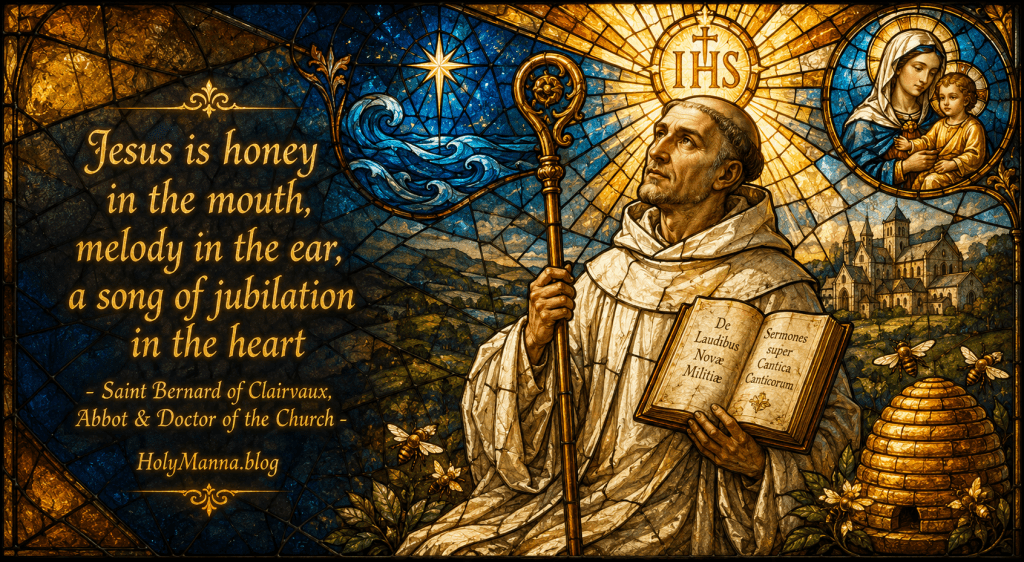
He was known, second, as a teacher of divine love. His treatise On Loving God asks why and how much God should be loved, and his answer has never been improved upon: “The reason for loving God is God Himself; the measure of loving God is to love Him without measure.” His eighty-six Sermons on the Song of Songs read the Bible’s great love poem as the romance between Christ and the soul, and in Sermon 15 he gave the Church one of its most beloved lines about the Holy Name: “Jesus is honey in the mouth, melody in the ear, a song of jubilation in the heart.” The Catechism itself reaches for Bernard when it teaches that Christianity is not a religion of the book but of the living Word, quoting his Homily on the Missus est to say that the Word of God is “not a written and mute word, but the Word which is incarnate and living” (CCC 108). When the universal Catechism quotes a man by name, the Church is telling every generation to sit at his feet.
He was known, third, as the great lover of Mary. The Catechism teaches that the Church rightly honors the Blessed Virgin with special devotion, a devotion that differs essentially from the adoration given to God alone (CCC 971). Bernard gave that teaching wings. In his Homilies in Praise of the Virgin Mother he wrote words that sailors, mothers, and sinners have clung to for nearly nine hundred years: “In dangers, in difficulties, in doubts, think of Mary, call upon Mary.” And again: “Look at the star, call upon Mary.” For Bernard, Mary was the star over the sea of this life, and no soul following her light could be lost. It should be noted honestly that the famous Memorare prayer, though often printed under Bernard’s name, is of unknown authorship; the attribution grew from confusion with a later French priest, Father Claude Bernard, who spread the prayer in the seventeenth century. Bernard needs no borrowed prayers; his authentic Marian writings are treasure enough.
He was known, fourth, as a worker of wonders. The Vita Prima, his earliest biography, begun during his lifetime by his friend William of Saint-Thierry and continued by Arnold of Bonneval and Geoffrey of Auxerre, records healings throughout his career. The most heavily documented season of miracles came during his preaching tour through the Rhineland in 1146 and 1147, when the men traveling with him kept near-daily written records of the blind receiving sight, the lame walking, and the sick being restored as Bernard prayed over them in town after town. For a medieval saint, the volume of contemporary eyewitness recording from that tour is remarkable. During that same journey Bernard performed an act of moral courage that history should never forget. A renegade monk named Radulf was whipping crowds along the Rhine into murderous violence against Jewish communities. Bernard traveled to confront him, publicly silenced him, and insisted that the Church absolutely forbade such bloodshed. The Jewish chronicler Ephraim of Bonn, who had no reason to flatter a crusade preacher, recorded his gratitude for Bernard’s intervention. That is not pious tradition; that is documented history, and it shows the true heart of the man.
He was known, finally, as the conscience of Christendom. At the Council of Troyes, held in 1128 or 1129 depending on how the sources reckon the calendar, Bernard helped draft the rule of life for the new Knights Templar and later wrote In Praise of the New Knighthood for them. When his own former monk, Bernardo Paganelli, was elected Pope Eugene III in 1145, Bernard wrote him On Consideration, a book of fatherly counsel urging the pope to guard his soul amid the crush of business, a book popes have read ever since. The abbot of a remote valley had become, without ever seeking it, the most influential man in Europe.
Battles He Never Wanted
Bernard liked to call himself the chimera of his age, a strange hybrid creature, neither fully cleric nor fully layman, a monk forever being pulled out of his monastery. His hardships were real, lifelong, and layered.
The first hardship was his own body. The austerities of his early years at Clairvaux, the fasting, the vigils, the crushing workload, permanently wrecked his digestive health, and he spent most of his adult life in chronic pain and weakness, at times so ill that a small hut had to be built for him apart from the community. The man whose words moved armies could often barely keep food down. He learned mercy the hard way, later moderating for his monks the severities he had inflicted on himself.
The second hardship was grief. When his beloved brother Gerard died, Bernard broke off his commentary on Scripture and poured out his sorrow in Sermon 26 on the Song of Songs, one of the most humanly raw laments in all medieval literature, refusing to pretend that faith removes the sting of loss even while proclaiming the hope of the resurrection. Anyone who has stood at a graveside knows that ache, and it is strangely consoling that a Doctor of the Church knew it too.
The third hardship was controversy. In 1130 the Church split between Pope Innocent II and the antipope Anacletus II, and for eight exhausting years Bernard crossed Europe, persuading kings, bishops, and cities to stand with the true pope until the schism finally healed in 1138. In 1140 or 1141, the dating varies by source, he confronted the brilliant philosopher Peter Abelard at the Council of Sens, convinced that Abelard’s method endangered the mystery of faith by submitting it wholly to human reasoning. The council censured Abelard’s propositions, and it is a mark of grace that the story did not end in bitterness; Abelard withdrew to Cluny, was reconciled to the Church, and Peter the Venerable later wrote that he died a humble and devout death. Bernard fought doctrines fiercely, yet the Church’s memory holds no hatred between the two men at the end.
The heaviest hardship came last. In 1146, at the direct command of Pope Eugene III, Bernard preached the Second Crusade at Vézelay, and his preaching was so overwhelming that the crowd ran out of cloth crosses and tore his habit into strips to make more. He was not martyred, but what followed crucified his reputation. The crusade collapsed in disaster, and public opinion across Europe blamed the preacher. Bernard bore the humiliation in his final years, writing in On Consideration that the failure was owed to the sins of the crusaders, and bowing before the judgments of God that no man can fully search. The Catechism teaches that the way of perfection passes by way of the Cross, and that there is no holiness without renunciation and spiritual battle (CCC 2015). Bernard’s cross in old age was to be misunderstood, blamed, and worn out in the service of a Church that could not stop asking things of him. He carried it to the end. Surrounded by his sons at Clairvaux, the Mellifluous Doctor died on August 20, 1153, at about sixty-three years of age.
Honey That Never Ran Dry
Death did not end Bernard’s influence; it multiplied it. Healings were reported and recorded at his tomb at Clairvaux, and the testimony of his sanctity was so overwhelming that Pope Alexander III canonized him in 1174, a mere twenty-one years after his death, a lightning-fast canonization by the standards of the age. In 1830 Pope Pius VIII declared him a Doctor of the Church, and in 1953 Pope Pius XII crowned the Church’s esteem with the encyclical Doctor Mellifluus, holding Bernard up as a teacher for the modern world.
Two famous traditions surround his memory and belong to the story of his veneration. The first is called the Lactatio Bernardi. In this tradition, as Bernard prayed before an image of the Virgin and asked her to show herself a mother, the Blessed Virgin moistened his lips with milk from her own breast, a sign that the sweetness of his preaching and his wisdom about her Son were her maternal gift. This story first appears centuries after Bernard’s death, and it cannot be verified. The second tradition is called the Amplexus Bernardi. In this account, as Bernard prayed before a crucifix, Christ loosened His arms from the wood and bent down to embrace the praying monk, a sign of the intimate love between the Crucified and His servant. This story likewise comes from later tradition, and it cannot be verified. Both traditions became beloved subjects of Catholic art precisely because they capture, in images, what is certainly true from his verified writings: Bernard’s theology was nursed on Marian tenderness and locked in the embrace of Christ crucified.
His relics had a turbulent history. Clairvaux Abbey was suppressed during the French Revolution, and its buildings were later turned into a French state prison, a strange fate for the Valley of Light. Bernard’s skull is venerated today in the Cathedral of Saint Peter and Saint Paul in Troyes, and pilgrims still visit his birthplace at Fontaine-lès-Dijon, where a church stands in his honor on the site of the family castle. His cultural reach is hard to overstate. Dante, in the Divine Comedy, chose Bernard as the final guide of the entire journey, the saint who takes the pilgrim’s hand in the highest heaven and, through his prayer to the Virgin, obtains for him the vision of God; the greatest poem of Christendom ends, in effect, inside Bernard’s Marian heart. It is worth noting for honesty’s sake that two beloved hymns long printed under his name, Jesu dulcis memoria and the text behind O Sacred Head Surrounded, are attributed by modern scholarship to other medieval authors; his true legacy rests securely on the works that are certainly his. Every August 20, the universal Church celebrates his Memorial, and the Cistercian and Trappist monasteries that still pray in his lineage around the world are his living relics, communities of silence and love descended directly from the thirty young men who followed him through the gates of Cîteaux.
Loving Without Measure in a Distracted Age
What does a twelfth-century abbot have to say to you, right now, in a world of notifications and noise? More than almost anyone. Bernard’s core teaching is devastatingly simple: God is the reason for loving God, and the only proper measure of that love is no measure at all. Most people love God the way they tip at a restaurant, calculating a respectable percentage. Bernard asks for the whole heart, because God gave His whole Heart first. When was the last time you gave God something without measuring it?
Start where Bernard started, with the Name of Jesus. He called that Name honey in the mouth, melody in the ear, jubilation in the heart. Try it as a practice this week: when anxiety spikes, when traffic stalls, when the scroll pulls at you, say the Name of Jesus slowly, once, and let it land. The Catechism teaches that the invocation of the holy Name of Jesus is the simplest way of praying always, a prayer possible at all times because it holds the whole of prayer within it (CCC 2668). That is Bernard’s spirituality shrunk to pocket size, and it works in a cubicle as well as a cloister.
Then take his advice for the storms. Bernard’s counsel was never complicated: in dangers, in doubts, in difficulties, think of Mary, call upon Mary. Look at the star. When the diagnosis comes, when the relationship cracks, when the finances tighten, the soul needs a fixed point above the waves. The Rosary in a coat pocket is a star chart. Who in your life is drowning right now, and have you asked the Mother of God to look at them?
Learn also from his courage. Bernard defended people who could not defend themselves, standing between a hate-filled preacher and the Jewish communities of the Rhineland when silence would have been easier. Holiness is not niceness; it is love with a spine. And learn from his humility in failure. The greatest preacher in Europe watched his greatest project collapse and bore the blame publicly without abandoning his post. Success is not the proof of faithfulness; perseverance is. Where have you confused God’s approval with visible results? Finally, learn from his honesty in grief. Bernard wept openly for his brother and put the weeping into a sermon, teaching every Christian that tears and trust can live in the same heart. The saint of honeyed words was never sentimental; he was real, and reality is exactly what the world is starving for.
Engage With Us!
Saint Bernard of Clairvaux spent his life persuading people, one soul at a time, that the love of God is worth everything, and now it is your turn to join the conversation. Share your thoughts and reflections in the comments below; this community grows the way Clairvaux grew, one honest voice inviting another. Here are some questions to pray with and to spark discussion.
- Bernard taught that the measure of loving God is to love Him without measure. What is one measured, calculated corner of your life that God might be asking you to hand over completely?
- Bernard brought thirty friends and family members with him into the monastery. Who is one person in your life you could gently invite closer to Christ this month, and what would that invitation look like?
- In dangers, doubts, and difficulties, Bernard said to call upon Mary. What storm are you facing right now that you have not yet entrusted to her?
- Bernard bore public blame after the failure of the Second Crusade without abandoning his vocation. How do you respond when faithfulness does not produce visible success?
- Bernard risked his reputation to protect the vulnerable from violence. Where is God asking you to be love with a spine, defending someone who cannot defend themselves?
Take the Mellifluous Doctor as a friend this week. Let the Name of Jesus be honey in your mouth, keep your eyes on the star of the sea, and love the people in front of you without keeping score. Live boldly, forgive quickly, pray constantly, and do everything, in the words that echo from every page of Bernard’s life, with the love and mercy that Jesus taught us.
Saint Bernard of Clairvaux, pray for us!
Follow us on YouTube, TikTok, Instagram and Facebook for more insights and reflections on living a faith-filled life.


Leave a Reply