Memorial of Saint Bernard, Abbot and Doctor of the Church – Lectionary: 422
When Heaven Sends the Invitation and Sews the Suit
Imagine receiving an invitation to a royal wedding, only to discover that the king has also arranged the tailor, the washing, and the ride. That is the astonishing generosity running through the readings for Thursday, August 20, 2026, the Memorial of St. Bernard, Abbot and Doctor of the Church. The central theme uniting them is this: God Himself creates the new heart of love that makes His people fit for His feast. In Ezekiel 36, the Lord speaks to a nation broken by exile in Babylon, a people whose sin had dragged His holy name through the mud of the pagan world. Instead of abandoning them, God promises to sprinkle clean water on them, tear out their stony hearts, and breathe His own Spirit into their chests. Psalm 51, David’s great cry of repentance, shows what it looks like when a sinner actually begs for that promise: “A clean heart create for me, O God.” Then, in The Gospel of Matthew, Jesus tells the chief priests a parable about a king whose wedding hall fills with guests gathered from the streets, bad and good alike, and about one man who shows up without the wedding garment. The Church Fathers, above all Pope St. Gregory the Great, teach that this garment is charity, the love God pours into cleansed hearts. It is fitting that the Church reads these texts on the feast of St. Bernard, the Mellifluous Doctor, who spent his life teaching that the measure of loving God is to love without measure. Is your heart dressed for the feast?
First Reading — Ezekiel 36:23-28
The God Who Restores His Own Reputation by Restoring You
Ezekiel was a priest who never got to serve in the Temple. Deported to Babylon around 597 BC, he watched from exile as Jerusalem fell and the Temple burned in 587 BC. To the ancient mind, this looked like the defeat of Israel’s God. The nations sneered, assuming the Lord could not protect His own people. This is what the oracle means by God’s name being profaned among the nations. Israel’s sin had created a public scandal against God’s holiness. What follows is one of the most stunning promises in the Old Testament, because God decides to defend His reputation not through punishment but through mercy, cleansing, and interior re-creation. This reading sets the day’s theme in motion: transformation begins with God’s initiative, not human achievement.
Ezekiel 36:23-28
Thus says the LORD:
I will prove the holiness of my great name,
profaned among the nations,
in whose midst you have profaned it.
Thus the nations shall know that I am the LORD, says the Lord GOD,
when in their sight I prove my holiness through you.
For I will take you away from among the nations,
gather you from all the foreign lands,
and bring you back to your own land.
I will sprinkle clean water upon you
to cleanse you from all your impurities,
and from all your idols I will cleanse you.
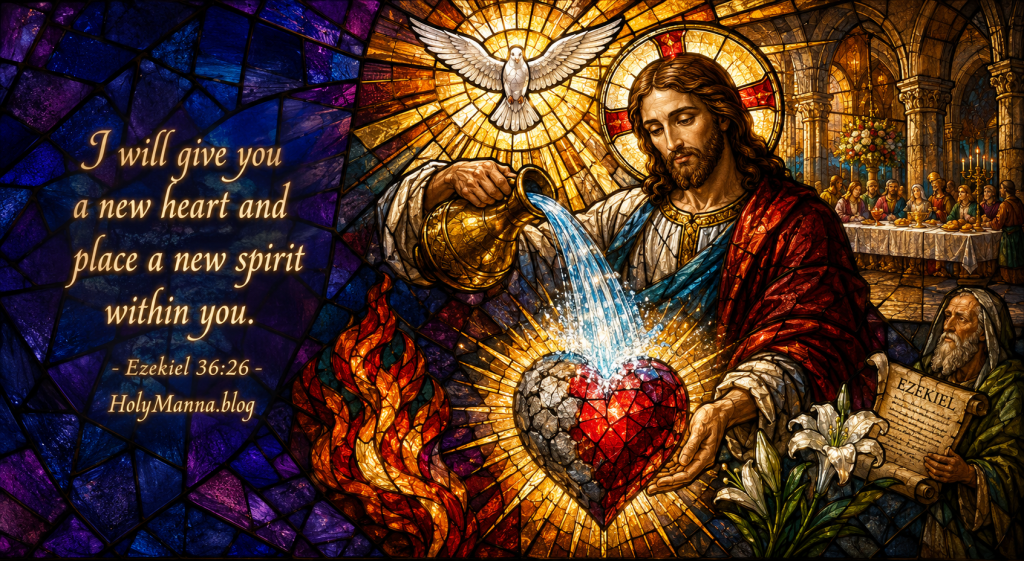
I will give you a new heart and place a new spirit within you,
taking from your bodies your stony hearts
and giving you natural hearts.
I will put my spirit within you and make you live by my statutes,
careful to observe my decrees.
You shall live in the land I gave your ancestors;
you shall be my people, and I will be your God.
Detailed Exegesis
Verse 23. “I will prove the holiness of my great name, profaned among the nations, in whose midst you have profaned it. Thus the nations shall know that I am the LORD, says the Lord GOD, when in their sight I prove my holiness through you.” God’s glory and His people’s restoration are bound together. He will demonstrate His holiness through them, meaning a transformed people becomes the evidence of a holy God. Every baptized Christian inherits this vocation to make God’s holiness visible.
Verse 24. “For I will take you away from among the nations, gather you from all the foreign lands, and bring you back to your own land.” The promise of return from exile prefigures the deeper homecoming of every sinner to God. The Church has always seen here a figure of the gathering of God’s scattered children into one family.
Verse 25. “I will sprinkle clean water upon you to cleanse you from all your impurities, and from all your idols I will cleanse you.” Sprinkling with water was a priestly ritual of purification, and Ezekiel the priest reaches for it as an image of total cleansing. The Church reads this verse as a prophecy of Baptism, which is why it echoes through the Easter Vigil liturgy and the rite of sprinkling at Mass.
Verse 26. “I will give you a new heart and place a new spirit within you, taking from your bodies your stony hearts and giving you natural hearts.” In Hebrew thought, the heart is the center of thinking, willing, and loving. A stony heart cannot respond to God. Notice that God does not command Israel to soften her own heart; He performs the transplant Himself.
Verse 27. “I will put my spirit within you and make you live by my statutes, careful to observe my decrees.” This is the promise of the Holy Spirit dwelling within the human person, fulfilled at Pentecost. Obedience becomes possible not by white-knuckled effort but by an indwelling divine power.
Verse 28. “You shall live in the land I gave your ancestors; you shall be my people, and I will be your God.” The covenant formula seals the oracle. The goal of all this cleansing and re-creation is communion, God and His people belonging to one another.
Teachings
The Catechism of the Catholic Church places this very passage at the heart of its teaching on conversion. CCC 1432 teaches, “The human heart is heavy and hardened. God must give man a new heart. Conversion is first of all a work of the grace of God who makes our hearts return to him.” That single paragraph settles a question many believers quietly agonize over, namely whether they must fix themselves before approaching God. The Church says no; grace comes first. CCC 1215 connects the water imagery to the sacrament itself, teaching that Baptism “signifies and actually brings about the birth of water and the Spirit without which no one ‘can enter the kingdom of God.’” St. Cyril of Jerusalem, catechizing new converts in the fourth century, drew on exactly this prophetic water imagery to explain what happens in the font. On his memorial today, St. Bernard of Clairvaux deserves the final word, since his whole theology flows from the God who loves first. In On Loving God, Bernard writes, “The reason for loving God is God Himself; and the measure of love due to Him is immeasurable love.” A new heart is precisely a heart capable of that kind of love.
Reflection
The stony heart is not just an ancient Israelite problem. It shows up today as cynicism, numbness at Mass, grudges nursed for years, and the quiet idolatry of career, comfort, or screens. Ezekiel’s oracle invites a different posture, one of surrender rather than self-improvement. A concrete way to live this reading is to return to the sacrament God gave for exactly this cleansing. Schedule Confession this week and bring the one hardened area you usually hold back. Another practical step is to renew baptismal promises consciously, perhaps by blessing yourself slowly with holy water when entering church, remembering that God once sprinkled clean water on you and meant it. Where has your heart turned to stone, and are you willing to let God, rather than your own willpower, replace it?
Responsorial Psalm — Psalm 51:12-15, 18-19
The Prayer of a Man Who Took God Up on His Offer
Tradition connects Psalm 51, the Miserere, with the darkest chapter of King David’s life, his adultery with Bathsheba and the arranged death of her husband Uriah, followed by the prophet Nathan’s devastating rebuke recorded in 2 Samuel 12. What makes this psalm immortal is not the sin but the response. David does not minimize, negotiate, or hide. He asks God to do something only God can do. Today’s liturgy pairs it with Ezekiel because it reads like the answer key: the prophet announces that God will give a new heart, and the psalmist kneels down and asks for one. The refrain even borrows Ezekiel’s own words about clean water, stitching the two readings together.
Psalm 51:12-15, 18-19
R. (Ezekiel 36:25) I will pour clean water on you and wash away all your sins.
A clean heart create for me, O God,
and a steadfast spirit renew within me.
Cast me not out from your presence,
and your Holy Spirit take not from me.
R. I will pour clean water on you and wash away all your sins.
Give me back the joy of your salvation,
and a willing spirit sustain in me.
I will teach transgressors your ways,
and sinners shall return to you.
R. I will pour clean water on you and wash away all your sins.
For you are not pleased with sacrifices;
should I offer a burnt offering, you would not accept it.
My sacrifice, O God, is a contrite spirit;
a heart contrite and humbled, O God, you will not spurn.
R. I will pour clean water on you and wash away all your sins.
Detailed Exegesis
Verse 12. “A clean heart create for me, O God, and a steadfast spirit renew within me.” The Hebrew verb translated “create” is bara, the same verb Genesis 1 uses for God’s creation of the world, an act only God ever performs in Scripture. David is asking for a miracle on the order of creation itself, not a moral touch-up.
Verse 13. “Cast me not out from your presence, and your Holy Spirit take not from me.” David had watched King Saul lose God’s favor and unravel. His plea reveals that the deepest punishment of sin is not external misfortune but separation from God’s presence.
Verse 14. “Give me back the joy of your salvation, and a willing spirit sustain in me.” Sin steals joy long before it steals anything else. David asks not merely for pardon but for restored gladness and a will that wants what God wants.
Verse 15. “I will teach transgressors your ways, and sinners shall return to you.” Forgiven people become evangelists. David promises that his restoration will not stay private, which is the pattern of every great conversion story in the Church.
Verse 18. “For you are not pleased with sacrifices; should I offer a burnt offering, you would not accept it.” David is not rejecting the Temple liturgy but exposing its abuse. Ritual without repentance is theater. God cannot be bribed with externals while the heart stays far away.
Verse 19. “My sacrifice, O God, is a contrite spirit; a heart contrite and humbled, O God, you will not spurn.” This verse is one of the Old Testament’s clearest anticipations of the Gospel. The offering God will never refuse is a broken and humbled heart, which is good news for everyone who has nothing else left to offer.
Teachings
The Church enshrined this psalm’s insight in her doctrine on the Sacrament of Penance. CCC 1451, drawing on the Council of Trent, teaches, “Among the penitent’s acts contrition occupies first place. Contrition is ‘sorrow of the soul and detestation for the sin committed, together with the resolution not to sin again.’” That definition is Psalm 51 in doctrinal form. The Church also prays this psalm every Friday morning in the Liturgy of the Hours, keeping David’s contrition on the lips of priests, religious, and laity around the world each week. St. Bernard, whose feast is celebrated today, understood the link between humility and love better than almost anyone; his first published treatise, The Steps of Humility and Pride, argues that humility is the necessary foundation for ascending to the love of God. A contrite heart is simply a humble heart telling the truth, and truth is where love begins.
Reflection
Modern culture treats guilt as a malfunction to be managed. David treats it as a doorway. The difference is that he brings his guilt to a merciful God rather than carrying it alone. A practical way to pray this psalm is to make it a nightly examen: read verses 12 through 19 slowly, name the day’s failures honestly, and end by asking God for the clean heart rather than resolving to try harder tomorrow. Another step is to stop performing for God, whether through busy religious activity or curated appearances, and offer Him the one sacrifice He never spurns, which is honesty about your brokenness. When you sin, do you hide from God like Adam, or run to Him like David?
Holy Gospel — Matthew 22:1-14
The Feast Is Free, but There Is a Dress Code
By the time Jesus tells this parable, it is Holy Week. He has entered Jerusalem to shouts of Hosanna, cleansed the Temple, and is now standing in its courts facing the chief priests and elders who are already plotting His death. This is the third judgment parable in a row aimed directly at them, following the two sons and the wicked tenants. The image of a wedding feast for the king’s son draws on Isaiah 25:6-10, where God promises a rich banquet for all peoples on His holy mountain, a passage Israel understood as a picture of the messianic age. Jesus is claiming that the banquet is now being served, that He is the Son, and that the leaders of Israel are refusing the invitation. The parable then swings wide open to the streets, and finally narrows to a single silent man, holding together the day’s theme: everyone is invited, but the feast requires the new heart clothed in love.
Matthew 22:1-14
Jesus again in reply spoke to the chief priests and the elders of the people in parables saying,
“The Kingdom of heaven may be likened to a king
who gave a wedding feast for his son.
He dispatched his servants to summon the invited guests to the feast,
but they refused to come.
A second time he sent other servants, saying,
‘Tell those invited: “Behold, I have prepared my banquet,
my calves and fattened cattle are killed,
and everything is ready; come to the feast.”’
Some ignored the invitation and went away,
one to his farm, another to his business.
The rest laid hold of his servants,
mistreated them, and killed them.
The king was enraged and sent his troops,
destroyed those murderers, and burned their city.
Then the king said to his servants, ‘The feast is ready,
but those who were invited were not worthy to come.
Go out, therefore, into the main roads
and invite to the feast whomever you find.’
The servants went out into the streets
and gathered all they found, bad and good alike,
and the hall was filled with guests.
But when the king came in to meet the guests
he saw a man there not dressed in a wedding garment.
He said to him, ‘My friend, how is it
that you came in here without a wedding garment?’
But he was reduced to silence.
Then the king said to his attendants, ‘Bind his hands and feet,
and cast him into the darkness outside,
where there will be wailing and grinding of teeth.’
Many are invited, but few are chosen.”
Detailed Exegesis
Verse 1. “Jesus again in reply spoke to the chief priests and the elders of the people in parables saying,” The audience matters. This is not a cozy teaching moment but a confrontation with religious authorities in the Temple itself, days before the Cross.
Verse 2. “The Kingdom of heaven may be likened to a king who gave a wedding feast for his son.” The king is the Father, the son is Christ, and the feast is the joy of the Kingdom, consummated in the marriage of Christ and His Church. Scripture ends, in Revelation 19, with precisely this wedding supper of the Lamb.
Verse 3. “He dispatched his servants to summon the invited guests to the feast, but they refused to come.” The first servants represent the prophets sent to Israel. In the culture of the time, guests were invited twice, once in advance and once when all was ready, so this refusal is a calculated insult, not a scheduling conflict.
Verse 4. “A second time he sent other servants, saying, ‘Tell those invited: “Behold, I have prepared my banquet, my calves and fattened cattle are killed, and everything is ready; come to the feast.”‘” The king’s patience is the point. Instead of anger at the first refusal, he sends a second wave with an even warmer message. God’s persistence with sinners outlasts their indifference.
Verse 5. “Some ignored the invitation and went away, one to his farm, another to his business.” The tragedy here is not hatred but distraction. Farm and business are good things that become idols when they crowd out the King. This verse reads like a portrait of the modern calendar.
Verse 6. “The rest laid hold of his servants, mistreated them, and killed them.” Indifference in some ripens into violence in others. Israel’s history of persecuting the prophets, which Jesus laments elsewhere in Matthew 23, stands behind this line, as does the coming persecution of the apostles.
Verse 7. “The king was enraged and sent his troops, destroyed those murderers, and burned their city.” Many Fathers and commentators have read this verse in light of the destruction of Jerusalem by Rome in AD 70, a sobering reminder that rejecting grace carries real historical and eternal consequences.
Verse 8. “Then the king said to his servants, ‘The feast is ready, but those who were invited were not worthy to come.’” Worthiness in this parable is not moral achievement but willingness. The invited proved unworthy simply by refusing.
Verse 9. “Go out, therefore, into the main roads and invite to the feast whomever you find.” The invitation explodes outward to everyone, prefiguring the mission to the Gentiles and the Church’s mandate to evangelize to the ends of the earth.
Verse 10. “The servants went out into the streets and gathered all they found, bad and good alike, and the hall was filled with guests.” The Church on earth is a mixed hall, saints and sinners side by side. Membership in the visible Church is real grace, but it is not the end of the story.
Verse 11. “But when the king came in to meet the guests he saw a man there not dressed in a wedding garment.” In the customs of the time, appearing at a royal wedding in soiled everyday clothes dishonored the host. The king’s entrance to meet the guests images the final judgment, when God examines not the invitation but the heart.
Verse 12. “He said to him, ‘My friend, how is it that you came in here without a wedding garment?’ But he was reduced to silence.” The king still calls him friend, and the man has no answer. His silence signals that the garment was available and he simply declined to put it on. Before God, no excuse survives.
Verse 13. “Then the king said to his attendants, ‘Bind his hands and feet, and cast him into the darkness outside, where there will be wailing and grinding of teeth.’” Jesus uses His standard imagery for final loss. Hell is exclusion from the feast, the darkness outside the lighted hall, chosen by the one who refused to dress for love.
Verse 14. “Many are invited, but few are chosen.” The invitation is universal; the chosen are those who respond and persevere in grace. The line is a warning against presumption, not a statement that God is stingy.
Teachings
The classic Catholic interpretation of the wedding garment comes from Pope St. Gregory the Great in his Homily 38 on the Gospels. Gregory reasons that the garment cannot be faith or Baptism, since no one enters the Church without them, and concludes, “What then must we understand by the wedding garment but love?” He adds, “He who came to men for love’s sake, calls this love the wedding garment.” In other words, a person can be inside the Church, pew and all, yet lack the charity that makes faith alive. St. Augustine teaches the same in his sermons on this parable, identifying the garment with the charity that flows from a pure heart. The Catechism confirms that the parables demand this response, teaching in CCC 546, “Words are not enough; deeds are required.” The Church even sews this doctrine into her liturgy: at every Baptism the newly baptized receives a white garment, and CCC 1243 explains that it “symbolizes that the person baptized has ‘put on Christ,’ has risen with Christ.” The saint honored today embodied that garment. St. Bernard of Clairvaux entered the struggling monastery of Cîteaux around 1113, bringing roughly thirty relatives and friends with him, founded Clairvaux in 1115, and shaped the entire twelfth century through his preaching on divine love before dying on August 20, 1153. Pope Pius XII honored him in 1953 with the encyclical Doctor Mellifluus, celebrating the sweetness of his teaching on the love of God.
Reflection
This parable dismantles two opposite errors. The first error says God’s love is exclusive, reserved for the impressive; the streets full of bad and good alike refute that. The second error says the invitation is all that matters and how one lives is irrelevant; the man without the garment refutes that. A concrete way to put on the garment this week is to perform one deliberate, costly act of charity for someone who cannot repay it, since Gregory teaches that love of God and love of neighbor are woven together. Another step is to arrive at Sunday Mass early and consciously prepare, treating the Eucharist as the wedding feast it truly is rather than an errand. If the King walked into your life today, would He find you wearing love, or just wearing the invitation?
The King Is Still Filling the Hall
Step back and watch the whole story the Church tells on this memorial of St. Bernard. In Babylon, God looked at a people who had wrecked everything and promised to sprinkle them clean, pull the stone out of their chests, and breathe His own Spirit into them. In Jerusalem, a guilty king took that promise personally and prayed the words sinners have borrowed ever since: “A clean heart create for me, O God.” And in the Temple, days before He would pay for it all on the Cross, Jesus revealed where the whole plan was heading, a wedding feast thrown by the Father for the Son, with servants combing the streets so that the hall would be full. The readings together tell one story of grace from start to finish. God issues the invitation, God provides the washing, and God supplies the garment of charity; the only thing He will not do is force anyone to wear it. St. Bernard, who taught that the reason for loving God is God Himself and that the only measure of that love is to love without measure, shows what a life looks like when the garment is worn gladly. The call to action today is simple and urgent. Answer the invitation before the distractions of farm and business swallow another week. Get to Confession and let God perform the heart transplant He promised through Ezekiel. Receive the Eucharist as the foretaste of the wedding supper of the Lamb. Then walk out and love someone concretely, because that is the garment, and the King is coming in to meet His guests.
Engage With Us!
The conversation does not end with the final paragraph, so please share your reflections in the comments below. This community grows stronger every time someone opens up about how God is working in an ordinary life, and someone reading today may need exactly the insight you have to offer. Here are a few questions to pray with before you comment.
- In Ezekiel 36:23-28, God promises to replace stony hearts with natural hearts. What is one area of your life where your heart has hardened, and what would it look like to let God soften it this week?
- In Psalm 51:12-15, 18-19, David asks God to create a clean heart in him rather than trying to fix himself. When you fall, do you tend to hide, self-justify, or bring your contrition honestly to God in Confession?
- In Matthew 22:1-14, the wedding garment is understood by the Church Fathers as charity. What everyday distractions, your own version of the farm and the business, keep you from fully accepting the King’s invitation?
- Taking all the readings together, how is God inviting you to receive a new heart clothed in love, and what is one concrete step you can take today to respond?
Living a life of faith is not about earning a seat at the table; it is about accepting the seat already prepared and dressing the part with love. Keep showing up, keep repenting, keep loving without measure as St. Bernard taught, and do everything with the love and mercy Jesus taught us. The feast is ready, and there is room in the hall for you.
Sacred Heart of Jesus, we trust in You!
Immaculate Heart of Mary, pray for us!
Saint Michael the Archangel, defend us in battle!
Follow us on YouTube, TikTok, Instagram and Facebook for more insights and reflections on living a faith-filled life.


Leave a Reply