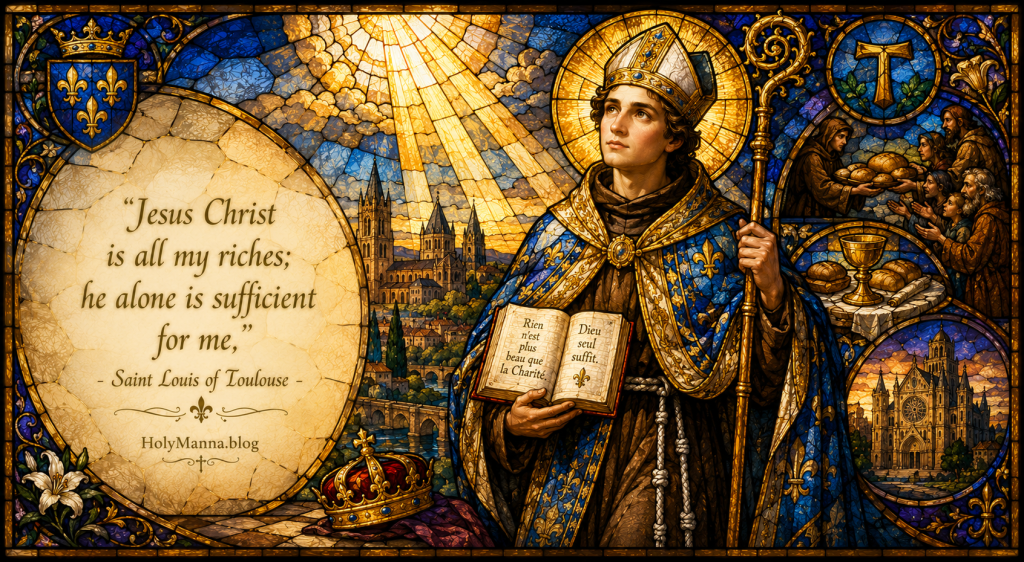
The Prince Who Traded His Crown for Christ
Imagine standing one signature away from a crown. The kingdom of Naples, the wealth of the house of Anjou, the prestige of royal blood flowing back to the kings of France; all of it waits for you, and all you have to do is say yes. Now imagine saying no, not out of fear or weakness, but because you have found something better. That is the story of Saint Louis of Toulouse, a young man who walked away from one of the most powerful thrones in medieval Europe because, in his own oft-repeated words, “Jesus Christ is all my riches; he alone is sufficient for me.”
The Church celebrates Saint Louis of Toulouse on August 19th, the anniversary of his death in 1297 at the age of only 23. In that short life he managed to be a prince, a hostage, a Franciscan friar, and the Bishop of Toulouse, and he poured himself out so completely for the poor that the faithful were calling him a saint before his body was cold. He is the patron saint of the city of Valencia in Spain, where his relics rest in the cathedral to this day, and his name lives on across the world, including in the California city and mission of San Luis Obispo, named in his honor.
His witness speaks with startling force to anyone in their twenties, thirties, or forties trying to figure out what actually matters. The Catechism of the Catholic Church teaches that “Jesus enjoins his disciples to prefer him to everything and everyone, and bids them ‘renounce all that [they have]’ for his sake and that of the Gospel” (CCC 2544). Most of the faithful will never be asked to renounce a literal kingdom. Louis was, and he did it with joy. What would you do if God asked you for the one thing you treasure most?
Born Between Thrones
Louis was born in February of 1274 at Brignoles in Provence, in the south of modern France. His pedigree was staggering even by medieval standards. His father was Charles II of Anjou, called Charles the Lame, King of Naples. His mother was Mary of Hungary, whose great-aunt was Saint Elizabeth of Hungary, the beloved princess who spent her brief life serving the poor. On his father’s side, Louis descended from the royal house of France; his great-uncle was none other than Saint Louis IX, the crusader king whose name he bore. Holiness, quite literally, ran in the family on both sides.
Yet Louis’s childhood was anything but a fairy tale. In 1284, when Louis was ten years old, his father was defeated and captured in a naval battle off Naples by the combined forces of the Sicilians and the Aragonese. The price of the king’s freedom was steep. In 1288, fourteen-year-old Louis and two of his brothers were handed over to the Kingdom of Aragon as hostages, human collateral guaranteeing their father’s good behavior. For seven years, from 1288 to 1295, the princes were held in the castle of Sciurana in the Diocese of Tarragona and for a time in Barcelona.
Here is where the story turns, because God has a habit of writing straight with crooked lines. The education of the three royal hostages was entrusted to Franciscan friars, among them a learned man named Ponzius Carbonell. What Aragon intended as captivity, God used as formation. Under the friars, Louis made remarkable progress in his studies and, more importantly, in the interior life. Tradition holds that even before his captivity, as a child, he would carry food from the castle to feed the poor; now, under the sons of Saint Francis, that childhood instinct matured into a vocation. Like Saint Francis himself, Louis developed a special love for those afflicted with leprosy, the most feared and shunned people of his age.
Somewhere in those seven years of confinement, the decisive interior conversion happened. While still a hostage, still a teenager, still legally a prince of Naples, Louis resolved to renounce his royal inheritance and give his life to God as a priest. The Catechism describes exactly this movement of the soul: “Christ proposes the evangelical counsels, in their great variety, to every disciple”, and the perfection of charity is bound up with freely embracing poverty, chastity, and obedience (CCC 915). A prison had become a novitiate. Has there been a season of your life that felt like captivity but turned out to be preparation?
The Beggar Bishop of Toulouse
In 1295 the political winds shifted, and Louis was released. That same year his eldest brother, Charles Martel, died, which meant that Louis was suddenly the heir to the throne of Naples. Everything he had renounced in his heart was now legally his. The temptation must have been enormous, and the pressure from his family even greater. Kings do not lightly watch their heirs walk away.
Louis did not hesitate. According to the contemporary account of his chaplain, John of Orta, he received the clerical tonsure on November 1st, 1295, the Feast of All Saints, almost immediately after regaining his freedom. He then returned to Naples and formally renounced all his rights of succession in favor of his younger brother Robert. Robert would go on to reign as King of Naples, and he never forgot that he owed his crown to his brother’s sanctity.
Events then moved with astonishing speed. Louis was ordained a subdeacon in Rome by Pope Boniface VIII himself, and in 1296 he was ordained deacon and then priest at Naples. He was 22 years old. Boniface VIII, recognizing both the young man’s holiness and, no doubt, the political value of his royal blood, appointed him Bishop of Toulouse, one of the great sees of southern France. Louis accepted on one remarkable condition: he wished first to become a Friar Minor, a true son of Saint Francis, before he would wear a mitre. On December 24th, 1296, Christmas Eve, he received the Franciscan habit in Rome from the minister general, John Minio of Murro, and immediately made his solemn profession. Days later, on December 29th of that year, Boniface VIII consecrated him Bishop of Toulouse. After the Feast of Saint Agatha on February 5th, 1297, Louis appeared in public for the first time wearing the rough Franciscan habit, and in it he set out for his diocese.
What followed was one of the most extraordinary episcopates in the history of the Church, not for its length but for its purity. In Toulouse, the people were astonished by their new shepherd. Contemporary accounts record that his gentle bearing and his virtues won the admiration of everyone, and that he was known as the father of the poor and a model of administration. He continued to wear the Franciscan habit under his episcopal vestments, and at times he even went out and begged, a royal prince with his hand extended like the poorest friar. He set aside fully three quarters of his episcopal income to feed the poor and maintain churches. Every single day he fed twenty-five poor people at his own table, and he served them himself.
Perhaps most striking of all, Louis assigned a friar to correct him whenever he fell short, in public if necessary, and the friar took the assignment seriously. Here was a bishop, a prince of royal blood, deliberately building humility into the structure of his daily life. The Catechism teaches that “The works of mercy are charitable actions by which we come to the aid of our neighbor in his spiritual and bodily necessities”, and it lists feeding the hungry and clothing the naked among the chief of them (CCC 2447). Louis did not merely fund the works of mercy; he performed them with his own hands.
It should be said honestly that no specific wonder-working miracles are securely documented from Louis’s lifetime. His contemporaries did not remember him for spectacular signs. They remembered him because holiness itself is the great sign. As the Catechism puts it, “All Christians in any state or walk of life are called to the fullness of Christian life and to the perfection of charity” (CCC 2013). Louis’s miracle during life was a life fully given. Who in your daily life needs to be served, not from a distance, but at your own table?
The Weight of the Crown He Never Wore
Louis was never martyred; he was a confessor, a saint who bore witness through his life rather than his blood. But it would be a mistake to imagine his path was easy. His hardships began early and never really stopped.
Consider what those seven years as a hostage actually meant. Louis lost his adolescence to a political bargain he did not make. He was separated from his home, his mother, and his country from age fourteen to age twenty-one, precisely the years when a young man builds his identity. He lived under guard, his freedom traded away as a diplomatic asset. That he emerged from that experience not bitter but radiant, not resentful of his father but eager to serve God, is itself a quiet heroism. The Catechism reminds the faithful that “The way of perfection passes by way of the Cross. There is no holiness without renunciation and spiritual battle” (CCC 2015). Louis learned the Cross in a Spanish castle before he ever preached it from a cathedral.
Then there was the battle over his vocation. When Charles Martel died in 1295, Louis became heir to Naples, and his renunciation was no longer a private spiritual aspiration but a public act with dynastic consequences. A royal family does not surrender an heir without resistance, and Louis’s insistence on the priesthood, and even more his insistence on the humble Franciscans rather than a princely career among the secular clergy, cut against every expectation of his station. He held firm. He would be a friar first and a bishop second, and only under obedience.
The office itself was another cross. Louis did not want to be a bishop. He accepted Toulouse under the authority of the Pope, but the weight of the office pressed hard on a soul in love with Franciscan littleness. He governed well, by every account, but he governed as a penance, wearing the mitre the way other men wear a hair shirt. And his body, perhaps weakened by years of austerity and the strain of captivity, could not carry the burden for long.
In the summer of 1297, Louis traveled to visit his sister Blanche, Queen of Aragon. On the return journey he was seized by fever. He made it as far as Brignoles in Provence, the very town where he had been born twenty-three years earlier, and there, on August 19th, 1297, he died. His episcopate had lasted roughly six months. He had given away a kingdom, embraced poverty, shepherded a diocese, and finished the race before his twenty-fourth birthday. The Catechism teaches that “The Beatitudes reveal the goal of human existence, the ultimate end of human acts: God calls us to his own beatitude” (CCC 1719). Louis reached that goal at a sprint. If your life were measured not in years but in love, how full would it be?
A Legacy That Crossed the Sea
Devotion to Louis began the moment he died. His body was carried to Marseilles and buried with honor in the church of the Friars Minor there, and the faithful began coming to his tomb. His chaplain, John of Orta, wrote a contemporary life of the saint and appended to it a collection of the miracles attributed to his intercession. The sick were reported healed, and numerous graces were credited to him by those who sought his prayers. The individual accounts of these healings survive in the ancient records gathered by the Bollandist scholars, though the details of specific cases are preserved in scholarly collections rather than in popular accounts, and the particulars of each story cannot be independently verified today. What is documented beyond doubt is that the reports were serious enough, and numerous enough, to move the Church to act.
Louis’s brother, King Robert of Naples, together with their mother Mary of Hungary, pressed the cause. Pope Clement V formally opened the inquiry into Louis’s life and miracles in 1307, just ten years after his death, and the sworn depositions of the witnesses still survive. One of those witnesses was a churchman named Jacques Duèze. In one of the beautiful symmetries of Providence, that same Jacques Duèze was later elected pope, taking the name John XXII, and it was he who solemnly canonized Louis on April 7th, 1317, with the bull Sol oriens. The Church’s teaching on what canonization means is worth savoring here: “By canonizing some of the faithful, i.e., by solemnly proclaiming that they practiced heroic virtue and lived in fidelity to God’s grace, the Church recognizes the power of the Spirit of holiness within her and sustains the hope of believers by proposing the saints to them as models and intercessors” (CCC 828).
The Franciscan Order embraced its royal son wholeheartedly. The general chapter held at Marseilles in 1319 decreed his feast for August 19th, and King Robert himself, the brother who owed his crown to Louis, composed a rhythmical office in his honor beginning with the word Tecum, which was later inserted into the Franciscan Breviary. Robert also commissioned the great painter Simone Martini to create an altarpiece, completed around 1317, showing Louis being crowned by angels with the crown of heaven while he simultaneously places the earthly crown of Naples on Robert’s head. That single image captures the whole paradox of his life: the crown surrendered below, the crown received above. In sacred art ever after, Louis appears as a young bishop in pontifical vestments, often with the Franciscan habit visible beneath and a discarded royal crown lying at his feet.
His relics rested in the Franciscan church at Marseilles until 1423, when King Alfonso V of Aragon carried them to Spain and enshrined them in the cathedral of Valencia. Louis became the patron saint of that city, and Valencia venerates him to this day. His patronage is also invoked in Málaga in Spain, in Limosano in Italy, and in the towns of Baler and Lucban in the Philippines. Devotion to him spread as well to Hungary, his mother’s homeland. And in 1772, Saint Junípero Serra founded Mission San Luis Obispo de Tolosa in California under his patronage, which is why an American city today bears the name of a medieval Franciscan prince. The Roman Martyrology commemorates him with these words: “In Provence, at the village of Brignoles, the death of St. Louis, bishop of Toulouse, of the Order of Friars Minor, renowned for holiness of life and miracles.” The Catechism explains why the faithful still seek his help across seven centuries: the saints “do not cease to intercede with the Father for us” (CCC 956), and “their intercession is their most exalted service to God’s plan” (CCC 2683). Have you ever asked a saint to pray for you the way you would ask a trusted friend?
What Louis Asks of the Reader
Saint Louis of Toulouse lived twenty-three years, and yet his life poses questions that most people spend eighty years avoiding. His story is not really about a crown. It is about the moment when every follower of Jesus must decide what is negotiable and what is not.
Start with his detachment. Louis did not renounce Naples because power is evil; he renounced it because he had found a greater good and refused to let a lesser one crowd it out. The Catechism teaches that “The precept of detachment from riches is obligatory for entrance into the Kingdom of heaven” (CCC 2544). For most readers the “kingdom” to be surrendered is not a literal throne. It may be a career track that is quietly devouring a family, a comfort that has become a compulsion, an image on social media that has to be maintained at any cost, or simply the stubborn insistence on having life go according to plan. Louis’s question is direct: what is the crown you are still clutching, and what would it take to lay it at the feet of Christ?
Consider next his humility under authority. Louis wanted to be a simple friar; God, through the Church, handed him a mitre. He obeyed, and he sanctified an office he never sought. Many of the faithful today face the opposite of their preferences: the job that was not the dream, the season of caregiving no one planned, the parish ministry that needs a volunteer. Louis shows that holiness is found less in choosing the perfect circumstances than in loving God completely inside the circumstances chosen for us.
Then there is his concrete, daily, unglamorous charity. Twenty-five poor people at his table, every day, served by his own hands. Three quarters of his income given away. This is not a metaphor, and it was not delegated. A practical resolution in his spirit might look like this: pick one regular, scheduled act of mercy, something with names and faces attached, and guard it on the calendar the way Louis guarded his table. Feed someone. Visit someone. Fund something sacrificially rather than conveniently.
Finally, his witness to the young. Louis was formed in adversity as a teenager, made his life’s defining decision in his early twenties, and was dead at 23. No one is too young for heroic sanctity, and no season of life is a waiting room. If God is calling you to something greater right now, what is the reason for delay, and is it a reason or an excuse?
Engage With Us!
Saint Louis of Toulouse gave up everything the world calls success and gained everything heaven calls glory. His story deserves conversation, so share your thoughts and reflections in the comments below; the HolyManna community grows stronger every time someone speaks honestly about the faith. Here are some questions to pray with and respond to:
- What is the “crown” in your own life, the possession, position, or plan that competes with Christ for the center of your heart?
- Louis was formed spiritually during seven years of captivity. How has God used a painful or confining season of your life to prepare you for something greater?
- Louis fed twenty-five poor people at his table every day. What is one concrete, recurring act of mercy you could commit to this month?
- Louis asked a friar to correct him publicly when he failed. Who in your life has permission to tell you the truth about yourself, and do you listen?
- Louis accomplished his mission by age 23. What is one step you can take this week toward the mission God has given you, rather than waiting for a “better time”?
Whatever crown you are carrying, remember that it will look very small next to the one Christ has prepared for those who love Him. Live this day generously, serve someone with your own hands, and do everything with the love and mercy that Jesus taught us.
Saint Louis of Toulouse, pray for us!
Follow us on YouTube, TikTok, Instagram and Facebook for more insights and reflections on living a faith-filled life.


Leave a Reply