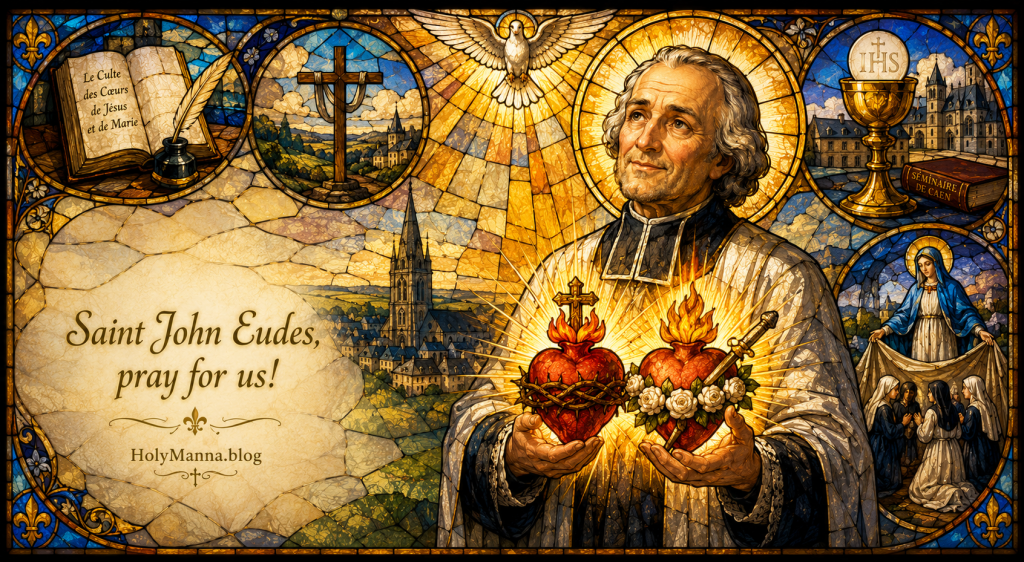
The Farmer’s Son Who Gave the Church the Hearts of Jesus and Mary
Some saints change the Church with a single dramatic moment. Saint John Eudes changed it with fifty years of relentless, unglamorous love. Born in 1601 in the little Norman village of Ri and dying at Caen on August 19, 1680, he lived through what the French still call the Great Century, an age of political turmoil, devastating plagues, the Thirty Years’ War, and, at the very same time, an astonishing flowering of holiness in France. Into that world stepped a priest who nursed the dying when everyone else fled, who preached more than a hundred parish missions, who built seminaries when almost no one was forming priests well, who opened a house of refuge for women the world had thrown away, and who, before anyone else, placed the Hearts of Jesus and Mary on the Church’s altars in public liturgical worship.
That last achievement is why the Church remembers him with a special title. When Pope Pius XI canonized him on May 31, 1925, he called John Eudes “the father, doctor, and apostle of the liturgical devotion to the hearts of Jesus and Mary.” Every Catholic who has ever prayed before an image of the Sacred Heart, celebrated the Feast of the Immaculate Heart of Mary, or whispered a prayer to the Heart of Jesus owes something to this tireless Norman priest. The Catechism teaches that Jesus “has loved us all with a human heart,” and that for this reason His Sacred Heart, pierced by our sins and for our salvation, is the sign and symbol of that infinite love (CCC 478). John Eudes spent his whole life making sure ordinary Catholics could see, celebrate, and imitate that love.
He holds several patronages. He is the patron of the two religious families he founded, the Eudists and the Order of Our Lady of Charity, the patron of the Diocese of Baie-Comeau in Québec, Canada, and he is invoked as a patron of missionaries. Given how he spent his life, every one of those titles fits him like a glove.
A Farmer’s Son Promised to Our Lady
John Eudes was born on November 14, 1601, at Ri, a small farming village in Normandy near Argentan, in the Diocese of Sées. His father, Isaac Eudes, worked the land, and his mother was Marthe Corbin. John was the eldest of seven children, and one of his younger brothers, François Eudes de Mézeray, would grow up to become one of the most famous historians in France. There is a beautiful detail about his very existence that John himself recorded. His parents had been childless, and they turned to the Blessed Virgin Mary, entrusting their hope for a family to her intercession. John was the answer to that prayer, and he knew it. Writing later in The Life and Kingdom of Jesus in Christian Souls, he recalled that he was born and raised in a parish placed under Our Lady’s protection and that he owed his being and his life to her prayers. From his first breath, this was a man who belonged to Mary.
His childhood piety was not a later embellishment. On Pentecost of 1613, at about twelve years old, he received his First Holy Communion, and around the age of fourteen he privately vowed perpetual chastity to God. His parents sent him to the Jesuit college at Caen, where he excelled. His father hoped he would come home, marry, and settle down as the eldest son of a farming family should. John respectfully refused. He had already given himself away, and he begged to continue his studies for God. His father relented.
On March 25, 1623, the Feast of the Annunciation, John entered the French Oratory in Paris, the community of priests founded by Cardinal Pierre de Bérulle. The choice of date was no accident for a man so devoted to Mary. The French Oratory was the beating heart of what would come to be called the French School of Spirituality, a movement of Catholic renewal that responded to the religious wars and the confusion of the age not with weapons but with a burning, Christ-centered interior life. John’s spiritual masters were Bérulle himself and Father Charles de Condren, two of the great spiritual teachers of the century. From them he absorbed the conviction that would define everything he later wrote and preached: the Christian life is not merely imitating Jesus from the outside, it is Jesus living His own life within the baptized soul. The Catechism teaches exactly this when it says that all Christ lived, He lived for us, and that “Christ enables us to live in him all that he himself lived, and he lives it in us” (CCC 521). Remarkably, in that very paragraph, the Catechism quotes Saint John Eudes by name, drawing on his teaching that “we must continue to accomplish in ourselves the stages of Jesus’ life and his mysteries and often to beg him to perfect and realize them in us and in his whole Church” (CCC 521). Very few saints have the honor of being quoted directly in the Catechism of the Catholic Church. This farmer’s son from Ri is one of them.
He was ordained a priest on December 20, 1625, at the age of twenty-four.
Plague Barrels, Parish Missions, and a House of Mercy
John’s priesthood began not in a pulpit but at deathbeds. In 1627, and again in 1631, plague swept through Normandy. The disease was terrifying and contagious, and many understandably kept their distance. John volunteered to go straight into the outbreak, hearing confessions, anointing the dying, and caring for the sick in his home diocese. His early biographers hand down a striking story from this period. So that he would not carry the infection back to his confreres, John is said to have lived apart from his community in a huge cider cask set in the middle of a field, sleeping in a barrel so that others might be safe. It is a story preserved and repeated in accounts of his life, though the detail of the barrel itself cannot be independently verified; it is told here as the cherished story his biographers recorded rather than as an established certainty. What is certain is the heroic charity behind it. He went to the plague-stricken when others fled, and he did it twice.
Around the age of thirty-two, John found the work that would occupy him for four decades: the parish mission. Seventeenth-century France was full of baptized Catholics who had never been properly taught the faith, and John became one of the most powerful mission preachers of his era. Over his lifetime he preached well over one hundred missions, with Eudist sources counting more than one hundred and twenty, some lasting from four weeks to as long as twenty. These were not quick weekend retreats. A Eudes mission meant weeks of daily preaching, teams of priests hearing confessions around the clock, and catechists meeting daily with small groups of parishioners. Whole towns were converted. His gifts as a preacher and confessor made him famous across Normandy and beyond, yet the substance of his preaching was never about himself. It was always the love of God made visible in the Heart of Jesus and the Heart of His Mother.
It is worth being honest here, because honesty honors a saint more than embellishment does. The sources of his life do not attribute dramatic wonder-working miracles to John Eudes during his lifetime, no levitations, no multiplied loaves. His miracles during life were of another kind: hardened sinners weeping in confessionals after decades away, plague victims dying with the sacraments instead of alone, and thousands of souls catechized who had never once heard the Gospel explained. The Church teaches that the works of mercy are “charitable actions by which we come to the aid of our neighbor in his spiritual and bodily necessities” (CCC 2447), and by that measure John’s entire ministry was one long act of God’s intervention through him.
Then came 1641, and one of the most humbling moments of his life. In Caen, a laywoman named Madeleine Lamy had taken into her care several women trying to escape prostitution, and she was overwhelmed. The tradition of the order that grew from this encounter preserves her blunt challenge to Father Eudes. She essentially asked him where he was going, supposing it was to church to mumble his prayers before the statues and feel very devout, and told him he would do better to build a house for these poor girls who would be lost for want of direction and resources. The exact wording comes down through the memory of the community she inspired, but the substance of the rebuke, and its effect, are documented history. John did not defend himself. He acted. On November 25, 1641, he founded the Order of Our Lady of Charity of the Refuge in Caen, a religious community whose whole purpose was to give shelter, dignity, education, and a path of penance and healing to women society had discarded. Three Visitation nuns came to help him begin, a house opened, the Bishop of Bayeux gave diocesan approval in 1651, and Pope Alexander VII granted papal approval on January 2, 1666. John gave the sisters a fourth vow beyond poverty, chastity, and obedience: a vow of zeal for souls. Centuries later, this foundation would blossom again when Saint Mary Euphrasia Pelletier founded the Sisters of Our Lady of Charity of the Good Shepherd from its stock, a congregation that spread across the entire world serving women and children. One overwhelmed laywoman’s challenge, received by one humble priest, became a river of mercy that is still flowing today.
Two years later, on March 25, 1643, again on the Annunciation, John made the hardest institutional decision of his life. Convinced that the deepest need of the Church in France was the formation of holy priests, and unable to pursue that work freely within the Oratory, he left the community that had formed him, with the support of Cardinal Richelieu and several bishops, and founded the Congregation of Jesus and Mary, known ever since as the Eudists. Their twofold mission was seminaries and parish missions. He opened his first seminary in the university town of Caen in 1644, and the work spread to Coutances, Lisieux, Rouen, Évreux, and Rennes. Pope Benedict XVI, teaching about John Eudes during the Year for Priests, explained that the saint founded this congregation precisely because he was lucidly aware of the grave spiritual need of souls caused by the inadequacy of so much of the clergy of his day. The Church teaches that priests are configured to Christ so as to act in the person of Christ the Head (CCC 1548), and John understood that souls could not meet the Heart of Jesus if the men ordained to bring Him to them did not know that Heart themselves. His exhortation to priests, quoted by Benedict XVI in that same catechesis, still burns: “Give yourselves to Jesus in order to enter the immensity of his great Heart which contains the Heart of his Holy Mother and the hearts of all the Saints and lose yourselves in this abyss of love, charity, mercy, humility, purity, patience, submission and holiness.”
And then there is the achievement for which heaven seems to have raised him up. On February 8, 1648, with episcopal approval, John Eudes celebrated the first public liturgical feast in honor of the Holy Heart of Mary, having composed the Mass and Office himself. In 1652 he built the first church ever placed under the patronage of the Immaculate Heart, the chapel of his seminary at Coutances. In 1670, following a mission and the founding of his seminary at Rennes, he celebrated the first Feast of the Sacred Heart of Jesus with the approval of the local bishop, and by 1672 he had composed a complete Mass and Office for the Sacred Heart. Pause on the dates. The great revelations of the Sacred Heart to Saint Margaret Mary Alacoque at Paray-le-Monial began in 1673. John Eudes had already been placing the Heart of Jesus on the altar before Jesus showed His Heart to Margaret Mary. Heaven, it seems, prepared the liturgy before publishing the revelation. For John, the two Hearts were never in competition and never separate; Jesus lived and reigned so completely in Mary that to honor her Heart was to honor Him, and to approach His Heart was to find hers beside it. The Church continues to pray in this key, invoking the Heart of Jesus and honoring the Immaculate Heart of Mary as the model of the Church’s own love (CCC 2669; CCC 967).
Through it all he wrote. His masterpieces, The Life and Kingdom of Jesus in Christian Souls and The Admirable Heart of the Most Holy Mother of God, remain classics of the French School. One line attributed to The Life and Kingdom of Jesus summarizes his whole vision: “The Christian life is a continuation and completion of the life of Christ in us. We should be so many Christs here on earth, continuing His life and His works.”
Slandered, Blocked, and Undeterred
John Eudes was not a martyr; he was a confessor, a saint who bore witness through endurance rather than blood. And endure he did, because his hardships were long, personal, and painful precisely where they could hurt a faithful priest the most.
Leaving the Oratory in 1643 cost him dearly. Many of his former confreres regarded his departure as betrayal and ambition, and he faced years of criticism and cold opposition from men he had loved as brothers. The Jansenists, whose rigid and gloomy theology John’s warm doctrine of the merciful Heart of Jesus directly contradicted, attacked him relentlessly. He was denounced, mocked, and slandered at court and in Rome. His new congregation, the Eudists, was refused the papal approval he longed for; despite repeated efforts, John died without ever seeing Rome formally approve the Congregation of Jesus and Mary, and the community simply kept working under the approval of the French bishops who trusted him. Imagine pouring your life into a work for the formation of holy priests and going to your grave with its highest approval still withheld. He also suffered criticism for his association with Marie des Vallées, a mystic of Coutances whose case was controversial in his own day; his confidence in her was used as ammunition against him. Through decades of this, John neither abandoned his work nor answered hatred with hatred. The Catechism teaches that interior conversion and penance are expressed in bearing wrongs patiently and enduring persecution for the sake of righteousness (CCC 1435; CCC 1808 on the virtue of fortitude), and John’s later years were a masterclass in exactly that fortitude.
His body broke down before his zeal did. Worn out by fifty years of missions, foundations, controversies, and penances, he spent his final months completing The Admirable Heart of the Most Holy Mother of God, finishing his life’s great book on the Heart of Mary shortly before his death. He died peacefully at Caen on August 19, 1680, at the age of seventy-eight, having given every drop of his strength to the two Hearts he loved.
Four Miracles, a Canonization, and a Statue in Saint Peter’s
The Church’s judgment on John Eudes came slowly and then gloriously. His cause opened in the Diocese of Sées in 1868, and Pope Pius IX formally introduced it in 1874. On January 6, 1903, Pope Leo XIII declared his virtues heroic, proclaimed him Venerable, and honored him with the title Author of the Liturgical Worship of the Sacred Heart. Two miracles attributed to his intercession were then examined and approved by the Church, leading Pope Saint Pius X to beatify him in Saint Peter’s Basilica on April 25, 1909. Two further miracles were approved for his canonization, and Pope Pius XI canonized him on May 31, 1925, during the Holy Year, the same day on which Saint John Vianney, the Curé of Ars, was also canonized. It is a fitting pairing: the patron of parish priests raised to the altars alongside the man who spent his life building seminaries to form them. The particulars of the four approved miracles, healings verified through the formal process of his cause, are preserved in the acts of that cause rather than in widely accessible accounts, so no details of them are narrated here; the Church’s solemn verification of them stands on its own. The Catechism teaches that by canonizing certain of the faithful, the Church recognizes the power of the Spirit of holiness within her and sustains the hope of believers by proposing the saints as models and intercessors (CCC 828).
His visible legacy is everywhere once you know to look for it. A statue of Saint John Eudes, carved by Silvio Silva in 1932, stands among the founders of religious orders in Saint Peter’s Basilica in Rome. Another statue of him adorns the Basilica of Our Lady of the Rosary at Fátima in Portugal, showing him holding the Sacred Heart of Jesus. His birthplace at Ri in Normandy is preserved and visited by pilgrims, and Caen, the city of his labors and his death, remains the historical heart of the Eudist family. The Eudists continue his work of priestly formation and evangelization across Europe, Africa, and the Americas, which is why the Diocese of Baie-Comeau in Québec, a land served by Eudist missionaries, claims him as patron. The Sisters of Our Lady of Charity and the worldwide Good Shepherd Sisters continue the mercy that began with Madeleine Lamy’s challenge in 1641. In 1928, three years after his canonization, Pope Pius XI issued the encyclical Miserentissimus Redemptor on reparation to the Sacred Heart, and the twentieth century saw the devotion John pioneered embraced by the whole Church, with the Feast of the Immaculate Heart of Mary now on the universal calendar. Bishops from around the world have petitioned the Holy See to declare him a Doctor of the Church, a recognition of the depth and purity of doctrine that the scholars of his cause found in his writings. On August 19, 2009, Pope Benedict XVI devoted an entire General Audience to him, holding him up during the Year for Priests as a model for the formation of clergy. Nearly three and a half centuries after his death, the Church is still learning from him.
Letting Jesus Live His Life in You
What does a seventeenth-century Norman missionary have to say to you, right now, in a world of screens and schedules? More than almost anyone, because his central teaching is not about the seventeenth century at all. It is about what your Baptism actually did to you.
John Eudes taught, and the Catechism teaches with him, that Jesus Christ does not merely stand outside your life as an example to copy. He desires to live His own life in you, to continue His mysteries in you, to love the Father and love your neighbor through your heart (CCC 521). The passage from his writings that the Church reads in the Liturgy of the Hours on his feast day puts it directly: “I ask you to consider that our Lord Jesus Christ is your true head, and that you are one of his members.” Everything that is His is yours. His Heart is yours. That is not poetry; that is baptismal reality (CCC 1265 to 1266). When was the last time you approached prayer not as talking to a distant God but as letting Jesus love the Father from within you?
His life also preaches. He went toward the plague when everyone ran from it. He let a frustrated laywoman’s rebuke pierce his pride, and instead of defending his devotions he built a house of mercy. He endured slander from brothers, rejection from Rome, and decades of Jansenist contempt without growing bitter, because his confidence rested in a Heart that could not fail him. There is a lesson in each of these. Compassion means moving toward suffering, not observing it. Humility means letting God correct us through inconvenient people. Fortitude means continuing the work when approval is withheld (CCC 1808). Who is the Madeleine Lamy in your life, the person whose uncomfortable challenge might actually be the voice of God? And where have you quietly decided to stop serving because no one thanked or approved you?
Practical devotion follows naturally from his story. Consider consecrating your morning each day to the Sacred Heart of Jesus and the Immaculate Heart of Mary, even in a single sentence. Return to confession the way the crowds at his missions did, honestly and without delay, trusting the mercy of the Heart of Jesus rather than fearing His justice (CCC 1428; CCC 1465). Pray for priests and seminarians by name, because John Eudes staked his whole life on the truth that holy priests are formed, not found. Perform one hidden work of mercy this week for someone the world overlooks, in honor of the women of the Refuge. Sainthood, in his school, is not spectacular. It is Jesus, continued.
Engage With Us!
Saint John Eudes still has more to teach, and the conversation continues with you. Share your thoughts, your questions, and your own experiences with devotion to the Hearts of Jesus and Mary in the comments below. To help you reflect, pray with these questions:
- Saint John Eudes taught that the Christian life is Jesus continuing His own life in you. What is one concrete area of your daily routine where you could consciously invite Jesus to act through you this week?
- Madeleine Lamy’s blunt challenge changed the course of his life and of Church history. Is there a criticism you have been resisting that might actually be an invitation from God?
- John cared for plague victims at the risk of his own life. What fear currently keeps you from serving someone who needs you?
- He spent decades building seminaries because he believed holy priests change the world. How often do you pray for your parish priest by name, and could you begin today?
- He honored the Heart of Mary and the Heart of Jesus as inseparable. How might deepening your relationship with Mary lead you closer to her Son this month?
Saint John Eudes gave fifty years to one conviction: that the Heart of Jesus is real, burning, and meant for you. Take that conviction into your week. Love the people in front of you with patience when it is inconvenient, serve without waiting for approval, and let the mercy that Jesus taught us flow through your hands, your words, and your heart.
Saint John Eudes, father of the devotion to the Two Hearts, pray for us!
Follow us on YouTube, TikTok, Instagram and Facebook for more insights and reflections on living a faith-filled life.

 Holy Manna!
Leave a comment