Wednesday of the Twentieth Week in Ordinary Time – Lectionary: 421
When the Boss Fires Everyone and Does the Job Himself
Everyone has worked under a bad boss, or watched a leader fail the very people depending on him. Today’s readings for Wednesday of the Twentieth Week in Ordinary Time speak directly into that wound, and then heal it in a way nobody expects. In the Book of Ezekiel, God surveys the leaders of Israel, the kings and priests he appointed to shepherd his people, and finds them fattening themselves while the flock starves, scatters, and gets eaten alive. His response is breathtaking. He does not send a better manager. He announces that he is coming to do the job personally: “I myself will look after and tend my sheep.” Psalm 23 then shows the world what that personal shepherding looks like, green pastures, restful waters, a table spread in the presence of enemies. And in the Gospel of Matthew, Jesus reveals the economics of this divine Shepherd through the parable of the vineyard laborers, where the workers hired at five o’clock receive the same full wage as those hired at dawn. Human leadership exploits; God’s leadership provides. Human math demands proportion; God’s math overflows with generosity. The central theme uniting these readings is that God himself takes responsibility for his people, and his care runs on mercy rather than merit. Written to exiles in Babylon who had lost everything because of failed leadership, Ezekiel’s promise became the seed of the Good Shepherd, fulfilled when the Lord took flesh and said, “I am the good shepherd. A good shepherd lays down his life for the sheep” (John 10:11). Today the Church invites every reader to stop keeping score and start trusting the Shepherd.
First Reading — Ezekiel 34:1-11
The Day God Fired the Shepherds
Ezekiel spoke these words from exile in Babylon, after Jerusalem had fallen in 587 BC and the survivors were asking how everything had gone so wrong. His answer was uncomfortable: the shepherds failed. In the ancient Near East, “shepherd” was the standard title for kings; even pagan rulers like Hammurabi claimed it. So when Ezekiel prophesies against “the shepherds of Israel,” his audience knew exactly who was on trial, the kings, priests, and elders entrusted with God’s people. This oracle fits the day’s theme perfectly, because it ends not with despair over human failure but with God’s stunning decision to take the shepherd’s staff into his own hands.
Ezekiel 34:1-11
The word of the Lord came to me:
Son of man, prophesy against the shepherds of Israel,
in these words prophesy to them to the shepherds:
Thus says the Lord GOD: Woe to the shepherds of Israel
who have been pasturing themselves!
Should not shepherds, rather, pasture sheep?
You have fed off their milk, worn their wool,
and slaughtered the fatlings,
but the sheep you have not pastured.
You did not strengthen the weak nor heal the sick
nor bind up the injured.
You did not bring back the strayed nor seek the lost,
but you lorded it over them harshly and brutally.
So they were scattered for the lack of a shepherd,
and became food for all the wild beasts.
My sheep were scattered
and wandered over all the mountains and high hills;
my sheep were scattered over the whole earth,
with no one to look after them or to search for them.Therefore, shepherds, hear the word of the LORD:
As I live, says the Lord GOD,
because my sheep have been given over to pillage,
and because my sheep have become food for every wild beast,
for lack of a shepherd;
because my shepherds did not look after my sheep,
but pastured themselves and did not pasture my sheep;
because of this, shepherds, hear the word of the LORD:
Thus says the Lord GOD:
I swear I am coming against these shepherds.
I will claim my sheep from them
and put a stop to their shepherding my sheep
so that they may no longer pasture themselves.
I will save my sheep,
that they may no longer be food for their mouths.For thus says the Lord GOD:
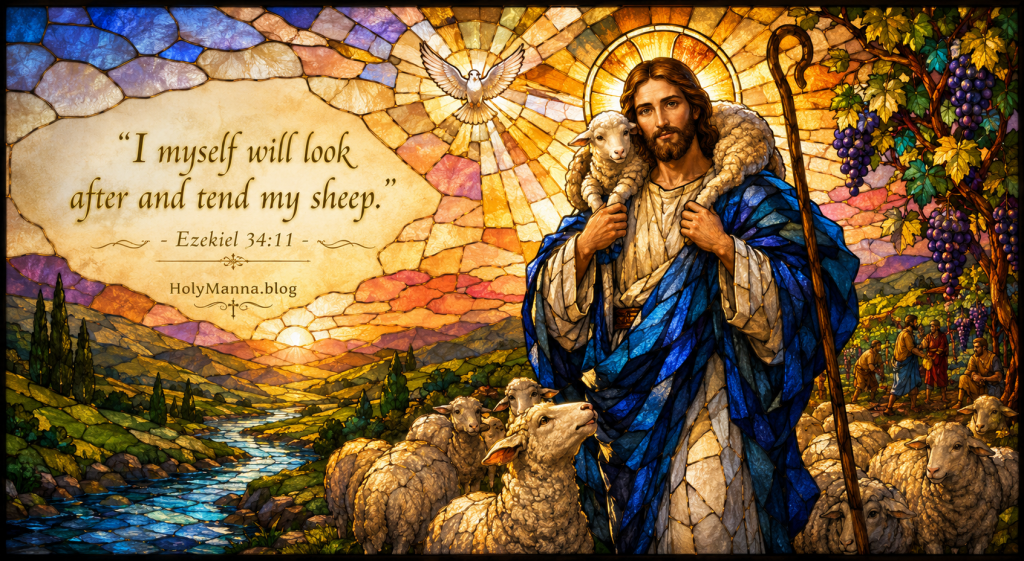
I myself will look after and tend my sheep.
Detailed Exegesis
Verses 1-2: “The word of the Lord came to me: Son of man, prophesy against the shepherds of Israel, in these words prophesy to them to the shepherds: Thus says the Lord GOD: Woe to the shepherds of Israel who have been pasturing themselves! Should not shepherds, rather, pasture sheep?”
The prophetic “woe” is a funeral cry, language reserved for the dead. God pronounces it over living leaders because their leadership has already died. The indictment is contained in one devastating reversal: shepherds exist to feed sheep, and these shepherds have been feeding on them. The rhetorical question exposes how obvious the failure is; even a child knows what a shepherd is for.
Verses 3-4: “You have fed off their milk, worn their wool, and slaughtered the fatlings, but the sheep you have not pastured. You did not strengthen the weak nor heal the sick nor bind up the injured. You did not bring back the strayed nor seek the lost, but you lorded it over them harshly and brutally.”
God lists five duties the shepherds abandoned: strengthening the weak, healing the sick, binding the injured, retrieving the strayed, and seeking the lost. Notice that every duty concerns the vulnerable. A shepherd’s quality is measured not by how the strong sheep fare but by what happens to the wounded ones. The leaders took the benefits of office, milk, wool, and meat, while refusing its burdens, and governed with harshness instead of tenderness.
Verses 5-6: “So they were scattered for the lack of a shepherd, and became food for all the wild beasts. My sheep were scattered and wandered over all the mountains and high hills; my sheep were scattered over the whole earth, with no one to look after them or to search for them.”
The scattering describes the exile itself. Historically, Israel was dispersed to Assyria and Judah to Babylon; spiritually, souls without pastoral care wander into danger and become prey. Listen to the possessive pronoun repeated like a heartbeat: “my sheep.” God never stopped claiming his people, even when their leaders stopped caring for them.
Verses 7-8: “Therefore, shepherds, hear the word of the LORD: As I live, says the Lord GOD, because my sheep have been given over to pillage, and because my sheep have become food for every wild beast, for lack of a shepherd; because my shepherds did not look after my sheep, but pastured themselves and did not pasture my sheep.”
God swears by his own life, the most solemn oath possible, because there is nothing greater to swear by. The repetition of the charges is deliberate courtroom language; the verdict is being read into the record before sentencing.
Verses 9-10: “Because of this, shepherds, hear the word of the LORD: Thus says the Lord GOD: I swear I am coming against these shepherds. I will claim my sheep from them and put a stop to their shepherding my sheep so that they may no longer pasture themselves. I will save my sheep, that they may no longer be food for their mouths.”
The sentence falls: removal from office. God will personally reclaim the flock. The chilling phrase “food for their mouths” reveals that the wild beasts were never the worst predators; the shepherds themselves were devouring the flock.
Verse 11: “For thus says the Lord GOD: I myself will look after and tend my sheep.”
This is the hinge of salvation history in miniature. God does not merely promise better management; he promises his own presence. The Church reads this verse as fulfilled in Jesus Christ, who declared himself the Good Shepherd and laid down his life for the sheep, doing personally everything the failed shepherds refused to do.
Teachings
The Catechism draws a straight line from Ezekiel’s promise to the Church: “The Church is, accordingly, a sheepfold, the sole and necessary gateway to which is Christ. It is also the flock of which God himself foretold that he would be the shepherd, and whose sheep, even though governed by human shepherds, are unceasingly led and nourished by Christ himself, the Good Shepherd and Prince of Shepherds, who gave his life for his sheep” (CCC 754). The Catechism also makes Ezekiel’s standard binding on every bishop: “The Good Shepherd ought to be the model and ‘form’ of the bishop’s pastoral office” (CCC 896). St. Augustine preached an entire sermon series on this very chapter, Sermon 46, De Pastoribus, warning clergy against seeking their own benefit from the flock, and he summarized the right posture of a pastor in his famous words from Sermon 340: “For you I am a bishop; with you, after all, I am a Christian.” St. Gregory the Great, a pope formed by Ezekiel’s warnings, opened his Pastoral Rule by calling “the government of souls the art of arts,” insisting that no one should presume to shepherd souls carelessly when even physical wounds require a trained physician. Church history offers sobering confirmation; whenever pastors have pursued wealth or power, from the corruptions that preceded the Gregorian reforms to scandals in living memory, the flock has scattered, and renewal has always come when shepherds returned to Ezekiel’s five duties toward the weak, the sick, the injured, the strayed, and the lost.
Reflection
This reading is not only for clergy. Every baptized person shepherds someone, a child, a spouse, an employee, a friend, an aging parent. Ezekiel’s five failed duties become an examination of conscience: strengthening the weak, healing the sick, binding the injured, bringing back the strayed, seeking the lost. A practical step for today is to choose one person under one’s care who is struggling and do one concrete act of tending, a phone call, a meal, an honest conversation, a prayer offered by name. Another step is to pray for priests and bishops, who carry this oracle’s weight daily and need the flock’s intercession. Who has God placed in your care, and which of the five shepherd’s duties have you been neglecting? When you hold any kind of authority, do you use it to feed others or to feed yourself? Have you ever been wounded by a failed shepherd, and can you bring that wound to the God who says he himself will tend you?
Responsorial Psalm — Psalm 23:1-6
What It Feels Like When God Holds the Staff
If Ezekiel announces that God will shepherd his people personally, Psalm 23 describes the experience from inside the flock. David composed it with a shepherd’s calloused hands and a poet’s heart; he had guarded sheep in the Judean wilderness long before he wore a crown, so every image comes from lived experience. The psalm answers today’s First Reading like a testimony answers a promise, showing exactly what the flock receives when the Lord himself does the tending.
Psalm 23:1-6
R. (1) The Lord is my shepherd; there is nothing I shall want.
The LORD is my shepherd; I shall not want.
In verdant pastures he gives me repose;
Beside restful waters he leads me;
he refreshes my soul.
R. The Lord is my shepherd; there is nothing I shall want.
He guides me in right paths
for his name’s sake.
Even though I walk in the dark valley
I fear no evil; for you are at my side
With your rod and your staff
that give me courage.
R. The Lord is my shepherd; there is nothing I shall want.
You spread the table before me
in the sight of my foes;
You anoint my head with oil;
my cup overflows.
R. The Lord is my shepherd; there is nothing I shall want.
Only goodness and kindness will follow me
all the days of my life;
And I shall dwell in the house of the LORD
for years to come.
R. The Lord is my shepherd; there is nothing I shall want.
Detailed Exegesis
Verse 1: “The LORD is my shepherd; I shall not want.”
Six words carry the whole spiritual life. The verse does not say the sheep will have everything it desires but that it will lack nothing it needs. Where Ezekiel’s shepherds created want through neglect, this Shepherd’s presence itself is provision.
Verses 2-3: “In verdant pastures he gives me repose; beside restful waters he leads me; he refreshes my soul. He guides me in right paths for his name’s sake.”
In the semi-arid hills of Judea, green pasture and calm water are not scenery; they are survival, and finding them requires a shepherd who knows the land. The phrase “for his name’s sake” grounds everything in God’s own faithfulness rather than the sheep’s worthiness; God guides rightly because of who he is.
Verse 4: “Even though I walk in the dark valley I fear no evil; for you are at my side with your rod and your staff that give me courage.”
Here the psalm shifts from talking about God to talking to him. Theology becomes intimacy precisely in the dark valley. The rod defended against predators and the staff pulled sheep from crevices; God’s protection and rescue accompany the soul through suffering rather than around it.
Verse 5: “You spread the table before me in the sight of my foes; you anoint my head with oil; my cup overflows.”
The image expands from shepherd to host. The Fathers of the Church, notably St. Ambrose and St. Cyril of Jerusalem in their instructions to the newly baptized, taught that these verses point to the sacraments, the anointing of Confirmation and the table and cup of the Eucharist, where God feeds his flock in the very sight of every enemy, including sin and death.
Verse 6: “Only goodness and kindness will follow me all the days of my life; and I shall dwell in the house of the LORD for years to come.”
The Hebrew verb behind “follow” suggests pursuit. Goodness and mercy do not trail passively; they chase the believer down, a perfect echo of the God who promised to seek the lost. The psalm ends where every Catholic life aims, dwelling in the house of the Lord.
Teachings
The Church places this Shepherd’s ministry concretely in the confessional: “When he celebrates the sacrament of Penance, the priest is fulfilling the ministry of the Good Shepherd who seeks the lost sheep, of the Good Samaritan who binds up wounds, of the Father who awaits the prodigal son and welcomes him on his return, and of the just and impartial judge whose judgment is both just and merciful” (CCC 1465). Notice how directly this paragraph answers Ezekiel; the seeking and binding the old shepherds refused, Christ now performs through his priests in every confession. The sacramental reading of the psalm belongs to solid patristic tradition; St. Cyril of Jerusalem, teaching the newly baptized of the fourth century, presented the anointing and the table as figures of Chrismation and the Eucharist, and St. Ambrose formed his catechumens in Milan with the same vision, so that Christians for sixteen centuries have prayed this psalm on the way to Communion.
Reflection
A soul that trusts the Shepherd stops living in scarcity. One concrete practice is to pray Psalm 23 slowly before receiving the Eucharist this week, letting verse five land at the moment the table is spread on the altar. Another is to name the current dark valley honestly in prayer, then add David’s confession, for you are at my side. Which verse of this psalm is hardest for you to believe right now, and why? Do you approach Confession as a courtroom or as the Good Shepherd’s rescue of a sheep from a crevice? If goodness and mercy are truly pursuing you, what would change about how you face tomorrow?
Holy Gospel — Matthew 20:1-16
The Paycheck That Scandalized the Payroll
Jesus tells this parable right after Peter asks, in Matthew 19:27, what the disciples will receive for having left everything. The answer comes wrapped in the economics of a Galilean harvest. Day laborers were the most vulnerable workers in the ancient world; they stood in the marketplace at dawn hoping for hire, and the denarius, the usual daily wage, was roughly what a family needed to eat that day. A man unhired by evening went home to hungry children. Into that world Jesus drops a landowner whose payroll practices reveal the very heart of the God who said, “I myself will look after and tend my sheep.”
Matthew 20:1-16
Jesus told his disciples this parable:
“The Kingdom of heaven is like a landowner
who went out at dawn to hire laborers for his vineyard.
After agreeing with them for the usual daily wage,
he sent them into his vineyard.
Going out about nine o’clock,
he saw others standing idle in the marketplace,
and he said to them, ‘You too go into my vineyard,
and I will give you what is just.’
So they went off.
And he went out again around noon,
and around three o’clock, and did likewise.
Going out about five o’clock,
he found others standing around, and said to them,
‘Why do you stand here idle all day?’
They answered, ‘Because no one has hired us.’
He said to them, ‘You too go into my vineyard.’
When it was evening the owner of the vineyard said to his foreman,
‘Summon the laborers and give them their pay,
beginning with the last and ending with the first.’
When those who had started about five o’clock came,
each received the usual daily wage.
So when the first came, they thought that they would receive more,
but each of them also got the usual wage.
And on receiving it they grumbled against the landowner, saying,
‘These last ones worked only one hour,
and you have made them equal to us,
who bore the day’s burden and the heat.’
He said to one of them in reply,
‘My friend, I am not cheating you.
Did you not agree with me for the usual daily wage?
Take what is yours and go.
What if I wish to give this last one the same as you?
Or am I not free to do as I wish with my own money?
Are you envious because I am generous?’
Thus, the last will be first, and the first will be last.”
Detailed Exegesis
Verses 1-2: “The Kingdom of heaven is like a landowner who went out at dawn to hire laborers for his vineyard. After agreeing with them for the usual daily wage, he sent them into his vineyard.”
The strangeness begins immediately; landowners sent stewards to hire workers, yet this owner goes personally, at dawn, and keeps going back all day. The vineyard is a classic biblical image for Israel and for the Kingdom, and the owner’s personal initiative mirrors the God of Ezekiel who refuses to delegate the care of his own.
Verses 3-5: “Going out about nine o’clock, he saw others standing idle in the marketplace, and he said to them, ‘You too go into my vineyard, and I will give you what is just.’ So they went off. And he went out again around noon, and around three o’clock, and did likewise.”
Only the dawn workers negotiate a contract; the later groups receive simply a promise of justice and go on trust. The owner’s repeated trips to the marketplace show a seeking heart; he is not short on labor, he is long on mercy.
Verses 6-7: “Going out about five o’clock, he found others standing around, and said to them, ‘Why do you stand here idle all day?’ They answered, ‘Because no one has hired us.’ He said to them, ‘You too go into my vineyard.’”
Five o’clock leaves one working hour before sunset. No sane employer hires then, and no promise of payment is even mentioned. The answer “because no one has hired us” is one of the saddest lines in the Gospels, the voice of everyone overlooked, rejected, or written off, and the owner’s response is pure grace.
Verses 8-9: “When it was evening the owner of the vineyard said to his foreman, ‘Summon the laborers and give them their pay, beginning with the last and ending with the first.’ When those who had started about five o’clock came, each received the usual daily wage.”
Paying the last first is deliberate; the dawn workers are made to watch. The one-hour workers receive a full denarius, a full day’s bread for their families, not because they earned it but because the owner is good.
Verses 10-12: “So when the first came, they thought that they would receive more, but each of them also got the usual wage. And on receiving it they grumbled against the landowner, saying, ‘These last ones worked only one hour, and you have made them equal to us, who bore the day’s burden and the heat.’”
The first workers receive exactly what justice promised, yet generosity to others makes justice feel like insult. Their true complaint is equality itself: “you have made them equal to us.” Envy cannot enjoy its own gift while watching another receive one.
Verses 13-15: “My friend, I am not cheating you. Did you not agree with me for the usual daily wage? Take what is yours and go. What if I wish to give this last one the same as you? Or am I not free to do as I wish with my own money? Are you envious because I am generous?’”
The owner commits no injustice; he pays the contract in full and then exceeds justice with the others. The final question exposes the wound literally rendered as an evil eye in the Greek text, a gaze that sours at another’s blessing. God’s generosity is never subtracted from anyone; grace is not a pie that runs out.
Verse 16: “Thus, the last will be first, and the first will be last.”
The Kingdom overturns every seniority system. Entrance and reward flow from God’s free gift, so the latecomer, the deathbed convert, and the prodigal stand shoulder to shoulder with the lifelong laborer, all equally rich in the one wage that matters, eternal life with God.
Teachings
This parable anchors the Church’s doctrine of grace and merit. The Catechism teaches: “With regard to God, there is no strict right to any merit on the part of man. Between God and us there is an immeasurable inequality, for we have received everything from him, our Creator” (CCC 2007). Even the ability to work in the vineyard at all is gift, for as CCC 1996 teaches, “Our justification comes from the grace of God. Grace is favor, the free and undeserved help that God gives us to respond to his call to become children of God, adoptive sons, partakers of the divine nature and of eternal life.” St. John Chrysostom, in his sixty-fourth homily on Matthew, taught that the parable exists to encourage those who turn to God late in life, so that no one converted in old age despairs of receiving the full reward. St. Gregory the Great, in his nineteenth homily on the Gospels, read the hours of the day as the ages of a human life, teaching that God calls some in childhood, some in youth, some in maturity, and some at the very end, and that what matters is answering when called. The Catechism gives the parable a face in St. Thérèse of Lisieux, quoting her own words: “In the evening of this life, I shall appear before you with empty hands, for I do not ask you, Lord, to count my works. All our justice is blemished in your eyes. I wish, then, to be clothed in your own justice and to receive from your love the eternal possession of yourself” (CCC 2011). The Doctor of the little way understood the vineyard perfectly; the wage was never a salary, it was always a gift.
Reflection
The honest question is which worker each reader resembles today. Longtime Catholics can quietly become dawn workers, resentful when God is lavish with people who seem to have skipped the burden and the heat. A concrete step is to pray sincerely for one person whose blessings currently provoke envy, asking God to convert the evil eye into a rejoicing one. Another is to stop postponing conversion; five o’clock people still get hired, and it is not yet sunset. A third is to thank God daily for the wage itself, since eternal life cannot be earned at any hour. When God is generous to someone you think deserves less, does your heart rejoice or grumble? Where in your life are you still standing idle because no one has hired you, and can you hear the Owner calling now? If you appeared before God this evening with empty hands like St. Thérèse, would you trust his generosity to fill them?
Come Home to the Shepherd Who Pays in Full
Today’s readings tell one continuous story. In Ezekiel 34, God looks at the shepherds who devoured his flock and makes the promise that changes history: “I myself will look after and tend my sheep.” In Psalm 23, David sings what that promise feels like from inside the flock, green pastures, still waters, courage in the dark valley, and a table spread by God’s own hands. In Matthew 20, Jesus reveals the Shepherd’s economics, a vineyard owner who seeks workers at every hour and pays the last as generously as the first. The failed shepherds took; the true Shepherd gives. Human justice calculates; divine mercy overflows. This is not an abstraction for people in Scripture; it is the living reality of every Mass, where the Good Shepherd still spreads the table, still anoints, still fills the cup to overflowing, and still pays wages no one could ever earn. Whoever has been wounded by a bad shepherd can bring that wound to the God who swore by his own life to tend his sheep personally. Whoever feels it is too late, too much time wasted, too many hours standing idle in the marketplace, can hear the Owner’s voice at five o’clock saying, you too, go into my vineyard. And whoever has labored faithfully since dawn can trade the grumbling ledger for gratitude, because the wage was always going to be infinitely more than the work. The invitation today is simple: return to the sacraments, kneel before the spread table, and let the Shepherd do what he promised. He never quits. He seeks the lost until he finds them, and he pays in full.
Engage With Us!
The comments below are open, and every reflection shared there helps another traveler on the road, so readers are warmly invited to share what today’s readings stirred in their hearts. These questions can help start the conversation:
- In Ezekiel 34:1-11, God names five duties the shepherds abandoned: strengthening the weak, healing the sick, binding the injured, bringing back the strayed, and seeking the lost. Which of these is God asking you to practice toward someone in your life this week?
- In Psalm 23:1-6, David declares that he fears no evil in the dark valley because God is at his side. What dark valley are you walking through right now, and what would it mean to walk it with the Shepherd instead of alone?
- In Matthew 20:1-16, the dawn workers grumble because the landowner made the latecomers equal to them. When have you struggled with God’s generosity toward someone else, and what would it take to rejoice in it instead?
- Taken together, today’s readings reveal a God who personally tends his flock and gives far beyond what anyone earns. Where in your life do you most need to stop keeping score and start trusting the Shepherd’s generosity?
Living a life of faith is not about clocking hours or earning wages; it is about belonging to a Shepherd who knows his sheep by name and withholds nothing good from them. May every reader leave today’s readings resolved to tend the people God has entrusted to them, to trust the Shepherd in every valley, and to do everything, at whatever hour they were called, with the love and mercy Jesus taught us.
Sacred Heart of Jesus, we trust in You!
Immaculate Heart of Mary, pray for us!
Saint Michael the Archangel, defend us in battle!
Follow us on YouTube, TikTok, Instagram and Facebook for more insights and reflections on living a faith-filled life.


Leave a Reply