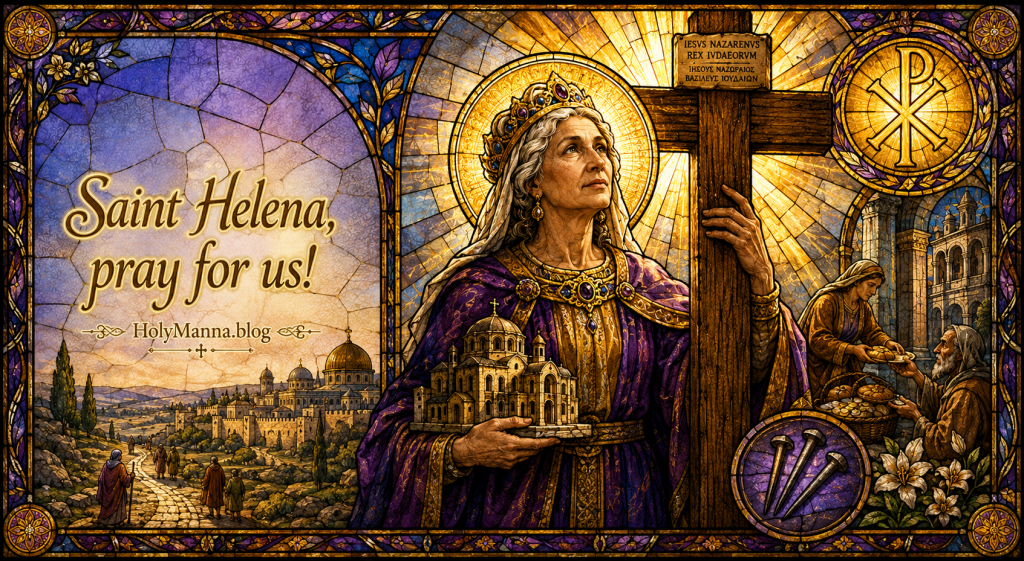
The Empress Who Went Digging for God
Every August 18th, the Church remembers a woman who spent the first sixty years of her life outside the faith and the last twenty rearranging the world for it. Saint Helena, mother of Emperor Constantine the Great, began her story pouring drinks and tending animals at a roadside inn in Asia Minor. She ended it as Augusta of the Roman Empire, the most powerful woman in the world, on her knees in the dirt of Jerusalem. In between, she was married, discarded for political convenience, separated from her only son, and left in obscurity for nearly two decades. If anyone had a right to grow bitter, it was Helena. Instead, she became one of the most beloved saints in the history of the Church, the woman whom early tradition credits with finding the True Cross of Jesus Christ.
Helena matters because she embodies a truth the Church never tires of proclaiming: God is not finished with anyone, and He is especially not finished with those the world has set aside. The Catechism teaches that the saints who have gone before remain intimately bound to those still on the journey, for “they do not cease to intercede with the Father for us” (CCC 956). Helena has been interceding for a very long time, and the faithful have long turned to her in situations that mirror her own wounds. In Catholic devotional tradition she is honored as the patroness of converts, of difficult marriages, of divorced people, of empresses, and of archaeologists, and she is invoked for new discoveries. The city of Helena, Montana, bears her name, as does the remote island of Saint Helena in the South Atlantic. Not bad for a stable-maid from Bithynia.
Her feast on August 18th is an invitation to every reader who feels that the best chapters are behind them, or that faith arrived too late to matter. Helena’s entire public life as a Christian happened after most people today would be collecting retirement benefits. What might God still be planning to do with the years you have left?
From the Stables of Bithynia to the Palace of an Emperor
Helena was born around the year 246 to 248 in Drepanum, a small town on the Gulf of Nicomedia in Bithynia, in what is today northwestern Turkey. Her origins were genuinely humble. Saint Ambrose of Milan, preaching at the funeral of Emperor Theodosius in the year 395, called her a stabularia, a maid who served in a stable or an inn, and he turned the detail into a compliment, praising her as “a good stable-maid, who so diligently sought the manger of the Lord” (De obitu Theodosii 42). Ambrose saw in her lowly beginnings an echo of Bethlehem itself. The girl who worked among mangers would one day build a basilica over the manger.
A later story told by medieval English chroniclers claimed that Helena was actually a British princess, the daughter of a king. The Catholic Encyclopedia judges this account to be entirely without historical foundation, apparently born of a misread phrase in an old imperial panegyric, so it is set aside here as a story that cannot be verified and is almost certainly untrue.
Around the year 270, Helena met a rising Roman officer named Constantius Chlorus. She became his lawful wife, and around the year 272, though some older sources give 274, she bore their only child at Naissus in the Balkans, a boy named Constantine. For roughly two decades Helena lived as the wife of an increasingly important man. Then politics intervened. When Constantius was elevated to the rank of Caesar in the new imperial tetrarchy, around the years 289 to 292 depending on the source, he set Helena aside and married Theodora, the stepdaughter of the senior emperor Maximian. The marriage that had lifted Helena out of the stable dissolved in an instant, and with it went her position, her security, and much of her access to her son, who was sent east to serve at the court of Diocletian.
Everything changed in the year 306, when Constantius died at York and his troops acclaimed young Constantine as emperor. One of Constantine’s first acts was to bring his mother out of obscurity and into his court, probably first at Trier and later at Rome. He honored her publicly and, after his victory over Licinius made him sole master of the empire, he conferred on her the title Augusta around 324 to 325. Coins were struck across the empire bearing the image and name of Flavia Helena Augusta. The discarded innkeeper’s daughter was now, by law and acclamation, the first lady of the Roman world.
The most important change, though, was not political. The Church historian Eusebius, a contemporary who knew the imperial family, records that Constantine led his mother to the Christian faith. Since Constantine’s own turn to Christ followed the Battle of the Milvian Bridge in 312, Helena entered the Church when she was already past sixty years old. Eusebius is emphatic that her conversion was no court formality. From that moment she lived an earnestly Christian life, and she threw the full weight of her position and her wealth behind the spread of the Gospel. The Church teaches that conversion is not a single moment but a lifelong labor of the heart, and Helena’s final decades prove the point; the Catechism speaks of an “uninterrupted task for the whole Church” of penance and renewal (CCC 1428). Helena took up that task at an age when the world expected nothing more from her.
The Empress on Her Knees
What did the most powerful woman in the world do with her power? Eusebius gives a remarkable answer, and it is worth hearing in his own words, because no wonder-working is recorded of Helena during her lifetime in the historical sources. Her documented miracle was mercy. As she traveled through the eastern provinces, Eusebius writes, she showered gifts on whole cities and on individual petitioners alike, and “especially abundant were the gifts she bestowed on the naked and unprotected poor” (The Life of Constantine, Book III, Chapter 44). He goes on to record that “she liberated some from imprisonment, or from the bitter servitude of the mines”, delivered others from unjust oppression, and recalled exiles to their homes. This is a portrait of the corporal works of mercy carried out on an imperial scale, and it is exactly what the Church means when she teaches that “the works of mercy are charitable actions by which we come to the aid of our neighbor in his spiritual and bodily necessities” (CCC 2447).
Eusebius adds a detail that says everything about her heart. The Augusta of the Roman Empire, who could have commanded private liturgies in palace chapels, chose instead to slip into ordinary churches in modest clothing and pray in the crowd with everyone else. She also adorned houses of worship with rich gifts, not forgetting, Eusebius notes, even the humblest chapels in the smallest towns.
Then came the pilgrimage that made her immortal in Christian memory. Around the year 326, when she was approaching eighty years of age, Helena set out for the Holy Land. Eusebius, who documents the journey, says she resolved to bring to God, the King of kings, the homage of her devotion, and to pray at the places where the Savior’s feet had touched the earth. Two churches rose through her patronage on the two great caves of the Gospel: the Church of the Nativity over the grotto of Bethlehem, and the Eleona on the Mount of Olives, at the place associated with the Ascension. These foundations are documented history, attested by her contemporary. Tradition also links her name to church building in Rome and in Trier, and there is no strong reason to doubt it.
It is here that the most famous story of her life enters, and it must be told honestly. According to a tradition first attested in the late fourth century, Helena undertook a search for the Cross of Christ itself. Golgotha had been deliberately buried under a pagan temple in the previous century, and the tradition holds that Helena directed the excavation of the site. Saint Ambrose, preaching in 395, gives the earliest surviving narrative naming her: Helena found three crosses in a mound at Golgotha, together with the title that had hung above the Lord’s head, reading Jesus the Nazarene, King of the Jews. Because three crosses lay together, the true Cross had to be identified, and the accounts describe a miracle of discernment. In the version told by the historians Rufinus and Socrates, Bishop Macarius of Jerusalem had the crosses touched to a gravely ill woman, who was instantly healed at the touch of the third; some later accounts speak instead of a dead man restored to life. The differing versions are themselves a signal that this account is handed down as sacred tradition rather than as court record. Eusebius, who knew Helena and described her pilgrimage in detail, never mentions her finding the Cross, though Saint Cyril of Jerusalem confirms as early as 348 that the wood of the Cross had been found in Jerusalem and was already venerated throughout the world. Helena’s personal role in the discovery, treasured by the Church from Ambrose onward, is a tradition and cannot be verified as documented history.
What can be verified is how the early Church understood the discovery, and Ambrose’s words remain the perfect safeguard against superstition: “She worshipped the King, not the wood, indeed, because this is an error of the Gentiles and a vanity of the wicked; but she worshipped him who hung on the tree” (De obitu Theodosii 46). That single sentence is a whole catechesis on relics. The Church venerates the Cross because of the One who hung upon it, in exactly the sense the Catechism teaches when it quotes Saint Basil: “the honor rendered to an image passes to its prototype, and whoever venerates an image venerates the person portrayed in it” (CCC 2132).
One further tradition from Ambrose deserves a place here. He relates that Helena also found the nails of the Crucifixion, and that she had one worked into a bridle for her son’s horse and another into his helmet, so that the emperor himself would be governed, in battle and in rule, by the Passion of Christ. Ambrose read the gesture through the prophet: “And on that day there shall be inscribed on the bells of the horses, ‘Holy to the LORD’” (Zechariah 14:20). This story of the nails is likewise handed down as tradition and cannot be verified.
Set Aside, Forgotten, and Faithful
Helena was not a martyr. Her hardships were quieter, slower, and painfully familiar to modern readers, which is precisely why so many people love her. Consider what she endured. She was rejected by her husband after roughly twenty years of marriage, not for any fault of her own, but because a more advantageous match had become available. The divorce cost her everything at once: her home, her rank, and daily life with her only child, who was taken to a distant court partly as a political hostage. For nearly two decades she lived in the shadows while the man who had set her aside rose from honor to honor. History does not record a single word of complaint from her.
Anyone who has walked through a divorce, an abandonment, or long years of feeling invisible will recognize this season of Helena’s life, and it is no accident that Catholic devotion came to invoke her as patroness of difficult marriages and of divorced people. Her waiting was not wasted. The Catechism teaches that “the way of perfection passes by way of the Cross. There is no holiness without renunciation and spiritual battle” (CCC 2015). Helena’s cross arrived decades before she ever went looking for the Cross.
Her later years held sorrow too. In the year 326, the imperial family was shattered by tragedy when Constantine ordered the death of his own son Crispus, Helena’s grandson, and shortly afterward the empress Fausta also died under circumstances the sources describe only darkly. The full truth of that terrible year is beyond recovery, and speculation is not the business of a devotional life of a saint. What history does record is the sequence: within months of the catastrophe, the elderly Helena departed on her great pilgrimage of prayer, almsgiving, and church building. Many Catholic writers across the centuries have seen in that journey a penitential and intercessory character, an old woman carrying the wounds of her family to the wounds of Christ. Read that way, her pilgrimage answers the Catechism’s description of pilgrimage as an expression of conversion and prayer in the life of the faithful (CCC 1438, CCC 2691).
Finally, there was the hardship of the journey itself. Travel in the ancient world was grueling for the young; Helena undertook thousands of miles by land and sea when she was nearly eighty. She poured herself out along the way and did not long survive the effort. Around the year 330, with Constantine at her side, Helena died at about eighty years of age. Eusebius records that her illustrious son attended her and watched by her at the end, and that she made her will in favor of him and her grandchildren. The stable-maid who had once lost her son to imperial politics left the world holding his hand.
Helena’s Long Shadow
Helena’s veneration began almost immediately, and her relics tell a story of just how widely the Church came to love her, even if that story includes honest complications. Her body was carried in state to Constantinople and laid in the imperial vault of the Church of the Holy Apostles. Roman tradition holds that she was buried in the great Mausoleum of Helena on the Via Labicana outside Rome, at the site known today as Tor Pignattara, and her magnificent porphyry sarcophagus is displayed in the Vatican Museums. A ninth century account by the monk Altmann records that her remains were translated in 849 to the Abbey of Hautvillers near Reims in France, where cures and favors were reported by pilgrims across the centuries; the city of Venice also claims her body in the church of Sant’Elena, and the cathedral of Trier, where she once lived, venerates her head. These claims cannot all be fully reconciled, and the reported cures at her shrines are handed down as tradition and cannot be verified. What is beyond dispute is the devotion behind them: for more than a thousand years, Christians across Europe wanted Helena close.
Rome holds her memory in a special way. The Basilica of Santa Croce in Gerusalemme, one of the seven pilgrim churches of the city, rose out of the chapel of Helena’s own Sessorian palace, and tradition says its foundations were laid over soil she brought back from Calvary, so that pilgrims in Rome would stand, in a sense, in Jerusalem. That basilica became the home of the most famous relics associated with her search, including a fragment inscribed with the title of the Cross. In Saint Peter’s Basilica, one of the four colossal statues beneath the great dome, at the piers guarding the most precious relics of the Passion, is Helena, holding the Cross. Tradition also credits her with bringing to Rome the Scala Sancta, the staircase said to be from the praetorium of Pilate, which the faithful still climb on their knees; this tradition cannot be verified. Far to the east, the monastery of Stavrovouni in Cyprus holds a tradition that Helena founded it on her return voyage and left there a relic of the Cross; this too is a tradition and cannot be verified.
Her cultural footprint is enormous. The Orthodox Church venerates her with her son on May 21st under the magnificent title Equal to the Apostles, while the Roman Martyrology commemorates her on August 18th. Her name sailed the oceans: Portuguese navigators named the South Atlantic island of Saint Helena in her honor, and American pioneers named the capital of Montana for her, where she remains patroness of the diocese. Even modern literature bows to her; the great Catholic novelist Evelyn Waugh considered his novel about her, simply titled Helena, the best book he ever wrote. And every September 14th, when the whole Church celebrates the Exaltation of the Holy Cross, the liturgy itself stands in the long shadow of the excavation at Golgotha. The Church honors all of this rich devotional inheritance when the Catechism lists among the beloved expressions of popular piety “the veneration of relics, visits to sanctuaries, pilgrimages, processions, the stations of the cross, religious dances, the rosary, medals” (CCC 1674). Helena stands near the source of several of them.
What a Late Bloomer Teaches the World About Grace
Helena’s life dismantles one of the most persistent lies of the modern age: the idea that a person’s story is fixed by middle age. She was past sixty when she was baptized and nearly eighty when she did the work the Church remembers her for. Grace does not check birth certificates. If you have ever told yourself that it is too late to come back to the faith, too late to repair what is broken, too late to begin praying seriously, Helena is the friend God has placed in your path this August 18th. What have you quietly decided is too late for God to redeem in your life?
She also teaches something profound about wounds. Helena did not find the Cross in spite of her suffering; in the Church’s memory, she went looking for it because she understood suffering from the inside. A rejected wife, a separated mother, a grandmother grieving unspeakable family tragedy, she took all of it to Calvary, literally. Saint Paul’s boast became hers: “But far be it from me to glory except in the cross of our Lord Jesus Christ” (Galatians 6:14). The world calls that folly, and Scripture answers: “For the word of the cross is folly to those who are perishing, but to us who are being saved it is the power of God” (1 Corinthians 1:18). Where in your own life is God inviting you to stop fleeing the cross and start finding Him in it?
Practically, her example lands in three places. First, mercy on whatever scale you can manage: Helena freed prisoners and clothed the poor with an empress’s purse, but the Catechism addresses the same command to every believer (CCC 2447), and a meal delivered, a debt forgiven, or a lonely relative visited is the same Gospel in miniature. Second, holy places: make a pilgrimage this year, even a humble one, to a local shrine, a cathedral, or simply an hour before the Blessed Sacrament, because bodies were made to seek God somewhere. Third, perseverance in family wounds: pray for the people who hurt you and the relatives you cannot fix, as Helena surely prayed for hers, trusting the Catechism’s teaching that “their intercession is their most exalted service to God’s plan” and its encouragement that the faithful “can and should ask them to intercede for us and for the whole world” (CCC 2683). Ask Helena, specifically, to intercede for the marriage, the conversion, or the lost cause you carry. Finding buried treasure was her specialty.
Engage With Us!
Saint Helena’s story has been drawing wanderers, late bloomers, and wounded hearts back to the Cross for seventeen centuries, and every reader’s reflection adds another voice to that long procession. Share your thoughts and reflections in the comments below; this community grows stronger every time someone has the courage to speak honestly about their own journey. To help the conversation begin, here are some questions to pray with.
- Helena converted after the age of sixty. What has her example changed about the way you view the remaining chapters of your own life, or the life of someone you have stopped praying for?
- Helena endured rejection and divorce without recorded bitterness. How do you respond when life sets you aside, and what would it look like to hand that wound to Christ this week?
- Ambrose said Helena worshipped the King, not the wood. How can you keep your own devotions, sacramentals, and traditions pointed toward the Person they represent?
- Helena sought Christ in a physical place. Is there a pilgrimage, large or small, that God may be inviting you to make this year?
- Her greatest documented works were works of mercy. Which corporal work of mercy could you take up before her feast day comes around again?
Wherever this finds you, whether strong in faith or digging through the rubble of a hard season, take courage from the stable-maid who became an empress and the empress who became a servant. It is never too late, no wound is too old, and no cross is buried so deep that grace cannot unearth it. Go and live this day with the love and mercy that Jesus taught us, and let Saint Helena show you where to dig.
Saint Helena, pray for us!
Follow us on YouTube, TikTok, Instagram and Facebook for more insights and reflections on living a faith-filled life.


Leave a Reply