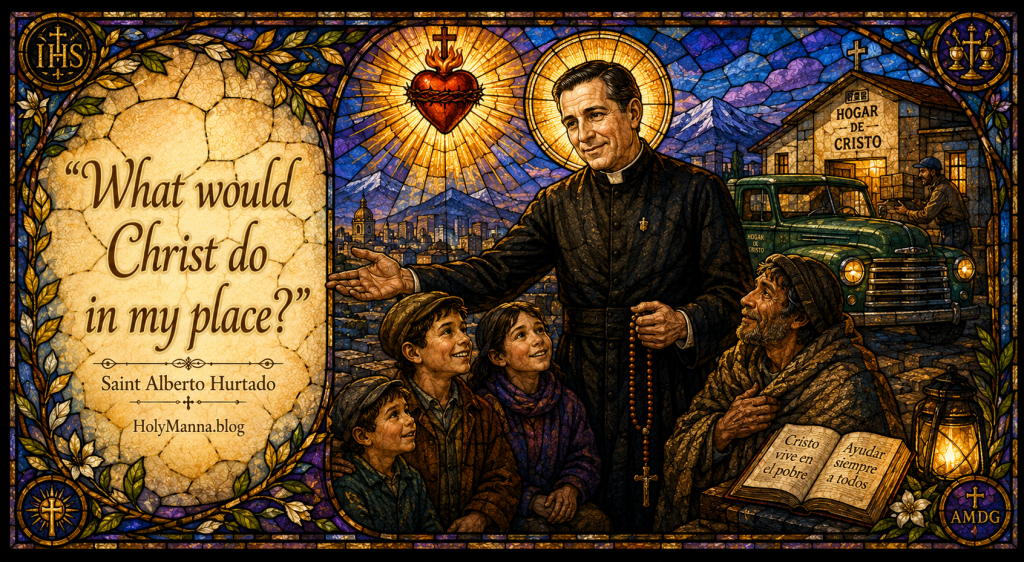
The Priest with the Green Truck
There is something startling about a saint who drove a truck. Most of the saints celebrated through the liturgical year lived centuries ago, in worlds of stone monasteries and Roman roads. Saint Alberto Hurtado lived in the world of automobiles, newspapers, labor unions, and radio. He died in 1952, which means there are still people alive today whose parents knew him, shook his hand, or climbed into the back of his battered green pickup truck on a freezing Santiago night. When the Church raised him to the altars on October 23rd, 2005, she was not canonizing a distant figure of tradition. She was pointing to a man of the modern world and saying, in effect, that holiness is possible right now, in cities like yours, amid problems like yours.
Alberto Hurtado Cruchaga, known throughout Chile simply as Padre Hurtado, was a Jesuit priest, a lawyer, a teacher, a writer, and above all a man consumed by one question that he asked constantly, in season and out of season: “What would Christ do in my place?” That question drove him to found Hogar de Cristo, the Home of Christ, a network of shelters for homeless children, women, and men that continues to serve the poor of Chile to this day. It drove him to organize workers, to write books that made powerful people uncomfortable, and to spend his nights searching the streets for people whom everyone else had stopped seeing. He was ordained for less than nineteen years, and he packed those years so full of love that when pancreatic cancer took him at fifty one, an entire nation wept.
His feast is celebrated on August 18th, the anniversary of his death, which the Church calls a saint’s dies natalis, the day of his birth into eternal life. The Catechism teaches that by canonizing certain of the faithful, the Church “recognizes the power of the Spirit of holiness within her and sustains the hope of believers by proposing the saints to them as models and intercessors” (CCC 828). Padre Hurtado is exactly that kind of model, and his story deserves to be told from the beginning.
A Boy Who Knew What It Meant to Have Nothing
Luis Alberto Hurtado Cruchaga was born on January 22nd, 1901, in Viña del Mar, a coastal city in central Chile. His family belonged to Chile’s old landed class, but whatever comfort surrounded his infancy vanished quickly. When Alberto was four years old, his father died. His widowed mother, left with two small sons, was forced to sell the family property at a loss in order to pay the family’s debts. From that point forward the Hurtados had no home of their own. Alberto and his brother Miguel were passed from relative to relative, living always in someone else’s house, always as guests, always at the mercy of others.
The Vatican’s own biography of the saint makes a point of this detail, and it matters enormously. From an early age, Alberto knew in his own body what it meant to be poor, to be without a home, and to depend on the goodwill of others. The saint who would one day open homes for the homeless was himself, in a real sense, a homeless child. God wastes nothing, and the wound of Alberto’s childhood became the very place where grace entered.
A scholarship opened the door to the Jesuit Colegio San Ignacio in Santiago, where Alberto studied from boyhood through 1917. There he joined the Sodality of Our Lady, and there something remarkable began. Every Sunday afternoon, the well mannered scholarship boy made his way to the most miserable neighborhoods of Santiago to spend time with the poor. This was not a school requirement or a résumé builder. It was the first stirring of a lifelong vocation. The boy who had lost his own home was drawn, week after week, to the people who had even less than he did.
When he finished secondary school in 1917, Alberto wanted to enter the Society of Jesus immediately. His spiritual advisors told him to wait. His mother and younger brother needed him, and duty came first. So Alberto did something that reveals his character better than any pious anecdote could. He enrolled in law at the Catholic University of Chile and worked afternoons and evenings to support his mother and brother, all while continuing his Sunday visits to the poor. Obligatory military service interrupted his studies, but he completed his degree in early August of 1923. Then, with his family provided for and his obligations discharged, he waited not one moment longer. On August 14th, 1923, days after finishing his law degree, the young lawyer walked into the Jesuit novitiate at Chillán and gave his life to God.
His formation took him across the world. He studied humanities in Córdoba, Argentina, beginning in 1925, then philosophy and theology in Spain from 1927. When the Spanish government suppressed the Jesuits in 1931, he moved to Louvain in Belgium, where he was ordained a priest on August 24th, 1933, and where he earned a doctorate in pedagogy and psychology in 1935. In Belgium he also encountered the social vision of Joseph Cardijn, the great apostle of young workers, an influence that would shape everything to come. Those who lived alongside him saw something exceptional. Father John Baptist Janssens, rector of the Louvain theologate and later Superior General of the Jesuits, wrote to Chile praising the “great edification” Hurtado had given everyone through his piety, his enthusiasm, and his example, judging that the Lord had destined a truly eminent man for the Chilean Province. After his final year of Jesuit formation in Drongen, Belgium, Father Hurtado sailed home, arriving in Chile in January 1936. He would live only sixteen more years. What he accomplished in them is astonishing.
A Fire That Lights Other Fires
Padre Hurtado liked to speak of the apostle as a fire that lights other fires, and his own life became the proof of the phrase. Back in Santiago, he threw himself into teaching, serving as professor of religion at his old school, Colegio San Ignacio, and professor of pedagogy at the Catholic University. He directed the students’ Sodality of Our Lady and sent his young men out to teach catechism to the poor, refusing to let faith remain a classroom subject. He preached retreats constantly, gave spiritual direction to countless young men, and accompanied many of them into the priesthood. He made his solemn profession as a Jesuit on February 2nd, 1941.
That same year he published the book that made him famous and controversial at once, Is Chile a Catholic Country? In it he laid out an uncomfortable truth: a nation could be culturally Catholic, full of baptisms and processions, while vast numbers of its people lived and died without real formation in the faith and without the Church ever reaching them in their poverty. Also in 1941 he was named Assistant for the Youth Movement of Catholic Action, first for the Archdiocese of Santiago and then for the whole nation, a role he filled with exceptional initiative and sacrifice.
Here it must be said honestly that the Church’s reliable sources record no thaumaturgic miracles worked by Padre Hurtado during his lifetime. He did not still storms or multiply loaves in the visible manner of some ancient saints. Yet to stop there would be to miss what his contemporaries could not miss. The miracle of his life was charity itself, heroic, relentless, and humanly inexplicable, and Catholic teaching invites exactly this way of seeing. The Catechism states that “love for the poor is even one of the motives for the duty of working, so as to ‘be able to give to those in need’” and devotes an entire section to the Church’s love for the poor, insisting that the works of mercy are “charitable actions by which we come to the aid of our neighbor in his spiritual and bodily necessities” (CCC 2444, CCC 2447). Padre Hurtado lived those paragraphs before they were written.
The defining moment came in October 1944. While preaching a retreat, Padre Hurtado stood before his listeners and felt impelled to speak of what he kept encountering in the streets of Santiago: the poor with nowhere to sleep, and above all the homeless children roaming the city. A story told within the Jesuit tradition holds that shortly before this retreat, on a cold and rainy night, a shivering man, sick and soaked to the skin, approached the padre begging for shelter, and that this encounter set the fire blazing. That story of the specific encounter is told as tradition, and it cannot be verified with certainty. What is verified beyond doubt is the appeal itself. Padre Hurtado cried out to his listeners that Christ walks the streets in the person of the suffering poor, and pressed the point home with words that still sting: “Christ is without a home! Shouldn’t we want to give him one?”
The response was immediate and generous. On October 19th, 1944, Hogar de Cristo was born, the Home of Christ. With donations from benefactors and the tireless collaboration of committed laypeople, Padre Hurtado opened a first house for children, then a house for women, then one for men. These were never meant to be mere warehouses for the destitute. The Vatican’s biography stresses that the Hogar provided not only housing but a home-like milieu, a family atmosphere permeated by Christian values, and over time the houses multiplied and diversified into rehabilitation centers and trade schools where the poor could rebuild their lives. In 1945 he traveled to the United States to study the famous Boys Town and adapt its lessons for Chile. Jesuit sources estimate that between 1945 and 1951 more than eight hundred fifty thousand children received help through the movement, a staggering figure for a work barely seven years old, though it is best held as an estimate rather than an exact count.
The image of Padre Hurtado that Chile can never forget comes from these years. Night after night he drove his old green pickup truck through the streets of Santiago, personally searching out the people sleeping under bridges and in doorways, loading them into the truck bed, and bringing them home. At his canonization, a Chilean pilgrim in Rome put it simply, remembering him as a priest of the poor whose old green truck everyone knew, the truck in which he went about helping the poor and the abandoned children. A tender detail is told within the tradition: no matter how late he returned from those nighttime searches, he never went to bed without praying his rosary. That detail of the nightly rosary is handed down as tradition and cannot be independently verified, though it fits everything documented about his interior life.
His vision of the poor was never sentimental. It was theological to the core, and he said so plainly: “every poor man, every vagrant, every beggar is Christ carrying his cross.” This is precisely the vision of The Gospel of Matthew, chapter 25, where the Lord declares, “as you did it to one of the least of these my brothers, you did it to me” (Mt 25:40), and it is the vision of The Catechism, which teaches that Jesus “makes charity the new commandment” and that the Eucharist itself “commits us to the poor” (CCC 1823, CCC 1397).
And still he was not finished. Convinced that charity must be completed by justice, since The Catechism teaches that society ensures social justice “when it provides the conditions that allow associations or individuals to obtain what is their due” (CCC 1928), Padre Hurtado founded the Chilean Trade Union Association, known as ASICH, in 1947, to build a labor movement inspired by the social doctrine of the Church rather than by class hatred. Between 1947 and 1950 he wrote three substantial works on trade unions, social humanism, and the Christian social order. In 1951, with one year left to live, he founded Mensaje, the Jesuit periodical dedicated to explaining the doctrine of the Church to the modern world, a magazine still published today. Formed at Louvain and wary of every ideology, he criticized both unbridled capitalism and atheistic communism, seeking always a path that was simply and fully Christian.
The Cost of Loving the Poor
Saint Alberto Hurtado was not a martyr. No tyrant demanded his blood, and no executioner ended his life. His hardships were of the quieter kind that most believers actually face, which is exactly why they repay close attention.
The first hardship was the poverty of his childhood, already described, which left him fatherless at four and homeless in all but name for years. The second was the long delay of his vocation, six years of waiting, working, and studying law while his heart was already in the novitiate. He obeyed, and the obedience bore fruit, but the waiting was real.
The sharper trials came after his return to Chile, and they came, painfully, from within the household of the faith. Is Chile a Catholic Country? provoked fierce controversy. Some prominent Catholics accused him of exaggeration and pessimism, of airing the Church’s failures in public. His work with Catholic Action youth, performed with such dedication, became entangled in tensions over the direction of Catholic engagement in society, and in 1944 he stepped down from the national role rather than become a cause of division. His labor organizing drew even harsher fire. In the polarized climate of the 1940s, a priest who defended workers’ rights was suspected in some quarters of smuggling communism into the Church, an accusation that wounded him precisely because his union work was built explicitly on the Church’s social teaching and set against Marxist materialism. He answered criticism not with bitterness but with more work, more writing, and more charity, embodying the teaching that the Church’s love for the poor “is a part of her constant tradition” (CCC 2444).
The final hardship was the cross that came for his body. In 1952, Padre Hurtado was diagnosed with pancreatic cancer, one of the most painful and swiftest of cancers, and within a few months it brought him to the end. Here the confessor showed the same mettle the martyrs show. Visitors to his bedside expected to console a dying man, and instead they found a man consoling them. In the midst of terrible pain, the Vatican biography records, he was heard to repeat again and again the phrase that has become his signature in Chile: “I am content, Lord.” In Spanish it sings: Contento, Señor, contento. There was no resentment at dying at fifty one with so much left undone, no bargaining, only a settled joy that his life had been spent and not saved. He died in Santiago on August 18th, 1952. His funeral at the Church of Saint Ignatius overflowed with the poor who had loved him, so many that longtime friends could not get inside the doors. The poor had come to bury their father.
A Nation Kneels at His Tomb
Death did not end Padre Hurtado’s work. It multiplied it. Hogar de Cristo survived its founder and grew into one of the largest charitable institutions in Chile, still sheltering, feeding, educating, and accompanying the poorest Chileans more than eighty years after that October retreat. The fire he lit kept lighting other fires.
The Church, for her part, began the careful process of discernment that leads to the altars. The cause of Padre Hurtado advanced through the examination of his life, virtues, and writings, and on October 16th, 1994, Pope Saint John Paul II beatified him. On October 23rd, 2005, Pope Benedict XVI canonized him in Saint Peter’s Square, making him only the second Chilean saint, after Saint Teresa of the Andes. The canonization was a national event. The President of Chile led a large delegation to Rome, and back home an entire country celebrated a man whom Chile’s president had called one of the nation’s founding fathers.
Regarding miracles after his death, honesty requires care. The Church’s process for beatification and canonization of a confessor requires medically inexplicable healings attributed to the candidate’s intercession, each investigated by physicians and theologians and approved by the Holy See. Such healings attributed to Padre Hurtado’s intercession were duly examined and accepted, which is precisely why the Church was able to beatify and canonize him. However, the detailed accounts of these particular healings have not been widely published in reliable Catholic sources, and some versions circulating online contain names and details that cannot be confirmed. Those unverified versions are stories as they stand, and it must be stated plainly that their specifics cannot be verified. What can be affirmed with confidence is the Church’s own judgment, rendered through her formal process, that God worked healings through the intercession of Padre Hurtado. The Catechism explains why the faithful seek such intercession at all: the saints “do not cease to intercede with the Father for us” and their “fraternal concern is a great help to our weakness” (CCC 956).
Devotion to the saint today centers on the Shrine of Father Hurtado in Santiago, built beside the original Hogar de Cristo, where his remains rest and where Chileans arrive in a steady stream of pilgrimage, especially each August. In Chile, the month of August is observed as the Month of Solidarity in his memory, culminating on August 18th, a remarkable case of a saint’s feast shaping the civic calendar of a modern nation. His name is everywhere in Chilean life. The Jesuit Universidad Alberto Hurtado in Santiago bears his name, as do the Jesuit novitiate in Saint Paul, Minnesota, and schools, streets, and institutions across Chile and beyond. Even the Santiago metro carries his memory in the district named for him. In sacred art he is shown in his black Jesuit cassock, often beside the famous green truck, sometimes surrounded by children, an iconography of tenderness rather than triumph.
What Would Christ Do in Your Place?
The question Padre Hurtado carried through his life is not a museum piece. It is portable, and it fits every life, including yours. “What would Christ do in my place?” is a question a student can ask before an exam week, a parent can ask in a hard season of family life, an employee can ask in a workplace dilemma, and every believer can ask when passing a person asleep on the sidewalk. How would your ordinary Tuesday change if you asked that question even three times before sunset?
The first lesson of his life is that wounds can become vocations. Alberto lost his father and his home as a small boy, and God transformed exactly that wound into a lifetime of homemaking for the homeless. Whatever loss sits in a person’s past need not be wasted. What painful experience in your own story might God be inviting you to transform into compassion for someone suffering the same thing now?
The second lesson is that the poor are not a problem to be managed but Christ to be encountered. This is not poetic exaggeration. It is the plain teaching of the Lord in The Gospel of Matthew, chapter 25, and of The Catechism, which lists the works of mercy and insists that giving alms to the poor “is one of the chief witnesses to fraternal charity” and “a work of justice pleasing to God” (CCC 2447). Practically, this can begin small. A monthly commitment to a local shelter or food pantry, learning the name of the person asked for help, supporting organizations that provide not only beds but dignity, family, and formation, these are Hurtado’s methods scaled to ordinary life.
The third lesson is his serenity under criticism. Padre Hurtado was attacked by fellow Catholics for telling the truth and suspected of bad motives for doing good. He responded without bitterness and without quitting the Church’s communion, staying obedient, charitable, and productive. When criticism comes for doing what is right, do you grow bitter, grow quiet, or grow deeper?
The final lesson is his joy. A man dying in agony at fifty one repeated, “I am content, Lord.” That contentment was not a personality trait. It was the fruit of a life spent rather than hoarded, and it is available to anyone willing to make the same trade. If today were the last day of your life, could you honestly pray those four words, and if not, what would need to change starting tomorrow?
Engage With Us!
Saint Alberto Hurtado has a way of unsettling comfortable faith, and that is a grace worth talking about. Share your thoughts, your questions, and your own experiences of meeting Christ in the poor in the comments below; this community grows when readers speak up. To help the conversation along, here are some questions to pray with and respond to:
- Padre Hurtado asked constantly, “What would Christ do in my place?” In what one concrete situation this week will you commit to asking that question before acting?
- Alberto’s childhood wound of losing his home became his vocation to shelter others. What wound in your own life could God be redeeming into a mission?
- He insisted that every poor person is Christ carrying his cross. What habit, small or large, could you begin this month to serve Christ in the poor of your own city?
- Hurtado was criticized by fellow Catholics for his honesty and his defense of workers. How do you respond when doing good draws suspicion or criticism?
- Dying in great pain, he prayed, “I am content, Lord.” What would it take for contentment like that to become the deepest truth of your life?
Saint Alberto Hurtado proves that sanctity does not require another century or another country; it requires only a heart that refuses to look away from Christ, especially when Christ arrives cold, hungry, and inconvenient. Take his question with you this week, ask it often, and act on the answer. Live your faith boldly, serve generously, and do everything with the love and mercy that Jesus taught us.
Saint Alberto Hurtado, pray for us!
Follow us on YouTube, TikTok, Instagram and Facebook for more insights and reflections on living a faith-filled life.

 Holy Manna!
Leave a comment