Tuesday of the Twentieth Week in Ordinary Time – Lectionary: 420
The Day Heaven Answered the Self-Made Man
There is a lie so old that it predates every empire, and so current that it hides inside every bank account. The lie sounds like success. It says that a person who has built enough, earned enough, and secured enough no longer needs anyone, not even God. On this Tuesday of the Twentieth Week in Ordinary Time, the Church places three readings side by side that tear that lie open. In Ezekiel 28, a fabulously wealthy ruler of the island city of Tyre looks at his treasuries and concludes, “A god am I!” In the Song of Moses from Deuteronomy 32, Israel’s enemies survey a battlefield and boast, “Our own hand won the victory; the LORD had nothing to do with it.” And in Matthew 19, Jesus watches a rich young man walk away sad and tells His disciples that a camel will squeeze through a needle’s eye before a rich man strolls into the Kingdom on his own strength. The uniting theme of the day is unmistakable: God alone is God, and God alone gives life. Every attempt to be self-made, whether through gold, power, or military might, ends in the pit. Yet the day does not end in the pit. It ends with the most liberating sentence a self-sufficient age could ever hear: “For men this is impossible, but for God all things are possible.” These readings were spoken to an exiled prophet in Babylon, a dying lawgiver on the plains of Moab, and a band of fishermen in Galilee, but they land squarely on every modern heart that has ever mistaken a full account for a full life.
First Reading — Ezekiel 28:1-10
The Merchant King Who Crowned Himself a God
Ezekiel prophesied from exile in Babylon while Nebuchadnezzar’s armies dismantled the world he knew. Around the fall of Jerusalem in 586 BC, the prophet turned his gaze toward Tyre, the Phoenician island fortress whose ships ruled Mediterranean trade. Tyre seemed untouchable, ringed by the sea, drowning in silver, and led by a ruler, commonly identified with King Ithobaal III, who drew a fatal conclusion from his own success. This oracle fits the day’s theme perfectly, because it shows where the road of self-deification actually ends.
Ezekiel 28:1-10
The word of the LORD came to me: Son of man,
say to the prince of Tyre:
Thus says the Lord GOD:Because you are haughty of heart,
you say, “A god am I!
I occupy a godly throne
in the heart of the sea!”—
And yet you are a man, and not a god,
however you may think yourself like a god.
Oh yes, you are wiser than Daniel,
there is no secret that is beyond you.
By your wisdom and your intelligence
you have made riches for yourself;
You have put gold and silver
into your treasuries.
By your great wisdom applied to your trading
you have heaped up your riches;
your heart has grown haughty from your riches–
therefore thus says the Lord GOD:
Because you have thought yourself
to have the mind of a god,
Therefore I will bring against you
foreigners, the most barbarous of nations.
They shall draw their swords
against your beauteous wisdom,
they shall run them through your splendid apparel.
They shall thrust you down to the pit, there to die
a bloodied corpse, in the heart of the sea.
Will you then say, “I am a god!”
when you face your murderers?
No, you are man, not a god,
handed over to those who will slay you.
You shall die the death of the uncircumcised
at the hands of foreigners,
for I have spoken, says the Lord GOD.
Detailed Exegesis
Verse 1: “The word of the LORD came to me.” The oracle begins with divine initiative. Tyre’s ruler believes he answers to no one, yet heaven has already opened a case against him, and the true God speaks first.
Verse 2: “Son of man, say to the prince of Tyre: Thus says the Lord GOD: Because you are haughty of heart, you say, ‘A god am I! I occupy a godly throne in the heart of the sea!’ And yet you are a man, and not a god, however you may think yourself like a god.” The sin named here is not commerce but a haughty heart. Surrounded by water and wealth, the prince felt invulnerable, and invulnerability felt like divinity. God’s answer is devastatingly simple: he is a man. This is the same temptation the serpent offered in Genesis 3, and the Catechism teaches that every sin repeats it: “Like the first sin, it is disobedience, a revolt against God through the will to become ‘like gods,’ knowing and determining good and evil” (CCC 1850).
Verse 3: “Oh yes, you are wiser than Daniel, there is no secret that is beyond you.” The line drips with irony. Some see here the biblical Daniel, Ezekiel’s contemporary famed for wisdom in a pagan court, while others point to Dan’el, a wise figure remembered in ancient Canaanite tradition. Either way, God mocks a wisdom that cannot see its own mortality.
Verse 4: “By your wisdom and your intelligence you have made riches for yourself; You have put gold and silver into your treasuries.” Notice that God does not deny the prince’s talent. Intelligence and industry are real gifts. The tragedy is what he did with the credit.
Verse 5: “By your great wisdom applied to your trading you have heaped up your riches; your heart has grown haughty from your riches.” Here is the spiritual mechanics of the whole reading: riches feed the heart before they ever fill the vault. Wealth grew, then pride grew with it, until the man disappeared inside the god he imagined himself to be.
Verse 6: “Therefore thus says the Lord GOD: Because you have thought yourself to have the mind of a god,” the sentence turns on a single word, “therefore.” Judgment is not arbitrary; it is the harvest of a specific thought held long enough to become an identity.
Verse 7: “Therefore I will bring against you foreigners, the most barbarous of nations. They shall draw their swords against your beauteous wisdom, they shall run them through your splendid apparel.” History answered through Babylon, which besieged Tyre for thirteen years, and later through Alexander, who finally broke the island itself. Swords pierce exactly the two things the prince worshiped, his wisdom and his splendor.
Verse 8: “They shall thrust you down to the pit, there to die a bloodied corpse, in the heart of the sea.” The throne “in the heart of the sea” from verse 2 becomes a grave “in the heart of the sea.” The place of his boast becomes the place of his burial.
Verse 9: “Will you then say, ‘I am a god!’ when you face your murderers? No, you are man, not a god, handed over to those who will slay you.” Death is the great truth-teller. No creed of self-sufficiency survives it.
Verse 10: “You shall die the death of the uncircumcised at the hands of foreigners, for I have spoken, says the Lord GOD.” Herodotus records that the Phoenicians practiced circumcision, so this is the ultimate disgrace: the god-king will die like an outsider to every covenant and every dignity he claimed.
Teachings
The Church has always read pride as the taproot of every other sin. Saint Augustine defines it in City of God, Book XIV: “And what is pride but the craving for undue exaltation? And this is undue exaltation, when the soul abandons Him to whom it ought to cleave as its end, and becomes a kind of end to itself.” That is Tyre’s prince in a single sentence, a soul that became its own end. Saint Gregory the Great, in Moralia in Job, Book XXXI, calls pride the commander of the vices, teaching that when pride has captured a heart it hands that heart over to the principal sins that follow. The Catechism draws the modern application with uncomfortable precision: “Man commits idolatry whenever he honors and reveres a creature in place of God, whether this be gods or demons (for example, satanism), power, pleasure, race, ancestors, the state, money, etc.” (CCC 2113). A venerable tradition of interpretation, found in Tertullian’s Against Marcion and Origen’s De Principiis, saw in the ruler of Tyre, especially in the lament that follows in Ezekiel 28:11-19, a figure of Satan’s own fall, the first creature who reached for godhood. Presented as tradition rather than the literal sense, it still teaches something true: every proud heart replays the oldest rebellion in creation.
Reflection
The prince of Tyre never built a temple to himself. He simply looked at what his competence had produced and quietly stopped needing God. That is how self-deification actually works in ordinary life. Begin today with a deliberate act of dependence: before checking a bank balance, a portfolio, or a to-do list, thank God aloud for one specific gift that no effort could have earned, such as life, faith, or the people who love you. Then practice giving credit away all day, naming God and others in every success. Where has competence quietly replaced prayer in your life? If everything you built were taken tonight, what would remain of your identity?
Responsorial Psalm — Deuteronomy 32:26-28, 30, 35cd-36ab
The Song a Dying Prophet Taught a Forgetful People
Today the Church responds not with a psalm but with the Song of Moses, the sweeping canticle Moses taught Israel on the plains of Moab just before his death. It is structured like a covenant lawsuit, with heaven and earth summoned as witnesses against a people who forgot the God who carried them. The excerpted verses reveal something astonishing: God restraining His own judgment so that arrogant enemies cannot claim His victory as their own. The refrain, drawn from Deuteronomy 32:39, is the thesis of the entire liturgy: “It is I who deal death and give life.”
Deuteronomy 32:26-28, 30, 35cd-36ab
R. (39c) It is I who deal death and give life.
“I would have said, ‘I will make an end of them
and blot out their name from men’s memories,’
Had I not feared the insolence of their enemies,
feared that these foes would mistakenly boast.”
R. It is I who deal death and give life.
“‘Our own hand won the victory;
the LORD had nothing to do with it.’”
For they are a people devoid of reason,
having no understanding.
R. It is I who deal death and give life.
“How could one man rout a thousand,
or two men put ten thousand to flight,
Unless it was because their Rock sold them
and the LORD delivered them up?”
R. It is I who deal death and give life.
Close at hand is the day of their disaster,
and their doom is rushing upon them!
Surely, the LORD shall do justice for his people;
on his servants he shall have pity.
R. It is I who deal death and give life.
Detailed Exegesis
Verse 26: “I would have said, ‘I will make an end of them and blot out their name from men’s memories.’” God speaks with startling honesty about what justice alone would demand. Israel’s infidelity deserved erasure, and the song refuses to soften that truth.
Verse 27: “Had I not feared the insolence of their enemies, feared that these foes would mistakenly boast, ‘Our own hand won the victory; the LORD had nothing to do with it.’” What stays the sentence is God’s zeal for truth itself. The nations would read Israel’s fall as proof of their own power, committing Tyre’s exact sin on a battlefield instead of a trading floor. Mercy here protects the world from a lie.
Verse 28: “For they are a people devoid of reason, having no understanding.” Scripture calls the boast of self-sufficiency what it is, not merely wicked but irrational. A creature claiming credit for existence has misread reality at the root.
Verse 30: “How could one man rout a thousand, or two men put ten thousand to flight, Unless it was because their Rock sold them and the LORD delivered them up?” Even Israel’s defeats belong to God’s providence. The verse dismantles every purely military explanation of history, insisting that outcomes rest finally in the hands of “their Rock,” the song’s favorite name for God.
Verses 35cd and 36ab: “Close at hand is the day of their disaster, and their doom is rushing upon them! Surely, the LORD shall do justice for his people; on his servants he shall have pity.” Judgment and pity arrive in the same breath. Saint Paul quotes this very passage in Romans 12:19, and Hebrews 10:30 cites both lines, teaching that vengeance belongs to God precisely so that His people can be free to hope for His compassion.
Teachings
The refrain proclaims the divine attribute the Creed names first. The Catechism observes: “Of all the divine attributes, only God’s omnipotence is named in the Creed: to confess this power has great bearing on our lives” (CCC 268). Yet the Church insists this power is not raw force. “Thus God shows forth his almighty power by converting us from our sins and restoring us to his friendship by grace: ‘God, you show your almighty power above all in your mercy and forgiveness . . .’” (CCC 277). The song holds both truths together, death and life, doom and pity, in one sovereign voice. The Catechism adds the confidence this creates in the middle of confusing history: “We firmly believe that God is master of the world and of its history. But the ways of his providence are often unknown to us” (CCC 314). Hannah will later sing this same theology in 1 Samuel 2, and the Blessed Virgin Mary will perfect it in the Magnificat, where the mighty fall and the lowly rise.
Reflection
Moses wanted Israel to memorize this song so that in every future generation the melody would correct the boast before it formed. You can do the same. When something goes well this week, a project, a healing, a reconciliation, resist the reflex to say it was all skill or luck, and instead pray one sentence of thanksgiving on the spot. When something collapses, resist despair by remembering that the same Rock still holds the story. When you win, whose hand do you honestly credit? Can you trust the God who deals death and gives life with the chapter of your life that currently makes no sense?
Holy Gospel — Matthew 19:23-30
The Needle’s Eye and the God of the Impossible
This scene opens in the silence after heartbreak. A sincere, wealthy young man has just asked Jesus about eternal life, heard the call to sell everything and follow, and walked away sad. Jesus turns to His disciples and speaks the hardest economics lesson in the Gospel. In a culture where wealth was widely read as proof of God’s blessing, His words landed like thunder, which is exactly why this passage completes the day’s theme. Tyre’s prince and Israel’s enemies trusted their own hand; now Jesus reveals the only hand that can actually save.
Matthew 19:23-30
Jesus said to his disciples:
“Amen, I say to you, it will be hard for one who is rich
to enter the Kingdom of heaven.
Again I say to you,
it is easier for a camel to pass through the eye of a needle
than for one who is rich to enter the Kingdom of God.”
When the disciples heard this, they were greatly astonished and said,
“Who then can be saved?”
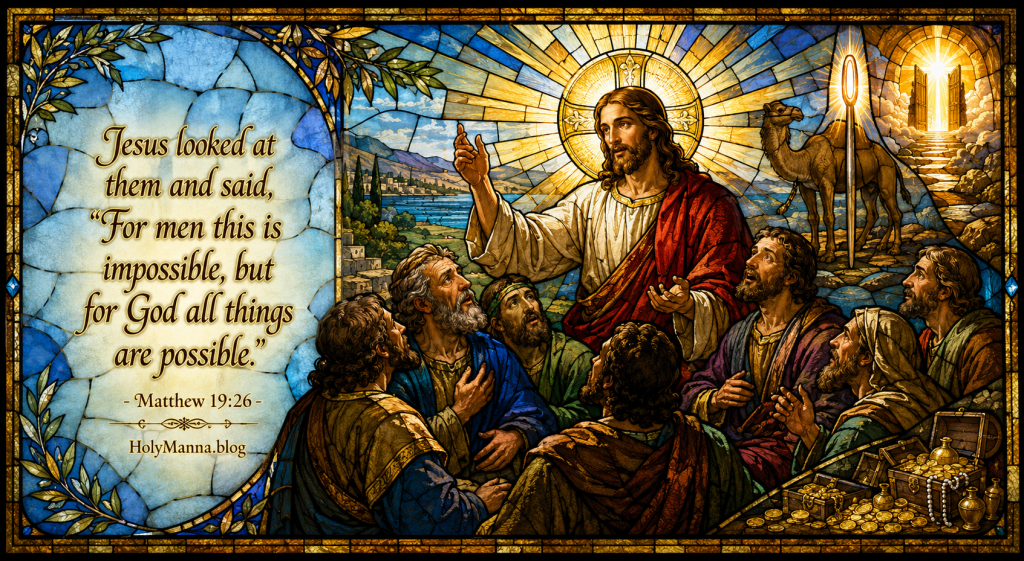
Jesus looked at them and said,
“For men this is impossible,
but for God all things are possible.”
Then Peter said to him in reply,
“We have given up everything and followed you.
What will there be for us?”
Jesus said to them, “Amen, I say to you
that you who have followed me, in the new age,
when the Son of Man is seated on his throne of glory,
will yourselves sit on twelve thrones,
judging the twelve tribes of Israel.
And everyone who has given up houses or brothers or sisters
or father or mother or children or lands
for the sake of my name will receive a hundred times more,
and will inherit eternal life.
But many who are first will be last, and the last will be first.”
Detailed Exegesis
Verse 23: “Amen, I say to you, it will be hard for one who is rich to enter the Kingdom of heaven.” The double “Amen” marks solemn testimony. Saint John Chrysostom, preaching on this passage in Homily 63 on the Gospel of Matthew, explains precisely where the difficulty lies: “blaming not riches but them that are held in subjection by them.” Wealth is not condemned; enslavement to it is.
Verse 24: “Again I say to you, it is easier for a camel to pass through the eye of a needle than for one who is rich to enter the Kingdom of God.” A popular story claims “the eye of the needle” was a low gate in Jerusalem’s wall that a camel could crawl through once unloaded. It is a charming picture, but it is a later story with no ancient evidence, and it blunts the point. Jesus means a real camel and a real needle, the largest animal in Israel and the smallest opening in the house. Chrysostom read it exactly that way, noting that Jesus “shows that it is even impossible, and not merely impossible, but even in the highest degree impossible.”
Verse 25: “When the disciples heard this, they were greatly astonished and said, ‘Who then can be saved?’” If the visibly blessed cannot be saved, the disciples reason, no one can. Their question is the honest cry of every human religion of achievement.
Verse 26: “Jesus looked at them and said, ‘For men this is impossible, but for God all things are possible.’” This is the hinge of the entire day. Salvation is not a difficult human project; it is an impossible one, accomplished only by grace. Chrysostom lingers over that look of Jesus, teaching that with a mild and meek gaze the Lord soothed their fear before relieving them with His words.
Verse 27: “Then Peter said to him in reply, ‘We have given up everything and followed you. What will there be for us?’” Peter’s boats and nets were modest, but they were everything he had. Jesus does not rebuke the question; grace makes room for honest hearts wondering whether surrender is worth it.
Verse 28: “Jesus said to them, ‘Amen, I say to you that you who have followed me, in the new age, when the Son of Man is seated on his throne of glory, will yourselves sit on twelve thrones, judging the twelve tribes of Israel.’” Jesus promises the Twelve a share in His own royal judgment in the renewed creation. The Church is here revealed as the new Israel, founded on twelve apostles as ancient Israel stood on twelve tribes.
Verse 29: “And everyone who has given up houses or brothers or sisters or father or mother or children or lands for the sake of my name will receive a hundred times more, and will inherit eternal life.” The promise widens from the Twelve to everyone. Nothing surrendered for the name of Jesus is lost; it is invested at a rate no market can match.
Verse 30: “But many who are first will be last, and the last will be first.” The saying seals the day’s reversal. The self-made first, like Tyre’s prince, are thrust down, while the self-emptied last are seated on thrones.
Teachings
The Catechism gathers this passage into its teaching on poverty of heart: “Jesus enjoins his disciples to prefer him to everything and everyone, and bids them ‘renounce all that [they have]’ for his sake and that of the Gospel” (CCC 2544). It diagnoses the rich man’s sadness with a single sentence: “The Lord grieves over the rich, because they find their consolation in the abundance of goods” (CCC 2547). And it states the requirement plainly: “Detachment from riches is necessary for entering the Kingdom of heaven” (CCC 2556). On the surrender of family bonds in verse 29, the Church teaches: “Christ is the center of all Christian life. The bond with him takes precedence over all other bonds, familial or social” (CCC 1618), a truth lived visibly by every consecrated religious through history, from the desert fathers to the newest novice. Chrysostom, ever the practical pastor, refuses to let the impossible paralyze anyone, counseling gradual detachment: “Do not then seek all at once, but gently, and little by little, ascend this ladder, that leads you up to Heaven.”
Reflection
Chrysostom’s ladder is climbable this very week. Pick one rung: give away something you actually like rather than something you were discarding anyway, increase your tithe by a concrete amount, or fast from one purchase and give the money to the poor. Then attack the deeper attachment by scheduling generosity with the things money cannot buy, an evening of undistracted presence with family, or an hour of adoration. Let grace do the impossible part; your part is simply to open the hand. What is the one possession, comfort, or ambition you would find hardest to surrender if Jesus asked? Do you believe, practically and not just theoretically, that God can do in you what you cannot do in yourself?
The Hand That Opens Is the Hand That Receives
Set the three scenes side by side one last time. A merchant king stands on his island throne, counting gold, whispering, “A god am I.” Armies stand over a battlefield boasting, “Our own hand won the victory.” And a good young man stands before the Son of God, holding everything, and walks away with nothing that lasts. Every one of them made the same wager, that a full hand means a safe life. The liturgy answers with the voice from the Song of Moses: “It is I who deal death and give life.” Life was never something a creature could hoard, earn, or defend. It is dealt, moment by moment, from the hand of God. That truth sounds like a threat only to the proud. To everyone else it is the best news imaginable, because it means the doorway to the Kingdom was never a merit exam. It is a needle’s eye that no camel, no fortune, and no résumé fits through, and a God who delights in doing the impossible for anyone humble enough to ask. Peter proved it. He let go of boats, nets, and the only life he knew, and received a throne, a hundredfold, and eternity. The prince of Tyre clutched everything and went down to the pit still insisting on his own divinity. Two hands, one clenched and one open, and only one of them ended up full. May every reader leave these readings with the open hand, offering back to God this day’s work, wealth, family, and future, and trusting the promise that seals it all: “For God all things are possible.”
Engage With Us!
These readings touch something tender, the quiet ways self-sufficiency creeps into a believing heart, and hearing how others wrestle with them is a grace for the whole community. Please share your reflections, questions, and stories in the comments below.
- In Ezekiel 28:1-10, the prince of Tyre let real talents and real riches convince him he no longer needed God. Which of your genuine strengths is most likely to tempt you toward quiet self-reliance, and what daily habit could turn that strength back into gratitude?
- In Deuteronomy 32:26-28, 30, 35cd-36ab, God restrains judgment so that no one can falsely boast, “Our own hand won the victory.” When you look back on your greatest successes, how honestly have you credited God’s hand, and how might you do so more visibly?
- In Matthew 19:23-30, Jesus promises a hundredfold to everyone who gives things up for His name. What is one concrete thing, a possession, a habit, or an ambition, you sense Jesus inviting you to release this week?
- Taken together, today’s readings proclaim that salvation is impossible for man but possible for God. Where in your life do you most need to stop striving and start surrendering, trusting God to do the impossible?
Living faith is exactly this, a daily choice to open the hand rather than clench it, and to do everything with the love and mercy Jesus taught us. The God who deals life is generous beyond every calculation, and no one who trusts Him ever ends up poor.
Sacred Heart of Jesus, we trust in You!
Immaculate Heart of Mary, pray for us!
Saint Michael the Archangel, defend us in battle!
Follow us on YouTube, TikTok, Instagram and Facebook for more insights and reflections on living a faith-filled life.


Leave a Reply