The Night Heaven Stood Silent
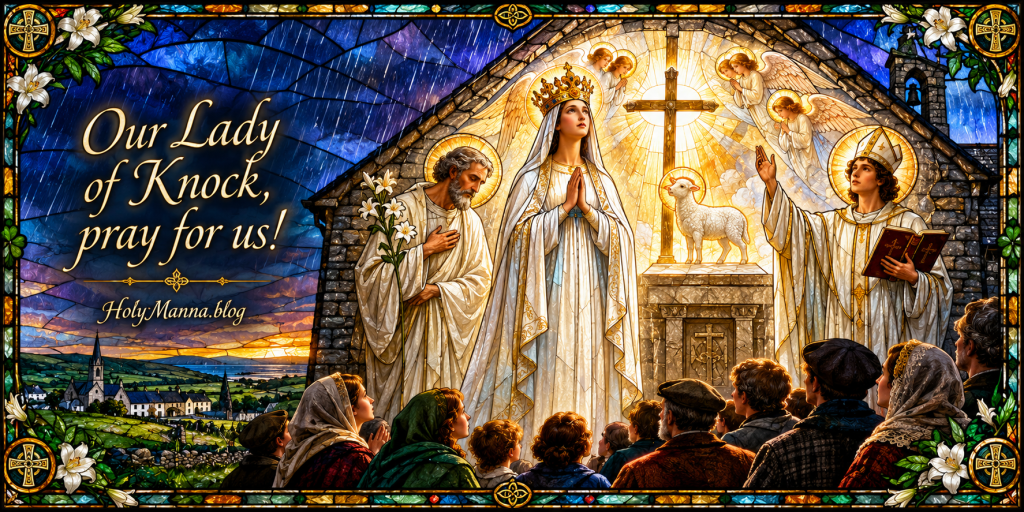
Every August 17th, the Church in Ireland pauses to honor one of the most unusual Marian apparitions in history: Our Lady of Knock. Most famous apparitions come with messages. Lourdes gave the world the words of the Immaculate Conception. Fatima gave urgent calls to prayer and penance. Knock gave silence. On the rainy evening of August 21st, 1879, at the gable wall of a small parish church in County Mayo, the Blessed Virgin Mary appeared alongside Saint Joseph, Saint John the Evangelist, and a lamb standing upon an altar before a cross, surrounded by adoring angels. Not a single word was spoken. Not one message was delivered. And yet the apparition has never stopped speaking.
The Memorial of Our Lady of Knock holds a treasured place on the Irish liturgical calendar, and the shrine that grew up around that gable wall now welcomes roughly one and a half million pilgrims each year. Two popes have knelt there in prayer. Two ecclesiastical commissions examined the witnesses and found their testimony, in the commission’s own words, “trustworthy and satisfactory.” In 2021, Pope Francis raised Knock to the dignity of an International Shrine of Special Eucharistic and Marian Devotion, placing this quiet corner of the Irish countryside in the company of the great Marian sanctuaries of the world.
What makes Knock central to Marian devotion is precisely what makes it strange. The apparition is not primarily about Mary at all, and Mary herself seems to insist on that point. She appears in an attitude of prayer, eyes lifted to heaven, hands raised, directing every gaze past herself toward the altar and the Lamb. The Catechism of the Catholic Church teaches that Mary’s entire role in the economy of salvation is to lead souls to her Son; her motherhood in the order of grace continues uninterrupted until the eternal fulfillment of all the elect (CCC 963, 969). Knock is that teaching painted in light on a stone wall. The Mother of God stood before a starving, grieving people and preached the most eloquent homily imaginable on the Mass, the Lamb of God, and the hope of heaven, all without opening her mouth. For adults navigating a noisy world today, that silence is not a gap in the story. It is the story.
Rain, Hunger, and a Village Called Cnoc
To understand what happened at Knock, it helps to understand what Ireland was suffering in 1879. The village’s very name comes from the Irish word cnoc, meaning hill, and the community that clung to that hill was poor even by the harsh standards of rural Mayo. The Great Famine of the 1840s was still a living memory; parents at Knock had buried children and siblings during those years, and emigration had hollowed out entire townlands. The year 1879 itself brought another failure of the potato crop, one of the worst since the Famine, along with crushing rents, the constant threat of eviction, and the social upheaval that would soon erupt into the Land War. The people of Knock were, in a very real sense, a people standing in the dark.
Their parish church, dedicated to Saint John the Baptist, was served by Archdeacon Bartholomew Cavanagh, a priest remembered for his devotion to Our Lady and his extraordinary generosity to the poor. On the evening of Thursday, August 21st, 1879, at about 8 o’clock, rain was driving across the bogland when Mary McLoughlin, the archdeacon’s housekeeper, passed the south gable of the church with a young woman of the parish, Mary Byrne. They saw the gable bathed in a brilliant light, and within that light, living figures. Mary Byrne ran to gather her family and neighbors, and soon a crowd had assembled in the downpour.
What followed lasted about two hours. Men, women, and children stood in the soaking rain, praying the Rosary before the vision. Witness accounts record a detail that has moved pilgrims ever since: though the rain drenched the onlookers, the gable and the figures remained dry. One elderly witness, Bridget Trench, approached to embrace the feet of the Blessed Virgin, and her arms closed on nothing but the stones of the wall; the figures were vivid and dimensional yet beyond human grasp. Fifteen official witnesses, ranging from young children to the elderly, later gave sworn testimony about what they had seen. Reported ages vary slightly across the sources, with the youngest witness, John Curry, listed as 5 or 6 years old and the oldest, Bridget Trench, as 74 or 75; some accounts also suggest that more people saw the apparition than the 15 who formally testified. Those discrepancies concern details of record keeping, not the substance of the event, and the substance was about to face rigorous examination.
Fifteen Witnesses and the Judgment of the Church
The Church did not rush to embrace the reports from Knock. In October 1879, only weeks after the apparition, the Archbishop of Tuam, John MacHale, established a Commission of Enquiry. The commissioners interviewed all 15 official witnesses individually. Their accounts agreed on the essential vision: the Blessed Virgin clothed in white, crowned, with a golden rose at her brow, her eyes and hands raised toward heaven in prayer; Saint Joseph at her right, head bowed in reverence; Saint John the Evangelist at her left, vested like a bishop, an open book in his hand, his gesture that of a preacher; and to the left of the figures a plain altar bearing a cross and a lamb, with angels hovering about it in adoration. The commission weighed the possibility of natural causes and of fraud, found no basis for either, and concluded that the testimony of the witnesses, taken as a whole, was trustworthy and satisfactory.
A second Commission of Enquiry was convened in 1936 by Archbishop Gilmartin of Tuam to examine the surviving witnesses. Mary Byrne, by then Mrs. Mary O’Connell, gave her sworn testimony from her deathbed, confirming every detail she had reported 57 years earlier and declaring, “I make this statement knowing I am going before my God.” She died 6 weeks later. The second commission likewise judged the witnesses upright and their evidence satisfactory.
Regarding the Church’s official position, honesty requires precision. The apparition at Knock has never been the object of a solemn dogmatic definition, because no apparition ever is. It stands as private revelation, which the Church teaches is never binding on the faithful and never adds to the one definitive Revelation given in Christ. The Catechism explains the purpose of authentic private revelation with beautiful clarity: “It is not their role to improve or complete Christ’s definitive Revelation, but to help live more fully by it in a certain period of history” (CCC 67). Within that framework, Knock enjoys the strongest form of ecclesiastical approval in practice: two positive commissions, the erection of a national and now international shrine, papal pilgrimages, a papal Golden Rose, and the elevation of its church to a basilica. The faithful may confidently venerate Our Lady of Knock, while remembering that every approved apparition exists only to serve the Gospel.
The Lamb on the Altar: A Wordless Homily on the Mass
The theological heart of Knock is the altar. Everything in the apparition converges on the Lamb standing before the cross, and Scripture leaves no doubt about who the Lamb is. Saint John the Baptist, patron of the very church on whose wall the vision appeared, pointed to Jesus with the words recorded in The Gospel of John: “Behold, the Lamb of God, who takes away the sin of the world” (John 1:29). Saint John the Evangelist, who stands in the apparition dressed as a bishop and preaching, is the same John who beheld in his heavenly vision “a Lamb standing, as though it had been slain” (Revelation 5:6). The Catechism teaches that the liturgy of the Church on earth participates in exactly this heavenly liturgy that John saw, where Christ the Lamb, once sacrificed and forever living, is adored by angels and saints (CCC 1137). It teaches further that in the earthly Eucharist the Church is united to that same worship of heaven (CCC 1326).
Read in that light, Knock is a catechism lesson in images. A famine-scarred people who had clung to the Mass through centuries of persecution, through penal laws and hedge schools and Mass rocks, were shown the eternal reality behind every Mass they had ever attended: the Lamb upon the altar, the cross behind him, the angels adoring, the Mother and the saints interceding. Mary appears at Knock not as the center but as the great worshipper, modeling for the Church what the Catechism calls her singular cooperation and her continuing intercession. Assumed body and soul into heavenly glory (CCC 966), she did not abandon her children; rather, as the Catechism teaches, “by her manifold intercession continues to bring us the gifts of eternal salvation” (CCC 969). The apparition also gently illuminates her title as Mother of the Church, the mother given to the beloved disciple from the cross in John 19:26-27, a motherhood the Church honors with a devotion that, while wholly special, differs essentially from the adoration given to God alone (CCC 963, 971). Saint Joseph’s silent, reverent presence completes the scene, the guardian of the Holy Family standing guard once more beside the Mother and the Lamb.
The magisterium of the 20th century gives this reading firm footing. Chapter VIII of Lumen Gentium, the Second Vatican Council’s great constitution on the Church, insists that Mary’s maternal role in no way obscures or diminishes the unique mediation of Christ but rather shows its power, since her entire influence on souls flows from the merits of her Son and leads directly back to him. That is the exact choreography of Knock. Saint Paul VI, in Marialis Cultus, taught that authentic Marian devotion must be biblical, liturgical, and Christ-centered, and it would be difficult to design an apparition more perfectly matched to that standard than one whose whole composition is a liturgy, with Scripture held open by an Evangelist and the Lamb of the Book of Revelation enthroned upon an altar. Saint John Paul II, who devoted his encyclical Redemptoris Mater to Mary’s pilgrimage of faith, saw in her the one who walked by faith even when God’s plan was wrapped in silence and suffering, a pilgrimage the Catechism describes as her union with her Son unto the cross (CCC 964). At Knock, the woman who once stood beneath the cross stands beside the altar that makes the sacrifice of the cross present, quietly confirming that the Mass and Calvary are one reality. For a generation of young adults who sometimes hear that Catholic devotion to Mary competes with devotion to Jesus, Knock is the serene, visual refutation. The Mother’s eyes are not on the crowd. They are lifted to heaven, and her whole being points to the Lamb.
From a Gable Wall to the World: Pilgrimage and Devotion
Pilgrims began arriving at Knock almost immediately, and reported healings followed within days of the apparition. One of the earliest and most frequently retold is the story of Delia Gordon, a young girl suffering from deafness and pain in her ear, whose mother touched a fragment of cement from the gable to the child’s ear during a visit to the site; the family attributed her sudden cure to Our Lady’s intercession. That account, like the many cures recorded in the shrine’s early diaries, is a matter of devotional testimony rather than formally adjudicated miracle, and it is offered here as exactly that. What is beyond dispute is the river of prayer that has flowed through Knock ever since.
Today Knock Shrine functions as Ireland’s National Marian Shrine and, since March 19th, 2021, as an International Shrine of Special Eucharistic and Marian Devotion by designation of Pope Francis. The Apparition Chapel now encloses the famous gable, where sculpted white figures recreate the vision for the steady stream of pilgrims who come to pray where the witnesses once stood in the rain. The great church nearby, completed in 1976 and raised to the dignity of a basilica during the papal visit of 1979, is dedicated to Our Lady, Queen of Ireland. The rhythms of devotion at Knock center on exactly what the apparition pointed toward: constant celebration of the Mass, Eucharistic adoration, the Rosary, candlelight processions, anointing of the sick, and confession offered so generously that Knock has long been called the confessional of Ireland. The annual National Novena to Our Lady of Knock draws tens of thousands each August, and the shrine’s ministry to the sick continues the maternal tenderness that pilgrims have always sensed in this place. Even the local airport owes its existence to the shrine; Monsignor James Horan, the visionary rector who prepared Knock for its centenary, famously championed the airport that now carries pilgrims into Mayo from around the world.
The list of pilgrims tells its own story. Saint John Paul II came in 1979. Saint Teresa of Calcutta prayed at the shrine in the 1990s. Countless bishops, religious, and ordinary families have knelt in the Apparition Chapel, and the shrine’s trained handmaids and stewards, a lay ministry of welcome that stretches back generations, continue to serve pilgrims and the sick with a hospitality that has become part of Knock’s identity. For those who cannot travel, the shrine’s daily Masses and the annual novena are broadcast to a worldwide congregation, so that the gable wall of a Mayo village now anchors a truly global network of prayer. Pilgrimage to Knock, like every authentic Catholic pilgrimage, is not spiritual tourism; it is an embodied act of faith, a deliberate stepping out of ordinary routine to seek God where he has shown particular favor, and pilgrims consistently describe returning home with a renewed hunger for the sacraments that the apparition itself so vividly proclaimed.
A Feast Woven into Irish Faith and Beyond
The memorial on August 17th is a comparatively recent gift to the universal rhythm of Irish prayer, formally added to the national liturgical calendar in 2012 and assigned to the 17th because August 21st, the actual anniversary, already belongs to Pope Saint Pius X on the General Roman Calendar. The shrine itself still keeps the anniversary solemnly on the 21st, so the Irish Church in effect honors Our Lady of Knock twice within a single week, once liturgically throughout the country and once historically at the gable wall itself.
The celebration has left deep marks on Irish culture. Generations of families have made the pilgrimage to Mayo, walking the processional paths, filling bottles with Knock holy water, and singing the beloved hymn Lady of Knock, popularized by the singer Dana, whose refrain about the Lamb who will conquer has become an unofficial anthem of the shrine. Papal recognition wove Knock into the story of the universal Church. On September 30th, 1979, Pope Saint John Paul II came to Mayo for the centenary and told the vast crowd, “Here I am at the goal of my journey to Ireland,” presenting the shrine with a Golden Rose and entrusting the families of Ireland to Mary. On August 26th, 2018, during the World Meeting of Families, Pope Francis prayed in the Apparition Chapel, presented a golden rosary in tribute to Ireland’s tradition of the family Rosary, and reminded the crowd, “Mary is our Mother and the Mother of the Church.” The Irish diaspora carries the devotion worldwide, and in 2017 the remains of John Curry, the youngest witness, were solemnly reinterred at the Basilica of Saint Patrick’s Old Cathedral in New York, a quiet sign that the light of the gable wall now shines far beyond Mayo.
Standing in the Rain: What Knock Asks of You
It is tempting to want a Knock with words, an apparition that hands you a message to quote. But consider what the silence actually offers. The witnesses of 1879 were people whose prayers, humanly speaking, had gone unanswered for decades. Famine, eviction, emigration, and grief had emptied their villages, and heaven seemed quiet. Then heaven appeared and remained quiet, yet everything changed, because the silence was full. Pope Francis, in elevating the shrine, taught that the message of Knock is “the great value that silence has for faith.” Mary herself lived that lesson long before Mayo; The Gospel of Luke says of her, “But Mary kept all these things, pondering them in her heart” (Luke 2:19).
Perhaps your own life has seasons that feel like Knock in 1879, seasons when you pray and hear nothing back. The apparition suggests that God’s answer in such seasons may not be an explanation but a presence, and that his presence is found exactly where Knock pointed: at the altar. When words fail you, go to Mass. When you cannot pray eloquently, stand before the Blessed Sacrament and simply look, as the witnesses looked at the gable. Take up the Rosary as those drenched villagers did, letting the repetition carry you when your own words run dry. Imitate Mary’s posture at Knock, hands lifted, eyes on heaven, attention fixed on the Lamb rather than on the storm. Imitate Saint Joseph’s reverent silence in your family, choosing quiet fidelity over noise. Let Saint John remind you to open the Scriptures, the book he holds open still. And when suffering visits you or someone you love, remember that the Mother who stood by the cross chose to stand by a famine village, and she has not moved from her children since.
Engage With Us!
Our Lady of Knock still gathers her children at the gable wall, and this community would love to gather your voice as well. Share your thoughts, experiences, and reflections in the comments below, especially if you have made the pilgrimage to Knock or carry a devotion to this silent apparition.
- When have you experienced God’s presence more powerfully in silence than in words?
- The witnesses prayed the Rosary for two hours in the rain. What would it look like for you to bring that kind of perseverance to your own prayer this week?
- Mary appears at Knock pointing beyond herself to the Lamb on the altar. How might you let the Mass become more central in your spiritual life?
- Saint Joseph and Saint John stand beside Mary as models of reverence and witness. Which of these two saints speaks most to your current season, and why?
May the silent Lady of the gable wall teach every heart to ponder, to persevere, and to adore. Keep walking the pilgrim road with courage, keep returning to the altar of the Lamb, and keep growing together in faith under the guidance of our Blessed Mother.
Our Lady of Knock, Queen of Ireland, pray for us!
Follow us on YouTube, TikTok, Instagram and Facebook for more insights and reflections on living a faith-filled life.

 Holy Manna!
Leave a comment