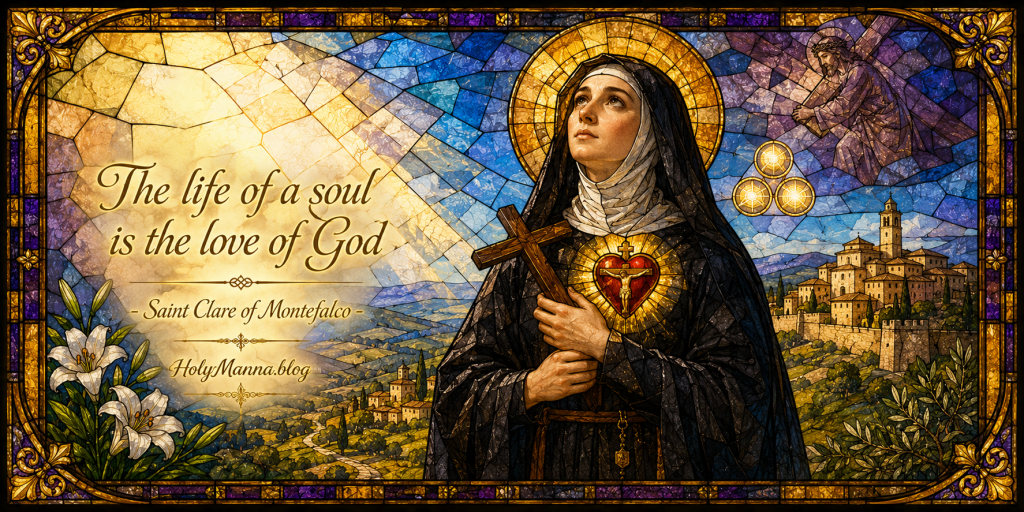
The Woman Who Carried the Cross Inside Her Heart
Every so often, God gives His Church a saint whose story sounds almost too vivid to be real, and then the evidence sits quietly in a small Umbrian town for seven centuries, waiting for anyone who wants to come and look. Saint Clare of Montefalco, also known as Saint Clare of the Cross, is that kind of saint. Born around 1268 in the hill town of Montefalco in Umbria, Italy, she entered a hermitage as a small child, became an Augustinian abbess in her early twenties, counseled bishops and theologians, defended the faith against a dangerous heresy, and lived a hidden life of prayer so completely centered on the Passion of Jesus that she often told her sisters she carried the cross of Christ within her heart. When she died on August 17th, 1308, her nuns opened her heart and found, formed in its very tissue, the image of the crucifix and the instruments of the Passion. In her gallbladder they found three stones, understood as a sign of the Most Holy Trinity. Her body remains incorrupt to this day in Montefalco, where she is honored as the patron saint of the town.
Her feast is kept on August 17th, and the Roman Martyrology remembers her with striking words: “At Montefalco in Umbria, Saint Clare, a nun of the Order of Hermits of Saint Augustine, virgin. In her flesh were renewed the mysteries of the Lord’s passion, which the faithful honor with great devotion.” The Church does not canonize curiosities. She canonizes holiness. As The Catechism teaches, by canonizing some of the faithful the Church solemnly proclaims that they practiced heroic virtue and lived in fidelity to God’s grace, proposing them to believers as models and intercessors (CCC 828). The wonders in Clare’s story matter, but they matter because of the love that produced them. That love is what this post is about.
A Little Girl in a Hermitage on a Hill
Clare was born into a comfortable, devout family in Montefalco, a walled town perched above the valley of Spoleto, within sight of Assisi to the north. Her parents were Damiano and Iacopa Vengente, and her name in Italian, Chiara, means clear, bright, or pure. Her older sister Giovanna, called Joan in English, had already chosen a life of radical prayer and penance. Together with a companion, Giovanna lived as a Franciscan tertiary in a small hermitage that their father Damiano had built near the family home. This was thirteenth-century Umbria, the same soil that had produced Saint Francis of Assisi only a generation earlier, and the air itself seemed charged with the call to leave everything for Christ.
What happened next is one of the most remarkable details of Clare’s story. Around 1274 or 1275, when Clare was only about six years old, she was permitted to join her sister in the hermitage. Sources differ slightly on the exact year, but the picture is consistent: a very small girl, with the blessing of her God-fearing parents and the permission of the Bishop of Spoleto, entered a life of enclosure, silence, and prayer. From the beginning she observed the rule of the Third Order of Saint Francis and embraced penances far beyond her years, keeping strict silence, fasting on bread and water, and sleeping on the bare ground. Later Catholic historians debated for centuries whether Clare should be counted a Franciscan or an Augustinian. The Catholic Encyclopedia explains that Franciscan biographers claimed her for the Third Order of Saint Francis, while Augustinian writers, favored by the Bollandist scholars, claimed her for their own order. The most probable resolution is that both are partly right. She began as a Franciscan tertiary and ended as an Augustinian nun, which feels fitting for a saint whose whole life bridged the poverty of Francis and the interior fire of Augustine.
The decisive turn came in 1290. The community of women around Giovanna had grown, and they desired to profess religious vows in the strict sense. They petitioned the Bishop of Spoleto for an approved rule of life, and he placed them under the Rule of Saint Augustine, formally establishing them as a monastic community. Their monastery took the name of the Holy Cross, Santa Croce, a name that would prove prophetic. Then, in November of 1291, Giovanna died. The nuns turned to Clare, who was only about twenty-three years old, and elected her abbess. She resisted out of humility, but she accepted the office in obedience, and she would carry it for the rest of her life. The Catechism teaches that God calls each person in the concrete circumstances of daily life, and that the way of perfection is open to every state of life, since “all Christians in any state or walk of life are called to the fullness of Christian life and to the perfection of charity” (CCC 2013). Clare did not choose her office. She chose Christ, and the office found her.
The Abbess Who Counseled Bishops and Unmasked a Heresy
It would be easy to imagine Clare as a fragile mystic floating above the practical world, but the historical record shows the opposite. As abbess she governed her monastery with a steady, worldly-wise hand, careful to protect the communal harmony of her sisters and attentive to the daily management of the house. In 1303 she undertook the building of a church in Montefalco that would serve not only her nuns but the whole town. The Bishop of Spoleto blessed the first stone on June 24th of that year, and the church was dedicated to the Holy Cross. She was, in the fullest sense, a spiritual mother: teacher, guide, and directress of her community, and at the same time a builder, an administrator, and a servant of the poor. Her practical concern for the needy is one of the consistent notes of her life. Holiness, for Clare, never floated free of charity, which is exactly what The Catechism teaches when it calls charity the soul of all the virtues (CCC 1827).
Her reputation spread far beyond the monastery walls. Bishops, priests, friars, theologians, judges, the educated and the illiterate alike came to the grille of Santa Croce seeking her counsel, and the testimony of those who knew her says that her advice was scriptural, logical, and almost always on target. This is worth pausing on. A cloistered woman in a small Umbrian town, with no formal theological training, became a trusted counselor to the learned men of her day. The Church has always recognized that the Holy Spirit distributes His gifts as He wills, and that “the anointing of the Holy Spirit” gives the whole body of the faithful a supernatural sense of the faith (CCC 91 and CCC 92).
That gift was put to a severe test. In Clare’s lifetime, a dangerous error was spreading through Umbria, the heresy of the sect of the Spirit of Freedom, a quietist movement associated with the wider Free Spirit errors. Its adherents taught, in effect, that a soul could reach a state of union with God in which sin became impossible and the moral law no longer applied. One of its leading figures was a friar named Bentivenga da Gubbio. According to the early biographical accounts of her life, Bentivenga came to the monastery and engaged Clare in a theological dispute that stretched from early morning until midday and continued into a second day. She spent the night between the two sessions in prayer rather than sleep. When the heresiarch returned and put forward all his fallacies, the accounts say she unveiled his sophisms and refuted his false views with prompt and solid answers. She did not succeed in converting him, but she refuted his heresy, and the evidence that emerged from this episode contributed to the case against him. Bentivenga was ultimately condemned and imprisoned for life. The Catechism defines heresy as the obstinate denial, after Baptism, of a truth that must be believed with divine and catholic faith (CCC 2089), and Clare’s firmness shows what love of souls actually looks like. She did not attack the man. She attacked the error, precisely because she wanted the man, and the many souls he was leading astray, to be saved.
Her mystical life ran alongside all of this. She was often favored with visions, and the most famous of them defined everything that followed. In it, Christ appeared to her as a poor pilgrim, weary, carrying His cross and searching for a place to plant it. The accounts relate that He found that place in Clare’s heart, and that He planted His cross there. From that moment, a real and lasting pain remained with her, and she began to say openly that she bore the cross of Christ within her heart. Her sisters heard her say it again and again. One of her sayings, preserved in the testimony surrounding her life and death, has become her signature: “If you seek the cross of Christ, take my heart; there you will find the suffering Lord.” She also taught her nuns a sentence that could serve as a summary of her entire existence: “The life of a soul is the love of God.” Both sayings are verified in the Catholic sources of her life, and both point to the same truth Saint Paul proclaimed: “it is no longer I who live, but Christ who lives in me” (Gal 2:20).
One miracle from her lifetime deserves special mention because it entered the sworn testimony of her canonization process. According to that testimony, Clare was given the sudden gift of speaking French in order to converse with a pious woman pilgrim who visited the monastery for a short time. Other nuns witnessed the conversation and testified to it during the process. The Church has always understood such gifts as graces given for the good of others (CCC 2003), and in Clare’s case the gift served a simple, humble purpose: so that a tired pilgrim far from home could be understood, consoled, and encouraged in the faith.
The Weight of the Cross She Asked For
Clare was not a martyr. She died in her bed, surrounded by her sisters, in the monastery she had governed for seventeen years. But anyone who thinks her life was therefore easy has not been paying attention, because the cross Christ planted in her heart was not a metaphor to her. It was a weight she carried every single day.
Her hardships began with the penances she chose. From childhood she embraced fasting, silence, and bodily mortification with a severity that startled even her contemporaries in an age accustomed to such things. She was kind and indulgent toward others, the sources record, but she treated herself with unrelenting strictness. The Church, following the example of Christ Himself, has always taught that interior conversion must find expression in visible acts of penance, and that fasting, prayer, and almsgiving express conversion in relation to oneself, to God, and to others (CCC 1434). Clare lived that teaching in its most demanding form.
Then there were the trials she did not choose. The early accounts of her life speak of a long interior ordeal, a period in which her heart was filled daily with spiritual turmoil, temptation, and darkness. God permitted her to walk for years through the kind of desert that the great mystics describe, where consolation vanishes and faith must stand on obedience alone. She persevered through it, and she emerged with a wisdom that made her counsel so sought after. This is the pattern The Catechism describes when it teaches that spiritual progress entails mortification and that “There is no holiness without renunciation and spiritual battle” (CCC 2015).
After her great vision, physical suffering joined the spiritual kind. The pain in her heart, which she attributed to the cross Christ had planted there, remained with her for the rest of her life. In her final years, illness confined her to bed, and her body failed her long before her spirit did. Through all of it she continued to serve joyfully as abbess, teacher, mother, and spiritual directress of her nuns. She governed from her sickbed. She encouraged her sisters even as her own strength drained away. In the summer of 1308, at the age of forty, she reached the end. She commended her sisters to the care of her brother, the Franciscan Father Francesco Damiani, and died on August 17th, 1308. It should be noted honestly that the 1908 Catholic Encyclopedia records her death as August 18th, while the New Catholic Encyclopedia and the Augustinian sources give August 17th, the date on which her feast is universally kept. Whatever the exact hour, the manner of her death matched the manner of her life. She had spent forty years learning to say with the psalmist that her heart belonged entirely to God, and Jesus had told all of His disciples plainly: “let him deny himself and take up his cross and follow me” (Mt 16:24). Clare had done exactly that, from the age of six to her last breath.
The Heart Opened and the Wonders That Followed
What happened next made Clare famous across Christendom, and it began with her sisters simply believing her. The nuns of Santa Croce had heard their abbess say for years that she carried the cross of Christ in her heart. They also judged it unfitting to bury her in the ordinary way, remembering her holiness, so they resolved to embalm her body, a practice not unknown at the time for persons who died with a reputation for sanctity. In the course of that preparation they removed her heart and placed it in a wooden bowl carved with flowers. The day after the funeral, the heart was examined carefully in the presence of learned persons and laypeople. Sister Francesca of Montefalco, attended by others, cut the heart open. What they found stunned everyone present. Formed within the tissue of the heart, in white fibrous material, were the images of the instruments of the Passion. The witnesses described a crucifix, a crown of thorns, nails, and a scourge, wrought in the very substance of the organ. Just as she had said, the marks of the Passion were upon her heart.
The wonders did not end there. When the question arose whether some illness might explain the formations, the nuns consulted Master Simone of Spello, the monastery’s physician. Handed Clare’s gallbladder, Master Simone refused to dissect it, saying he felt unworthy of such a task. Sister Francesca opened it herself and found three small stones, which those present understood as a symbol of the Most Holy Trinity, three in one. The faith of the Church confesses one God in three Persons, the central mystery of Christian life (CCC 253 and CCC 261), and to the people of Montefalco it seemed that God had signed His own name inside the body of His servant.
The Church, to her credit, did not simply accept the claims. The vicar of the Bishop of Spoleto, Berengario of Saint-Affrique, traveled to Montefalco burning with indignation, suspecting that the nuns had planted the objects to promote a fraudulent cult. In 1309 he convened a commission of physicians, jurists, and theologians to examine the findings, the preserved heart and gallbladder, and the sworn testimony of those who had been present. The commission ruled out fabrication and artifice. The experts stated under oath that they could detect no fraud and that what they saw exceeded the medical knowledge of the day. Berengario himself, the man who had arrived as a hostile investigator, became convinced of the authenticity of the findings and went on to write the first Life of the saint. His depositions were incorporated into the diocesan process and later sent to Pope John XXII, under whom the formal inquiries of 1318 and 1319 began.
Meanwhile, the miracles multiplied. Clare’s heart was soon credited with working healings, particularly of injuries to the hands, feet, and limbs, and pilgrims began to stream to Montefalco seeking her intercession. Reports of healings and conversions at her tomb accumulated across the decades and centuries. A story is also told of the liquefaction and bubbling of her preserved blood on certain occasions, a phenomenon reported in the Franciscan accounts of her cult. This story belongs to the tradition surrounding her relics rather than to formally documented history, and it cannot be verified. What can be verified, and what any pilgrim can still see today, is this: her body lies in state, incorrupt after more than seven hundred years, in the church of the Augustinian nuns at Montefalco, and her heart with its formations, together with the three stones, is preserved and displayed in the Sanctuary of Saint Clare there. Witnesses across the centuries, including visitors at the time of her canonization in 1881, have described her preserved face and hands with astonishment. The Catechism teaches that the religious sense of the Christian people has always found expression in forms of piety surrounding the Church’s sacramental life, including the veneration of relics and pilgrimages (CCC 1674), and Montefalco has been a living example of that piety for seven centuries.
The city of Montefalco established an annual holiday in Clare’s honor shortly after her death, and it is still observed. Her cult, paid to her as Blessed from the time of her death, received formal approval in 1624, when Pope Urban VIII granted permission for an office and Mass in her honor. Some sources also record a beatification under Pope Clement XII in 1737, and the records are not fully consistent on that point, so it is flagged here rather than asserted. What is certain is the final step: on December 8th, 1881, the Solemnity of the Immaculate Conception, Pope Leo XIII solemnly canonized Clare of Montefalco at Saint Peter’s Basilica, inscribing her among the holy virgins of the Church. Her name has since traveled far beyond Umbria. Parishes and communities dedicated to Santa Clara de Montefalco flourish as far away as the Philippines and the United States, and the Augustinian family throughout the world keeps her feast each August 17th.
Making Room for the Cross
So what does a fourteenth-century Umbrian abbess with a miraculous heart have to say to you, right now, in a world of commutes and screens and ordinary Tuesdays? More than you might think, because the deepest miracle of Clare’s life was not what the nuns found in her heart after she died. It was what she allowed God to do in her heart while she lived.
Clare’s story teaches that the heart becomes what it loves. She meditated on the Passion of Christ so constantly, so honestly, and for so long that her interior life took the shape of the cross. That is not a spiritual trick reserved for medieval mystics. It is simply what The Catechism describes as meditation and contemplative prayer, the engagement of thought, imagination, emotion, and desire in seeking Christ, and the silent gaze of faith fixed on Jesus (CCC 2708 and CCC 2715). You may never receive a vision. You will certainly receive, if you ask for it, the slow transformation that comes from spending real time with the crucified and risen Lord. What does your heart meditate on most during an average day, and what shape is that meditation slowly giving it?
Clare also teaches that suffering, united to Christ, is never wasted. She did not seek pain for its own sake. She sought Jesus, and she accepted the share of His cross that came with Him, echoing Saint Paul’s words: “in my flesh I complete what is lacking in Christ’s afflictions” (Col 1:24). There is a version of that invitation sitting in your life right now, in the illness you did not choose, the difficult person you cannot avoid, the disappointment that will not resolve. You can carry it resentfully, or you can carry it with Christ and let it become prayer. What cross are you currently carrying alone that Jesus is asking you to carry with Him instead?
Finally, Clare shows that contemplation and action are not rivals. The same woman who bore the cross in her heart also built a church, fed the poor, governed a community, counseled the learned, and stood her ground against a smooth-talking heretic. Practical suggestions flow naturally from her example. Spend ten unhurried minutes each day this week meditating on one scene of the Passion. Choose one hidden act of service for someone in your household and do it without mentioning it. When you encounter a distortion of the faith, respond the way Clare did, with clarity and charity together, attacking the error while loving the person. And when your own interior life feels like a desert, remember her years of darkness and hold your ground, because “The way of perfection passes by way of the Cross” (CCC 2015). If someone examined the evidence of your daily choices, what would they conclude your heart is truly full of?
Engage With Us!
Saint Clare of Montefalco left the world proof that a human heart can be completely conquered by the love of Christ, and her witness deserves a conversation. Share your thoughts and reflections in the comments below; this community grows stronger every time one reader’s honesty encourages another’s. To help the discussion begin, here are some questions to prayerfully consider.
- Clare said, “If you seek the cross of Christ, take my heart.” If your heart were opened today, what would it reveal about what you treasure most?
- Clare entered the hermitage at about six years old. How has God been calling you since childhood, and where have you answered or delayed?
- Clare endured years of interior darkness without abandoning prayer. How do you respond when God feels silent, and what would perseverance look like for you this month?
- Clare refuted the heresy of Bentivenga with both firmness and charity. When the faith is distorted in your presence, how can you defend the truth without wounding the person?
- Clare balanced deep contemplation with building, governing, and serving the poor. Which side of that balance needs strengthening in your own life right now?
Saint Clare of Montefalco spent forty years making room in her heart for the cross of Christ, and God honored that hospitality in a way the world can still see and touch. The same Lord who came to her as a weary pilgrim looking for a place to plant His cross is standing at the door of your heart today. Let Him in. Live this week with courage, pray with persistence, serve the people in front of you, and do everything with the love and mercy that Jesus taught us.
Saint Clare of Montefalco, pray for us!
Follow us on YouTube, TikTok, Instagram and Facebook for more insights and reflections on living a faith-filled life.


Leave a Reply