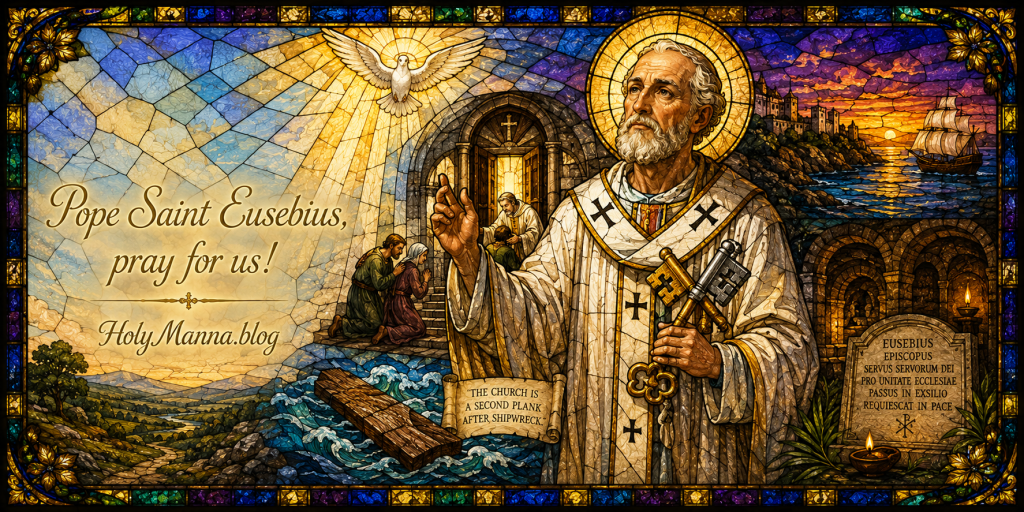
The Pope Who Taught Sinners to Weep
Some saints are remembered for decades of preaching, for towering theological works, or for dramatic deaths in the arena. Pope Saint Eusebius, celebrated on August 17th, is remembered for four months. That is all the time he was given as the thirty-first Bishop of Rome, reigning from April 18th to August 17th in the year 309 or 310, according to the ancient record known as the Liberian Catalogue. Yet in those four months he defended something that every Christian who has ever fallen and longed to come home depends upon: the truth that the Church can forgive any sin, and the equally important truth that forgiveness passes through real repentance.
Eusebius took up the See of Peter in the aftermath of the Diocletian persecution, the most savage assault the Roman Empire ever launched against the Church. Thousands of Christians had been imprisoned, tortured, and killed. Thousands of others, terrified, had denied Christ, burned incense to the idols, or handed over the Scriptures to be destroyed. These fallen Christians were called the lapsi, from the Latin word for those who have slipped and fallen. When the storm passed, many of them stood weeping at the doors of the Church, begging to come back. The question of what to do with them nearly tore the Church of Rome apart, and it fell to Eusebius to answer it. He answered with the mind of the Church: the fallen could return, and must return, through penance. For holding that line he was exiled to Sicily by the Emperor Maxentius, and there he died, honored ever after as a martyr for the discipline and mercy of the Church.
The Catechism teaches exactly what Eusebius defended seventeen centuries ago: “There is no offense, however serious, that the Church cannot forgive” (CCC 982). His whole pontificate was spent proving that sentence true, and paying for it with his life.
A Physician Before the Altar
Almost nothing certain survives about the early life of Eusebius, and honesty requires saying so plainly. The ancient book of papal biographies called the Liber Pontificalis records the tradition that he was a Greek, and that before his ordination he had been a physician. That book was compiled centuries after his death and is known to be unreliable for this early period, so these details must be received as tradition rather than established fact. They cannot be verified. Nothing at all is known of his family, his birthplace beyond the general claim of Greek origin, or the road that brought him to Rome and into the service of the Church.
Even so, the tradition of the physician is worth pondering, because it fits the man the historical record does reveal. A doctor learns two things that never leave him. He learns that wounds are real and cannot be wished away, and he learns that wounds can heal if they are treated honestly. When Eusebius was chosen Bishop of Rome on April 18th of 309 or 310, after a vacancy following the death of Pope Saint Marcellus I, he inherited a city full of spiritually wounded people. The persecution had ended in Rome, but its damage had not. The lapsi were everywhere: neighbors, family members, even clergy who had failed in the hour of trial and now carried their guilt through the streets of the city. Whether or not Eusebius ever practiced medicine, God placed on the Chair of Peter a man who treated the lapsi as patients to be healed rather than enemies to be destroyed or customers to be flattered.
His election also placed him in the line of the successors of Peter at one of the most dangerous moments in the Church’s history, an office the Catechism describes soberly: the Roman Pontiff “is the perpetual and visible source and foundation of the unity both of the bishops and of the whole company of the faithful” (CCC 882). Unity was precisely what Rome did not have, and defending it would cost Eusebius everything.
Holding the Door Open Without Tearing It Off Its Hinges
It must be said clearly at the outset of this section, because integrity demands it: no miracles are attributed to Pope Saint Eusebius during his lifetime in any Catholic source. No healings, no wonders, no dramatic signs are recorded. His holiness took another form, one that is in some ways harder to imitate than miracle working, because it is available to everyone. He was faithful under pressure from two directions at once.
The crisis of the lapsi was not new. After the earlier persecution under the Emperor Decius in the years 250 and 251, the Church of Rome had already worked out her answer, guided by the Holy Spirit. Against the rigorists, who said that apostasy could never be forgiven and that the fallen were lost forever, the Church taught that the power of the keys given to Peter covers every sin. Against the lax, who wanted the fallen readmitted immediately without any reckoning, the Church taught that reconciliation requires genuine penance, a real turning of the heart back to God, expressed in concrete acts. Eusebius inherited this answer and held it without flinching. The fallen would be received back into communion, but only after due penance.
This is nothing other than the sacramental logic the Church still teaches today. The Catechism explains that Christ instituted the sacrament of Penance “for all sinful members of his Church: above all for those who, since Baptism, have fallen into grave sin, and have thus lost their baptismal grace and wounded ecclesial communion” (CCC 1446). The same paragraph preserves the beautiful image the Church Fathers used for this sacrament, calling it “the second plank [of salvation] after the shipwreck which is the loss of grace” (CCC 1446). The lapsi of Rome were shipwrecked souls, and Eusebius spent his entire pontificate lashing that second plank together for them. The Catechism also teaches that interior repentance is the heart of the matter, “a radical reorientation of our whole life, a return, a conversion to God with all our heart, an end of sin, a turning away from evil” (CCC 1431). That is what Eusebius asked of the fallen. Not humiliation for its own sake, but conversion.
Scripture had already given the Church this pattern. Through the prophet Joel, God pleads with His unfaithful people: “Rend your hearts, not your garments, and return to the LORD, your God” (Joel 2:13). The psalmist, himself a forgiven sinner, sings that “a contrite, humbled heart, O God, you will not scorn” (Psalm 51:19). And the Lord Jesus Himself promises that “there will be more joy in heaven over one sinner who repents than over ninety-nine righteous people who have no need of repentance” (The Gospel of Luke 15:7). Notice the word that appears in every one of those passages: repents, returns, contrite. Heaven rejoices over the sinner who comes home, and coming home means turning around. Eusebius refused to separate the joy from the turning. That refusal is why he matters, and why he deserves to be remembered and imitated. Every generation of Christians is tempted to solve the problem of sin either by slamming the door of the Church or by pretending sin does not wound anything. Eusebius shows a third way, which is simply the way of Christ: the door stands open, and it leads through the Cross.
Exile on the Sicilian Shore
The trouble came from a man named Heraclius. The one nearly contemporary source for these events, a poetic epitaph composed decades later by Pope Saint Damasus I, describes the conflict in searing terms, and its opening lines draw the battle plainly: “Heraclius forbade the lapsed to grieve for their sins; Eusebius taught the wretched to weep for their faults.” The wording is compressed, as inscriptions are, and scholars have debated its exact meaning. The standard Catholic reading, favored by the Catholic Encyclopedia and the historian Johann Peter Kirsch, is that Heraclius led a faction demanding that the lapsi be readmitted to communion at once, without penance, in effect forbidding the Church to require sorrow for sin at all. Some writers have read him instead as a rigorist who denied the lapsi any return. The reader deserves to know that this ambiguity exists. What is certain from the epitaph is that Heraclius fought the Pope’s discipline, that he gathered a party around himself, and that later tradition counts him an antipope set up against Eusebius.
Damasus describes what followed in a single devastating line: “The people were split into parties as fury swelled: sedition, slaughter, war, discord, quarrels.” Christians who had survived Diocletian’s torturers were now rioting against one another in the streets of Rome over the terms of mercy. It appears likely that the partisans of Heraclius tried to force their way into the assemblies of worship, and the faithful gathered around Eusebius resisted them. The disorder grew so severe that it reached the ears of the Emperor Maxentius, who ruled Rome as a usurper in those years. Maxentius was no persecutor in the mold of Diocletian; he wanted quiet, not martyrs. So he applied the empire’s oldest tool for religious quarrels. He banished both men. Heraclius disappears from history at this point. Eusebius was deported to the island of Sicily.
There, far from his city and his flock, the Pope died. The traditional date, following the end of his reign in the Liberian Catalogue, is August 17th of 309 or 310, which is why the Church keeps his memory on this day; some modern historians instead place his death in Sicily on October 21st of 310, counting August 17th as the day his reign in Rome ended with his exile. The sources do not allow certainty, and it is better to say so than to pretend otherwise. What the sources do allow, wonderfully, is a glimpse of how he died. Damasus wrote of him: “He bore his exile gladly, with the Lord as his judge, and on the Sicilian shore he gave up the world and his life.” With the Lord as his judge. Eusebius went into exile appealing his case past the tyrant’s court to the only tribunal that mattered, and he went gladly.
Was he a martyr? He was not beheaded or burned. He died of the sufferings of banishment, an old man broken by injustice for the sake of the Church’s discipline. Yet Pope Saint Damasus, writing within living memory of these events, deliberately closed the epitaph with the dedication “to Eusebius, bishop and martyr,” and the Church has venerated him under that title ever since. The Church’s understanding of martyrdom illuminates this judgment: “Martyrdom is the supreme witness given to the truth of the faith: it means bearing witness even unto death” (CCC 2473). Eusebius bore witness unto death to a truth of the faith, the truth about sin, penance, and the Church’s power to reconcile. The instrument of his death was not a sword but an exile’s slow grief, and heaven counts the witness the same.
A Crypt, a Poem, and a Title Carved in Marble
Honesty requires the same plainness here as before: no miracles are attributed to Pope Saint Eusebius after his death in any Catholic source consulted. No healings at his tomb are recorded, no wonders through his relics. There are no famous stories or traditions of the dramatic kind attached to his name. His legacy after death took a quieter and, in its own way, more remarkable form: a homecoming, a poem, and a rediscovery.
The homecoming came first. The Roman Church did not leave her exiled shepherd in foreign ground. His body was brought back to Rome, probably in the year 311, and according to the ancient calendar known as the Depositio Episcoporum, preserved in the Chronographer of 354, he was laid to rest on September 26th in the Catacomb of Callixtus on the Appian Way, the great underground cemetery where so many third century popes already slept. He was not placed in the famous Crypt of the Popes with his predecessors, but in a separate chamber of his own, a cubiculum now known as the Crypt of Eusebius. For many centuries his feast was kept on September 26th, the anniversary of that burial, before the Roman Martyrology fixed his memory on August 17th, the traditional day of his death, where it remains today.
The poem came next. More than half a century after Eusebius died, Pope Saint Damasus I, the great restorer of the Roman catacombs and champion of the martyrs’ memory, composed the verse epitaph quoted throughout this post and had it carved over the tomb by his celebrated calligrapher, Furius Dionysius Filocalus, whose name is cut vertically along the edge of the stone. Damasus understood that the memory of this quiet confessor pope was in danger of fading, and he refused to let it fade. The original marble was later shattered, but around the year 550, probably under Pope Vigilius, the Church carved a full copy to replace it. Then the catacombs themselves were forgotten for a thousand years.
The rediscovery is a story of Catholic scholarship at its finest. In the nineteenth century the pioneering archaeologist Giovanni Battista De Rossi, working under papal patronage to recover the lost cemeteries of the early Roman Church, excavated the Catacomb of Callixtus and found the Crypt of Eusebius, with fragments of the original Damasan inscription and the sixth century copy that preserves its full text. The stone Damasus carved to keep Eusebius from being forgotten did exactly what it was made to do, across fifteen centuries. Today the Catacomb of Callixtus is one of the most visited pilgrimage sites in Rome, and pilgrims walking its dark galleries can stand in the chamber of the pope who taught sinners to weep. In venerating him there, the Church does what she has always done, for “the witnesses who have preceded us into the kingdom, especially those whom the Church recognizes as saints, share in the living tradition of prayer” (CCC 2683). It should be noted, to spare the reader confusion, that this Eusebius is a different saint from Eusebius of Vercelli, the courageous bishop celebrated on August 2nd, and from the Roman priest Eusebius remembered on August 14th. No verified personal sayings of Pope Saint Eusebius survive, and no patronage is formally attached to his name, so none is claimed here.
Learning to Weep in the Right Direction
What does a four month pontificate from seventeen centuries ago have to say to a believer today? A great deal, because the two errors Eusebius fought have never gone away. They live in every human heart, including yours.
The error of Heraclius, in its classic reading, is the more fashionable one now. It says that sorrow for sin is unhealthy, that talk of repentance is harsh, that mercy means being told there was never anything to forgive. It forbids the lapsed to grieve. But a mercy that forbids grief is a mercy that cannot heal, because it refuses to touch the wound. The Catechism teaches that conversion is “the movement of a ‘contrite heart,’ drawn and moved by grace to respond to the merciful love of God who loved us first” (CCC 1428). Grace draws the heart to contrition, not away from it. When Eusebius taught the wretched to weep for their faults, he was not being cruel. He was being a physician, refusing to bandage over an infected wound.
The opposite error whispers just as loudly, especially to anyone who has fallen far. It says that some sins are too great, that the door is closed, that a person who denied Christ, or abandoned the faith for years, or committed the sin they can hardly name in prayer, has no way back. Eusebius staked his life against that lie too. The Church he governed reconciled apostates, people who had done the very worst thing a Christian can do, and she reconciles their spiritual descendants in every confessional in the world today. Whoever has been away from the sacraments for a month or for thirty years, the answer of Pope Saint Eusebius still stands: come home, and come home through penance, because that is the door Christ Himself built when He breathed on the Apostles and said, “Whose sins you forgive are forgiven them” (The Gospel of John 20:23; see CCC 1441 and CCC 1461).
There is a third lesson, quieter than the other two. Eusebius suffered a public failure. He was driven from his office, his city, and his people by a government that found him inconvenient, and he died without seeing the conflict resolved. By every worldly measure his pontificate ended in defeat. Yet he bore it gladly, with the Lord as his judge, and the Lord judged well: the rival is remembered only as a footnote in the saint’s epitaph, while the exile is honored on the altars of the Church. Anyone enduring a season where faithfulness seems to be losing can take that to the bank of heaven.
When was the last time you brought a real sin to the sacrament of Confession, named plainly, without excuses? Is there a fault you have been forbidding yourself to grieve, calling it no big deal when your conscience says otherwise? And is there someone in your life whom you have quietly treated as beyond mercy, the way the rigorists treated the lapsi? Sit with those questions honestly. Pope Saint Eusebius gave his life so that the answers could lead somewhere good.
Engage With Us!
Pope Saint Eusebius held the door of mercy open with one hand and pointed to the path of penance with the other, and it cost him everything. Share your thoughts and reflections in the comments below; stories of returning to the faith, of a good confession after a long absence, or of learning to hold truth and mercy together are especially welcome, and they encourage more readers than you know. To help the conversation begin, consider these questions:
- Eusebius taught that the fallen could always return through penance. Has there been a moment in your life when the sacrament of Confession felt like the “second plank after the shipwreck” described in CCC 1446?
- The faction of Heraclius wanted reconciliation without repentance. Where do you see that same temptation in the world today, or in your own heart?
- Eusebius died in exile, appearing to lose the battle he had given his life to fight. How does his vindication by the Church challenge the way you measure success and failure in your own faith journey?
- Damasus wrote that Eusebius bore his exile gladly, with the Lord as his judge. What would change in your daily struggles if you truly lived for the judgment of God rather than the opinions of people?
- Is there someone you have written off as too far gone for God’s mercy? What is one concrete thing you could do this week to hold the door open for them?
Take heart from this brief and mighty pontificate. The same Lord who welcomed back the lapsi of Rome is waiting to welcome you, as many times as it takes, and He asks only for a heart willing to turn. Live this week as a person of the second chance: quick to repent, quick to forgive, patient under trial, and confident that no defeat suffered for Christ is ever final. Do everything, in your home, your work, and your friendships, with the love and mercy that Jesus taught us.
Pope Saint Eusebius, pray for us!
Follow us on YouTube, TikTok, Instagram and Facebook for more insights and reflections on living a faith-filled life.


Leave a Reply