Monday of the Twentieth Week in Ordinary Time – Lectionary: 419
When God Asks for the Delight of Your Eyes
Everyone carries something they cannot imagine losing. For Ezekiel it was his wife. For Israel it was the Temple. For the rich young man in today’s Gospel it was a comfortable pile of possessions. On this Monday of the Twentieth Week in Ordinary Time, the Church places three difficult texts side by side and asks a piercing question: what does your heart treasure most, and what would happen if God asked for it?
The central theme uniting these readings is the undivided heart. God does not want a portion of His people’s love. He wants all of it, because He is the one who, in the striking maternal language of Deuteronomy 32, gave His people birth. When Israel forgot that and gave her heart to idols, the covenant curses fell, and Ezekiel’s Babylon became the classroom where a stubborn nation relearned who God is. The exiles of 588 BC watched everything they treasured, homeland, Temple, children, stripped away, and the Church teaches that this purification mysteriously prepared the way for something greater. Six centuries later, a sincere young man stood before Jesus with his commandments kept and his heart still divided, and he was offered the very thing the exiles lost the hard way: the chance to surrender the delight of his eyes freely, for love.
That is the drama of this Monday. Judgment and invitation are two faces of the same truth. God will have the whole heart, either through the painful stripping of exile or through the joyful, costly freedom of discipleship. Today’s readings ask each reader which way it will be.
First Reading — Ezekiel 24:15-23
The Prophet Who Lost Everything So Israel Could Finally See
Ezekiel was a priest deported to Babylon in 597 BC, eleven years before Jerusalem fell. From the exile settlement of Tel-abib he acted out God’s messages in his own body: lying bound on his side, shaving his head, packing an exile’s bag. Chapter 24 is dated to the very day King Nebuchadnezzar’s army began the final siege of Jerusalem, and it contains the costliest sign of all. The prophet’s beloved wife dies suddenly, and God commands him not to mourn. His silent grief becomes a living prophecy of the day the Temple, the delight of Israel’s eyes, would be desecrated. The passage fits the day’s theme perfectly: it shows what happens when the things a people treasures most are torn away because their hearts had drifted from the Giver.
Ezekiel 24:15-23
The word of the LORD came to me:
Son of man, by a sudden blow
I am taking away from you the delight of your eyes,
but do not mourn or weep or shed any tears.
Groan in silence, make no lament for the dead,
bind on your turban, put your sandals on your feet,
do not cover your beard, and do not eat the customary bread.
That evening my wife died,
and the next morning I did as I had been commanded.
Then the people asked me, “Will you not tell us what all these things
that you are doing mean for us?”
I therefore spoke to the people that morning, saying to them:
Thus the word of the LORD came to me:
Say to the house of Israel:
Thus says the Lord GOD:
I will now desecrate my sanctuary, the stronghold of your pride,
the delight of your eyes, the desire of your soul.
The sons and daughters you left behind shall fall by the sword.
Ezekiel shall be a sign for you:
all that he did you shall do when it happens.
Thus you shall know that I am the LORD.
You shall do as I have done,
not covering your beards nor eating the customary bread.
Your turbans shall remain on your heads, your sandals on your feet.
You shall not mourn or weep,
but you shall rot away because of your sins and groan one to another.
Detailed Exegesis
Verse 15: “The word of the LORD came to me:”
This simple formula opens nearly every oracle in the book, and its placement here matters. Even the most devastating moment of Ezekiel’s personal life is enfolded within God’s word. Nothing that follows is random tragedy; it is revelation.
Verse 16: “Son of man, by a sudden blow I am taking away from you the delight of your eyes, but do not mourn or weep or shed any tears.”
The phrase “the delight of your eyes” refers to Ezekiel’s wife, and the same phrase will be applied to the Temple in verse 21. God deliberately links the two. The prohibition of tears is not cruelty for its own sake; it is prophecy in flesh, preparing Israel for a grief too vast for ritual.
Verse 17: “Groan in silence, make no lament for the dead, bind on your turban, put your sandals on your feet, do not cover your beard, and do not eat the customary bread.”
Each command reverses a standard mourning custom of the ancient Near East. Mourners went bareheaded and barefoot, covered the lower face, and ate bread brought by neighbors. Ezekiel must look, outwardly, like a man untouched, while groaning within.
Verse 18: “That evening my wife died, and the next morning I did as I had been commanded.”
Scripture records no protest. This single verse holds one of the most sober acts of obedience in the Old Testament. The prophet’s life had long ago ceased to be his own; here that surrender reaches its depth.
Verse 19: “Then the people asked me, ‘Will you not tell us what all these things that you are doing mean for us?’
The strange behavior does its work. The exiles, so often deaf to sermons, are provoked to ask. Sign precedes explanation, exactly as God intended.
Verses 20-21: “I will now desecrate my sanctuary, the stronghold of your pride, the delight of your eyes, the desire of your soul. The sons and daughters you left behind shall fall by the sword.”
Here is the terrible parallel. What Ezekiel’s wife was to him, the Temple was to Israel: delight, desire, identity. Yet God calls it “the stronghold of your pride.” Israel had come to trust the building rather than the God who dwelt in it, a presumption the prophet Jeremiah also condemned. Even the sanctuary, when it becomes an idol of national security, will be taken away.
Verses 22-23: “You shall do as I have done, not covering your beards nor eating the customary bread. Your turbans shall remain on your heads, your sandals on your feet. You shall not mourn or weep, but you shall rot away because of your sins and groan one to another.”
When Jerusalem falls, the exiles will not mourn, partly because the catastrophe is judgment they cannot protest, and partly because grief this total goes beyond ritual. Ezekiel is named a sign for them; his obedience becomes the pattern by which they will finally know that the LORD alone is God.
Teachings
The Church reads the Babylonian Exile not as God’s abandonment but as His severe mercy. The Catechism teaches in CCC 710: “The forgetting of the Law and the infidelity to the covenant end in death: it is the Exile, apparently the failure of the promises, which is in fact the mysterious fidelity of the Savior God and the beginning of a promised restoration, but according to the Spirit. The People of God had to suffer this purification. In God’s plan, the Exile already stands in the shadow of the Cross, and the Remnant of the poor that returns from the Exile is one of the most transparent prefigurations of the Church.” That is a breathtaking claim. The smoke rising over Jerusalem in 586 BC already pointed toward Calvary, where God Himself would surrender the delight of His eyes, His only Son, to win back a forgetful people. Ezekiel, the priest who lost his wife and his Temple in a single chapter, stands in a long line of figures whose personal desolation carried redemptive meaning for others, a line that culminates in Christ.
Reflection
This reading invites an honest inventory. What is the delight of your eyes? It may be a person, a career, a home, a reputation, even a ministry. None of these things is evil; Ezekiel genuinely loved his wife, and the Temple was genuinely holy. The danger is when a good gift quietly takes the throne that belongs to the Giver. A concrete practice for this week: name the one thing whose loss you fear most, then consciously offer it back to God in prayer each morning, asking for the grace to hold it with open hands. Consider also how you respond when God permits a loss you cannot explain. Ezekiel groaned in silence but did not walk away from his calling. When God has taken something from you, did you let the grief drive you toward Him or away from Him? Is there a treasure in your life that has quietly become the stronghold of your pride?
Responsorial Psalm — Deuteronomy 32:18-19, 20, 21
The Song of the Mother Who Was Forgotten
Today the Church replaces the usual psalm with verses from the Song of Moses, the great canticle Moses taught Israel on the plains of Moab before his death. God commanded that this song be memorized as a standing witness: when future generations fell into idolatry, its words would testify against them. The verses chosen today land like a lament from a forgotten parent, and they explain exactly why the disaster in Ezekiel had to come. The refrain drives the day’s theme home: “You have forgotten God who gave you birth.”
Deuteronomy 32:18-19, 20, 21
R. (see 18a) You have forgotten God who gave you birth.
You were unmindful of the Rock that begot you.
You forgot the God who gave you birth.
When the LORD saw this, he was filled with loathing
and anger toward his sons and daughters.
R. You have forgotten God who gave you birth.
“I will hide my face from them,” he said,
“and see what will then become of them.
What a fickle race they are,
sons with no loyalty in them!”
R. You have forgotten God who gave you birth.
“Since they have provoked me with their ‘no-god’
and angered me with their vain idols,
I will provoke them with a ‘no-people’;
with a foolish nation I will anger them.”
R. You have forgotten God who gave you birth.
Detailed Exegesis
Verse 18: “You were unmindful of the Rock that begot you. You forgot the God who gave you birth.”
Two images collide on purpose. God is the Rock, unshakable and strong, yet He is also described in the language of a mother in labor. Israel’s sin is not first a broken rule but a broken relationship: forgetting the One from whom her very existence came.
Verse 19: “When the LORD saw this, he was filled with loathing and anger toward his sons and daughters.”
The anger described here is not petty temper. It is the wounded love of a parent watching children destroy themselves. Notice that even in judgment they remain “his sons and daughters.”
Verse 20: “I will hide my face from them, and see what will then become of them. What a fickle race they are, sons with no loyalty in them!”
The hiding of God’s face is the Old Testament’s most feared punishment, because Israel’s life depended on His presence. The Exile was precisely this: God stepping back and letting His people taste life without Him.
Verse 21: “Since they have provoked me with their ‘no-god’ and angered me with their vain idols, I will provoke them with a ‘no-people’; with a foolish nation I will anger them.”
The Hebrew wordplay is exquisite. Israel chased a no-god, so God will stir them to jealousy through a no-people. St. Paul quotes this very verse in Romans 10:19 to explain the calling of the Gentiles into the Church. What sounded like a threat became, in God’s providence, a promise of a family enlarged.
Teachings
The Catechism names the sin at the heart of this canticle with clinical precision. Among the sins against God’s love, CCC 2094 lists ingratitude, which “fails or refuses to acknowledge divine charity and to return him love for love.” Forgetting God is rarely a dramatic renunciation; it is usually a slow leak of gratitude. And what fills the vacuum is described in CCC 2113: “Idolatry not only refers to false pagan worship. It remains a constant temptation to faith. Idolatry consists in divinizing what is not God. Man commits idolatry whenever he honors and reveres a creature in place of God, whether this be gods or demons (for example, satanism), power, pleasure, race, ancestors, the state, money, etc. Jesus says, ‘You cannot serve God and mammon.’” The ancient no-gods have modern names, and the Catechism is unafraid to list them. This teaching binds the whole day together, because the idol condemned in the psalm reappears in the Gospel wearing the respectable clothing of great possessions.
Reflection
Forgetting rarely announces itself. Prayer gets shorter, gratitude gets thinner, and one day you realize you have not genuinely thanked God in weeks. A concrete remedy this week: end each day by naming three specific gifts received in the previous twenty-four hours and thanking the God who gave them, a simple practice drawn from the Church’s long tradition of the examen. Another step: identify your personal no-god, the thing you instinctively turn to for comfort, security, or identity before you turn to God, and fast from it in some small, real way. When was the last time you thanked God simply for giving you life? What vain idol has been quietly collecting the loyalty that belongs to the Rock who begot you?
Holy Gospel — Matthew 19:16-22
The Man Who Kept Every Commandment and Still Walked Away Sad
This encounter, recorded by Matthew, Mark, and Luke, is one of the most important conversations in the Gospels. The Church built her entire catechesis on the Ten Commandments around it, and St. John Paul II opened his great moral encyclical Veritatis Splendor with it. A sincere, observant young man meets Jesus face to face, receives a personal invitation to perfection, and declines. Where Ezekiel’s generation had their treasures torn away, this man is offered the freedom of giving his treasure up, and the difference between those two paths is the whole spiritual life.
Matthew 19:16-22
A young man approached Jesus and said,
“Teacher, what good must I do to gain eternal life?”
He answered him, “Why do you ask me about the good?
There is only One who is good.
If you wish to enter into life, keep the commandments.”
He asked him, “Which ones?”
And Jesus replied, “You shall not kill;
you shall not commit adultery;
you shall not steal;
you shall not bear false witness;
honor your father and your mother;
and you shall love your neighbor as yourself.”
The young man said to him,
“All of these I have observed. What do I still lack?”
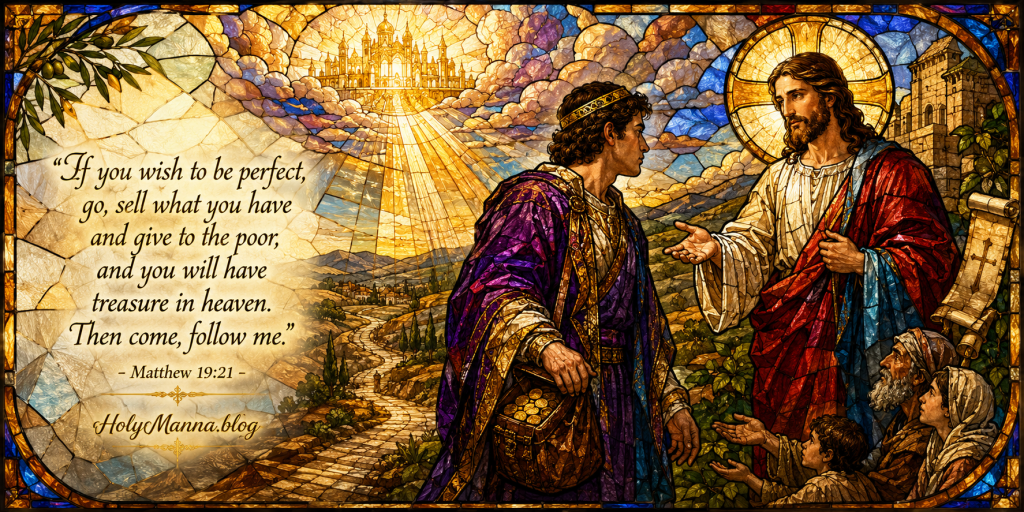
Jesus said to him, “If you wish to be perfect, go,
sell what you have and give to the poor,
and you will have treasure in heaven.
Then come, follow me.”
When the young man heard this statement, he went away sad,
for he had many possessions.
Detailed Exegesis
Verse 16: “Teacher, what good must I do to gain eternal life?”
The question is genuine and beautiful. St. John Paul II wrote in Veritatis Splendor 8: “The question which the rich young man puts to Jesus of Nazareth is one which rises from the depths of his heart. It is an essential and unavoidable question for the life of every man, for it is about the moral good which must be done, and about eternal life.” Every human being eventually asks it.
Verse 17: “Why do you ask me about the good? There is only One who is good. If you wish to enter into life, keep the commandments.”
Jesus first lifts the man’s eyes from a checklist to a Person. Goodness is not a technique; it is God Himself. Then, far from dismissing the Law, Jesus confirms it: the commandments remain the real road into life.
Verses 18-19: “You shall not kill; you shall not commit adultery; you shall not steal; you shall not bear false witness; honor your father and your mother; and you shall love your neighbor as yourself.”
Jesus cites the commandments concerning love of neighbor and sums them up with Leviticus 19:18. The Catechism observes in CCC 2052 that Jesus answers “by invoking the necessity to recognize God as the ‘One there is who is good,’ as the supreme Good and the source of all good” before pointing to these precepts.
Verse 20: “All of these I have observed. What do I still lack?”
Here is the ache underneath all his obedience. He has done everything right and still senses an emptiness. That question, what do I still lack?, may be the most honest prayer a comfortable, rule-keeping believer can offer.
Verse 21: “If you wish to be perfect, go, sell what you have and give to the poor, and you will have treasure in heaven. Then come, follow me.”
Jesus answers the lack not with another rule but with Himself. The Catechism teaches in CCC 2053 that this call “does not do away with the first: following Jesus Christ involves keeping the Commandments. The Law has not been abolished, but rather man is invited to rediscover it in the person of his Master who is its perfect fulfillment.”
Verse 22: “When the young man heard this statement, he went away sad, for he had many possessions.”
The only person in the Gospels recorded as leaving Jesus sad is the one who refused His invitation. His possessions did not follow him out; they led him out.
Teachings
St. John Chrysostom, preaching on this passage in his Homily 63 on Matthew, defends the young man’s sincerity while diagnosing his chains: “For they that have little are not equally held in subjection, as they that are overflowed with great affluence, for then the love of it becomes more tyrannical.” And again: “the increase of acquisitions kindles the flame more, and renders the getters poorer, inasmuch as it puts them in greater desire, and makes them have more feeling of their want.” The golden-mouthed preacher saw what modern psychology keeps rediscovering, that possessions possess their owners. The Church has never taught that wealth itself damns, but she has always taught, following this Gospel, that attachment enslaves. The evangelical counsel of poverty, embraced radically by religious and lived in spirit by every baptized person, exists because Jesus spoke this verse. As CCC 2053 concludes, the counsels “are inseparable from the Commandments.” Keeping the rules is the floor of the Christian life; following Christ with an undivided heart is the ceiling He invites everyone toward.
Reflection
The young man’s tragedy is not that he was wicked but that he settled. He wanted eternal life at a price he had already decided he could afford. Jesus loves people too much to negotiate. A concrete step this week: give something away that actually costs you, not just spare change but something whose absence you will feel, and give it to someone who is poor. Another step: sit with the question the young man asked and let Jesus answer it personally in prayer rather than assuming the answer will be comfortable. What do you still lack? If Jesus named the one thing standing between you and wholehearted discipleship, do you already know what He would say? And would you follow Him, or walk away sad?
The God Who Is Worth Everything
Hold the three scenes together and a single story emerges. A prophet buries his wife in silence while an army surrounds Jerusalem. A nation hears the old song of Moses accusing it of forgetting the Mother who gave it birth. A rich young man stands at the threshold of everything and turns back because his hands are too full to take the hand of God.
Each scene asks the same question from a different angle: whom does the heart belong to? Israel learned through catastrophic loss what the young man was offered as a free gift, that nothing, not the delight of the eyes, not the Temple itself, not great possessions, can substitute for the living God. The Catechism’s stunning line bears repeating, that the Exile “already stands in the shadow of the Cross.” Every stripping in Scripture points toward the day when God, who asks His people to surrender everything, surrendered everything first. The Father gave the delight of His eyes. The Son sold all He had, so to speak, emptying Himself for the poor, which is everyone. No one who follows Him is ever asked for more than He already gave.
So the invitation of this Monday in Ordinary Time is not grim. It is the most liberating offer imaginable: trade the treasures that rot and groan for treasure in heaven that nothing can touch. Go to Mass this week and lay the delight of your eyes on the altar next to the bread and wine. Go to Confession if attachment has hardened into idolatry. Then come, follow Him, and discover that the God who gave you birth is the only treasure that makes you rich.
Engage With Us!
Share your reflections in the comments below. This community grows stronger every time someone honestly wrestles with the Word, and your insight might be exactly what another reader needs today.
- In Ezekiel 24:15-23, God calls both Ezekiel’s wife and the Temple “the delight of your eyes.” What good gift in your life is at risk of becoming the stronghold of your pride, and how can you return it to God’s hands this week?
- In Deuteronomy 32:18-19, 20, 21, Israel is accused of forgetting the God who gave her birth. What daily habit could you build to keep gratitude to God from slowly leaking out of your life?
- In Matthew 19:16-22, the young man asks what he still lacks and walks away sad. If you asked Jesus that same question tonight in prayer, what do you honestly expect He would ask you to surrender?
- Taking all the readings together, what would it look like, concretely, for you to give God an undivided heart this week rather than waiting for Him to ask for everything the hard way?
Living a life of faith is not about white-knuckled deprivation. It is about discovering, day by day, that Jesus is worth more than anything He asks us to release. Whatever you hold, hold it loosely, love the Giver more than the gift, and do everything this week with the love and mercy Jesus taught us.
Sacred Heart of Jesus, we trust in You!
Immaculate Heart of Mary, pray for us!
Saint Michael the Archangel, defend us in battle!
Follow us on YouTube, TikTok, Instagram and Facebook for more insights and reflections on living a faith-filled life.


Leave a Reply