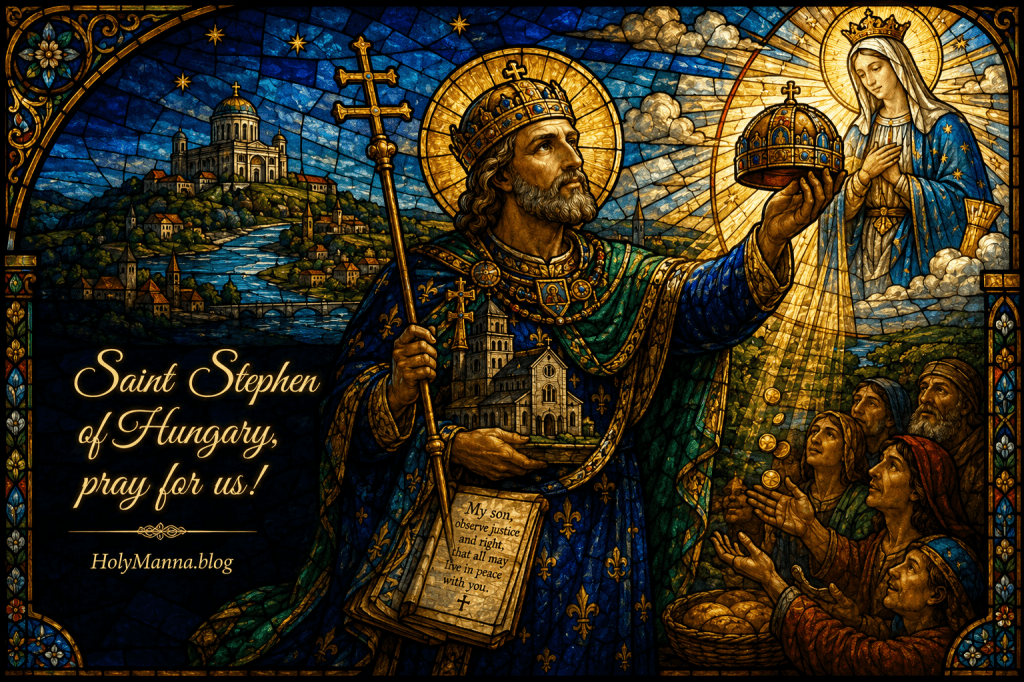
The King Who Laid His Crown at Mary’s Feet
Some saints changed a heart, some changed a city, and a rare few changed the destiny of an entire nation. Saint Stephen of Hungary belongs to that last company. Born a pagan prince named Vajk on the plains of the Danube, he became the first King of Hungary, the father of a canonized saint, and the man who led the Magyar people from the old gods into the arms of the Catholic Church. History remembers him as the founder of the Hungarian state; the Church remembers him as the Apostle of Hungary, a title he earned not with a sword alone but with monasteries, dioceses, laws shaped by the Gospel, and a heart that could not say no to the poor. He is the patron saint of Hungary and of kings, and more than a thousand years after his coronation, his memory still anchors the identity of his people.
The universal Church celebrates his optional memorial on August 16th, the day after his death, since he entered eternal life on the Solemnity of the Assumption itself. This year the 16th falls on a Sunday, so the Lord’s Day takes precedence at Mass, yet the Roman Martyrology still commemorates him, and his story deserves telling on any day of the week. Hungary keeps his greatest festival on August 20th, the anniversary of the translation of his relics, a date so woven into the nation’s soul that it doubles as the country’s founding holiday. The Church’s own prayer for his memorial captures why he matters, asking God that she may have “Saint Stephen of Hungary, who fostered her growth while a king on earth, as her glorious defender in heaven.” A king who spent his crown building up the Body of Christ now intercedes for that same Body before the throne of God, which is exactly what the Catechism teaches about the saints, who “do not cease to intercede with the Father for us” as CCC 956 explains, words originally drawn from the Church’s teaching on the communion of saints. That is the man this post introduces, and his story begins in a world caught between two ages.
From Vajk to Stephen: A Boy Between Two Worlds
Stephen was born around the year 975 in Esztergom, a fortress town on a bend of the Danube in what was then the Principality of Hungary. The ancient chronicles disagree on the exact year, with estimates ranging from the late 960s to 975, so honesty requires holding the date loosely. His birth name was Vajk, and his family was the ruling house of the Magyars, the Árpád dynasty. His father was Géza, the Grand Prince of the Hungarians, and his mother was Sarolt, a woman from a family already touched by Christianity through the influence of the Byzantine East.
To understand Stephen, you have to understand the world he inherited. The Magyars were a fierce, formerly nomadic people who had swept in from the East a few generations earlier and settled the fertile Carpathian Basin. For decades their raiding parties had terrorized Europe. By Géza’s time, the old way of life was reaching its limit. Surrounded by Christian powers, Géza made a calculated opening to the Church, accepting baptism and inviting missionaries into his lands, though by most accounts his own conversion remained more political than deep. The seed he planted casually, his son would water with his whole life.
Tradition holds that Vajk was baptized around the year 985 and received the name Stephen, and the same tradition says the one who baptized him was Saint Adalbert of Prague, the great missionary bishop of Central Europe. The connection to Adalbert cannot be verified from contemporary documents, so it is told here as the Church has long told it, as a cherished tradition rather than settled fact. What is certain is that the boy was raised a Christian, and unlike his father, he believed. In 996 he married Gisela of Bavaria, a devout princess and the sister of the future Holy Roman Emperor, Saint Henry II. Think about that for a moment. Stephen’s brother in law and his own son would both be canonized alongside him in the Church’s memory. Holiness ran through this family like a current.
When Géza died in 997, the succession exploded. Under the old pagan rules of the Árpáds, the throne passed not to the son but to the eldest male of the clan, and Stephen’s older cousin Koppány claimed his right, backed by everyone who wanted the old gods and the old ways back. This was never merely a family quarrel; it was a battle for the soul of the nation. Stephen met Koppány’s forces near Veszprém in 998 and defeated them decisively. With that victory, the question was settled. Hungary would be Christian.
Then came the moment that changed everything. On Christmas Day in the year 1000, or on the first day of January 1001, since the sources preserve both dates, Stephen was anointed and crowned the first King of Hungary. Tradition holds that the crown itself was sent by Pope Sylvester II, a sign that this new kingdom entered history under the blessing of the See of Peter. The papal origin of the crown rests on an account written about a century later and cannot be verified from documents of Stephen’s own time, yet the tradition is honored at the highest levels of the Church; Saint John Paul II, marking the millennium of the coronation, spoke of the royal crown Stephen received from Pope Sylvester II and called his legacy “a heritage of fundamental and indestructible values: the true house built upon the rock.” Whatever the crown’s precise origin, its meaning was never in doubt. Stephen understood kingship as a commission from God, and he set out to spend it entirely on the Gospel.
Building a Kingdom on the Rock
What Stephen did next has few parallels in Christian history. In a single reign he built the entire structure of the Church in Hungary from almost nothing. He established the archbishopric of Esztergom, freeing the Hungarian Church to answer to Rome rather than to neighboring powers, and he founded ten dioceses across the land. He completed and endowed the great Benedictine monastery of Pannonhalma, which his father had begun, and he seeded the countryside with religious houses. He decreed that every ten towns together must build and support a parish church with a priest, so that no village would be far from the sacraments. He made laws protecting Sunday worship, safeguarding property, and providing for tithes to sustain the clergy. Missionaries flowed in, and Stephen protected them.
None of this was cold administration. Stephen’s laws and letters breathe conviction that authority is a stewardship before God, which is exactly how the Church understands political power. The Catechism teaches in CCC 2235 that “those who exercise authority should do so as a service,” and Stephen wrote that principle into the founding documents of a nation. His zeal for spreading the faith earned him the title Apostolic King, and Hungary’s kings carried the apostolic cross in their arms for centuries because of him.
His most personal legacy is a small book. Sometime in the 1010s or 1020s, Stephen had prepared for his son Emeric a set of fatherly instructions known as the Admonitions, a guide for a young Christian ruler. Scholars note that a court cleric may have drafted the Latin text at the king’s direction, but the Church has always received it as Stephen’s own voice, and the Liturgy of the Hours places an excerpt from it in the Office of Readings for his feast. Its opening is one of the most tender lines a saint ever addressed to his child: “My beloved son, delight of my heart, hope of your posterity.” Its counsel could have been written this morning: “Be merciful to all who are suffering violence, keeping always in your heart the example of the Lord who said: I desire mercy and not sacrifice.” And again: “Be patient with everyone, not only with the powerful, but also with the weak.” And most piercing of all: “Be humble in this life, that God may raise you up in the next.”
One passage of the Admonitions has echoed across a thousand years with startling freshness. Stephen urged his son to receive strangers and newcomers with honor, because they enrich a kingdom, writing in the translation quoted by the Vatican itself: “A country that has only one language and only one tradition is weak and failing. I therefore urge you to welcome foreigners kindly and to hold them in honour, so that they prefer to stay with you rather than elsewhere.” A medieval king arrived by conviction at what the Church teaches to this day, for CCC 2241 instructs that prosperous nations are obliged, to the extent they are able, to welcome the foreigner in search of security and livelihood. Stephen closed his counsel with an image worthy of Scripture, telling Emeric that the virtues of mercy, patience, humility, and purity form the true regalia of a ruler: “All these virtues I have noted above make up the royal crown, and without them no one is fit to rule here on earth or attain the heavenly kingdom.”
Stephen practiced what he preached, above all toward the poor. The old accounts describe him visiting the poor in their houses, washing their feet with his own royal hands, and giving alms with an openness that alarmed his treasurers. Here belongs one of the most beloved stories attached to his name. Tradition tells that Stephen liked to distribute alms in disguise, so that the poor would meet a brother rather than a king, and that on one such night a crowd of beggars mobbed him, knocked him down, tugged at his beard, and made off with his purse. Rather than take offense, the king is said to have laughed at the indignity, rejoiced that he had suffered a little something for Christ, and renewed his vow to Our Lady never to refuse alms to anyone who asked in her name. That story comes from the later Lives of the saint and cannot be verified. Yet it fits everything documented about him, and it makes flesh what the Catechism calls the works of mercy, which CCC 2447 describes as charitable actions that come to the aid of a neighbor in his bodily and spiritual necessities. Contemporary accounts do not attach wonder working to Stephen during his lifetime in the way they do to some saints; his miracle, if you want to call it that, was a pagan nation turned toward Christ in a single generation, and a king who stayed humble while doing it.
The Sorrows of a Father and King
Stephen was never martyred, but do not imagine his path was smooth. His whole reign was a long endurance. It began in war against his own cousin, and years later he had to subdue the powerful chieftain Ajtony, who resisted the new order in the southern territories. In 1030 the Holy Roman Emperor Conrad II invaded Hungary, and Stephen, who had spent his reign avoiding wars of ambition, successfully defended his young kingdom. Enemies of the faith he planted waited through his whole life for a chance to uproot it, and he carried that knowledge every day.
The deepest wounds came from inside his own house. Stephen and Gisela buried child after child. Only one son, Emeric, survived into adulthood, and Stephen poured everything into him. The boy was educated in a strict and prayerful spirit under the guidance of the Venetian monk Gerard, later a bishop and a saint himself, and Emeric grew into a young man of remarkable purity. Stephen prepared the Admonitions for him and intended to elevate him as co-heir, dreaming of handing over the kingdom and retiring to a life of contemplation. Then, on September 2, 1031, Emeric was killed in a hunting accident, gored by a boar at twenty four years of age. Every parent who has lost a child knows a grief that has no bottom, and Stephen drank it in full. The son for whom the book was written never wore the crown it described.
His last years were heavy. His health failed, and a bitter quarrel broke out among his nephews over the succession, none of whom shared his heart for the faith. The sources record that some of them even joined a conspiracy against the old king’s life. Imagine that sorrow, a man who had given everything to God and nation, watching his own blood scheme against him at his sickbed. Stephen endured it without abandoning either his duty or his trust in God, and in his final act he solved the problem of succession in the most Catholic way imaginable. Having no worthy heir on earth, he gave his crown to Heaven. Before his death, Stephen solemnly offered his kingdom, his crown, and his people to the Blessed Virgin Mary, asking her to be the true Queen of Hungary. To this day she is honored there as the Patroness of Hungary, and the Catechism affirms in CCC 971 that the Church rightly honors the Blessed Virgin with special devotion. Stephen died on August 15, 1038, on the very Solemnity of the Assumption he loved above all feasts. The Hungarians took note of the timing and never forgot it; following their holy king, they call the Assumption the Day of the Great Lady. It is hard not to see a mother coming for her devoted son on her own feast.
The Incorrupt Hand and the Memory of a Nation
After Stephen’s death, the faith he planted was tested by decades of unrest, yet it held, exactly as he had prayed it would. Meanwhile, reports of healings and answered prayers gathered at his tomb in Székesfehérvár, the church he himself had built in honor of Our Lady, where the kings of Hungary would be crowned and buried for centuries. Those reports moved King Ladislaus I, himself a future saint, to seek Stephen’s elevation to the altars. In 1083, with the authorization of Pope Saint Gregory VII, Stephen was canonized together with his son Emeric and the martyred Bishop Gerard, Emeric’s old tutor. A father and son raised to sainthood together is one of the rarest graces in the history of the Church, and it remains one of the most touching facts about this family. Canonization, as CCC 828 teaches, is the Church solemnly recognizing that a member of the faithful practiced heroic virtue and lived in fidelity to God’s grace, and in Stephen’s case the Church was recognizing a holiness that had built her very house in Hungary.
A tradition preserved in the medieval chronicles says that when the moment came to open Stephen’s tomb, the great stone could not be moved at all until King Ladislaus released his imprisoned rival, King Solomon, from captivity, as if the saint himself demanded mercy and reconciliation before he would allow his own glorification. Once mercy was shown, the tradition says, the stone yielded. That story cannot be verified. It is told here because Hungary has told it for nine centuries, and because it sounds exactly like the king who wrote that mercy belongs to the royal crown.
What was found inside the tomb became the most famous relic in Hungarian history. The body had returned to dust, but the right hand, the hand that had signed the founding charters of churches and pressed alms into the palms of the poor, was found remarkably intact. The Hungarians named it the Szent Jobb, the Holy Right, and its preservation was received as a sign of the sanctity of the man. The chronicles then record an almost unbelievable episode: a canon of Székesfehérvár secretly carried the relic off to his estate in Bihar County, and King Ladislaus, rather than punishing him, recovered the Holy Right on May 30, 1084 and founded a monastery on the spot, around which grew a town called Szentjobb, named for the relic itself. The relic’s later travels read like a history of Central Europe in miniature. It was guarded by Dominican friars in Dubrovnik during the Tartar invasions, kept for a time in Vienna, returned to Hungary through the intervention of Empress Maria Theresa in 1771, hidden near Salzburg during the Second World War, and solemnly returned to Hungary by the United States Army in 1945. Today it rests in a golden reliquary in the Holy Right Chapel of Saint Stephen’s Basilica in Budapest, and every August 20th it is carried through the streets in the great Szent Jobb procession, the spiritual high point of Hungary’s national feast. The veneration of relics like this is a treasured expression of Catholic piety, which CCC 1674 names among the forms of devotion surrounding the Church’s sacramental life.
Stephen’s canonization has borne fruit beyond anything he could have foreseen. His feast, long kept on September 2nd in the old calendar, was placed on August 16th in the 1969 reform, the day after his heavenly birthday, since the Assumption itself occupies the 15th. It is also widely reported that in the year 2000, the Ecumenical Patriarchate of Constantinople recognized his sanctity, so that the first King of Hungary is now honored in both East and West, a bridge between the two lungs of Christendom a thousand years after his coronation. Pilgrims still stream to Esztergom, to Pannonhalma, to Székesfehérvár, and to the basilica in Budapest that bears his name. A nation still dates its founding from his crown. Few saints can claim that their fingerprints remain on an entire country, and in Stephen’s case, quite literally, the hand itself remains.
What a Thousand Year Old King Teaches You Today
It would be easy to file Saint Stephen away as a figure for historians, a crowned statue from a distant age. That would be a mistake, because the questions he faced are your questions wearing older clothes. He held power and had to decide what it was for. He raised a child in a culture hostile to his faith. He buried people he loved. He watched people he trusted turn against him. He had wealth and had to choose daily whether it would own him. Strip away the crown, and Stephen is a working father trying to be faithful in every role at once, and that is precisely why the Church holds him up. The Catechism teaches in CCC 2013 that all the faithful, whatever their condition or state, are called to the fullness of the Christian life and to the perfection of charity. Stephen’s condition happened to be kingship. Yours might be an office, a classroom, a kitchen, or a hospital shift. The call is identical.
Consider his counsel to Emeric as counsel to you. “Be humble in this life, that God may raise you up in the next” is a whole spirituality in thirteen words. Where in your life are you grasping for a crown that God is asking you to lay down? Stephen also teaches something urgently needed now: that strength and mercy are not opposites. This was a warrior who defended his kingdom in battle, yet he wrote that a ruler unfit for mercy is unfit to rule at all, and he let beggars knock him into the mud without a word of anger. When someone wrongs you this week, in traffic, in a meeting, in your own home, what would it look like to respond the way Stephen responded to those beggars? His welcome of the stranger asks its own hard question in an age that argues bitterly about borders and belonging. How do you personally treat the outsider, the newcomer at the parish, the coworker nobody talks to, the family that just moved in?
Finally, learn from how he handled loss. When Emeric died, Stephen’s life plan died with him, and when his own family betrayed him, his last earthly securities collapsed. His answer was not despair but consecration; he placed everything that remained into the hands of the Blessed Mother. There is a practical invitation hiding in that gesture. Entrust to Mary the thing you cannot fix, the child you worry over, the future you cannot control. Pray a daily decade of the Rosary for it this week and mean it. Give alms this week the way Stephen did, personally and generously, without checking whether the recipient deserves it. And ask yourself the question his whole life poses: if everything you have is a stewardship from God, what are you building with it that will outlast you?
Engage With Us!
Saint Stephen of Hungary spent a crown on the Kingdom of God, and his story has been stirring hearts for a thousand years. Now it is your turn to share. Drop your thoughts and reflections in the comments below; this community grows the way Stephen’s kingdom did, one honest soul at a time. Here are a few questions to get you started.
- Saint Stephen treated his power as a stewardship from God rather than a possession. What authority or influence has God placed in your hands, and how are you using it to serve others?
- The Admonitions urge mercy, patience, and humility as the true royal crown. Which of those three virtues is hardest for you right now, and what is one concrete step you could take this week to grow in it?
- Stephen consecrated his kingdom to the Blessed Virgin Mary when he had no earthly solution left. What situation in your life is ready to be entrusted to Our Lady’s care?
- Stephen welcomed the stranger and honored the newcomer. Who is the outsider in your daily orbit, and how could you honor them this week?
- After losing his son, Stephen kept building for a future he would never see. What are you building in faith that may only bear fruit after you are gone?
Wherever this finds you, take courage from the king who knelt. Live your faith boldly this week, hold your plans with open hands, and do everything, from the biggest decision to the smallest chore, with the love and mercy that Jesus taught us.
Saint Stephen of Hungary, pray for us!
Follow us on YouTube, TikTok, Instagram and Facebook for more insights and reflections on living a faith-filled life.


Leave a comment