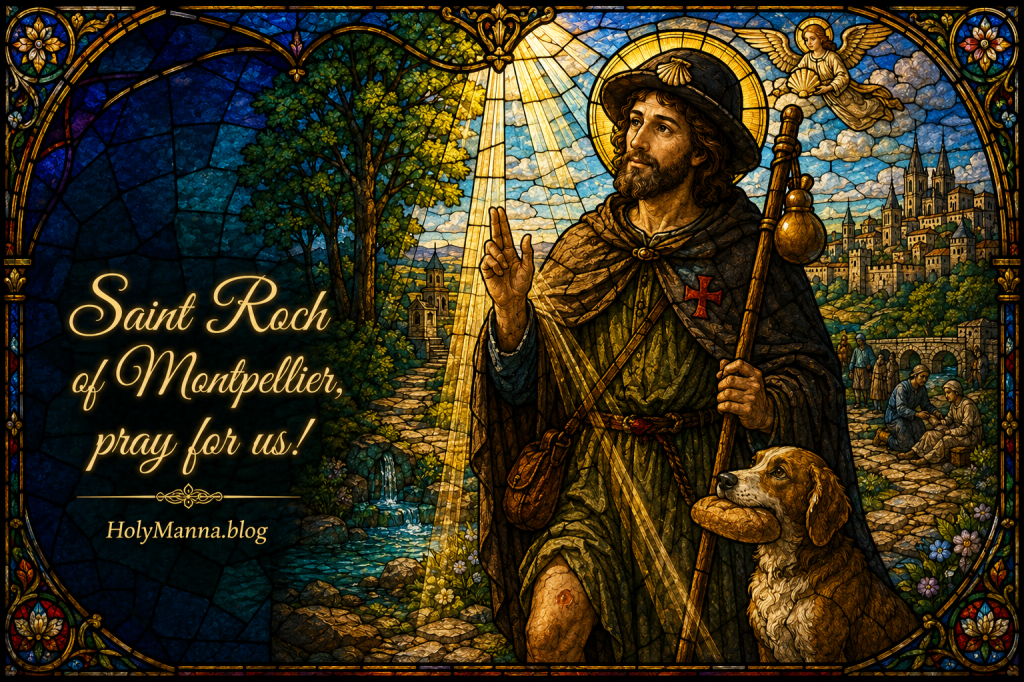
The Pilgrim Who Walked into the Plague
There are saints whose names fill libraries, and there are saints whose lives come down to us in fragments, carried across the centuries by the love of ordinary believers. Saint Roch of Montpellier belongs to the second kind, and yet few saints have ever been loved so widely or invoked so desperately. When the Black Death swept through Europe in the fourteenth century and killed perhaps a third of the continent, this young French nobleman did the one thing almost nobody else was willing to do. He walked toward the dying instead of away from them. He nursed plague victims town after town, caught the disease himself, and died alone in a prison cell, unrecognized, mistaken for a spy. Within a few generations, his name was on the lips of frightened Christians from Montpellier to Venice to Constantinople, and processions in his honor were credited with stopping epidemics in their tracks.
Saint Roch, known as Rocco in Italy, Roque in Spain and Portugal, and Rock in older English usage, is celebrated on August 16, the day after the Solemnity of the Assumption. He holds one of the broadest sets of patronages in the entire calendar. He is invoked against plague, epidemics, cholera, skin diseases, and knee ailments, and he is the patron of invalids, pilgrims, bachelors, surgeons, apothecaries, gravediggers, tile makers, second hand dealers, diseased cattle, and people who have been falsely accused. Most famously of all, because of the faithful animal who kept him alive in the forest, he is the patron saint of dogs. Countless towns in Italy and the Philippines claim him as their protector, and during the recent global pandemic, Catholics around the world rediscovered him almost overnight. His story is a portrait of what The Catechism calls the works of mercy, the charitable actions by which the faithful come to the aid of their neighbor in his bodily and spiritual necessities, works which include visiting the sick even at the cost of one’s own life (CCC 2447).
A Child Marked With the Cross
Roch was born in Montpellier, in the south of what is now France, into a family of real prominence. His father was the governor of the city, and tradition names his parents John and Libera, a devout couple known for their generosity to the poor. Here an honest word about dates is needed, because the sources genuinely disagree. The older tradition, preserved in the Catholic Encyclopedia and in centuries of devotional writing, places his birth around the year 1295 and his death in 1327. Modern scholarship, working from the earliest documents and from the later history of his relics, generally places his life between roughly 1348 and 1376 or 1379, with his death falling on the fifteenth or sixteenth of August at Voghera in Lombardy. The later dating would set his entire life inside the era of the Black Death, which fits the story handed down about him. Readers should know that both chronologies circulate in reputable Catholic sources, and that certainty is simply not possible at this distance.
What the tradition tells about his beginnings is tender and striking. His mother is said to have been unable to conceive for many years, and she begged the intercession of the Blessed Virgin Mary until God granted her a son. The child was born, so the story goes, bearing a birthmark in the shape of a red cross on his breast, a mark that grew as he grew. The old accounts add that even as a nursing infant he joined his mother’s fasts in his own small way. These birth traditions cannot be verified as historical fact, and they are told here as the treasured stories they are, but the red cross will return at the end of his life in a way that mattered enormously to the people who first told his story.
Roch’s conversion was not a turn from sin so much as a deepening unto radical surrender. When he was about twenty years old, both of his parents died. Suddenly this young man held an immense fortune and stood in line to govern one of the great cities of southern France. He refused all of it. Following the counsel the Lord gave to the rich young man, he sold what he had, distributed the proceeds to the poor, and handed the governance of Montpellier over to his uncle. Then he put on the rough clothes of a mendicant pilgrim, took up a staff, and set out on foot for Rome. It is commonly held that he joined the Third Order of Saint Francis, and the Franciscan family has long claimed him, keeping his feast on August 17; the great Franciscan historian Luke Wadding examined the question and left it open, so his membership is a cherished tradition rather than a proven fact. What is beyond dispute is that he lived the Franciscan pattern perfectly, holding nothing back, owning nothing, and belonging entirely to Christ in the poor.
The Healer on the Road
Roch never made it to Rome the way an ordinary pilgrim would, because the road itself became his mission. Crossing into Italy, he arrived at the town of Acquapendente and found it in the grip of the plague. A prudent traveler would have gone around. Roch went in. He presented himself at the hospital and asked to serve the dying, and the tradition holds that he did more than nurse them. He healed them, tracing the sign of the cross over the sick and praying, and the plague victims recovered. From Acquapendente he moved to Cesena and other stricken cities, doing the same work, and then at last to Rome, where the epidemic was raging as well. The tradition preserved in the Golden Legend recounts that in Rome he healed a cardinal by marking the sign of the cross on his forehead, and that the mark remained visibly imprinted there, an astonishing sign that the healing had come from God and not from any human art. That story of the cardinal comes from later tradition and cannot be verified.
Why should you remember a man like this, and why should you want to be like him? Because Roch shows what the Church has always taught about Christ’s own ministry continuing in His members. The Catechism teaches that the Church received from the Lord Himself the charge to heal the sick, and that she strives to carry it out both by caring for the sick and by accompanying them with prayer of intercession, believing in the life giving presence of Christ, the physician of souls and bodies (CCC 1509). Roch was not a physician. He carried no medicine. His entire method was the sign of the cross, prayer, and the willingness to touch people whom everyone else had abandoned. In an age when plague victims were sealed into their houses and left to die, that willingness was itself a kind of miracle, and the cures that tradition attributes to him were understood by everyone who told his story as God’s own intervention through a man who had made himself completely available.
There is a detail worth sitting with here. Roch worked these wonders as a nobody. He had deliberately hidden his rank, his wealth, and even his name. Nobody in those Italian plague hospitals knew that the ragged pilgrim washing their sores could have been governing Montpellier. He had taken seriously the Lord’s instruction that when you give alms, your left hand should not know what your right hand is doing, and he extended that hiddenness to his whole existence. The world measures a life by recognition. Roch renounced recognition so thoroughly that it would eventually cost him his freedom and his life.
The Forest, the Dog, and the Prison
At Piacenza, while serving in the hospital of Our Lady of Bethlehem, the inevitable happened. Roch himself was stricken with the plague. A painful sore opened on his thigh, the mark by which artists would portray him ever afterward. And here the story reaches its most humanly devastating moment, because the man who had spent years tending abandoned plague victims was now abandoned in his turn. Not wanting to burden the hospital or endanger others, and by some accounts driven out of the city, he dragged himself into the forest near the village of Sarmato and built a little hut of boughs and leaves, expecting to die there alone.
God did not leave him alone. The tradition tells that a spring of fresh water rose up miraculously beside his hut to cool his fever. And then came the dog. A hunting dog belonging to a nobleman of the region, remembered by name as Gottardo Pallastrelli, began stealing bread from his master’s table and disappearing into the woods with it, day after day. The dog carried the bread to Roch and, the tradition adds, licked his wounds, which began to heal. Gottardo, puzzled by his dog’s strange behavior, finally followed the animal into the forest and found the dying pilgrim. He brought Roch home, cared for him until he recovered, and was so moved by the holiness of his guest that he gave up his own wealth and became Roch’s disciple, living afterward as a hermit and dying in the odor of sanctity himself. This entire episode, the spring, the dog, and the conversion of Gottardo, comes from the traditional accounts written down long after the events and cannot be verified as history, yet it has been told with love for six centuries, and it is the reason a dog with a loaf of bread in its mouth sits at the feet of nearly every statue of Saint Roch in the world.
Think about what the story is saying. The man who fed the abandoned was fed by a dog. The nurse of the dying was nursed by an animal’s tongue. God’s providence reached His servant through one of the humblest of His creatures, and the Church has never been embarrassed by that. The Catechism affirms that animals are God’s creatures, that He surrounds them with His providential care, and that by their mere existence they bless Him and give Him glory (CCC 2416). Every dog lover who has ever felt that their animal’s loyalty was somehow a gift from above has an ally in the story of Saint Roch.
Roch was not a martyr, and no one ever claimed he was. His crown was of a different kind, and it came in the form of a prison cell. After his recovery he turned homeward, and here again the accounts diverge. The older tradition says he arrived back at Montpellier itself; another account, which fits the modern chronology, places what follows at Voghera in Lombardy. In either telling, the substance is the same. Wars were on, suspicion was everywhere, and a gaunt stranger in a pilgrim’s cloak who refused to give his name was an obvious suspect. Roch was arrested as a spy and thrown into prison, and the bitterest turn of the old tradition is that the governor who ordered his arrest was, some writers say, his own uncle, who did not recognize the nephew who had once handed him a city. Roch could have spoken one sentence and walked free. He never spoke it. Having given away his name along with his fortune, he refused to reclaim either, accepting the humiliation as from the hand of God. He remained in that cell for about five years, praying, wasting away, comforted according to tradition by the ministry of an angel, until he died on a mid August day. The Catechism teaches that illness and suffering, united to Christ, can become a participation in His saving work, configuring the sufferer to Him and joining him to His redemptive Passion (CCC 1505). Roch’s last five years produced no cures, no journeys, and no visible fruit at all, only a hidden offering, and heaven counted it his masterpiece.
The Plague Stops at His Name
Only in death was Roch finally recognized. The tradition holds that when his body was prepared for burial, the red cross birthmark on his breast was discovered, along with a document he had carried, and the truth came out. The unnamed prisoner was the governor’s son, the heir who had vanished decades before. The city that had jailed him as a spy gave him a public funeral, and miracles were reported at once around his body. One further tradition, dear to the centuries of plague sufferers who loved him, tells that a tablet was found in his cell bearing a heavenly promise that whoever invoked Roch against the pestilence would be delivered from it. That promise entered Christian art in the Latin words Eris in peste patronus, that is, you shall be the patron in the plague, which painters like Rubens placed on a tablet held out to the kneeling saint by an angel at Christ’s side. The tablet story, like so much else, cannot be verified.
What can be documented is the astonishing spread of his cult. In 1414, plague broke out in the city of Constance while the great Council of the Church was meeting there. The Council Fathers ordered public prayers and processions invoking the intercession of Saint Roch, and the epidemic ceased. That account was recorded by Francesco Diedo, the Venetian governor of Brescia, in his Vita Sancti Rochi of 1478, which is the earliest substantial biography of the saint, so even this famous episode reaches us through a source written decades afterward, and honesty requires saying so. What is certain is that by the later fifteenth century, devotion to Roch was exploding. During the terrible plague that swept northern Italy from 1477 to 1479, his name became a refuge, and in 1478 a confraternity dedicated to him was founded in Venice. In 1485 his relics were carried to Venice, furtively by most accounts, and enshrined there in triumph, where they rest to this day in the church of San Rocco. Modern research indicates the body was brought from Voghera rather than from Montpellier, another quiet argument for the later chronology of his life. Beside that church the confraternity raised the magnificent Scuola Grande di San Rocco, which Tintoretto spent decades filling with some of the greatest paintings of the Venetian Renaissance, including the saint in glory on its ceiling. Every year on August 16 the Doge of Venice himself would visit in state, for the Most Serene Republic had taken Roch as one of its principal protectors against the plague.
His veneration poured across borders into Spain, France, Germany, the Low Countries, Lebanon, and eventually the Americas and Asia. In the German lands he was often counted among the Fourteen Holy Helpers, the beloved band of saints invoked in the wake of the Black Death. His canonical path was unusual and worth understanding. Roch was never canonized by a formal papal bull; the Church received him, as she received many early saints, through the acclamation of the faithful, later confirmed by the Popes. He was inscribed in the Roman Martyrology, an act attributed by sources variously to Gregory XIII or Gregory XIV, a discrepancy the records do not fully resolve. Pope Sixtus V at one point demanded the documentation of his life and miracles and weighed the question sharply, but left the devotion in peace, and Pope Urban VIII approved the liturgical office for his feast on August 16. Earlier, Pope Alexander VI had built a church and hospital in his honor in Rome, Pope Paul III instituted a confraternity under his invocation to run them, and Pope Paul IV raised it to an archconfraternity whose daughter confraternities spread through the world. In all of this the Church was doing what The Catechism describes in her recognition of the saints, proclaiming the power of the Holy Spirit at work in her members and proposing them to the faithful as models and intercessors (CCC 828). And the faithful have never stopped asking his intercession, for the saints in heaven do not abandon those still on the way; as The Catechism teaches, they do not cease to intercede with the Father for us (CCC 956).
The cultural footprint of this quiet pilgrim is almost beyond counting. Across Italy, the feast of San Rocco is still kept with processions, brass bands, and festival lights, and Italian immigrants carried those celebrations to the streets of New York, Boston, and beyond. In the Philippines, whole towns bear his name and honor him with fiestas. In New Orleans, when yellow fever ravaged the city in the 1870s, a German priest named Father Peter Thevis led his parish in begging Saint Roch’s intercession and vowed to build a chapel in his honor if the congregation was spared; the devotional tradition of that parish holds that not one member was lost, and the Saint Roch Chapel and its campo santo stand in the city to this day as a monument of thanksgiving. And when a new pestilence circled the globe in 2020, Catholics everywhere reached back across six centuries and found him waiting, the saint who knew exactly what it meant to live in a time of contagion, quarantine, and fear.
What the Plague Saint Teaches a Pandemic Weary World
It would be easy to file Saint Roch away as a colorful medieval figure, the man on the pedestal with the dog and the walking stick. That would be a mistake, because his life presses on the modern conscience at every point. Roch had every excuse the world could offer. He was young, wealthy, important, and safe, and he traded all of it for the privilege of holding the hands of dying strangers. The recent pandemic gave every person alive a small taste of the choices he faced. Fear of contagion, the instinct to protect oneself first, the temptation to look away from the suffering because the suffering is frightening; none of that has changed since the fourteenth century. What Roch shows is that grace can master all of it.
Consider his hiddenness. Roch performed his greatest works anonymously and accepted five years of unjust imprisonment rather than trade on his name. In an age that measures human worth in visibility, followers, and recognition, he stands as a living rebuke and a living invitation. The Lord promised that the Father who sees in secret will repay what is done in secret, and Roch staked his whole existence on that promise. Is there a hidden act of mercy in your life that you have been postponing because no one would ever know or thank you for it? Consider also his surrender in suffering. When Roch could no longer serve, he offered. The sickbed, the forest hut, and the prison cell became his altar, and the Church teaches that suffering borne in union with Christ is never wasted (CCC 1505). When illness or helplessness comes to you, do you treat it only as an interruption of your life, or can you begin to treat it as a form of your vocation?
There are practical ways to weave his witness into daily life. Visit someone who is sick, not with a text message but with your presence, remembering that the Lord counted the words I was sick, and you visited me (The Gospel of Matthew, Mt 25:36) among the criteria of the final judgment. Support the health care workers, hospice staff, and caregivers in your parish with prayer and concrete help, for they are the Rochs of this generation. Practice one act of mercy each week that nobody will ever discover. Care for God’s creatures with gratitude, and let the loyalty of an animal remind you of the Providence that feeds the sparrows. And when sickness touches your own household, ask the intercession of Saint Roch by name, joining a chain of prayer that has run unbroken through plague, cholera, fever, and pandemic for six hundred years. If the plague came to your city tomorrow, in whatever form a plague takes today, which direction would you walk?
Engage With Us!
Saint Roch’s story has been carried for centuries by ordinary believers telling it to one another, and that conversation continues here. Share your thoughts, your questions, and your own experiences of his intercession in the comments below; someone else may need exactly the encouragement you have to give. To help the reflection along, here are some questions to pray with and to discuss.
- Saint Roch gave away his inheritance and his position at twenty years old. What is one form of security God might be inviting you to hold more loosely?
- Roch served the sick at the risk of his own life. Who are the sick, the isolated, or the contagious in your own community, and what would it cost you to move toward them instead of away?
- God sustained Roch through a dog carrying bread. When has God’s providence reached you through a humble, unexpected, or even humorous means?
- Roch refused to reveal his identity and accepted an unjust imprisonment in silence. How do you respond when you are misjudged, and what would it look like to entrust your reputation entirely to God?
- Roch’s last years produced no visible fruit, only hidden prayer and suffering offered to God. Do you believe that a hidden offering can be the most fruitful work of a life, and how might that change the way you view your own limitations?
Saint Roch walked into plague cities with nothing but a staff, the sign of the cross, and total confidence in God, and heaven made him a refuge for millions. You do not need a fortune to give away or an epidemic to face in order to follow him. You need only the next sick person, the next stranger, the next hidden act of mercy that God places on your road. Take it up with courage, do everything with the love and mercy that Jesus taught us, and trust that the Father who saw Roch in the forest and in the prison cell sees you too.
Saint Roch of Montpellier, pray for us!
Follow us on YouTube, TikTok, Instagram and Facebook for more insights and reflections on living a faith-filled life.


Leave a comment