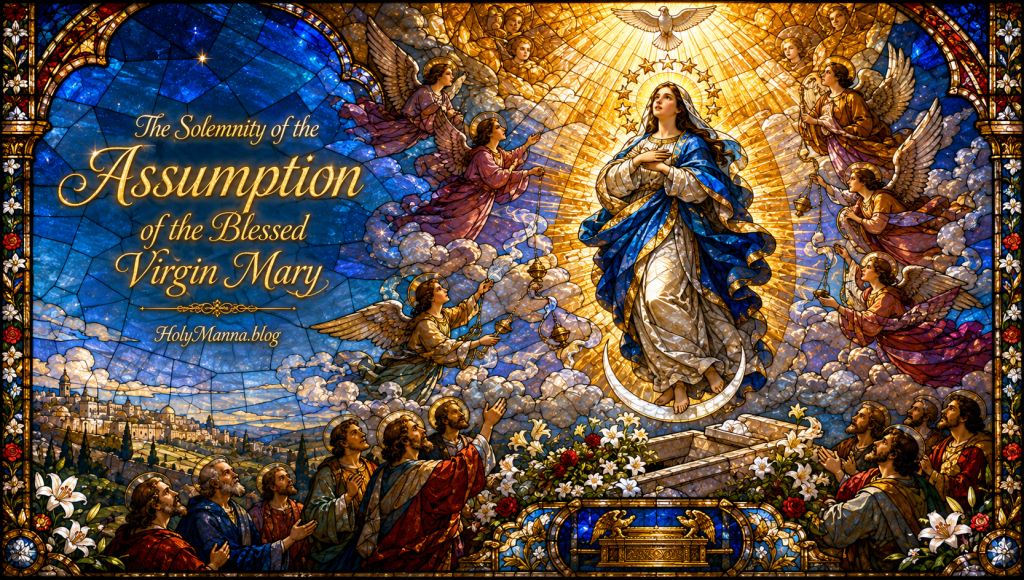
When Heaven Opened for the Most Blessed Mother
Every year on August 15th, the Catholic Church lifts her eyes toward heaven and celebrates the Solemnity of the Assumption of the Blessed Virgin Mary, the day when the Mother of God, at the end of her earthly life, was taken up body and soul into heavenly glory. Among all the Marian celebrations scattered across the liturgical calendar, this one stands at the summit. It is the most ancient of the great Marian feasts, the most solemn in rank, and the only Marian belief ever defined ex cathedra by a pope in the modern era. In many countries it remains a holy day of obligation and even a national public holiday, a sign of just how deeply this mystery has shaped the life of Catholic peoples across the centuries.
The Assumption is not a small devotion reserved for those who happen to love Mary. It touches the very center of the Gospel, because it proclaims what the Resurrection of Jesus Christ accomplishes in a human person who is perfectly united to Him. Mary is the first disciple and the first believer, and in her Assumption she becomes the first member of the redeemed human family to share fully, body and soul, in her Son’s victory over death. The Catechism of the Catholic Church teaches that her Assumption is a singular participation in the Resurrection of her Son and an anticipation of the resurrection of other Christians (CCC 966).
That is why the Church does not keep August 15th with quiet restraint but with processions, pilgrimages, blessed herbs, mystery plays, horse races, and packed basilicas from Jerusalem to Paraguay. The Assumption answers a question every human heart eventually asks: what happens to the body, to this flesh that labors, loves, and suffers? In Mary, the answer shines out with unmistakable clarity. The body is not a shell to be discarded; it is destined for glory. What follows walks through the history of the celebration, its foundations in Scripture and Sacred Tradition, the dogma defined in 1950, and the devotions and cultures that have grown up around it, so that this solemnity can be kept with deeper understanding and greater joy.
Jerusalem’s Dormition
The story of the feast begins in the East. After the Council of Ephesus in 431 solemnly confirmed that Mary is truly Theotokos, the God-bearer, devotion to her blossomed across the Christian world, and the churches of the Holy Land began keeping an annual commemoration known as the Memory of Mary. By the 6th century this observance had taken the shape of the feast of the Dormition, from the Latin dormitio, meaning a falling asleep, celebrated at the ancient church near Gethsemane associated with Mary’s tomb. Around the year 600, the Byzantine Emperor Maurice decreed that the Dormition be celebrated throughout the empire on August 15th, fixing the date that the universal Church still keeps more than 14 centuries later.
Rome received the feast in the 7th century. Pope Saint Sergius I, who reigned from 687 to 701, prescribed a solemn procession for the celebration, one of 4 great Marian feasts he honored in this way. Over the following century the name of the feast in the West gradually shifted from Dormition to Assumption, a change that reflected the Latin Church’s focus on the destination of the mystery, Mary taken up into glory, rather than on her peaceful passing alone. In that same early era, Saint Gregory of Tours, writing in Gaul before his death in 594, became one of the earliest Western witnesses to state plainly the belief that the Lord received the body of Mary into heavenly glory.
Through the Middle Ages the Assumption grew into the principal Marian celebration of the entire year. Great cathedrals from Chartres to Siena were dedicated under this title, cities and guilds placed themselves beneath Mary’s protection, and saints such as Anthony of Padua, Albert the Great, Bonaventure, and Francis de Sales preached and defended the fittingness of the belief with one voice.
What the faithful had believed for well over a millennium was finally defined at the highest level in the 20th century. Beginning in the pontificate of Blessed Pius IX, petitions poured into Rome from cardinals, bishops, priests, religious communities, universities, and countless lay faithful, all asking that the bodily Assumption be proclaimed a dogma. On May 1st, 1946, Pope Pius XII sent the letter Deiparae Virginis Mariae to every bishop in the world, formally asking whether the Assumption could be defined and whether their clergy and people desired it. The response was nearly unanimous. And so, on November 1st, 1950, in the great Holy Year, before an immense crowd gathered in Saint Peter’s Square, Pius XII issued the apostolic constitution Munificentissimus Deus and solemnly defined the Assumption as a divinely revealed dogma. Writing only 5 years after the Second World War, the pope held up the glorified body of Mary before a world that had just treated millions of human bodies as disposable, proclaiming in the strongest way the Church possesses that the human person, body and soul, is destined for God.
The Woman Clothed with the Sun
The Assumption commemorates a dogma and a liturgical mystery rather than an apparition, so no private revelation or approval status attaches to this solemnity. Its foundations lie instead in Scripture read within Sacred Tradition, exactly as the Church teaches Scripture must always be read (CCC 113).
Scripture does not narrate the end of the earthly life of Mary. What it provides is a rich constellation of texts that the Fathers, the Doctors, and the popes have seen converging on this mystery. In Genesis, God promises enmity between the serpent and the woman, and between his seed and her seed (Genesis 3:15). Munificentissimus Deus points to this promise and sees Mary united with her Son in a complete victory over sin and death, a victory that would remain strangely unfinished if her body lay in corruption. Saint Paul teaches that when the corruptible puts on incorruption, “death is swallowed up in victory” (1 Corinthians 15:54), and the Church reads the Assumption as the first fruits of that victory in a purely human creature.
The Old Testament also speaks of the Ark of the Covenant, the gold-covered vessel of the presence of God, and the psalmist prays, “Arise, O Lord, into thy resting place”, together with the ark that the Lord has sanctified (Psalm 131:8 in the Douay-Rheims numbering, Psalm 132:8 in modern Bibles). The Fathers loved this image. Mary is the true Ark, the living vessel who carried the incarnate Word, and Saint Luke seems to invite the comparison directly: his account of the Visitation echoes the journey of the Ark toward Jerusalem, with the cry of Elizabeth and the leap of John recalling the joy of David before the Ark (Luke 1:39-56; 2 Samuel 6). Where the Ark of God goes, corruption cannot hold it.
Then there is the vision of the Apocalypse: “a woman clothed with the sun, and the moon under her feet” (Revelation 12:1), crowned with 12 stars, giving birth to the child who will rule the nations. The Church has long seen in this woman both the People of God and Mary herself, already sharing in glory, and the liturgy of August 15th proclaims this very passage at Mass.
Alongside Scripture stands Tradition. From roughly the 5th century onward, accounts known as the Transitus Mariae circulated widely, describing the end of the life of Mary with the apostles gathered around her. These narratives are traditions, devotional in character, and the Church has never approved their details as historical fact; the dogma rests not on them but on the living faith of the Church handed down through the centuries. Two ancient traditions locate the close of Mary’s earthly life either in Jerusalem, at the tomb venerated near Gethsemane, or in Ephesus, where she lived under the care of Saint John, and the Church has issued no formal judgment settling that historical question. Honesty requires saying so plainly. What history does record is remarkable in itself: although Christians eagerly preserved and venerated the relics of apostles and martyrs from the earliest generations, no church anywhere ever claimed to possess the body of the Mother of God. The most natural explanation the faithful gave was the one the Church would eventually define. Preachers such as Saint Germanus of Constantinople and Saint John Damascene gave that faith its classic voice; Damascene argued that it was fitting that she who remained a virgin in childbirth should be preserved from corruption after death, and that the Mother should dwell in glory where her Son reigns.
One final precision matters here. The solemn definition states only that Mary had completed the course of her earthly life before being assumed, wording chosen with great care. The Church thereby left open the question of whether Mary first died, as the ancient Dormition tradition holds and as most theologians favor, or was assumed without passing through death. The Church defined the glory itself, not the manner of the passage into it.
Body, Soul, and the Promise of Resurrection
At the heart of Munificentissimus Deus stands the solemn definition. Invoking the authority of Christ and of the apostles Peter and Paul, Pius XII pronounced, declared, and defined it to be a divinely revealed dogma that the Immaculate Mother of God, the ever Virgin Mary, at the completion of her earthly life, was “assumed body and soul into heavenly glory” (Munificentissimus Deus, 44). This was an exercise of the extraordinary papal magisterium, the charism by which the Roman Pontiff teaches infallibly when he defines a doctrine of faith or morals to be held by the whole Church (CCC 891). Catholics therefore embrace the Assumption with the full assent of faith.
The Catechism presents the mystery in the words of the Second Vatican Council: the Immaculate Virgin, preserved free from all stain of original sin, was at the end of her earthly life “taken up body and soul into heavenly glory” and exalted by the Lord as Queen over all things, so that she might be more fully conformed to her Son (CCC 966, citing Lumen Gentium, 59).
The Assumption is inseparable from the Immaculate Conception, which Blessed Pius IX had defined in Ineffabilis Deus on December 8th, 1854. Because Mary was preserved from every stain of original sin from the first instant of her conception (CCC 491), she stood untouched by sin’s deepest consequence, the corruption of the grave. Pius XII drew the two privileges together explicitly in his constitution: Christ conquered sin and death by His own death, and Mary, immaculate from her conception, shares in that conquest in a wholly singular way. Her freedom from corruption is the full flowering of her freedom from sin.
The dogma is also profoundly about everyone else. The Catechism teaches that the Most Blessed Virgin, taken up body and soul into the glory of heaven, already shares in the glory of the Resurrection of her Son, anticipating the resurrection of all the members of His Body (CCC 974). In Mary the Church contemplates her own destiny, for the Mother of God is the image and beginning of the Church as it will be perfected in the world to come (CCC 972). The Council therefore calls her “a sign of certain hope and comfort” for the pilgrim People of God (Lumen Gentium, 68). Saint John Paul II, teaching on this mystery in his general audience of July 2nd, 1997, described the Assumption as the culmination of Mary’s generous share in the work of redemption and as “the fruit of her unique sharing in the victory of the Cross”.
Later magisterial teaching keeps unfolding the same treasure. Saint Paul VI, in Marialis Cultus in 1974, presented the Assumption among the celebrations that direct Marian devotion toward Christ and toward the final hope of the Church, and Saint John Paul II wove the glorified Mary through Redemptoris Mater in 1987 as the one who goes before the pilgrim Church on her journey of faith. Queenship flows from the same mystery: exalted body and soul, Mary reigns as Queen of heaven and earth, which is why Pius XII instituted the feast of her Queenship soon after the definition, in the 1954 encyclical Ad Caeli Reginam, and why the Rosary passes from the 4th Glorious Mystery, the Assumption, directly into the 5th, her Coronation. Nor does glory distance Mary from her children on earth. Taken up to heaven, she did not lay aside her saving office, but by her constant intercession she continues to obtain the gifts of eternal salvation for the faithful (CCC 969). The dogma, in the end, preaches the Gospel itself: grace is stronger than the grave.
Walking Toward Mary
For most Catholics, devotion to the Assumption begins in the Rosary. The 4th Glorious Mystery invites meditation on Mary taken into heaven, and the Litany of Loreto invokes her as “Queen assumed into heaven”. Many of the faithful prepare for the solemnity with a novena prayed from August 6th through August 14th, moving from the light of the Transfiguration toward the glory of the Assumption. In central and eastern Europe the day itself carries one of the most beautiful blessings in the treasury of the Church, the blessing of herbs, flowers, and first fruits, an ancient practice preserved in the Roman Ritual. On the day the Church celebrates a creature glorified, creation itself is gathered into the offering.
Pilgrimage has always been woven into this feast. In Jerusalem, pilgrims visit the Benedictine Basilica of the Dormition on Mount Zion, built over the place where tradition holds that Mary fell asleep, and the ancient Tomb of Mary in the Kidron Valley near Gethsemane, venerated since the early centuries of the Church. Both sites rest on venerable tradition rather than on any formal historical judgment of the Church, yet both have drawn unbroken prayer for some 1,500 years. In Ephesus, the House of Mary on Nightingale Hill welcomes streams of Christian visitors, and several popes have knelt in prayer within its small stone walls.
In Rome, the Basilica of Saint Mary Major, the oldest church in the West dedicated to the Mother of God, keeps the Assumption as its patronal solemnity. For centuries medieval Rome celebrated the vigil with a famous night procession in which the ancient image of Christ from the Lateran was carried through the streets to meet the beloved icon of Mary known as Salus Populi Romani, the Salvation of the Roman People, an image before which popes still come to pray today. Across the world, an astonishing number of cathedrals bear the title of the Assumption, from Notre-Dame de Paris and Chartres in France to the cathedrals of Siena and Pisa in Italy, and in the United States the Baltimore Basilica, the first cathedral of the nation, is the Basilica of the National Shrine of the Assumption of the Blessed Virgin Mary. Every one of these journeys nourishes the same hope, because pilgrims who walk toward a shrine of the Assumption are walking toward a mother who already stands where they long one day to arrive.
A Feast the Whole World Keeps
Few celebrations reveal the incarnational genius of Catholic culture like August 15th. In Italy the day is Ferragosto, a national holiday whose very name descends from the Feriae Augusti, the ancient rest days of the Emperor Augustus, which the Church baptized and transformed into the feast of the Assumption. Processions fill Italian towns from the Alps to Sicily. In Siena, whose cathedral is dedicated to the Assumption, the celebrated Palio dell’Assunta thunders around the Piazza del Campo on August 16th in honor of the Madonna of the Assumption, the patroness of the city, while in Sassari on Sardinia the great Candelieri procession carries enormous wooden candlesticks through the streets in fulfillment of an ancient vow to Mary made in time of plague, a celebration recognized by UNESCO as intangible cultural heritage.
Spain offers one of the marvels of the Catholic world. In the city of Elche, the Misteri d’Elx, a sung sacred drama of the death, Assumption, and crowning of Mary with roots in medieval mystery plays, is performed every August 14th and 15th inside the Basilica of Santa Maria, and in 2001 UNESCO declared it a Masterpiece of the Oral and Intangible Heritage of Humanity. In France, where L’Assomption remains a national public holiday, devotion runs back to the vow of King Louis XIII, who in 1638 solemnly consecrated his kingdom to the Blessed Virgin and ordered processions in her honor every August 15th; torchlight processions still illuminate Lourdes and countless French parishes on the vigil of the feast each year.
Central and eastern Europe keep the day with earthy tenderness. In Poland the solemnity is lovingly called Matka Boska Zielna, Our Lady of the Herbs, and the faithful bring bouquets of herbs, grains, and flowers to be blessed, while the great walking pilgrimages converge on the shrine of Jasna Góra in Częstochowa throughout mid-August. Polish Catholics also remember on this date the 1920 victory at the Battle of Warsaw, long attributed by the faithful to the intercession of Mary. In Germany and Austria the day is Mariä Himmelfahrt, marked by blessed herb bundles, and it remains a public holiday in Saarland and in the Catholic communities of Bavaria.
The feast crossed the oceans with the missionaries. The capital of Paraguay, Asunción, was founded on August 15th, 1537 and bears the name of the Assumption to this day. Guatemala City honors the Assumption as its patroness with processions and festivities, and parishes across the Philippines, India, and Africa keep the day with Masses, novenas, and neighborhood celebrations. In the United States the Assumption is ordinarily a holy day of obligation; in 2026, because August 15th falls on a Saturday, the norm of the American bishops abrogates the Mass obligation for that year, though the solemnity itself remains in full splendor and attending Mass is warmly encouraged. Wherever the Church has taken root, this day has flowered into culture, because a people who believe that a human mother is glorified in heaven cannot help but sing about it.
Lifting Your Eyes Toward Home
The Assumption is a feast about Mary, and precisely for that reason it is a feast about you. Everything God accomplished in her, He accomplished as a promise of what He desires to accomplish in every member of His Son’s Body. When you profess in the Creed that you believe in the resurrection of the body, the Assumption shows you what that article of faith looks like when it is fully realized in a redeemed human person (CCC 989-990).
Begin with your grief. Nearly everyone carries the ache of a loved one who has died, and the modern world offers little comfort beyond sentiment. The Assumption offers something far sturdier. It declares that the grave does not get the last word about the body, and that what God has done for Mary He intends, at the resurrection, for all who die in His friendship (CCC 1023, 966). If you are mourning someone this August, bring that person to Mass on the 15th and entrust them to the Mother who has already passed through the end of earthly life into glory.
Consider also how you treat your own body. A culture that swings between worshiping the body and despising it needs the Assumption badly. Your body is not a machine to be optimized or an obstacle to be escaped; it is destined for glory, a temple of the Holy Spirit meant for resurrection. That truth invites practical reverence: honest rest, purity, moderation, and care for the sick and the elderly, whose bodies are not burdens but promises.
Let Mary also teach you her song. In the Magnificat she proclaims that all generations shall call her blessed, because “he that is mighty hath done great things to me” (Luke 1:48-49). Notice the shape of her holiness: everything is received, everything returns to God in praise. The surest path toward sharing her glory is sharing her humility. What great things has God done in your own story that you have never once thanked Him for?
Some concrete steps can carry this feast into your daily life. Pray the Glorious Mysteries on August 15th and rest inside the 4th mystery. Attend Mass even where no obligation binds this year, simply out of love. Bring flowers or herbs to be blessed if your parish keeps that custom, or place them before an image of Mary at home. Pray the Magnificat each evening through the rest of August. Consider preparing for or renewing a consecration to Jesus through Mary. Small acts like these slowly tilt a heart toward heaven, and that tilt is the whole point of the feast, because hope is not a mood; it is a direction.
Engage With Us!
The conversation does not end here, so please share your thoughts, memories, and reflections on the Solemnity of the Assumption in the comments below. Stories of family traditions, pilgrimages, blessed herbs, or a favorite line from the Magnificat are all welcome, and they encourage everyone who reads them.
- How does the promise that your body is destined for glory change the way you treat it, rest it, and offer it to God today?
- When you think about death, what fear could you hand over to Mary, who has already passed through the end of earthly life into the glory of heaven?
- Which line of the Magnificat speaks most directly to your life right now, and why?
- What is one concrete way you will honor the Blessed Mother this August 15th, whether at Mass, in the Rosary, or in a hidden act of love?
Keep pressing forward in faith, hope, and love, with your eyes lifted toward the place Christ has prepared for those who love Him. The Assumption is proof that the promise is real, that grace finishes what it starts, and that heaven is a home with a mother waiting in it. Grow together in faith, day by day, under the gentle guidance of our Blessed Mother, who is already assumed into glory and who never stops praying for her children on the way.
Most Blessed Virgin Mary, Mother of God, pray for us!
Follow us on YouTube, TikTok, Instagram and Facebook for more insights and reflections on living a faith-filled life.


Leave a comment