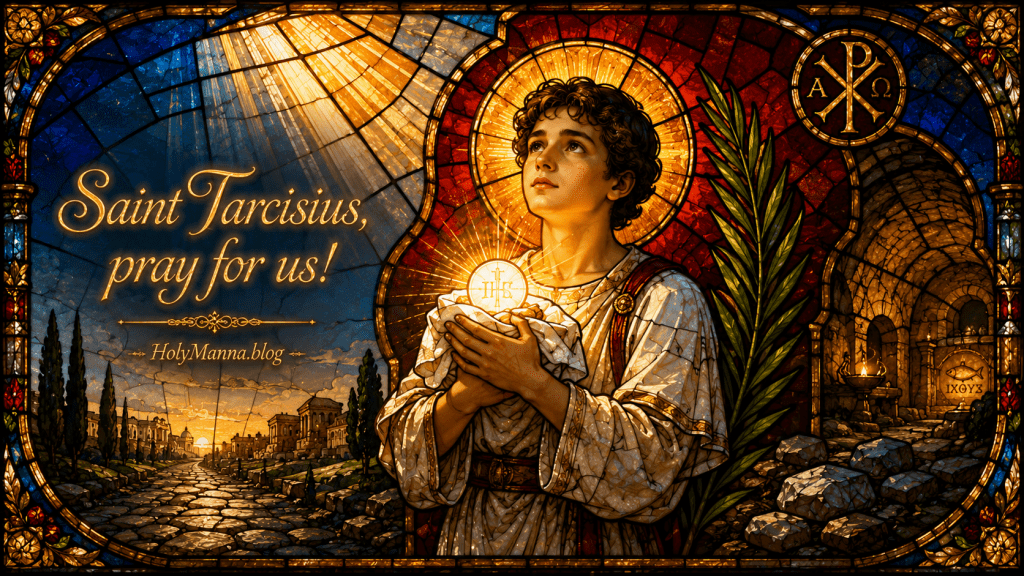
The Boy Who Carried Heaven Through the Streets of Rome
Some saints leave behind libraries. Some leave behind cathedrals, religious orders, or decades of documented miracles. Saint Tarcisius, celebrated on August 15th in the Roman Martyrology, left behind almost nothing at all; no writings, no sayings, no portrait, not even a surviving tomb. What he left behind was a single act, and that act has echoed through seventeen centuries of Catholic life. In the third century, during one of Rome’s brutal persecutions of Christians, Tarcisius was entrusted with carrying the Blessed Sacrament through the city streets. A hostile crowd stopped him and demanded to see what he held. He refused. They beat him to death, and he died still guarding the Body of Christ.
That is the whole story, and it is enough. The Church has never needed more than that to hold him up as one of her most beloved martyrs. He is the patron saint of altar servers and of First Communicants, the two groups of Catholics who, like him, draw near to the Eucharist with young hands and are asked to treat it as the most precious thing in the world. Pope Saint Damasus I honored him with a poetic inscription in the fourth century, comparing him to Saint Stephen, the first martyr. Pope Benedict XVI told his story to tens of thousands of altar servers gathered in Saint Peter’s Square in 2010. Between those two popes stretch sixteen centuries of Christians who have looked at this young Roman and understood something essential about what the Eucharist actually is.
His date on the calendar carries its own quiet lesson. August 15th belongs liturgically to the Solemnity of the Assumption of the Blessed Virgin Mary, which takes complete precedence, so Tarcisius is never celebrated at Mass on his own day. He stands in the Martyrology the way he stood on the Roman road, unnoticed by most, holding something infinitely greater than himself. There is something fitting about a saint whose entire legacy is self-effacement being permanently overshadowed by the Mother of God, and it is hard to imagine he would want it any other way.
A Life Known Almost Entirely by Its Ending
Honesty requires saying plainly what the historical record does and does not contain. Nothing is known of Tarcisius’s birthplace, his parents, his upbringing, or his formation in the faith. No document records where he came from or how he became a Christian. Everything the Church knows about him with historical confidence comes from a single source: the Latin epigram that Pope Saint Damasus I, who reigned from 366 to 384, composed for his tomb in the cemetery of Callixtus on the Via Appia, roughly a century after the martyr’s death. Damasus was the great restorer and poet of the Roman catacombs, a pope who spent his pontificate marking the graves of the martyrs so that their witness would never be forgotten, and his verses for Tarcisius pair the young martyr with Saint Stephen. In a rendering of the Latin, Damasus writes: “Whoever you are who read this, recognize the equal merit of the two to whom Damasus the bishop renders this inscription after their reward. The Jewish people struck down Stephen with stones as he taught them a better way; that faithful deacon, who carried off the trophy from the enemy, was the first to seize martyrdom. When a deranged band pressed holy Tarcisius, who was carrying the sacraments of Christ, to display them to the profane, he chose rather to be struck down and give up his own life than to betray the heavenly Body to raging dogs.”
That inscription is the bedrock. Everything else is later tradition, and the Church has always been comfortable saying so. Because Damasus set Tarcisius beside the deacon Stephen, some scholars conclude he was himself a deacon. A sixth-century account of the life of Pope Saint Stephen I describes Tarcisius instead as an acolyte, one of the minor ministers who assisted at the liturgy. And the image most Catholics carry, of a boy of perhaps twelve years old, comes from centuries of devotional tradition, given its most famous form in Cardinal Nicholas Wiseman’s 1854 novel Fabiola, which dramatized the martyr as a heroic child of the catacombs and fixed that picture in the Catholic imagination. Pope Benedict XVI, teaching about Tarcisius at his General Audience on August 4, 2010, modeled exactly how to hold these threads together. He acknowledged frankly that we do not have much information about him, then presented the tradition: a boy who came regularly to the Catacombs of Saint Callixtus, who took his Christian duties with great seriousness, who loved the Eucharist deeply, and who was presumably an acolyte, an altar server, in the years when the Emperor Valerian was harshly persecuting the Church.
Even the date of his death is not settled. The tradition most commonly places it during Valerian’s persecution around the years 257 to 258, the same storm that claimed Pope Sixtus II and his deacons, including Saint Lawrence, in that very catacomb complex. The Catholic Encyclopedia is more cautious, saying only that he died in one of the persecutions between the middle of the third century and the beginning of the fourth, and at least one account reads the tomb evidence as pointing to around the year 275. Rather than pretend to a precision the sources do not allow, it is enough to say that Tarcisius died young, in Rome, in an age when being caught as a Christian could cost everything, and that within about a hundred years the pope himself considered his grave one of the treasures of the city.
Whatever his exact age and rank, one thing about his formation can be said with confidence, because his death proves it. Somebody taught Tarcisius what the Eucharist is. Somebody, a priest in a hidden room, a parent, a catechist whose name is known only to God, formed this young Roman so thoroughly in the faith that when the moment came, he did not weigh the Host against his life and find the choice difficult. The Church teaches that in the Blessed Sacrament “the body and blood, together with the soul and divinity, of our Lord Jesus Christ” are contained, as the Council of Trent solemnly defined and as CCC 1374 teaches; the presence is true, real, and substantial. Tarcisius did not learn that as a formula. He learned it as a fact, the way a person knows the sun is hot. His conversion, or his deepening in faith, is invisible to history, but its result is not.
The Errand That Made a Martyr
To understand what Tarcisius was doing on that road, it helps to picture the Church he belonged to. Third-century Roman Christians could not worship openly. They gathered in private homes and at times in the catacombs, the underground burial galleries outside the city walls, to hear the Word of God and celebrate the Holy Mass in secret. The Catacombs of Saint Callixtus, where Tarcisius was later buried, were the official cemetery of the Roman Church, the resting place of popes, and one of the beating hearts of that hidden community. From those liturgies, the Eucharist was carried out to the members of the Body who could not be present, above all the sick and the imprisoned. Christians awaiting execution for the faith were strengthened for their final trial with the Bread of Life. This ministry of carrying Communion was ancient, essential, and, under persecution, increasingly dangerous, because the courier was by definition a Christian caught in the act.
The tradition, preserved through the centuries and retold by Benedict XVI, holds that after one such Mass the question arose of who would bring the Eucharist to the Christians in prison. The mission was so perilous that grown men hesitated, and the young Tarcisius volunteered, precisely because a boy on an errand would draw less suspicion. That detail of his volunteering belongs to the tradition rather than to the Damasus inscription, and it cannot be verified, but it fits everything the earliest source does say about his heart. He wrapped the consecrated Hosts, held them close to his chest, and set out across Rome carrying, under a fold of cloth, the same Lord who said, “I am the living bread which came down from heaven” (John 6:51).
There are no miracles recorded from Tarcisius’s lifetime, and none will be invented here. No healings are attributed to his hands, no wonders to his prayers. In a sense, that absence is the point of his story. The Church does not remember Tarcisius because God worked something extraordinary through him; the Church remembers him because he understood something extraordinary that God had already given. The Catechism teaches that the Eucharist is “the source and summit of the Christian life,” as the Second Vatican Council put it in Lumen Gentium and as CCC 1324 repeats, because in it is contained the whole spiritual good of the Church, Christ Himself. Every tabernacle lamp, every genuflection, every hushed church holds the same conviction Tarcisius carried through the streets. His witness showcases faith in its purest form: not faith in what God might do, but faith in what God, in the Blessed Sacrament, already is. That is why the reader should remember him. Most Catholics will never be asked to work a miracle. Every Catholic is asked, at every Mass, to believe what Tarcisius believed, and to treat the Eucharist accordingly.
Blood on the Appian Way
Somewhere along his route, according to the enduring tradition on the Via Appia, the famous road running south from the city, Tarcisius was stopped. The accounts describe a band of pagans, in some tellings rough boys of his own age who knew him, who noticed the way he shielded something at his chest and demanded to see it. Damasus calls them a deranged, unholy crowd pressing him to expose the sacraments of Christ to the profane. Tarcisius refused. Curiosity turned to mockery, mockery to violence. They swarmed him, striking and kicking; the traditions speak of clubs and stones, an eerie echo of Stephen’s death that Damasus surely intended his readers to hear. Through all of it, Tarcisius curled his body around the Blessed Sacrament and would not open his hands. He was beaten to death on the public road, a young minister of the Church murdered for refusing to hand over his Lord to desecration. Some later tellings add that a passing Christian, in some versions a soldier who secretly shared the faith, drove off the attackers and carried the dying or dead boy back to the community; that detail comes from the traditional accounts and cannot be verified.
The Church has a precise word for what happened on that road. Martyrdom, the Catechism teaches, is “the supreme witness given to the truth of the faith” (CCC 2473); the martyr bears witness to Christ, and endures death through an act of fortitude. What makes Tarcisius’s martyrdom so piercing is its object. He did not die refusing to burn incense to an idol or refusing to deny a doctrine under interrogation. He died protecting the Eucharist itself, which means his martyrdom is the Church’s Eucharistic faith written in blood. A person does not die to protect a symbol. A person does not accept being beaten to death over a piece of bread. Tarcisius’s death makes sense only if what he carried was who the Church says it is, and that is exactly the argument Damasus engraved in stone: the boy would not betray the heavenly Body, the caelestia membra, to raging dogs. In an age when Christians were slandered as criminals, the pope pointed to this grave as proof of what the Church truly believed about the Sacrament of the Altar, and of what that belief was worth.
His significance, then, reaches far beyond his own century. Every generation produces pressures that demand Catholics surrender what they carry: quietly, politely, just this once, just to get along. Tarcisius endured the ultimate form of that pressure at the cost of his life, with no audience but his attackers and no promise that anyone would ever know. God saw to it that everyone knew.
The Empty Hands and the Enduring Flame
One tradition above all attached itself to the aftermath of his death, and the Roman Martyrology itself preserves it. When the Christians recovered Tarcisius’s body, the story holds, the Blessed Sacrament was nowhere to be found, not in his hands, not in his clothing, not scattered on the ground. The tradition offers a breathtaking explanation: the Host he had defended with his life had become flesh of his flesh, so that his broken body and the Body he guarded formed together a single immaculate host offered to God. It is a story of stunning theological beauty, the guardian and the guarded made one offering, and generations of Catholics have treasured it. It is told here as the pious tradition it is; it cannot be verified.
What can be verified is the honor Rome paid him. Tarcisius was buried in the Catacombs of Saint Callixtus, in the most venerable Christian cemetery in the world, near the crypt where the martyred popes of the third century lay. There Damasus raised his inscription, and there the early medieval pilgrim itineraries, the travel guides of ancient Christian Rome, directed visitors to his tomb, which scholars locate on the surface above the oldest nucleus of the catacomb, though the tomb itself has not survived. Later tradition holds that his relics were translated into the city, to the church of San Silvestro in Capite near the heart of Rome, where he is venerated to this day; it must be said honestly that excavations seeking his relics there proved fruitless, so the translation is a documented tradition whose material trace has not been found. No major healings or apparitions are attributed to his relics in the historical record, and none will be claimed.
His true afterlife has been in the devotion of the Church. Cardinal Wiseman’s Fabiola carried his story into millions of homes in the nineteenth century and made him the emblem of the catacomb Church. Parishes, schools, altar server societies, and confraternities around the world bear his name. And on August 4, 2010, his story reached its largest audience in history, when Pope Benedict XVI dedicated his General Audience to Tarcisius before a crowd of more than fifty thousand, most of them young altar servers on an international pilgrimage to Rome. The servers presented the pope with a statue of the saint and a pilgrimage scarf, which Benedict put on while recalling his own boyhood at the altar. He told them Tarcisius’s story, tradition and history carefully distinguished, and drew from it the lesson of the ages: that the Eucharist is “a precious good, a treasure of incomparable value,” the Bread of Life, Jesus Himself become our nourishment. He reminded them that while martyrdom would probably not be asked of them, fidelity in small things would be, and he urged them to serve Jesus in the Eucharist with love, devotion, and faithfulness. Seventeen centuries after a mob left a young Roman dead on the road, the successor of Peter was still holding him up by name, and tens of thousands of young people who do today what he did then, approach the altar and handle holy things, were listening.
What a Teenager From Rome Asks of You
It would be easy to file Tarcisius away as a beautiful story from a distant, harsher world. Resist that. His life asks present-tense questions, and the first one is the sharpest. Tarcisius was willing to die rather than let the Eucharist be treated carelessly. How do you treat the Eucharist? Not in theory, but this coming Sunday: the way you dress, the way you approach, the recollection you bring or fail to bring, the thanksgiving you make or skip on the way to the parking lot. The Catechism teaches that the Church and the world have great need of Eucharistic worship, that Jesus waits in this sacrament of love, and it calls the faithful to be generous in adoration and contemplation of the Blessed Sacrament (CCC 1418). A concrete resolution honors the martyr better than admiration does. Arrive ten minutes early for Mass and kneel in silence. Make a monthly holy hour, or a weekly one. When traveling past a Catholic church, remember that the same Lord Tarcisius died for is inside, and stop in, even for two minutes.
His story also speaks to everyone who feels too young, too small, or too unimportant for God to use. The Church’s tradition remembers Tarcisius as a boy who volunteered when adults hesitated. Sanctity has no minimum age and no required résumé; it requires only love that acts. What is the dangerous errand in your life, the act of faith you keep deferring because someone more qualified should surely do it? Perhaps it is inviting a lapsed friend back to Mass, defending the faith in a conversation where silence would be easier, or simply praying grace before meals in public. Tarcisius carried Christ visibly through a hostile city. The baptized do the same every day, because every Christian who has received Communion carries Christ into streets that do not recognize Him.
Finally, he teaches perseverance under pressure, the virtue the Catechism calls fortitude, which strengthens resolve to resist temptation and overcome obstacles in the moral life, enabling a person to conquer fear, even fear of death (CCC 1808). Few will face a mob. Everyone faces the slow grind of ridicule, indifference, and fatigue that wears faith down one small surrender at a time. Tarcisius’s answer was to hold what he carried closer. When the pressure comes this week, and it will, what will you be holding, and how tightly?
Engage With Us!
Saint Tarcisius has been guarding his treasure for seventeen hundred years, and his story still stops people in their tracks; now it is your turn to sit with it. Share your thoughts and reflections in the comments below, because your experience of the Eucharist might be exactly the encouragement another reader needs today. To get the conversation started, here are some questions to pray with:
- When did you last truly reflect on what, and Who, you receive at Communion, and what would change in your life if you believed it the way Tarcisius did?
- Tarcisius is remembered as a young person who stepped forward when others hesitated. Where is God asking you to volunteer right now, even though you feel unqualified?
- What is one concrete practice of Eucharistic devotion, such as arriving early to Mass, making a holy hour, or visiting the Blessed Sacrament, that you can commit to this month?
- Who formed your faith the way someone unseen formed Tarcisius’s faith, and have you ever thanked them or thanked God for them?
- If you serve at the altar, or once did, how does knowing your patron saint died protecting the Eucharist change the way you see that service?
Whatever this account of Saint Tarcisius has stirred in you, do not let it stay a feeling. Carry it out the door the way he carried his treasure, close to the heart and without apology. Live your faith boldly this week, love the Lord in the Blessed Sacrament with everything you have, and do all of it with the love and mercy that Jesus taught us.
Saint Tarcisius, pray for us!
Follow us on YouTube, TikTok, Instagram and Facebook for more insights and reflections on living a faith-filled life.


Leave a comment