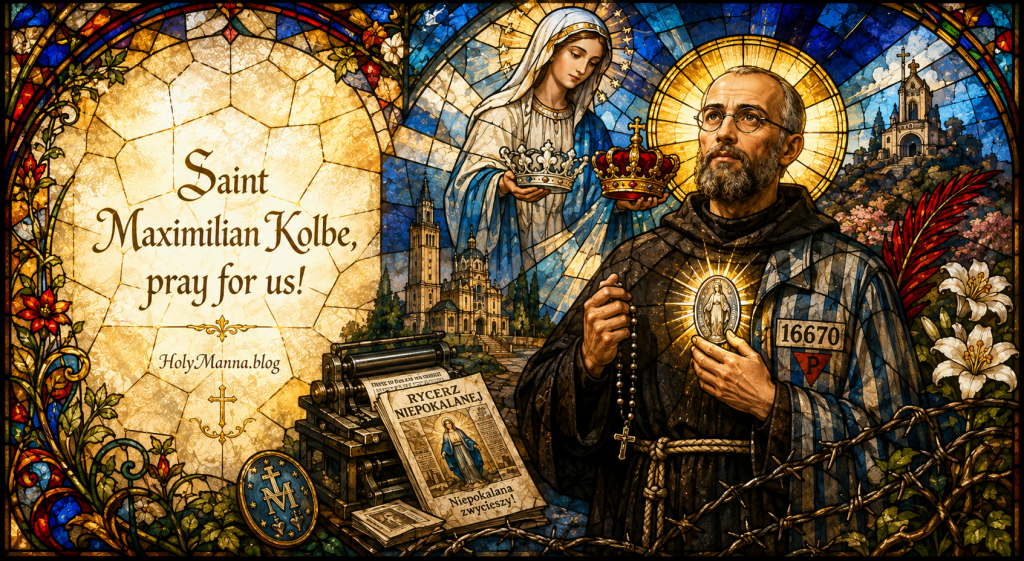
A Martyr of Charity
Every so often, God raises up a saint whose life reads like a direct answer to the darkness of his age. For the twentieth century, a century of world wars, ideologies, and death camps, that saint is Maximilian Maria Kolbe. He was a Polish Conventual Franciscan priest, a brilliant thinker with two Roman doctorates, a media pioneer decades ahead of his time, and above all a man utterly consecrated to the Blessed Virgin Mary. Yet the world remembers him first for a single moment in the summer of 1941, when he stepped out of a line of prisoners at Auschwitz and offered his life in exchange for a stranger, a husband and father he had never met.
Saint John Paul II, his fellow Pole, canonized him on October 10, 1982, and declared him a martyr of charity, naming him “patron of our difficult century.” The Church venerates Saint Maximilian Kolbe as the patron of drug addicts, because of the lethal injection by which he was killed, and also of prisoners and political prisoners, families, journalists, and the pro-life movement. He is frequently honored as a patron of amateur radio operators as well, since he held an operator’s license and grasped the power of radio for the Gospel long before most churchmen did.
His witness rests on the words of Our Lord in The Gospel of John: “No one has greater love than this, to lay down one’s life for one’s friends” (Jn 15:13). The Catechism teaches that “Martyrdom is the supreme witness given to the truth of the faith: it means bearing witness even unto death” (CCC 2473). Maximilian Kolbe bore that witness in the most hopeless place human beings have ever built, and he bore it with joy.
The Two Crowns
Rajmund Kolbe, called Raymond in English, was born on January 8, 1894, in Zduńska Wola, a weaving town in the part of Poland then occupied by the Russian Empire. His parents, Juliusz Kolbe and Maria Dąbrowska, were poor textile workers, and both were Third Order Franciscans who filled their home with prayer, hard work, and devotion to Our Lady.
Raymond was a devout boy, but he was also full of mischief, the kind of energetic child who exhausts his mother. One day, exasperated, she asked him what would ever become of him. The question pierced him. He took it to prayer before an image of Our Lady of Częstochowa, and what happened next set the course of his entire life. Years later his mother testified to what her son had confided to her. According to her sworn account, he told her: “That night I asked the Mother of God what was to become of me. Then she came to me holding two crowns, one white, the other red. She asked if I was willing to accept either of these crowns. The white one meant that I should persevere in purity, and the red that I should become a martyr. I said that I would accept them both.”
This account comes down through his mother’s testimony of his own words, given under oath during the investigation of his cause, and the Church has always treated it with great seriousness. It is a story of private grace rather than public record, and readers should receive it as the Church does, as the treasured testimony of a mother about her son. What is beyond dispute is that from that point forward Raymond’s life bent unmistakably toward both purity and martyrdom, as though he really had said yes to both crowns.
In 1907, Raymond and his older brother Francis decided to enter the Conventual Franciscans. So determined were the two boys that they crossed secretly from the Russian partition into the Austrian partition of Poland, hidden in a hay cart, to reach the minor seminary in Lwów. Raymond entered the novitiate in 1910 and received the religious name Maximilian, later adding Maria at his solemn vows as a mark of his total belonging to the Mother of God. His superiors, recognizing his gifts, sent him to Rome, where he studied at the Pontifical Gregorian University and the Pontifical University of Saint Bonaventure, earning a doctorate in philosophy and a doctorate in theology. He was ordained a priest in Rome in 1918.
It was also in Rome that his health broke. Maximilian contracted tuberculosis, which cost him the use of much of one lung and left him physically frail for the rest of his life. He never allowed the illness to become an excuse. He would later accomplish the work of ten healthy men on one working lung, offering his weakness to the Immaculata and trusting her to supply what he lacked.
The Knight of the Immaculata
While still a seminarian in Rome, Maximilian watched anticlerical demonstrations march through the streets of the Eternal City, some of them carrying banners against the Holy Father. Where others saw a reason for despair, he saw a battlefield and a call to arms. On October 16, 1917, with six companions, he founded the Militia Immaculatae, the Militia of the Immaculata, a movement of total consecration to the Blessed Virgin Mary for the conversion of sinners and the sanctification of the world. The intuition behind it was simple and bold. If Mary is the woman whose offspring crushes the serpent, as the Church has always read Genesis 3:15, then the surest way to win souls for Christ is to place oneself entirely in her hands. The Catechism affirms this maternal role, teaching that “by her manifold intercession” Mary “continues to bring us the gifts of eternal salvation” (CCC 969). Devotion to Mary never competes with devotion to Christ; it leads straight to Him, and the Church teaches that devotion to the Blessed Virgin is intrinsic to Christian worship (CCC 971).
Maximilian summarized his whole spirituality in a line from his own writings that still stops readers in their tracks: “Remember that you belong exclusively, unconditionally, absolutely, irrevocably to the Immaculate.” He meant it literally. Everything he built, he built as her instrument and under her banner.
And he built astonishing things. Back in Poland, in 1922, with no money and failing health, he began publishing a small magazine called Rycerz Niepokalanej, the Knight of the Immaculata. It grew explosively. In 1927, on donated land west of Warsaw, he founded an entire friary dedicated to the apostolate of Catholic media and named it Niepokalanów, the City of the Immaculata. By the late 1930s Niepokalanów was the largest friary in the world, home to hundreds of friars and brothers, and it had become the largest Catholic publishing center in Poland, very possibly in the world. The friars produced several magazines, launched Poland’s first Catholic daily newspaper, and in 1938 began broadcasting on Poland’s first Catholic radio station. Maximilian himself held an amateur radio license and dreamed openly of using film and every future means of communication for the Gospel. Decades before anyone spoke of Catholic media evangelization, this frail Franciscan in a patched habit was living it.
Then, in 1930, he did something that seemed almost reckless. He left the thriving work in Poland and sailed for Japan with a handful of friars, no money, and no knowledge of the language. Within a month of arriving in Nagasaki, he was printing a Japanese edition of the Knight, called Seibo no Kishi. On the steep slopes of Mount Hikosan outside the city he founded a friary named Mugenzai no Sono, the Garden of the Immaculate. He chose the site out of Franciscan poverty because the difficult hillside land was cheap, and some accounts add that local observers criticized the location as being on the wrong side of the mountain. He also built a grotto in honor of Our Lady of Lourdes, to whom he had a deep personal devotion, having himself experienced healing through Lourdes water during his Roman years. The significance of that hillside would only become clear years after his death.
There is no formally documented account of dramatic public miracles worked by Maximilian during his lifetime, and honesty requires saying so plainly. What his contemporaries remembered was in some ways more remarkable: a chronically ill man who founded movements on three continents, ran the largest religious publishing operation of his day, and radiated supernatural peace while doing it. Those who lived with him testified that the engine of it all was the Eucharist, the Rosary, and his consecration to the Immaculata. His life illustrates what The Catechism teaches about the universal call to holiness, that “All Christians in any state or walk of life are called to the fullness of Christian life and to the perfection of charity” (CCC 2013).
In 1936 his superiors recalled him to Poland, partly because his tuberculosis had advanced, and he resumed direction of Niepokalanów. He could not have known that he was returning home to die.
Prisoner 16670
On September 1, 1939, Germany invaded Poland, and the machinery of occupation descended on the Church almost immediately. Niepokalanów was bombed and briefly seized, and Maximilian was arrested for the first time that autumn, then released. Rather than flee or fall silent, he turned the City of the Immaculata into a city of refuge. During the occupation, Niepokalanów sheltered thousands of displaced Poles, and among them a great number of Jewish refugees, feeding, clothing, and hiding them at enormous risk. The friary also continued to publish, and its refusal to bow to Nazi ideology made its founder a marked man.
On February 17, 1941, the Gestapo arrested Father Maximilian. He was held first in Warsaw’s Pawiak prison, where, according to accounts from fellow prisoners, a guard who saw his habit and crucifix beat him while demanding whether he still believed in Christ; to every blow he answered that he did. In May 1941 he was transferred to Auschwitz and stripped of his name. He became prisoner 16670.
In the camp he was assigned brutal labor, at one point under a guard who singled him out for special cruelty, loading him with the heaviest planks until he collapsed and then beating him savagely. Fellow prisoners testified that he never cried out under blows, that he prayed for his tormentors, that he routinely shared his starvation rations with weaker men, and that at night prisoners would crawl across the barracks floor to his bunk to make their confessions and receive a whispered word of hope. Survivors recalled him urging the men around him to forgive their persecutors, telling them that hatred is not a creative force, and that only love is creative. That saying comes down through the memories of the men who heard him rather than through any written text of his from the camp, and it should be received as their testimony, yet it matches everything else known of him.
At the end of July 1941, the sirens howled. A prisoner from Kolbe’s block appeared to have escaped, and it was only discovered later that the man had not escaped at all but had drowned in a camp latrine. The deputy commandant, Karl Fritzsch, applied the camp’s rule of collective vengeance: ten men from the block would be locked in an underground starvation bunker in Block 11 and left to die without food or water. The prisoners stood at attention while Fritzsch walked the ranks and chose his victims. One of the ten, a Polish army sergeant named Franciszek Gajowniczek, broke down and cried out: “My wife! My children!”
Then something happened that eyewitnesses said had never happened before in Auschwitz and never happened again. A gaunt prisoner stepped out of the ranks, removed his cap, and stood before the commandant. Asked what he wanted, he pointed to Gajowniczek and said: “I am a Catholic priest. Let me take his place. I am old. He has a wife and children.” Perhaps because the exchange cost the SS nothing, perhaps because even evil was momentarily disarmed, Fritzsch accepted. Gajowniczek was returned to the ranks, and Father Maximilian walked with the nine condemned men into the death bunker.
What happened in that cell over the following two weeks is known through the testimony of Bruno Borgowiec, a Polish prisoner assigned to serve the bunker as janitor and interpreter, who recounted everything to his parish priest before his own death in 1947. He testified that from the underground cell where men were dying of thirst and starvation there rose, day after day, the sound of prayers and hymns to Our Lady, so that the death cell sounded like a church. He described how, at every inspection, when the others lay dying on the floor, Father Kolbe was seen kneeling or standing in the center of the cell, looking calmly, even cheerfully, at the SS men, until one guard was heard to say that this priest was a great man, the like of whom they had never seen. Kolbe never begged for anything for himself. He heard the confessions of the dying, prayed the men into eternity one by one, and encouraged the survivors.
After two weeks, four of the ten were still alive, and only Father Maximilian remained fully conscious. The cell was needed for new victims. On August 14, 1941, the vigil of the Assumption of Our Lady, an executioner from the camp hospital, a German named Bock, injected carbolic acid into the vein of Father Kolbe’s left arm. Witnesses said he raised his arm to the executioner himself, with a prayer on his lips. He was forty seven years old. His body was burned in the crematorium the next day, on the very Solemnity of the Assumption of the woman to whom he had given everything. The knight died on the eve of his Queen’s feast, and his ashes rose over the camp on her day.
The Church has always held that Kolbe’s death was a free offering of life made in faith and charity, in imitation of the Lord who “loved them to the end” (Jn 13:1), the very charity by which, as The Catechism teaches, “we love our neighbor as ourselves for the love of God” (CCC 1825).
The Garden That Survived the Fire
The story of Maximilian Kolbe did not end in the crematorium. It began to spread through the camp the same day, carried by prisoners who said that hope itself had been rekindled in Auschwitz. Franciszek Gajowniczek survived more than five years of imprisonment. His sons did not live to see his release, yet he was reunited with his wife and spent the rest of his long life bearing witness to the priest who had died for him. He stood in Saint Peter’s Square as an honored guest at both the beatification in 1971 and the canonization in 1982, a living monument to a dead man’s charity. He died in 1995, having outlived his rescuer by more than half a century.
Then there is the story of the friary at Nagasaki. On August 9, 1945, the atomic bomb destroyed the city and killed roughly eight and a half thousand of the twelve thousand parishioners of the Immaculate Conception Cathedral, the heart of Catholic Japan. Yet on the hillside in the Hongouchi district, the Garden of the Immaculate that Kolbe had built on the cheap, awkward side of the mountain remained standing, shielded from the main force of the blast by the mountain itself, and the friars survived. The survival of the friary is documented historical fact. Many of the faithful have seen in Kolbe’s choice of that hillside a quiet act of providence, even a kind of foresight; that interpretation is a matter of pious reflection rather than a formally verified miracle, and it is offered here as such. What can be said with certainty is that the community he founded still stands in Nagasaki today, still publishing Seibo no Kishi, which reached its one thousandth issue in 2021, and still bearing a Franciscan message of peace in a place that had every reason to choose despair.
Formal miracles were also examined by the Church. For his beatification, two cures attributed to his intercession were investigated and approved: the cure of Angela Testoni from intestinal tuberculosis in July 1948, and the cure of Francis Ranier from calcification of the arteries in August 1950. Pope Paul VI beatified him as a Confessor of the Faith on October 17, 1971. When Saint John Paul II canonized him on October 10, 1982, he made a decision of enormous significance, declaring Maximilian not merely a confessor but a martyr, a martyr of charity, since his death was a free offering of life in witness to the Gospel of love. In his canonization homily the Holy Father declared: “Maximilian did not die but gave his life for his brother.” The Catechism explains what such a canonization means, that by canonizing some of the faithful the Church “proclaims the power of the Spirit of holiness within her and sustains the hope of believers by proposing the saints to them as models and intercessors” (CCC 828).
Because his body was burned, no bodily relics of the ordinary kind exist. Yet first class relics survive through a remarkable act of quiet devotion: two friars who served as barbers at Niepokalanów between 1930 and 1941 preserved hairs from his head and beard without his knowledge, and since 1971 more than a thousand of these relics have been distributed around the world for veneration. The Church honors such veneration as an expression of the communion of saints, for The Catechism teaches that the saints “share in the living tradition of prayer” and that “their intercession is their most exalted service to God’s plan” (CCC 2683 and CCC 956).
His memory has reshaped geography. Niepokalanów, with its great basilica, remains one of Poland’s major pilgrimage centers, where pilgrims can visit his preserved cell and personal effects. At Auschwitz, the underground cell in Block 11 where he died has become a place of prayer visited by millions, including Saint John Paul II, who knelt there in 1979. A statue of Maximilian Kolbe even stands above the west door of Westminster Abbey in London among the twentieth century martyrs, a sign that his witness speaks far beyond Catholic walls. His feast is celebrated each year on August 14 with red vestments, the color of the second crown.
Choosing Both Crowns Today
It is tempting to file Maximilian Kolbe’s story under heroism of a kind ordinary people can admire but never imitate. That would be a mistake, and it would miss the whole point of his life. The moment in the roll call square at Auschwitz was not a sudden burst of courage from nowhere. It was the final step of a staircase he had been climbing since childhood, one small yes at a time. He said yes to his mother’s question, yes to two crowns, yes to a hay cart across a border, yes to tuberculosis patiently endured, yes to obscure editorial work, yes to a language he could not speak, yes to poverty, and finally yes to a stranger’s life over his own. The Catechism teaches that charity is the theological virtue by which “we love God above all things for his own sake, and our neighbor as ourselves for the love of God”, and that charity is the form of all the virtues (CCC 1822 and CCC 1827). Kolbe’s martyrdom was simply charity, practiced daily for decades, arriving at its full stature.
His life also offers a direct challenge about the tools of modern life. Kolbe seized printing presses and radio for the Kingdom of God with the zeal other men reserve for profit. What would it look like to consecrate your feeds, your posts, and your words to the Immaculata, so that everything you publish builds up rather than tears down? The question is not rhetorical for anyone living in the age of screens.
His consecration to Mary is likewise not a private devotion of a bygone Poland. It is a path the Church continues to hold out to everyone, for entrusting oneself to the Mother of God is entrusting oneself to the one whose only recorded command is found in The Gospel of John: “Do whatever he tells you” (Jn 2:5). Is there an area of your life you have been unwilling to hand over completely to God through the hands of His Mother?
Finally, there is the sergeant in the roll call square. Most readers will never be asked to die for a stranger, but every reader is surrounded by people crying out, sometimes silently, for their families, their dignity, and their hope. Kolbe teaches that love does not wait to be asked. Who in your life is quietly crying out, and what one concrete sacrifice could you make this week to step toward them? The white crown of daily fidelity and purity is offered to everyone; the red crown of sacrifice comes in a thousand small forms long before it ever comes in a great one. The invitation of Saint Maximilian Kolbe is to stop choosing between them and, like a mischievous boy before an image of Our Lady, to give the dangerous and glorious answer that young Raymond gave, accepting both crowns with joy.
Engage With Us!
The story of Saint Maximilian Kolbe has moved hearts for more than eighty years, and it is meant to move more than hearts; it is meant to move lives. Share your thoughts and reflections in the comments below. Tell the HolyManna community what struck you most about this martyr of charity, whether it was the vision of the two crowns, the publishing empire built on one lung, or the voice from the ranks saying he was a Catholic priest. To go deeper, prayerfully consider these questions:
- Saint Maximilian said yes to both the white crown and the red crown. Which crown do you find harder to accept in your own life, daily purity and fidelity, or costly sacrifice, and why?
- Kolbe used the most modern media of his day to spread the Gospel. How could you use your own platforms, however small, to bring one person closer to Christ this month?
- In the starvation bunker, Kolbe led dying men in hymns and prayer. When you face suffering, what would it take for your first instinct to become prayer rather than despair?
- Franciszek Gajowniczek spent fifty years telling the story of the man who died for him. Who has sacrificed for you, and how are you honoring that gift with the way you live?
- Total consecration to Jesus through Mary was the engine of Kolbe’s entire life. What is one practical step you could take this week to entrust your work, your family, or your worries to the Immaculata?
Saint Maximilian Kolbe proves that no darkness is deep enough to extinguish a soul that belongs entirely to God. May his intercession give you courage to love without counting the cost, to forgive without keeping score, and to do everything, from the greatest sacrifice to the smallest daily task, with the love and mercy that Jesus taught us.
Saint Maximilian Kolbe, pray for us!
Follow us on YouTube, TikTok, Instagram and Facebook for more insights and reflections on living a faith-filled life.

 Holy Manna!
Leave a comment