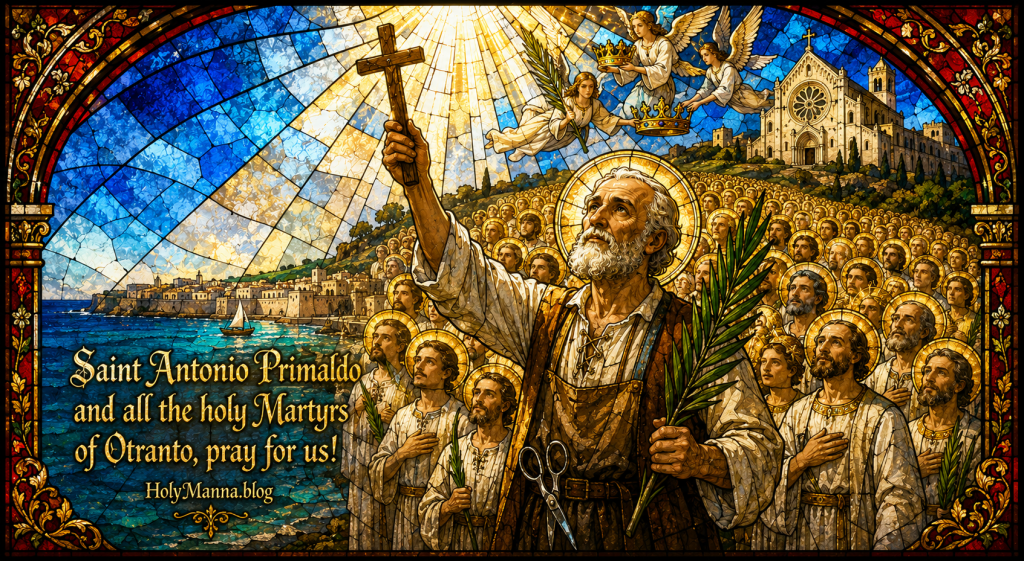
The Eight Hundred Who Stood Firm for the Faith
On the easternmost tip of Italy, where the heel of the boot reaches toward the sunrise over the Adriatic, there is a hill that used to be named for a pagan goddess. It is called the Hill of Minerva no longer. Today the people of Otranto call it the Hill of the Martyrs, because on the morning of August 14, 1480, roughly eight hundred ordinary men of that city climbed it with their hands bound, knelt in the summer grass, and gave their lives rather than deny Jesus Christ. The Church celebrates them each year on August 14 as Saints Antonio Primaldo and Companions, the Martyrs of Otranto, and they hold a remarkable distinction in modern Church history. When Pope Francis canonized them on May 12, 2013, in Saint Peter’s Square, they became the very first saints raised to the altars in his pontificate, and their number, counted at 813 souls, made that day one of the largest canonizations the Church has ever seen.
What makes their story so piercing is how unremarkable they were before that morning. These were not bishops, theologians, or founders of religious orders. They were fishermen, farmers, artisans, and shopkeepers, and the man who spoke for them all was an elderly tailor named Antonio Primaldo. The Catechism teaches that “Martyrdom is the supreme witness given to the truth of the faith” (CCC 2473), and the men of Otranto gave that witness together, as a city, in a single hour. They are venerated as the heavenly patrons of Otranto, the city that keeps their bones and their memory. Their feast falls, fittingly, on the day before the Assumption of the Blessed Virgin Mary, so that the Church honors these sons of Mary on the vigil of their Mother’s own entry into glory.
An Ordinary Tailor in a City at the Edge of Christendom
Very little is recorded about the early life of Antonio Primaldo, and honesty requires saying so plainly. Local tradition preserves his family name as Antonio Pezzulla, with Primaldo as the name by which history remembers him, and the sources agree that he was an elderly artisan, a tailor or cloth worker, well known and respected among his neighbors. He was not a cleric and held no office. He had lived his whole life in Otranto, a fortified port city of about six thousand people in the region of Apulia, in the territory called Salento, under the Kingdom of Naples. There is no record of a dramatic conversion in his life, no youthful rebellion followed by a return to grace. What the record suggests instead is something quietly beautiful: a man formed by decades of ordinary Catholic life, of Sunday Mass in the great Norman cathedral with its famous mosaic floor, of feast days and fasts, of work done honestly and prayers said faithfully. His conversion, if it can be called that, was the slow daily conversion that the Church asks of every baptized person, the steady turning of a heart toward God across a lifetime.
To understand what happened to him and his city, the wider world of 1480 has to come into view. Twenty seven years earlier, in 1453, Constantinople had fallen to Sultan Mehmed II, and the ancient heart of Eastern Christianity had been extinguished as a Christian capital. Mehmed, called the Conqueror, had ambitions that reached further west. He intended to take Italy itself, and Rome with it. In the summer of 1480 he dispatched a fleet under his commander Gedik Ahmed Pasha, a force the chronicles describe as some ninety galleys carrying as many as eighteen thousand soldiers. That armada had been besieging the island of Rhodes, defended heroically by the Knights of Saint John, and when Rhodes held firm, the fleet turned toward the Italian coast. On July 28, 1480, it appeared before Otranto. The little city on the edge of Christendom suddenly found itself standing between an empire and the See of Peter.
Fifteen Days of Fire
The siege of Otranto lasted about fifteen days, and the chronicles of it, written afterward by Giovanni Laggetto and Saverio de Marco, describe a city that decided early what it was willing to lose. The Ottoman commander offered clemency if Otranto surrendered. The city refused. A second messenger came to repeat the offer, and the answer this time was even more defiant; the accounts record that one of the guardsmen hurled the keys of the city into the sea. A rider was sent begging King Ferdinand of Naples for help, but his forces were tied down in Tuscany, and no relief came. Most of the hired militia lost heart and slipped over the walls by night, leaving barely fifty soldiers to stand with the citizens. And stand they did. Ordinary townspeople fought beside those few soldiers on the ramparts, pouring boiling oil and water down on the attackers between artillery bombardments, holding a professional army at bay for two weeks with almost nothing.
The walls were finally breached in the middle of August. The sources give the date of the city’s fall as August 11 or August 12, and the discrepancy between them is noted here honestly rather than smoothed over. What followed was a massacre through the streets. Many of the survivors had crowded into the cathedral, where the elderly Archbishop of Otranto, Stefano Pendinelli, did the most priestly thing imaginable. He did not hide, and he did not flee. He vested, and he celebrated Mass, and he gave the Eucharist to his terrified people as the doors were being broken down. The accounts of his death differ in their details; some report that he was cut down and quartered at the altar, others that he was beheaded at the cathedral door while holding a crucifix and calling on the invaders to convert, and a later tradition describes an even more gruesome end. The conflict among the accounts is acknowledged plainly. What every source agrees on is that the shepherd died with his flock, in his own cathedral, having fed them with the Body of Christ to the last.
No miracles are recorded as having been worked by Antonio Primaldo or his companions during their lives, and none will be invented here. Their lives, as far as the documents show, were outwardly unexceptional until the very end. That is precisely why they matter. The Catechism teaches that the virtue of fortitude “disposes one even to renounce and sacrifice his life in defense of a just cause” (CCC 1808), and fortitude of that magnitude does not appear from nowhere. It is built in secret, in small fidelities, over years. The men of Otranto had been preparing for the Hill of Minerva all their lives without knowing it, every time they chose Mass over convenience and honesty over advantage. When the test came, the habit of faithfulness held.
The Hill of Minerva
After the city fell, Gedik Ahmed Pasha gathered the surviving men of Otranto, those aged fifteen and older. Tradition counts them at eight hundred, while the formal reckoning used at the canonization counts 813, and both figures are given here because the sources preserve both. The captives were offered a single path to survival: renounce Jesus Christ and embrace Islam. To press the point, an apostate priest named Giovanni was brought forward to persuade them, a man who had already made the trade they were being offered. The sight of him must have been its own temptation, living proof that apostasy was survivable.
It was then that the old tailor stepped forward and answered for the city. The chronicler Giovanni Laggetto, in his Historia della guerra di Otranto del 1480, a work transcribed from an early manuscript and published centuries later, records the speech that Primaldo gave to his fellow prisoners. It must be said clearly that this speech survives through chronicles written after the events, so it is a chronicle account rather than a verbatim transcript, but it is the account the Church herself has told and retold. Primaldo reminded his brothers that until that day they had fought for their homeland, their lives, and their earthly lords, and then he turned them toward a different battle: “Now it is time for us to fight to save our souls for the Lord.” Since Christ had died on the cross for them, he told them, it was fitting that they should die for Christ, and by that earthly death they would win eternal life and the glory of martyrs. The chronicles record that the men answered him with one voice, crying out that they were ready to die a thousand times for Jesus Christ.
The sentence came swiftly. On the morning of August 14, 1480, the prisoners were bound together with ropes and marched out of the smoldering city, up the slope of the Hill of Minerva. There the executions began, and Antonio Primaldo was chosen to die first. He knelt, repeated his profession of faith, and was beheaded. One by one, hour after hour, roughly eight hundred men followed him, each given a final chance to apostatize, each refusing, husbands and sons and brothers watching one another die and still holding fast. It is one of the largest collective martyrdoms in the history of the Church, and it was accomplished not by consecrated religious but by laymen, which is a truth worth sitting with. The Catechism teaches that the Church “is the People of God” in all its members (CCC 782), and on that hill the lay faithful of one small city showed what the whole People of God is capable of when grace meets courage.
Two famous stories are attached to that morning, and both must be told as the traditions they are. The first tradition holds that after Primaldo was beheaded, his body remained standing upright, and that no effort of the executioners could force it to the ground until the last of his companions had died, at which point it fell of its own accord. The second tradition holds that one of the Ottoman executioners, an officer whom the chroniclers name Bersabei, was so shaken by what he witnessed that he professed faith in Christ on the spot, and was immediately impaled by his own comrades, becoming in effect a final martyr of that hill, baptized in his own blood. The Catechism itself teaches that those who die for the faith without baptism are baptized by their death for and with Christ (CCC 1258). Both of these stories come from the chronicle tradition surrounding the martyrdom, and neither can be verified as historical fact.
Honesty also requires one further acknowledgment. In modern times some historians have debated whether the men of Otranto were killed strictly for refusing conversion or as an act of wartime brutality. The Church examined that very question with care, and it is worth noting that even a contemporary Turkish historian, Ibn Kemal, explained the slaughter in religious terms. On July 6, 2007, Pope Benedict XVI settled the matter for the Church by issuing the formal decree recognizing that Antonio Primaldo and his companions were killed “out of hatred for their faith.” The Church does not canonize casualties of war; she canonizes witnesses, and after more than five centuries of examination she declared these men exactly that.
Incorrupt in Memory
Otranto did not remain in Ottoman hands for long. The following year, forces led by Alfonso of Aragon, son of King Ferdinand of Naples, and aided by soldiers sent by King Matthias Corvinus of Hungary, retook the city, helped along by the death of Sultan Mehmed II in May of 1481, which threw the Ottoman campaign into disarray. The last serious Muslim military attempt to conquer southern Italy ended at Otranto, and more than one historian has observed that if the city had simply surrendered and converted, the history of Italy, and perhaps of Rome itself, might have unfolded very differently. On October 13, 1481, the bodies of the martyrs were recovered from the hill where they had lain, and tradition holds that they were found uncorrupted after fourteen months exposed to the elements. That claim of incorruption belongs to the tradition surrounding the translation and cannot be verified. What is certain is that the remains were solemnly carried into the cathedral of Otranto, the same cathedral where their archbishop had died at the altar.
Anyone who visits Otranto today can see them still. In the Chapel of the Martyrs inside the cathedral, the bones and skulls of the eight hundred are preserved in seven great glass fronted cases rising behind the altar, one of the most arresting sights in all of Christian Italy. The visual effect is not morbid; it is a sermon. The martyrs face the visitor in silent ranks, an entire city’s worth of witnesses saying with their very bones that Jesus Christ is worth everything. Other relics of the martyrs were carried to Naples, where they are venerated in the Church of Santa Caterina a Formiello, and portions are found in churches of Puglia and as far away as France and Spain. Every August the city of Otranto celebrates its patrons with processions and solemn liturgies, and pilgrims climb the Hill of the Martyrs, where a church now stands on the site of the executions. The martyrs have marked Italian culture well beyond the sanctuary, inspiring literature, art, and a fierce local identity; to be Otrantine is, to this day, to be a child of the eight hundred.
The Church’s formal recognition moved with her usual patience. The canonical process opened in 1539, within living memory of grandchildren of the martyrs, and concluded on December 14, 1771, when Pope Clement XIV beatified Antonio Primaldo and his companions. There the cause rested for more than two centuries until the Archdiocese of Otranto petitioned for its resumption. After the 2007 decree on their martyrdom, a miracle was examined: the healing of Sister Francesca Levote, a professed religious of the Poor Sisters of Saint Clare, who had been cured of cancer through the intercession of the martyrs. On December 20, 2012, Pope Benedict XVI approved the decree recognizing that healing, and then came one of the most extraordinary coincidences in modern Church history. On February 11, 2013, Benedict convened the consistory to announce the canonization date of the Martyrs of Otranto, and in that same gathering, speaking quietly in Latin, he announced his own resignation from the papacy. The martyrs of 1480 are thus forever woven into the day the Church’s history turned. Three months later, on May 12, 2013, the Seventh Sunday of Easter, Pope Francis stood in Saint Peter’s Square and inscribed them in the catalogue of saints as the first canonization of his pontificate.
In his homily that day, preserved on the Vatican’s own site, Pope Francis said of the martyrs that “They refused to deny their faith and died professing the Risen Christ.” He asked where they found the strength to stay faithful and answered that they found it in faith itself, the faith that sees beyond the limits of human sight and the boundaries of earthly life, the faith that contemplates, as Saint Stephen did, the heavens opened and the living Christ at the right hand of God. And then the Holy Father did what the Church has always done with her martyrs; he turned their memory toward the present, asking God to sustain the many Christians who suffer violence for the faith in the present day and to give them courage to remain faithful and to answer evil with goodness. The eight hundred of Otranto, he made clear, are not museum pieces. They are older brothers to every persecuted believer alive right now.
What Would You Say on the Hill?
It is tempting to read this story from a safe distance, as something that happened to other people in an unimaginable century. Resist that temptation. The men of Otranto woke up on ordinary mornings, worried about money, argued with their families, and put off their prayers, just like everyone else. Antonio Primaldo spent his life sewing garments, not composing theology. Yet when the moment came that revealed what was truly inside him, what came out was Jesus Christ. Our Lord promised exactly this kind of testing and exactly this kind of grace when He said, “And do not be afraid of those who kill the body but cannot kill the soul” (Mt 10:28). The martyrs of Otranto took that verse literally, and heaven honored it literally.
Most people reading this will never face a sword on a hill. But every single day presents smaller hills, moments when faith costs something real: mockery at work for a moral conviction, the loss of a friendship for refusing to lie, the quiet social penalty of taking the Church’s teaching seriously in a culture that finds it strange. The Catechism reminds the faithful that every disciple must bear witness to the faith and, when required, be ready to confess it without shame (CCC 2471 to 2473). The way to become the kind of person who stands on the great hill is to stop kneeling on the small ones. Fidelity in little things built the eight hundred, one unremarkable act of faithfulness at a time.
If you had stood on the Hill of Minerva that morning, bound beside your neighbors, what do you honestly believe you would have said? What small apostasies, the little daily denials made for comfort or approval, are quietly training your heart right now? Consider choosing one concrete practice this week in honor of the martyrs: defend the faith aloud the next time it is dismissed in your presence, return to Confession if it has been a long while, or pray by name for persecuted Christians in the world today, who are living the story of Otranto in real time. The martyrs did everything together, as a community, and that is its own lesson. Faith that expects to survive testing should not be practiced alone.
Engage With Us!
The story of Saint Antonio Primaldo and his companions deserves to be talked about, so share your thoughts and reflections in the comments below. This community grows stronger every time someone speaks honestly about their walk with Christ, and your perspective may be exactly what another reader needs today. Here are some questions to pray with and respond to:
- What part of the Otranto story struck you most deeply, and why do you think it touched that particular place in your heart?
- Antonio Primaldo was an elderly tailor, not a priest or scholar. How does his example change the way you think about what holiness requires of ordinary laypeople?
- Where in your daily life are you most tempted to stay silent about your faith, and what would courage look like there this week?
- Pope Francis connected these martyrs to Christians persecuted today. How might you concretely support the persecuted Church through prayer, awareness, or generosity?
- The men of Otranto faced death together as a community. Who stands with you in your faith, and who might need you to stand with them?
The eight hundred climbed their hill only once, but they prepared for it every day of their lives. Let their witness stir up the same steady courage in you. Live this day, and every day, with the love and mercy that Jesus taught us, holding nothing back from the One who held nothing back from you, and trusting that the same grace that carried an old tailor and his neighbors into glory is fully available to you right now.
Saint Antonio Primaldo and the holy Martyrs of Otranto, pray for us!
Follow us on YouTube, TikTok, Instagram and Facebook for more insights and reflections on living a faith-filled life.

 Holy Manna!
Leave a comment