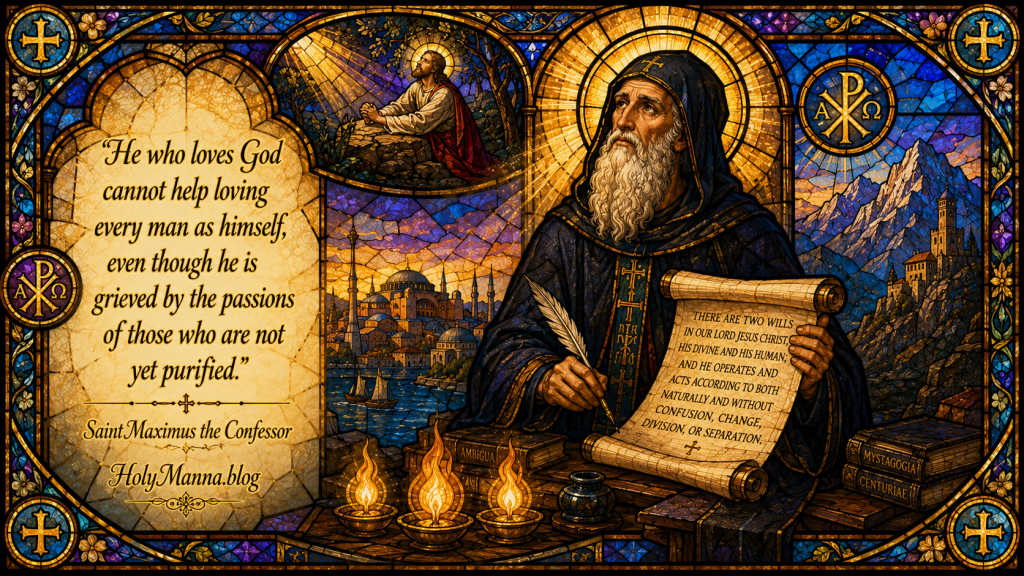
The Tongue They Could Not Silence
Every so often the Church remembers a saint whose entire life comes down to a single moment of choice, a moment when saying yes to Christ costs everything and the saint says yes anyway. On August 13th, the Roman Martyrology commemorates one of the most remarkable of these figures, Saint Maximus the Confessor, a Byzantine monk who lived from about 580 to 662 and who is widely regarded as the greatest theologian of the seventh century. He was never ordained a priest and never held a bishop’s chair. He was, to the end of his days, a simple monk. Yet when nearly the entire hierarchy of the Christian East, backed by the full power of the Roman Empire, embraced a subtle heresy about Jesus Christ, this one elderly monk refused to bend, and his refusal helped preserve the faith the Church professes to this day.
The controversy at the heart of his story sounds technical at first, but it touches the very center of the Gospel. The question was whether Jesus Christ, true God and true man, possesses a real human will alongside His divine will. Maximus insisted that He does, because anything less would mean that the Son of God had not truly become man. The Church solemnly confirmed his teaching at the Third Council of Constantinople, and the Catechism enshrines it today, teaching that Christ possesses a human will that “does not resist or oppose but rather submits to his divine and almighty will” (CCC 475). Maximus paid for that truth with his tongue, his right hand, and finally his life. He is called the Confessor because he confessed the faith under torture and died from his sufferings without being executed outright, and he is also honored with the title of the Theologian. His story is one of the great dramas of Church history, and it speaks with surprising force to anyone who has ever felt alone in standing for what is true.
From the Emperor’s Desk to the Monastery Door
According to the received Greek tradition, Maximus was born around the year 580 in Constantinople, the glittering capital of the Byzantine Empire, to a noble and pious Christian family. He received one of the finest educations his world could offer, mastering grammar, rhetoric, and philosophy, and reading deeply in the classical authors as well as the Fathers of the Church. It is worth noting honestly that a later hostile biography, written in Syriac by an opponent of his theology, claims he was born in Palestine instead. Catholic and secular scholars alike treat that account with caution, since attributing a rival’s birth to a distant province was a common way of discrediting an opponent in the seventh century, and the extraordinary education Maximus clearly received points strongly toward the capital. The sources conflict on this point, and the Constantinopolitan account remains the tradition the Church has received.
His talent did not go unnoticed. Around the year 610, the young Maximus was appointed first secretary, the protoasecretis, to the newly crowned Emperor Heraclius himself. He stood at the very top of the imperial civil service, trusted by the most powerful man in his world, with every honor and comfort within reach. And then, around 613 or 614, he walked away from all of it. Maximus resigned his post and entered the monastery at Chrysopolis, directly across the water from Constantinople, close enough that he could see the domes of the capital he had left behind. His was not a conversion from unbelief, since he had been raised in the faith, but a radical deepening of it, a decision that knowing God mattered more than serving an emperor. He later moved to the monastery of Saint George at Cyzicus, and when Persian invasions swept toward the capital in the 620s, he fled westward with many other monks, traveling through the Mediterranean world until he settled at a monastery near Carthage in North Africa around 628.
Carthage gave him the two great gifts of his life. The first was time to write, and it was there that much of his astonishing theological output took shape. The second was a spiritual father, the monk Sophronius, a man of deep learning and deeper holiness who would later become Patriarch of Jerusalem. Under Sophronius, Maximus was formed in the tradition of the Fathers, and from Sophronius he would inherit the great battle of his life.
A Mind on Fire with Love
Before Maximus was a controversialist, he was a contemplative, and the Church would remember him even if the Monothelite crisis had never happened, simply because of what he wrote. His works include the Four Hundred Chapters on Love, the Mystagogy, a mystical commentary on the Divine Liturgy, the Ambigua, the Questions to Thalassius, and a beautiful commentary on the Lord’s Prayer. Across all of them runs a single golden thread, the conviction that God created the entire cosmos in order to unite it to Himself in Christ, and that the human person is invited into a real participation in the divine life. The Catechism teaches this same staggering truth about the divinization of the human person when it recalls, in the words of the Fathers, that the Son of God became man “so that we might become God” by sharing His divine life through grace (CCC 460).
For Maximus, the path to that union has one name, and the name is love. In the opening line of the Four Hundred Chapters on Love he writes, “Love is a holy state of the soul, disposing it to value knowledge of God above all created things.” A few chapters later he draws out the consequence that makes his teaching so practical and so demanding: “He who loves God cannot help loving every man as himself, even though he is grieved by the passions of those who are not yet purified.” Notice what he is saying. Love of God and love of neighbor are not two separate projects; they are one movement of the soul, and the person who claims the first while refusing the second is deceiving himself. This is simply the teaching of Jesus in The Gospel of Matthew 22, and the Catechism echoes it in teaching that charity is the theological virtue by which a person loves God above all things for His own sake, and loves neighbor as self for the love of God (CCC 1822).
Here honesty requires a plain statement. The historical sources do not record Maximus working dramatic miracles during his lifetime, no healings, no multiplications, no wonders of that kind. His contemporaries were struck instead by something quieter and, in its own way, just as supernatural, the union of towering intellect with genuine humility, and the courage of a frail monk who feared God more than emperors. Grace was the miracle of his life, and it was about to be tested.
While Maximus prayed and wrote in Carthage, a storm was building in Constantinople. Emperor Heraclius, desperate to reunite his fractured empire, promoted a theological compromise. First came Monoenergism, the claim that Christ had only one activity, and then its refinement, Monothelitism, the claim that Christ had only one will, a divine will, with no truly human will at all. It sounded pious, and it was politically convenient. It was also fatal to the Gospel. If Christ has no human will, then He did not truly obey the Father as a man, He did not truly choose the Cross as one of us, and human freedom itself was never healed from the inside. Maximus saw this with piercing clarity. He pointed again and again to Gethsemane, where Jesus prays, “not as I will, but as you will” (Mt 26:39). That prayer only makes sense if there is a real human will in Christ freely surrendering itself to the divine will. Far from being crushed by God, the human will of Jesus shows every human being what freedom is actually for, loving union with God. This is precisely the faith the Church professes today when the Catechism teaches that Christ’s human will follows His divine will without resistance or reluctance (CCC 475).
In July of 645, in Carthage, Maximus met the deposed Monothelite Patriarch of Constantinople, Pyrrhus, in a formal public debate before the imperial governor. The record of that disputation survives, and it shows the monk calmly, charitably, and relentlessly dismantling the heresy point by point, until Pyrrhus himself conceded and, for a time, renounced his error. Councils across North Africa then condemned Monothelitism, and Maximus traveled to Rome, where his influence reached its height. In October of 649, Pope Saint Martin I convened the Lateran Council, with Maximus present as a monk among the theologians, and the council solemnly condemned Monothelitism in defiance of an imperial decree called the Typos, by which Emperor Constans II had forbidden all discussion of the question. Rome had spoken, and the monk from Constantinople had helped her find the words. It is a moving fact of history that this Greek saint became one of the great witnesses to the authority of the See of Peter, staking everything on the conviction that the faith confessed by Rome was the faith of the apostles.
The Trial of a Faithful Tongue
The emperor’s answer came swiftly and brutally. In 653, imperial soldiers arrested Pope Martin in Rome itself, dragging the sick pontiff to Constantinople, where he was condemned, publicly humiliated, and exiled to Cherson in the Crimea, dying there in 655 as the last pope venerated as a martyr. In the same sweep, the aged Maximus was arrested along with his faithful disciple Anastasius, later joined in suffering by a second Anastasius, a papal envoy. In 655, the monk of nearly seventy five years stood trial in Constantinople, charged not with heresy but with treason, accused absurdly of betraying imperial territory and of dishonoring the emperor. The trial record, the Relatio Motionis, was preserved by his supporters, and it lets the reader hear Maximus speak across the centuries, unshaken, courteous, and immovable.
The most dramatic moment came when his interrogators played their strongest card. Every patriarchate, they told him, including the representatives of Rome then present in the capital, was now in communion with the Patriarch of Constantinople and his doctrine. He was alone, one old monk against the whole Christian world. Would he not simply come along? His answer has echoed through history: “Even if the whole universe holds communion with the Patriarch, I will not communicate with him. For I know from the writings of the holy Apostle Paul: the Holy Spirit declares that even the angels would be anathema if they should begin to preach another Gospel.” He was appealing to Galatians 1, and beneath the defiance lay a profound act of faith, the conviction that truth is not decided by majorities, and that communion purchased at the price of the Gospel is no communion at all. The Catechism teaches that the disciple of Christ must not only keep the faith and live by it but also profess it and confidently bear witness to it, for “service of and witness to the faith are necessary for salvation” (CCC 1816). Maximus lived that paragraph before it was ever written.
He was exiled to the fortress of Bizya in Thrace, where he endured cold, hunger, and isolation, and where imperial envoys visited him repeatedly with offers of honor and comfort if he would only accept the Typos and stay silent. The record of one such encounter, the Dispute at Bizya, shows the old man gently turning even a polite greeting into a conversation about the providence of God. Silence, he explained, was not an option, because silence about the truth, when the truth is under attack, is itself a form of denial. Years of pressure followed, and finally, in 662, the exhausted patience of the empire ran out. Maximus and his two companions were brought back to Constantinople, tried again, and anathematized. Then came the sentence that still makes the blood run cold. Because he had spoken the truth, his tongue was cut out. Because he had written the truth, his right hand was cut off. The mutilated confessors were paraded through the city and then shipped to the farthest edge of the empire, the region of Lazica in the Caucasus mountains of modern Georgia, and imprisoned in the fortress of Schemaris. There, worn out by age, wounds, and the brutal journey, Saint Maximus died on August 13th, 662, at about eighty two years of age. Tradition holds that God revealed to him the day of his death beforehand. He was never formally executed, and so the Church honors him not as a martyr but as a confessor, though few martyrs have suffered more for Christ. In one of history’s quiet ironies, the empire that silenced his tongue only amplified his voice, for the Church has been listening to Maximus ever since.
Three Lights Over a Distant Grave
The first reports of wonders came from that lonely grave at the edge of the world. The ancient Life of the saint recounts that after his burial, three lamps of light appeared over his tomb at night, burning miraculously, a sign that the man silenced on earth now shone before God, and it reports that many healings occurred at his tomb for those who came to pray. These accounts come from his hagiography and pious tradition, and they cannot be historically verified, so they are told here as the treasured stories the faithful have handed down rather than as established fact.
What can be verified is something arguably more astonishing. Just nineteen years after his death, the Third Council of Constantinople, the Sixth Ecumenical Council, met from 680 to 681 and solemnly defined exactly what Maximus had taught, that in Christ there are two natural wills and two natural operations, divine and human, without division and without confusion, the human will freely following the divine. The patriarchs who had condemned him were themselves condemned, and the faith of the lone monk became the faith of the universal Church. In a detail that speaks volumes about imperial politics, the council never mentioned Maximus by name, since he had died under official condemnation, yet every line of its definition bears his fingerprints. The Catechism draws directly on that council to this day (CCC 475), which means that every Catholic who professes the full humanity of Christ is, whether they know it or not, an heir of Saint Maximus.
His veneration spread across both East and West. A Byzantine tradition, commemorated in the Greek calendar on August 13th, holds that his relics were later translated from Lazica to the monastery at Chrysopolis where his monastic life had begun, a homecoming after death that cannot be confirmed historically and is handed down as tradition. In Georgia, where he died, devotion to the saint has never ceased; the area around Tsageri, near the site of his final imprisonment, preserves his memory, a monastery and church there bear his name, and pilgrims still come to honor the confessor who sanctified their mountains with his death. A further tradition holds that his severed right hand is venerated as a relic at the Monastery of Saint Paul on Mount Athos, a story cherished by monks that likewise cannot be verified, and it is presented here as tradition. His writings entered the Philokalia, the great anthology of Eastern spiritual texts, through which his teaching on love and prayer has formed countless souls. In the twentieth century, the theologian Hans Urs von Balthasar reintroduced Maximus to the West with his study Cosmic Liturgy, and Pope Benedict XVI devoted a catechesis to the saint in June of 2008, holding him up to the whole Church as a model of costly fidelity to the truth about Jesus Christ. Few saints of the first millennium speak more directly into the questions of the present one.
When Standing Firm Is an Act of Love
It would be easy to admire Saint Maximus from a distance, as a hero of a controversy long settled, but his life presses closer than that. You live, as he did, in an age when the pressure to soften the faith for the sake of getting along can be enormous, at work, among friends, even within families. Maximus shows that fidelity and charity are not rivals. He never mocked his opponents, never returned cruelty for cruelty, and the same pen that dismantled heresy wrote that “he who loves God cannot help loving every man as himself.” His firmness flowed from love, love for Christ, whose full humanity was at stake, and love for every person whose salvation depended on the truth of the Incarnation. The Catechism teaches that all the faithful share a duty to bear witness to the truth in every circumstance of their lives (CCC 2472), and Maximus reminds you that such witness begins long before any dramatic trial, in a thousand small refusals to shade the truth for convenience.
His life also speaks to anyone who has ever felt outnumbered. One monk against the universe sounds like a lost cause, yet within two decades the universe had come around to the monk. Where in your own life are you tempted to believe that truth is decided by the crowd? Consider, too, what he surrendered before he ever suffered, a brilliant career at the summit of imperial power, exchanged freely for a monk’s cell, because knowing God was worth more. Is there any comfort, ambition, or approval that you are being invited to lay down so that Christ can have more room in your life? Finally, remember Gethsemane, the scene Maximus returned to again and again. Jesus, in His true human will, prayed, “not as I will, but as you will” (Mt 26:39), and in doing so He healed human freedom from the inside. Every time you surrender your own will to the Father in some small, hidden matter, in patience with a difficult person, in honesty when a lie would be easier, in prayer when you would rather scroll, you are living the mystery Maximus gave his tongue and hand to defend. When you pray for the Father’s will to be done, do you truly mean it, and what would change in your week if you did?
Engage With Us!
The story of Saint Maximus the Confessor is one that stays with you, and HolyManna.blog would love to hear how it lands in your own heart. Share your thoughts, your questions, and your reflections in the comments below, because faith grows when it is spoken and shared. To help you go deeper, here are some questions to pray with this week.
- Saint Maximus gave up a position of power and comfort to seek God in the monastery. What is one comfort or ambition God may be asking you to hold more loosely?
- When told that the whole world stood against him, Maximus refused to abandon the truth about Christ. Where do you feel pressure to stay silent about your faith, and what would courageous charity look like there?
- Maximus taught that whoever loves God cannot help loving every person. Is there someone difficult in your life whom God is inviting you to love this week?
- Jesus prayed in Gethsemane, “not as I will, but as you will.” What is one concrete area where you can surrender your will to the Father today?
- The Church vindicated Maximus only after his death. How does his story shape the way you think about faithfulness when there is no reward in sight?
Saint Maximus never saw his vindication, yet he trusted that God writes the last chapter of every faithful life, and God did. Let his witness stir up your own courage. Speak the truth with gentleness, love without keeping score, and surrender your will to the Father one day at a time, doing everything with the love and mercy that Jesus taught us.
Saint Maximus the Confessor, pray for us!
Follow us on YouTube, TikTok, Instagram and Facebook for more insights and reflections on living a faith-filled life.

 Holy Manna!
Leave a comment