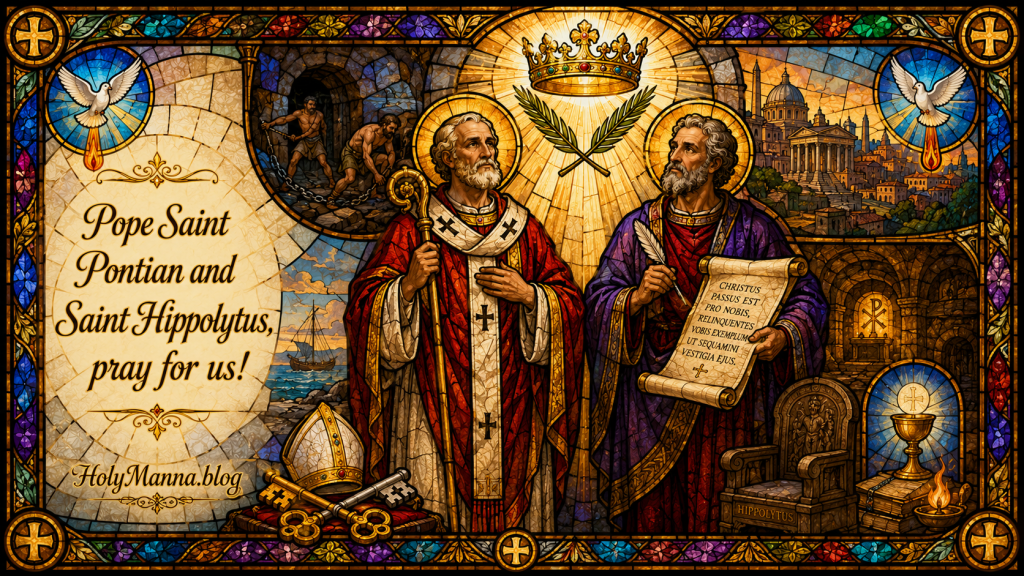
One Crown for Two Rivals
Every year on August 13th, the Church does something that should stop every reader in their tracks. She places on the same altar, in the same Mass, under the same red vestments of martyrdom, a pope and the man who spent years insisting that this pope and his predecessors were unworthy of the Chair of Peter. Saint Pontian was the Bishop of Rome from the year 230 to 235. Saint Hippolytus was the most brilliant theologian in the Roman Church of his day, and for a stretch of years he was also something far more troubling; he was history’s first antipope, a rival bishop set up against the legitimate successors of Peter. The ancient Roman Martyrology describes their end with a phrase that reads like poetry and lands like a thunderclap, saying that the two men were “deported together to Sardinia, where they both served a common sentence and were, as it seems, crowned with a single crown.”
One crown for two men who had stood on opposite sides of a schism. That is the whole Gospel in a single image. The Church venerates them together not in spite of their conflict but precisely because their story ends in reconciliation, suffering shared, and a communion restored before death sealed it forever. The Catechism teaches that by canonizing certain of the faithful, “the Church recognizes the power of the Spirit of holiness within her and sustains the hope of believers by proposing the saints to them as models and intercessors” (CCC 828). Pontian and Hippolytus are proposed as models of something the modern world desperately needs; they show that no wound of division is beyond the healing mercy of God, and that humility, whether the humility to resign an office or the humility to admit a grave error, is the road that leads to the crown.
A Roman Pope and a Roman Genius
Pontian was a Roman by birth. The ancient Liber Pontificalis, the old book of papal biographies, records that his father was named Calpurnius, and beyond that single detail history preserves almost nothing of his family or his early formation. This silence is itself instructive. Pontian did not enter history because of a famous family or a dramatic conversion story; he entered it because the Church of Rome, in the year 230, judged him worthy to succeed Pope Urban I as the successor of Saint Peter. The Catechism explains the weight of that office plainly, teaching that “the Pope, Bishop of Rome and Peter’s successor, is the perpetual and visible source and foundation of the unity both of the bishops and of the whole multitude of the faithful” (CCC 882). Pontian took up that ministry of unity at a moment when unity in Rome was in open crisis, because a rival bishop was already claiming the allegiance of a portion of the Roman faithful.
That rival was Hippolytus, and he was no ordinary troublemaker. He was probably born around the year 170, most likely in Rome itself, and he grew into the most learned Christian mind the city had yet produced. The ninth-century Patriarch Photius of Constantinople, in his Bibliotheca, describes Hippolytus as a disciple of Saint Irenaeus of Lyons, who was himself a disciple of Saint Polycarp, who had known the Apostle John. Scholars consider that chain of discipleship doubtful as a documented fact, but it captures how the early Church perceived him, as a man standing close to the apostolic wellspring. He wrote in Greek, and he wrote enormously. His Commentary on Daniel is the oldest surviving Christian commentary on any book of Scripture. He composed a Commentary on the Song of Songs, a treatise titled On Christ and Antichrist, a calculation table for the date of Easter, and his great heresy-hunting masterwork, the Refutation of All Heresies, also called the Philosophumena. To him has also long been attributed the Apostolic Tradition, a manual of early Christian worship whose ancient Eucharistic prayer became the principal model for Eucharistic Prayer II in the Roman Missal that Catholics hear at Mass today. Honesty requires a flag here; modern scholars vigorously debate whether the Apostolic Tradition truly comes from his pen, and even whether the works under his name belong to one author or two. What no one disputes is that the man buried on the Via Tiburtina was venerated by ancient Rome as a priest, a scholar, and finally a martyr.
How did such a man fall into schism? Hippolytus was a rigorist. He watched Pope Callixtus I, and after him Pope Urban and Pope Pontian, extend the Church’s penitential mercy to Christians who had committed grave sins, including sins of the flesh, welcoming them back to communion after repentance. To Hippolytus this looked like laxity, a cheapening of holiness, and he also accused Callixtus of imprecision in his teaching on the Trinity. Convinced that the Chair of Peter was occupied by unworthy men, he permitted a faction of like-minded Roman Christians to regard him as their bishop. The Catechism gives the sober name for what he chose, defining schism as “the refusal of submission to the Roman Pontiff or of communion with the members of the Church subject to him” (CCC 2089). The tragedy of Hippolytus is that his zeal for holiness, a genuinely good thing, curdled into a refusal of the very Church that Christ founded to dispense holiness. In this he was wrong, and the popes he opposed were right, for the Lord gave the Church the ministry of reconciliation precisely for great sinners. As the Catechism teaches, Christ willed that his Church “should be the sign and instrument of the forgiveness and reconciliation that he acquired for us at the price of his blood” (CCC 1442).
Shepherding and Scholarship in an Age of Calm Before the Storm
The five years of Pontian’s pontificate unfolded during the reign of Emperor Alexander Severus, a ruler tolerant enough that the Church in Rome could breathe, organize, and even argue with itself in public. Pontian used the calm to govern. His most consequential documented act was convening a synod at Rome that confirmed the sentence which Bishop Demetrius of Alexandria had issued against the brilliant and controversial theologian Origen. Whatever one makes of that long and complicated affair, it shows Pontian exercising exactly the office described in the Catechism, where the Roman Pontiff acts as “pastor of the entire Church” with authority given “in order that the episcopate itself might be one and undivided” (CCC 880 and CCC 882). He was not a philosopher or a famous preacher. He was a shepherd holding the center while a schismatic party pulled at the flock from one side and imperial politics rumbled on the other.
It must be said honestly that no miracles are recorded from the earthly lifetimes of either Pontian or Hippolytus. Their age did not leave miracle collections for them the way later centuries did for other saints, and this blog will never invent what history does not give. Yet their lives displayed something the Catechism calls the greatest witness of all. What God worked through these two men was the miracle of perseverance and the miracle of a healed heart, and readers should remember them for exactly that. Hippolytus, for all his rebellion, spent those same years writing works that fed the whole Church. In the soaring conclusion of the Refutation of All Heresies, he told his readers what God offers those who follow Christ, writing, “and thou shalt be a companion of the Deity, and a co-heir with Christ… for thou hast become God”, his bold ancient way of describing what the Catechism calls the astonishing truth that the Son of God became man “to make us partakers of the divine nature” (CCC 460). A man who could write those words about union with God was a man whose heart, however proud, was still aimed at heaven. God would finish the aim.
The Mines of Sardinia and the First Papal Resignation
The calm shattered in the year 235. Alexander Severus was murdered by his own troops, and a hulking soldier-emperor named Maximinus Thrax seized power. Maximinus had no patience for the previous regime’s tolerance, and he struck the Church with a persecutor’s shrewdness, targeting not Christians at large but the leaders of the Church. The two most visible Christian leaders in Rome were the pope and the antipope, and the emperor did not trouble himself with the difference. Both Pontian and Hippolytus were arrested and condemned to deportation to Sardinia, the island the Romans grimly called insula nociva, the harmful island, to labor in its mines. Everyone understood what the sentence meant. The mines were a death sentence in slow motion, a living death of chains, darkness, starvation, and the lash.
What Pontian did next changed the papacy forever. On September 28th in the year 235, a date preserved in the ancient Liberian Catalogue and generally regarded as the earliest precisely dated event in all of papal history, Pontian laid down the papacy so that the Church of Rome would not be left headless while her bishop wasted away in chains. He became the first pope in history to resign. Consider what that act required. Pontian surrendered the highest office on earth, not under pressure from rivals and not for comfort, but purely so that the flock would have a shepherd. The Roman clergy were thus free to elect Pope Anterus, and the line of Peter continued unbroken. The Catechism teaches that “the Lord made Simon alone, whom he named Peter, the ‘rock’ of his Church” and gave him the keys (CCC 881), and Pontian understood that the rock matters more than the man standing on it at any given moment. His resignation was not an escape; he went to Sardinia anyway, and he went as a prisoner stripped of everything but Christ.
And there, in the darkness of the mines, the miracle of this story happened. Hippolytus, chained on the same island, condemned under the same decree, suffering the same hunger and the same brutality, made his peace with the Catholic Church. The Catholic Encyclopedia records that shortly before his exile or soon after it began, he “became reconciled with the legitimate bishop and the Church of Rome.” Ancient tradition holds that he urged his followers back into communion with the lawful pope, and his schism dissolved. The proof of his reconciliation is written in stone and calendar, because Rome buried him and venerated him as a Catholic martyr, an honor the ancient Roman Church would never have granted a man who died in schism. The Catechism teaches that the sinner who returns is restored through “the sacrament of Reconciliation with God and with the Church” (CCC 1440), and it defines martyrdom as “the supreme witness given to the truth of the faith” in which the martyr “endures death through an act of fortitude” (CCC 2473). Hippolytus gave both witnesses at once, the witness of repentance and the witness of blood.
Neither man survived the island. The old Acts of the martyrs used by the author of the Liber Pontificalis record that Pontian died from the privations and inhuman treatment he endured, and Hippolytus likewise perished from the crushing conditions, probably in the year 235 or shortly after. They were not beheaded in an arena before a roaring crowd. They were ground down slowly in the dark, which is its own severe form of martyrdom, the kind that offers no dramatic moment of glory, only the daily choice to keep believing. The Church has always counted them martyrs in the fullest sense, for they died of the punishment inflicted on them for the name of Christ.
The Journey Home and the Single Crown
The persecution ebbed, and Pope Fabian, elected in 236, did something beautiful. He had the bodies of both confessors brought back from Sardinia to Rome, and on August 13th, in 236 or one of the years immediately following, the city buried them in solemn honor on the same day. Pontian was laid in the papal crypt of the Catacomb of Callixtus on the Appian Way, among his brother popes of that century. Hippolytus was laid in a catacomb on the Via Tiburtina that came to bear his own name and became a pilgrimage site for centuries of Roman Christians. The ancient Chronograph of 354, one of the oldest calendars of the Roman Church, records their deposition on August 13th, and that shared burial date is the very reason the Church celebrates them together on this day. The pope and the former antipope came home in the same procession. If that image does not move the reader, nothing will.
The centuries kept adding testimony. In 1854 the great archaeologist Giovanni Battista de Rossi rediscovered the papal crypt in the Catacomb of Callixtus, and in 1909 excavators found among the shattered marble on its floor the original epitaph of Pontian’s tomb, carved in Greek, reading “Pontianos, Episk(opos)”, Pontian, Bishop, with the word for martyr added by a later ancient hand, as if the Roman Church had returned to the stone to make sure history knew how he died. Three centuries earlier, in 1551, diggers near the Via Tiburtina unearthed a headless marble statue of a seated teacher, its chair inscribed with a catalogue of Hippolytus’s writings and his table for calculating Easter. Restored, that statue now stands at the entrance of the Vatican Apostolic Library, where the first antipope, reconciled, greets visitors to the heart of the Catholic Church he once fought. God writes long sentences, but He finishes them.
Two famous traditions attached themselves to Hippolytus over the centuries, and both must be told as traditions rather than fact. The first comes from the poet Prudentius, who around the year 400 wrote a vivid hymn describing a martyr named Hippolytus who was torn apart at Ostia by wild horses, his body dragged over rocks and brambles while weeping Christians gathered his remains. The image almost certainly migrated from Greek mythology, where Hippolytus, son of Theseus, died dragged by his own horses, and it does not match the documented death in Sardinia. It is a moving story, and it cannot be verified. The second tradition, found in the old accounts of Saint Lawrence, makes Hippolytus the Roman officer who guarded Lawrence in prison, was converted by him, buried him after his martyrdom on August 10th, and was then executed himself for the faith. This tale likely arose because the two feasts sit three days apart and their burial sites lay in the same region of the Via Tiburtina, and it appears to confuse the priest-theologian with a distinct soldier of the same name. It too is a story of tradition, and it cannot be verified. No miracles of healing are documented at their tombs in the ancient sources, and this blog will not invent any; the enduring wonder of these two saints is the reconciliation itself, venerated by pilgrims at the Via Tiburtina catacomb for centuries. For most of Church history Pontian was commemorated separately on November 19th, until the calendar reform of 1969 reunited the two men on August 13th, the ancient day their bodies came home together, which is exactly where they belong.
What a Resignation and a Repentance Teach the Modern Heart
These two saints press on wounds that every reader carries. Start with Pontian. He held the highest office in the Church and let it go the moment clinging to it would have harmed the flock. In an age obsessed with platforms, titles, followers, and personal brands, Pontian asks a piercing question. Is there any position, any status, any role you are gripping so tightly that you could not release it if God and the good of others required it? True authority in the Kingdom is service, for the Lord himself said, “whoever wishes to be first among you shall be your slave” (Matthew 20:27), and the Catechism echoes that the Church’s ministers must exercise their service “in the image of Christ, who freely became the servant of all” (CCC 876). You may never resign a papacy, but you will face a hundred smaller versions of Pontian’s choice, moments when your ego and someone else’s good cannot both win.
Now consider Hippolytus, who may be the more urgently needed saint of the two. He was right about many things, gifted beyond his contemporaries, and genuinely zealous for holiness, and precisely those strengths made his pride nearly fatal. He looked at a Church full of forgiven sinners and found it insufficiently pure, forgetting that he too lived only by mercy. How familiar that sounds. When you grow disgusted with the failures of others in the Church, does your zeal draw you closer to Christ’s Body, or does it tempt you to stand apart from it in superior judgment? The Catechism warns that ruptures wounding the unity of Christ’s Body “do not occur without human sin” (CCC 817), and Our Lord prayed on the night before he died “that they may all be one” (John 17:21). Hippolytus teaches that it is never too late to come home, that repentance late in life still ends in a martyr’s crown, and that God can be so extravagant in mercy that He lets a former antipope help shape the Eucharistic Prayer whispered at millions of Masses. Practically, this week, let their witness become concrete. Reach out to one person from whom you are estranged, especially over a matter of pride, and take the first step toward peace. If you have been away from Confession, go, because the sacrament Hippolytus once scorned and then embraced is waiting for you too (CCC 1446). And when the failures of Church members tempt you toward contempt, pray instead for the Church’s shepherds, remembering that the two men on this feast are now, as the Catechism says of all the saints, companions who “do not cease to intercede with the Father for us” (CCC 956).
Engage With Us!
The story of Pontian and Hippolytus belongs to every believer who has ever fought with the Church, resigned something precious, or longed for a reconciliation that seemed impossible, so share your thoughts and reflections in the comments below; this community grows stronger every time you do. As you ponder their single crown, sit with these questions:
- Pontian gave up the papacy itself so the Church could thrive without him; what position, possession, or piece of your identity is God inviting you to hold with open hands?
- Hippolytus let zeal for holiness harden into schism; where in your own life has a good desire, taken too far, pulled you away from communion with others?
- The two rivals were reconciled only in shared suffering; how have your own hardest seasons opened doors to forgiveness that comfort never could?
- Rome buried the pope and the antipope on the same day and honors them at the same altar; is there someone you have quietly decided is beyond reconciling with, and what would one step toward them look like this week?
- Hippolytus wrote that the Christian is called to become a companion of God and co-heir with Christ; what daily habit could you begin that takes that destiny seriously?
Do not let this feast pass as a mere history lesson. The same mercy that turned an antipope into a martyr and gave a deposed pope an everlasting crown is alive in the sacraments, in your parish, and in your home today. Go and be reconciled, quickly and generously, and do everything this day with the love and mercy that Jesus taught us.
Pope Saint Pontian & Saint Hippolytus, pray for us!
Follow us on YouTube, TikTok, Instagram and Facebook for more insights and reflections on living a faith-filled life.


Leave a comment