Thursday of the Nineteenth Week in Ordinary Time – Lectionary: 416
When Mercy Knocks on a Hardened Heart
Some warnings arrive as words, and some arrive as a man digging through a wall while his neighbors stare. The readings for Thursday of the Nineteenth Week in Ordinary Time are united by a sobering truth: the human heart can grow so hard that God must go to dramatic lengths to break through it. In the first reading, Ezekiel becomes a living billboard of the coming exile, packing his bags and crawling through a hole in the wall so that a rebellious house with eyes that do not see might finally understand. The Responsorial Psalm diagnoses the disease behind that blindness, which is forgetfulness, since a people who forget the works of the Lord soon rebel against Him. Then the Gospel brings the diagnosis into personal territory. A servant forgiven an unpayable debt walks out the door and immediately chokes a man who owes him pocket change, having received an ocean of mercy and refused to hand over a cup of it. Ezekiel preached around 592 BC, and Jesus told His parable six centuries later, yet both confront the same stubborn organ, the heart that will not see, will not remember, and will not forgive. Yet the readings leave no one in despair, because the same God who warns is the God who forgives entire debts the moment His servant falls to his knees.
First Reading — Ezekiel 12:1-12
A Prophet Packs His Bags While the Whole World Watches
Ezekiel was a priest of Jerusalem, deported to Babylon in 597 BC with King Jehoiachin and the first wave of exiles. He preached by the Chebar canal to deportees who clung to the conviction that Jerusalem would never fall. This oracle, delivered around 592 BC, follows his vision of God’s glory departing the temple. Because words alone had failed, God commanded street theater, and Ezekiel acted out the exile physically so that a people deaf to sermons might at least be curious. The passage anchors the day’s theme, showing the lengths to which God will go to reach hearts sealed shut.
Ezekiel 12:1-12
The word of the LORD came to me:
Son of man, you live in the midst of a rebellious house;
they have eyes to see but do not see,
and ears to hear but do not hear,
for they are a rebellious house.
Now, son of man, during the day while they are looking on,
prepare your baggage as though for exile,
and again while they are looking on,
migrate from where you live to another place;
perhaps they will see that they are a rebellious house.
You shall bring out your baggage like an exile in the daytime
while they are looking on;
in the evening, again while they are looking on,
you shall go out like one of those driven into exile;
while they look on, dig a hole in the wall and pass through it;
while they look on, shoulder the burden and set out in the darkness;
cover your face that you may not see the land,
for I have made you a sign for the house of Israel.I did as I was told.
During the day I brought out my baggage
as though it were that of an exile,
and at evening I dug a hole through the wall with my hand
and, while they looked on, set out in the darkness,
shouldering my burden.Then, in the morning, the word of the LORD came to me:
Son of man, did not the house of Israel, that rebellious house,
ask you what you were doing?
Tell them: Thus says the Lord GOD:
This oracle concerns Jerusalem
and the whole house of Israel within it.
I am a sign for you:
as I have done, so shall it be done to them;
as captives they shall go into exile.
The prince who is among them shall shoulder his burden
and set out in darkness,
going through a hole he has dug out in the wall,
and covering his face lest he be seen by anyone.
Detailed Exegesis
Verse 1: “The word of the LORD came to me:”
The prophet never speaks on his own authority. Every strange act that follows originates in God’s initiative, which is why the Church reads these sign-acts as revelation rather than eccentricity.
Verse 2: “Son of man, you live in the midst of a rebellious house; they have eyes to see but do not see, and ears to hear but do not hear, for they are a rebellious house.”
The address “son of man” underscores Ezekiel’s humanity before God’s majesty. The charge of seeing without seeing echoes Deuteronomy 29:3 and anticipates Matthew 13:13. The blindness is moral, not physical, since the people possess every faculty needed to perceive the truth and simply refuse to use them.
Verse 3: “Now, son of man, during the day while they are looking on, prepare your baggage as though for exile, and again while they are looking on, migrate from where you live to another place; perhaps they will see that they are a rebellious house.”
The word “perhaps” is the most tender word in the passage, for God stages this drama on the slim hope that even a rebellious house might be startled into repentance before judgment falls.
Verse 4: “You shall bring out your baggage like an exile in the daytime while they are looking on; in the evening, again while they are looking on, you shall go out like one of those driven into exile;”
The repetition of “while they are looking on” shows the entire performance exists for the audience. An exile’s baggage was pitifully small, and the sight of a priest packing it was meant to disturb.
Verse 5: “while they look on, dig a hole in the wall and pass through it;”
Babylonian houses were built of sun-dried mud brick, so digging through a wall by hand was possible. The act prefigures a desperate, secret escape rather than a dignified departure through the city gate.
Verse 6: “while they look on, shoulder the burden and set out in the darkness; cover your face that you may not see the land, for I have made you a sign for the house of Israel.”
God names the purpose, for Ezekiel is a sign, a living warning. The covered face carries a double meaning, the shame of a fugitive and, more hauntingly, a king brought to Babylon without ever seeing it.
Verse 7: “I did as I was told. During the day I brought out my baggage as though it were that of an exile, and at evening I dug a hole through the wall with my hand and, while they looked on, set out in the darkness, shouldering my burden.”
Ezekiel obeys immediately and without protest. His humiliation becomes the vehicle of God’s message, foreshadowing Christ, who did not merely act out salvation but accomplished it in His own flesh.
Verse 8: “Then, in the morning, the word of the LORD came to me:”
God allows a night to pass, and now comes the interpretation, because a sign without a word remains a riddle.
Verse 9: “Son of man, did not the house of Israel, that rebellious house, ask you what you were doing?”
Even a rebellious house cannot help asking questions when a prophet crawls through a wall, and curiosity opens the door for God’s answer.
Verse 10: “Tell them: Thus says the Lord GOD: This oracle concerns Jerusalem and the whole house of Israel within it.”
The exiles assumed the drama was about somebody else, and God corrects them, for the oracle targets Jerusalem itself, the city they were certain would stand forever.
Verse 11: “I am a sign for you: as I have done, so shall it be done to them; as captives they shall go into exile.”
The prophet’s body has become the prophecy. What Ezekiel performed in miniature, the nation will suffer in full, for God’s warnings are never empty theater.
Verse 12: “The prince who is among them shall shoulder his burden and set out in darkness, going through a hole he has dug out in the wall, and covering his face lest he be seen by anyone.”
The “prince” is King Zedekiah, whom Ezekiel never calls king, since the legitimate king Jehoiachin already sat in Babylonian custody. In 586 BC this verse was fulfilled with terrifying precision, for Zedekiah fled the besieged city by night, was captured near Jericho, watched his sons executed, and was then blinded and led away in chains, as 2 Kings 25:4-7 and Jeremiah 52:7-11 record. He never saw the land of his captivity.
Teachings
The Church treasures the prophets because episodes like this reveal how God educates His people. The Catechism teaches, “Through the prophets, God forms his people in the hope of salvation, in the expectation of a new and everlasting Covenant intended for all, to be written on their hearts” (CCC 64). Even this dark oracle serves that formation, for a warning is itself an act of hope. Saint Jerome, writing his Commentary on Ezekiel in the early fifth century, read the prophet’s sign-acts as God’s remedy for hearts too dull for words alone. The deeper malady here is hardness of heart, and the Church names the remedy. The Catechism teaches, “Interior repentance is a radical reorientation of our whole life, a return, a conversion to God with all our heart, an end of sin, a turning away from evil, with repugnance toward the evil actions we have committed” (CCC 1431). Ezekiel’s audience refused that reorientation and inherited the exile he performed within six years, proof that the God who keeps His warnings also keeps His promises.
Reflection
Ezekiel’s neighbors watched a man pack for an exile they refused to believe in, and it is worth asking whether God has staged any signs lately that have gone unnoticed. He rarely sends prophets through walls anymore, but He does send a homily that lands uncomfortably close, a friend’s gentle correction, a reading that will not leave the mind alone. A concrete step would be a sincere examination of conscience this evening, followed by the Sacrament of Reconciliation if it has been a while. Another is to become a small sign for others, since a person who quietly forgives, prays, and serves preaches louder than a megaphone. Where in life has God been trying to get attention, and what would it cost to finally look? Is there a truth being avoided because acknowledging it would demand change?
Responsorial Psalm — Psalm 78:7b, 56-59, 61-62
A National Examination of Conscience Set to Music
Psalm 78 is a maskil of Asaph, a teaching psalm that retells Israel’s history from the Exodus to King David, not as nostalgia but as a warning. The verses chosen today recall the era of the Judges, when Israel settled the Promised Land and promptly filled it with pagan high places and idols. The disaster in the final strophe is the catastrophe at Shiloh, when the Ark of the Covenant, the psalm’s “strength” and “glory,” was captured by the Philistines, recounted in 1 Samuel 4. The refrain distills the whole psalm into a single command about memory, making it the perfect bridge for this liturgy, since Ezekiel’s generation forgot the works of the Lord and inherited exile, and the unforgiving servant will forget the mercy shown to him before he reaches the street.
Psalm 78:7b, 56-59, 61-62
R. (see 7b) Do not forget the works of the Lord!
They tempted and rebelled against God the Most High,
and kept not his decrees.
They turned back and were faithless like their fathers;
they recoiled like a treacherous bow.
R. Do not forget the works of the Lord!
They angered him with their high places
and with their idols roused his jealousy.
God heard and was enraged
and utterly rejected Israel.
R. Do not forget the works of the Lord!
And he surrendered his strength into captivity,
his glory in the hands of the foe.
He abandoned his people to the sword
and was enraged against his inheritance.
R. Do not forget the works of the Lord!
Detailed Exegesis
Refrain, verse 7b: “Do not forget the works of the Lord!”
To remember God’s works is to let them govern present choices, which is why Scripture treats forgetting as the first step toward every other sin.
Verse 56: “They tempted and rebelled against God the Most High, and kept not his decrees.”
Testing God means demanding that He prove Himself on human terms while ignoring the proofs already given, and rebellion follows naturally, since a heart that distrusts God’s goodness will not long obey His commands.
Verse 57: “They turned back and were faithless like their fathers; they recoiled like a treacherous bow.”
A treacherous bow looks reliable until the moment of firing, when the arrow flies anywhere but at the target. Israel’s fidelity failed precisely when it was needed most, generation after generation.
Verse 58: “They angered him with their high places and with their idols roused his jealousy.”
The high places were hilltop shrines blending worship of the Lord with Canaanite idolatry. God’s jealousy is not petty possessiveness but the fierce, faithful love of a spouse defending His covenant.
Verse 59: “God heard and was enraged and utterly rejected Israel.”
God’s anger is His settled opposition to the sin destroying His people, and the rejection described is the withdrawal of protection that Israel’s infidelity had already chosen.
Verse 61: “And he surrendered his strength into captivity, his glory in the hands of the foe.”
The “strength” and “glory” name the Ark of the Covenant, seized by the Philistines at Aphek. God permitted the unthinkable to teach Israel that His presence is never a magic charm owed to an unrepentant people.
Verse 62: “He abandoned his people to the sword and was enraged against his inheritance.”
Shiloh fell, and centuries later Jerusalem would fall for the same reasons. The psalm was already ancient when Ezekiel preached, so his generation sang this warning and still refused to learn.
Teachings
The Church has always understood that memory is the guardian of faith. The Catechism teaches, “In the sense of Sacred Scripture the memorial is not merely the recollection of past events but the proclamation of the mighty works wrought by God for men” (CCC 1363). This is why the Mass is called a memorial, for at every altar the Church obeys the psalm’s refrain, remembering the work of the Lord until He comes again. Saint Augustine, in his Expositions on the Psalms, treated Psalm 78 as a mirror held up to every generation, insisting that the failures of the fathers are recorded so the children might not repeat them. A Catholic who knows the story of Shiloh, the exile, and the Cross possesses a built-in defense against the amnesia that breeds rebellion, which is why the Church sings these old verses to modern congregations.
Reflection
Forgetfulness rarely announces itself. Nobody decides to forget God, yet weeks slip by without gratitude, prayers shrink into wish lists, and the heart drifts toward its own private high places, whether careers, screens, or grievances. The psalm proposes memory as medicine. A concrete practice is to end each day naming three works of the Lord from that day alone and thanking Him aloud for each one. Another is keeping a simple journal of answered prayers, because a written record makes forgetting much harder. What works of the Lord have already faded from memory that once felt unforgettable? Which modern high places quietly compete for the worship that belongs to God alone?
Holy Gospel — Matthew 18:21–19:1
The Debt No One Could Ever Repay
This passage closes the fourth great discourse in The Gospel of Matthew, where Jesus teaches how life inside His community must work. The rabbis of the day taught that forgiving three times was sufficient, so Peter’s offer of seven is meant to be heroic. Jesus detonates the framework of counting, and the unforgiving servant becomes Ezekiel’s rebellious house shrunk to a single man who saw mercy with his own eyes and refused to let it change him.
Matthew 18:21–19:1
Peter approached Jesus and asked him,
“Lord, if my brother sins against me,
how often must I forgive him?
As many as seven times?”
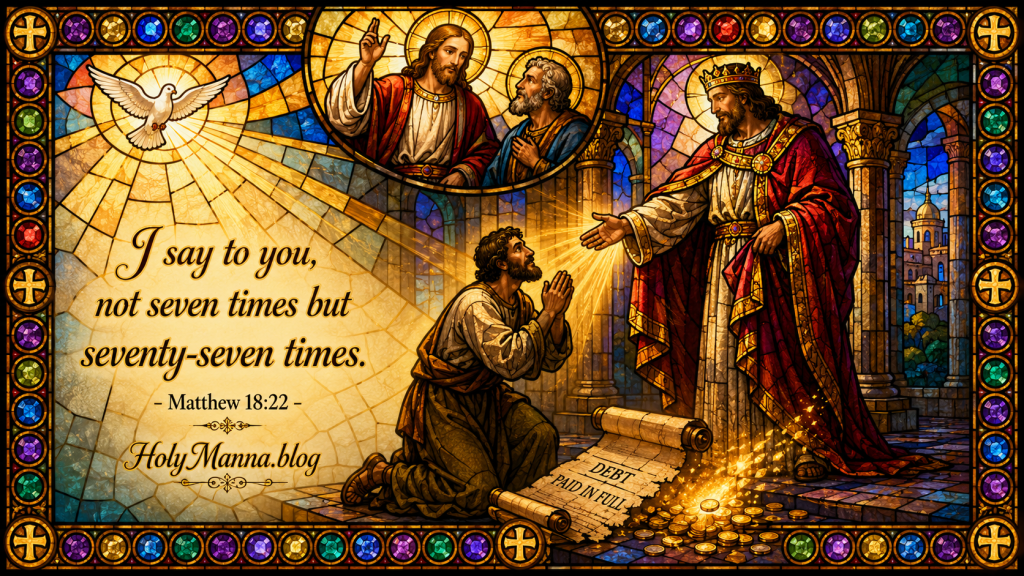
Jesus answered, “I say to you, not seven times but seventy-seven times.
That is why the Kingdom of heaven may be likened to a king
who decided to settle accounts with his servants.
When he began the accounting,
a debtor was brought before him who owed him a huge amount.
Since he had no way of paying it back,
his master ordered him to be sold,
along with his wife, his children, and all his property,
in payment of the debt.
At that, the servant fell down, did him homage, and said,
‘Be patient with me, and I will pay you back in full.’
Moved with compassion the master of that servant
let him go and forgave him the loan.
When that servant had left, he found one of his fellow servants
who owed him a much smaller amount.
He seized him and started to choke him, demanding,
‘Pay back what you owe.’
Falling to his knees, his fellow servant begged him,
‘Be patient with me, and I will pay you back.’
But he refused.
Instead, he had the fellow servant put in prison
until he paid back the debt.
Now when his fellow servants saw what had happened,
they were deeply disturbed,
and went to their master and reported the whole affair.
His master summoned him and said to him, ‘You wicked servant!
I forgave you your entire debt because you begged me to.
Should you not have had pity on your fellow servant,
as I had pity on you?’
Then in anger his master handed him over to the torturers
until he should pay back the whole debt.
So will my heavenly Father do to you,
unless each of you forgives his brother from his heart.”When Jesus finished these words, he left Galilee
and went to the district of Judea across the Jordan.
Detailed Exegesis
Verse 21: “Peter approached Jesus and asked him, ‘Lord, if my brother sins against me, how often must I forgive him? As many as seven times?’”
Seven is the biblical number of completeness, so Peter, generous by the standards of his day, is really asking whether forgiveness has a finish line.
Verse 22: “Jesus answered, ‘I say to you, not seven times but seventy-seven times.’”
By reversing Lamech’s boast of seventy-sevenfold vengeance in Genesis 4:24, Jesus abolishes the ledger entirely, making forgiveness a disposition to be lived rather than an act to be counted.
Verse 23: “That is why the Kingdom of heaven may be likened to a king who decided to settle accounts with his servants.”
The settling of accounts evokes the judgment every soul will face, since debts never acknowledged can never be forgiven.
Verse 24: “When he began the accounting, a debtor was brought before him who owed him a huge amount.”
The Greek text specifies ten thousand talents, one talent being worth roughly six thousand days’ wages, a sum no servant could ever repay and a picture of what sin owes to God.
Verse 25: “Since he had no way of paying it back, his master ordered him to be sold, along with his wife, his children, and all his property, in payment of the debt.”
Selling the household would recover a laughable fraction of the sum, and strict justice leaves the debtor without hope.
Verse 26: “At that, the servant fell down, did him homage, and said, ‘Be patient with me, and I will pay you back in full.’”
The promise is impossible, and both parties know it, but falling down and begging is all any sinner can do before God.
Verse 27: “Moved with compassion the master of that servant let him go and forgave him the loan.”
The Greek verb for compassion describes a mercy felt in the depths. The servant asked for patience and received total cancellation, which is how divine forgiveness outruns human petitions.
Verse 28: “When that servant had left, he found one of his fellow servants who owed him a much smaller amount. He seized him and started to choke him, demanding, ‘Pay back what you owe.’”
A hundred denarii, about three months’ wages, is a rounding error against ten thousand talents, and the choking hand shows a heart that mercy never actually entered.
Verse 29: “Falling to his knees, his fellow servant begged him, ‘Be patient with me, and I will pay you back.’”
The plea repeats the first servant’s own words almost exactly. He is handed a mirror, and the tragedy is that he looks straight into it and sees nothing.
Verse 30: “But he refused. Instead, he had the fellow servant put in prison until he paid back the debt.”
The refusal is deliberate, not a moment of temper. The act is justice weaponized by a man who survived only because justice was set aside for him.
Verse 31: “Now when his fellow servants saw what had happened, they were deeply disturbed, and went to their master and reported the whole affair.”
Unforgiveness is never a private affair, since it wounds the whole household of faith, which is why the servants bring the matter to their master.
Verse 32: “His master summoned him and said to him, ‘You wicked servant! I forgave you your entire debt because you begged me to.’”
The wickedness named here is not the original debt but the forgetting of its forgiveness, tying this Gospel directly to the psalm’s refrain.
Verse 33: “Should you not have had pity on your fellow servant, as I had pity on you?”
This question is the hinge of the parable, for received mercy creates an obligation of mercy, not as a fee for the gift but as its natural fruit.
Verse 34: “Then in anger his master handed him over to the torturers until he should pay back the whole debt.”
The forgiven debt returns in full, for the unforgiving heart already lives in a prison of resentment long before any sentence is passed.
Verse 35: “So will my heavenly Father do to you, unless each of you forgives his brother from his heart.”
Jesus leaves no loophole. The forgiveness required is interior, not a gritted-teeth formality, and He binds heaven’s mercy toward each person to that person’s mercy toward others, as He taught in the Our Father.
Verse 19:1: “When Jesus finished these words, he left Galilee and went to the district of Judea across the Jordan.”
Matthew’s formula marks the end of the discourse, and Jesus now moves toward Judea and ultimately Jerusalem, where He will pay the unpayable debt Himself upon the Cross.
Teachings
Saint John Chrysostom, preaching on this parable in Homily 61 on The Gospel of Matthew, taught, “If you want to learn how our sins against God are like ten thousand talents, or more in fact, and even much more, I will try to show you briefly”, concluding that no human offense can approach what each person owes to God. The Catechism warns that “this outpouring of mercy cannot penetrate our hearts as long as we have not forgiven those who have trespassed against us” (CCC 2840), yet the Church is honest about how hard this is, teaching, “It is not in our power not to feel or to forget an offense; but the heart that offers itself to the Holy Spirit turns injury into compassion and purifies the memory in transforming the hurt into intercession” (CCC 2843). Pope Benedict XVI, reflecting on forgiveness in Jesus of Nazareth, wrote, “The offense is a reality, an objective force; it has caused damage that must be repaired. Hence forgiveness must be more than a matter of ignoring, of merely trying to forget”. Forgiveness is neither denial nor amnesia but a costly participation in the mercy of the Cross.
Reflection
Nearly everyone carries a name that stings when it surfaces. This Gospel does not demand warm feelings on command, only a decision of the heart, renewed as often as necessary, to release the claim to revenge and to will the other person’s good. A first step is to pray for that person by name every day for a week, even through clenched teeth, since a heart offered to the Holy Spirit can turn injury into intercession. A second is to bring persistent resentment into Confession, and a third is to remember the ten thousand talents before rehearsing anyone else’s hundred denarii. Who still stands imprisoned in the heart’s ledger, and what would it take to tear up the page? When the Our Father reaches the word forgive, is it prayed or merely recited?
The Heart That Sees, Remembers, and Releases
Today’s readings tell one story from three angles, the story of God contending with the hardened human heart. Ezekiel packed an exile’s bag and crawled through a wall because his people had eyes that would not see, and history vindicated every gesture when Jerusalem fell. The psalmist traced the sickness to its root, a forgetful heart, since the generation that forgets the works of the Lord always ends up rebelling against Him. Then Jesus told of a servant forgiven an unpayable fortune who could not walk one hallway without strangling a man over spare change, proving that mercy received but not remembered changes nothing. The good news inside these hard readings is that God has not stopped staging signs. Every crucifix is Ezekiel’s drama perfected, the Son of God accomplishing the rescue of a rebellious house. Every Mass is the psalm’s refrain obeyed, the work of the Lord remembered and made present. Every absolution is the king canceling ten thousand talents again. The only question left is the one the master asked his servant, whether mercy received will become mercy given. Let today be the day the ledger gets torn up. Speak the name of the person who is hardest to forgive, hand the debt to God, and ask for the grace to release it from the heart. The house of Israel would not look, and the servant would not remember, but by God’s grace this generation can do better, seeing clearly, remembering gratefully, and forgiving freely.
Engage With Us!
Reflections and stories of hard-won forgiveness are warmly invited in the comments below, since walking this road together is half the grace of it. Here are questions to carry into prayer today.
- In Ezekiel 12:1-12, God turns His prophet into a living sign for people with eyes that do not see. What sign might God be placing in front of you right now?
- In Psalm 78:7b, 56-59, 61-62, Israel’s rebellion begins with forgetting the works of the Lord. What specific works of God in your own life do you need to deliberately remember this week?
- In Matthew 18:21–19:1, the forgiven servant refuses to forgive a far smaller debt. Whose debt are you still holding while God has already canceled your greater one?
- Taking the readings together, where is God asking you to trade a hardened, forgetful heart for one that sees His mercy and hands it on?
Living a life of faith is not about never falling. It is about remembering the King who canceled the debt, then walking out of His presence determined to treat every person with the love and mercy Jesus taught us. May your forgiveness be quick, your memory of His goodness long, and your heart soft enough for grace to enter.
Sacred Heart of Jesus, we trust in You!
Immaculate Heart of Mary, pray for us!
Saint Michael the Archangel, defend us in battle!
Follow us on YouTube, TikTok, Instagram and Facebook for more insights and reflections on living a faith-filled life.


Leave a comment