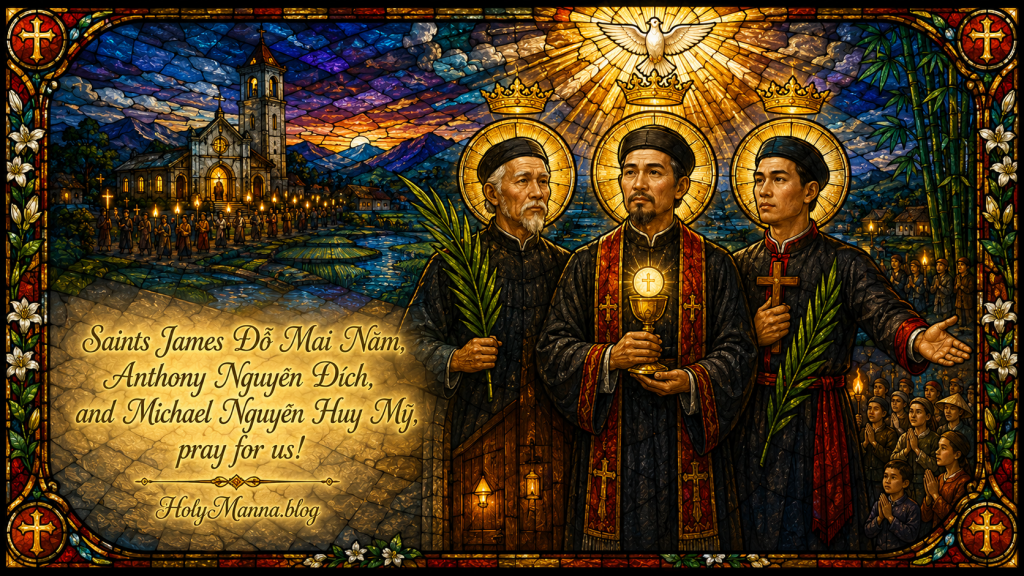
When One Village Gave the Church Three Saints in a Single Morning
Some saints stand alone in history, towering figures whose names echo across centuries. Others come down through history in company, bound together by blood, by friendship, and by a single terrible and glorious day. Saints James Đỗ Mai Năm, Anthony Nguyễn Đích, and Michael Nguyễn Huy Mỹ belong to the second kind. On August 12, 1838, these three men, a priest, an elderly lay leader, and the lay leader’s own son-in-law, knelt together at the Bảy Mẫu execution ground near Nam Định in northern Vietnam and were beheaded for refusing to renounce Jesus Christ. They died under the persecution of Emperor Minh Mạng, one of the fiercest waves of anti-Christian violence the Church has ever endured, and they now stand among the 117 Martyrs of Vietnam canonized by Pope John Paul II on June 19, 1988.
What makes these three so compelling is not only how they died but how they lived, and how completely their three vocations wove together. Father Năm was a hunted priest who needed shelter. Anthony Đích was the wealthy farmer and parish patriarch who opened his home to him at the risk of everything. Michael Mỹ was the young village mayor who used his civil office as a shield for the Church, and who, when the soldiers finally came, walked to his father-in-law’s house and declared that they would face death as one family. A priest, a grandfather, and a mayor; a shepherd, a host, and a protector. Together they show what the Catechism of the Catholic Church means when it teaches that martyrdom is “the supreme witness given to the truth of the faith”, a witness borne “even unto death” (CCC 2473). Their story is the story of an entire Catholic village that refused to let fear be stronger than love.
A Boy Called Ngũ, a Farmer Called Trùm, and an Orphan Called Mỹ
Each of the three men came to that execution ground by a different road, and each road began humbly.
James Đỗ Mai Năm was born in 1781 in the village of Đông Biên, in the Vĩnh Lộc district of Thanh Hóa province. Accounts preserved by the Catholic Church in Vietnam record that his name in the village registry during the Tây Sơn era was Mai Ngũ. From childhood he lived within the House of God, as the community life of the local Church was known, and he was eventually admitted to the seminary at Kẻ Vĩnh, also known as Vĩnh Trị, during the episcopate of Bishop Jacques Benjamin Longer. Before his ordination he served as a catechist, and the shape of his days in that role reveals everything about his heart. By day he cared for the sick and the dying. In the evenings he taught the children of the village. He was ordained a priest at roughly thirty two years of age, around the year 1813, and he served his people as a Vietnamese diocesan priest affiliated with the Society of Foreign Missions of Paris, the great French missionary society that helped plant and water the faith in Vietnam.
Anthony Nguyễn Đích, who appears in some records under the fuller name Nguyễn Tiến Đích, was born around 1769 in Chi Long. He became a farmer, and by the standards of his time and place a notably successful one. He married, raised a large family in the faith, and settled in the region of Vĩnh Trị within the apostolic vicariate of West Tonkin. His neighbors knew him as a solid and generous man, and the Church knew him as a trùm, the trusted lay head of the parish community. His wealth never became his master. Instead he treated it as a tool placed in his hands for the sake of the Gospel, funding the work of the missionaries and, as the persecution intensified, turning his own home into a hiding place for the hunted.
Michael Nguyễn Huy Mỹ had the hardest beginning of the three. He was born in 1804 in the hamlet of Đại Đăng, in territory belonging today to Ninh Bình province, the eldest son of a father whose family roots lay in Kẻ Vĩnh village. Suffering came for him early. He lost his father at the age of ten and his mother at the age of twelve, and the orphaned boy was taken in by his aunt, who saw to it that he studied the Confucian classics and the practice of medicine. Even as a young man he was known throughout the area as sharp, capable, and eloquent. At twenty he married Thị Mến, the daughter of Anthony Đích, and the marriage joined him to the family at the very center of the Catholic life of Vĩnh Trị. He and his wife were blessed with eight children, and the accounts describe a warm and devout household. When the villagers first tried to elect him to head the canton, he declined the honor. Later, on the advice of the bishop, he accepted the office of village chief, the lý trưởng, precisely so that he could use the position to protect the Church and its people during the persecution. From then on everyone called him Lý Mỹ.
For all three men, faith was not a private opinion but the organizing principle of an entire life. This is exactly the vocation of the laity that the Church would later articulate so clearly, for the Catechism teaches that lay people are called to seek the Kingdom of God “by engaging in temporal affairs and directing them according to God’s will” (CCC 898). Anthony directed his farm and his fortune toward God’s will. Michael directed his civil office toward God’s will. Neither man waited for permission to be holy in the middle of ordinary life.
The Shepherd in Hiding and the Household That Would Not Close Its Doors
To understand why these three men matter, it helps to grasp what it cost to be Catholic in Vietnam in the 1830s. Emperor Minh Mạng had issued edicts outlawing the Christian faith, expelling and hunting missionaries, and demanding that Catholics prove their apostasy by trampling on the crucifix. Soldiers forced the terrible test on villages and army garrisons alike. Informers were rewarded for betraying their neighbors. Priests were hunted like criminals, and anyone caught sheltering a priest faced the same death the priest faced. Every Catholic household in Tonkin lived with a question hanging over it: if the knock came at the door, would love prove stronger than fear?
In the household of Anthony Đích, the answer had already been given many times over. During the harshest years of the persecution, Anthony voluntarily sheltered an entire class of seminarians from the Vĩnh Trị seminary in his home for more than two years, and Bishop Joseph Havard, the vicar apostolic, often stayed under his roof. When Father Năm needed refuge, Anthony took him in for a long period, hiding the priest so that the sacraments would not disappear from the region. Every Mass Father Năm offered in hiding, every confession he heard, every dying villager he anointed, happened because one farmer decided his house belonged to God.
The accounts of Father Năm’s hidden years paint a picture of remarkable serenity. He did not grow bitter or fearful in confinement. He lived cheerfully among the people, told stories to the children, went out with the seminarians to help weed the fields of the family that sheltered him, and never treated any small task as beneath him. Most of all, he loved the poor. Whatever he received, he set aside for them. Here was a man under a death sentence who spent his hiding years thinking about other people’s hunger. There are no recorded miracles worked by any of these three men during their lifetimes, and honesty requires saying so plainly. Yet the Church has never taught that wonders are the measure of holiness. The daily fidelity of a priest who kept serving, a patriarch who kept sheltering, and a mayor who kept protecting is itself the quiet miracle of grace at work, for as the Catechism teaches, “The witness of a Christian life and good works done in a supernatural spirit have great power to draw men to the faith and to God” (CCC 2044).
Michael’s protection of the Church was anything but passive. As mayor he governed so well that the whole region praised Kẻ Vĩnh for being more peaceful than the surrounding villages, and he constantly encouraged his people to hold firm in the faith. When the governor of Nam Định, Trịnh Quang Khanh, began forcing Christian soldiers to trample the cross, Michael was away from home, but he immediately sent a letter to the Catholic soldiers of Vĩnh Trị. His words survive: “I beg you, brothers, to endure and not step on the cross. In just a few days, when I return home, I will come out to be with you.” Notice what he promised. Not advice from a safe distance, but his own presence in the danger. He had already weighed the cost. Before his arrest he asked his wife a question that very few husbands have ever had to ask: “If I receive the grace of martyrdom for the faith, would you consent?” Her answer deserves to be remembered alongside his: “If my husband receives such a great grace, I consent wholeheartedly.” That exchange between a husband and wife of eighteen years reveals an entire family already offered to God.
Five Hundred Lashes and a Vermilion Brush
The end began when informers reported that the village of Vĩnh Trị was harboring a priest. Soldiers surrounded the village; the sources differ on the exact date of the raid, with some accounts placing it in May of 1838 and records published with the Vietnamese Bishops’ Conference describing three hundred troops encircling the village on July 2, 1838, so the precise day cannot be stated with certainty. What is certain is what happened when the soldiers closed in. Michael did not run, and he did not hide behind his office. He walked to the house of his father-in-law and said: “Father and son live and die together.” Father Năm was discovered and arrested in Anthony’s home, and Anthony and Michael were seized with him. The three were bound and taken away, and Father Năm was imprisoned at Nam Định.
The interrogations that followed put each man’s love to the test, and each man answered with his own vocation. When the officials urged Father Năm to renounce the faith, the priest replied: “I have advised the faithful to stay firm with their belief. How can I reject it now?” Vietnamese accounts preserve his fuller answer before the mandarin: “I am a priest; how could I dare abandon the faith or trample on the sacred images I venerate.” A shepherd does not abandon in danger what he preached in peace.
Anthony was nearly seventy years old. The governor tried a gentler poison with him, urging the old man to step over the Cross and go home to enjoy his remaining years with his children and grandchildren. He steadfastly refused to deny his Lord. Then the governor ordered him beaten, and at that moment Michael stood up before the court and made the request that has echoed through Vietnamese Catholic memory ever since: “My father is old and advanced in years; I beg the great mandarin to spare him. I ask to take the blows in his place.” The mandarin, struck by such filial piety, granted it. Over roughly forty days of imprisonment, Michael was beaten again and again, both for his own steadfastness and in his father-in-law’s stead, receiving in total about five hundred lashes. The judges pressed him to think of his young family, eight children who would be left without a father. He would not trade their earthly security for his soul or theirs. He had already settled that question with his wife, and heaven had heard the answer.
On August 12, 1838, word arrived that Emperor Minh Mạng had endorsed the death sentence with his vermilion brush. The three men prepared their souls, devoutly received the Sacrament of Penance and the Body of Christ, and that same day were led out to the Bảy Mẫu execution ground, where each was beheaded. A priest of fifty seven, a patriarch of nearly seventy, and a mayor of thirty four laid down their lives within moments of one another. The Lord Himself had described such love long before: “No one has greater love than this, to lay down one’s life for one’s friends” (The Gospel of John, Jn 15:13). The Catechism teaches that martyrdom is the act by which the disciple “endures death through an act of fortitude” for the sake of the faith (CCC 2473), and it likewise affirms that those who suffer death for the faith without ever losing it are baptized by their very blood into the life they died confessing (CCC 1258). By that measure, August 12, 1838 was not a defeat at all. It was a triple coronation.
Bells, Torches, and a Family That Kept On Witnessing
What happened next shows how the people of Vĩnh Trị understood that day. The bodies of the three martyrs were not hidden away in shame. They were brought back to the village for burial, and the villagers rang the church bells, lit torches, and received their dead in solemn procession, welcoming them home the way a town welcomes victors. Anthony’s body was carried back to Kẻ Vĩnh that very night. Father Năm’s remains were later transferred to the church center at Kẻ Sở, where they continued to be honored.
There are no formally documented miracles attributed to the intercession of these three saints individually, whether healings or other divine interventions, and it would dishonor their honesty to invent any. Because they died as martyrs, the Church did not require an attributed miracle for their canonization; their witness unto death was itself the proof of heroic charity. Pope Leo XIII beatified all three on May 27, 1900, and Pope John Paul II canonized them on June 19, 1988, within the company of the 117 Martyrs of Vietnam, whose collective feast the universal Church keeps on November 24 while the Roman Martyrology remembers these three on August 12, the day of their birth into heaven. The Catechism explains what the Church does in canonizing her saints, for by this act she “proclaims the power of the Spirit of holiness within her and sustains the hope of believers by proposing the saints to them as models and intercessors” (CCC 828).
The impact of their deaths rippled outward through one family in particular. The witness of Anthony’s household did not end at Bảy Mẫu. His second son, known as Lý Thi, was strangled for the faith in 1858 under King Tự Đức, and his fourth son, known as Phó Nhâm, refused to step over the Cross, was exiled to the mountains of Cao Bằng, and died there. Neither son is counted among the named 117, yet both carried their father’s fidelity to the end. One patriarch’s decision to open his door to a hunted priest formed a family in which martyrdom became, quite literally, an inheritance. The ancient observation of Tertullian, which the Catechism itself quotes, proved true in a single bloodline: “The blood of martyrs is the seed of Christians” (CCC 852).
That seed has never stopped growing. The Catholic Church in Vietnam, watered by the blood of an estimated hundred thousand or more martyrs across three centuries of persecution, remains one of the most vibrant local churches in Asia. Vĩnh Trị itself, today in the Y Yên district of Nam Định province, continues to celebrate its three saints with deep devotion. In 2022, thousands of the faithful gathered at Vĩnh Trị Church for a special Mass marking the 184th anniversary of the martyrdoms, with the Archbishop of Hanoi presiding, joined by an emeritus bishop who traces his own family line to the household of Saint Anthony Đích. Nearly two centuries later, the descendants of the martyrs’ village still ring the bells for them.
What a Hunted Priest, a Generous Grandfather, and a Brave Mayor Can Teach You
It would be easy to file this story away as something that could only happen far away and long ago. That would be a mistake, because the three vocations that met at Bảy Mẫu are the same vocations that fill the pews of every parish today, including yours.
Father Năm’s lesson is fidelity without an audience. He spent his final years hidden in a farmhouse, saying Mass in secret, teaching children, pulling weeds, and giving away everything he had to the poor. Holiness, for him, was not a stage but a habit. When no one is watching your faith, does it look the same as when everyone is? Consider choosing one hidden act of service this week, one that no one will ever credit to you, and offering it to God alone.
Anthony’s lesson is hospitality that costs something. He was old, wealthy, and comfortable, with every earthly reason to protect what he had. Instead he decided that his house, his money, and his safety all belonged to Christ, and he sheltered the Church under his own roof when doing so carried a death sentence. You may never face that knock at the door, but you decide daily whether your resources serve your comfort or God’s Kingdom. What would change in your home if you truly believed it belonged to God before it belonged to you? Perhaps generosity for you this month looks like opening your table to someone lonely, funding a ministry quietly, or making your home a place where faith is actually practiced aloud.
Michael’s lesson is strength spent on others. He took five hundred lashes, many of them voluntarily, in the place of an old man he loved. He used civil power not to enrich himself but to shield the vulnerable. He led his household toward heaven with such clarity that his wife could bless his martyrdom through her tears. The Catechism teaches that parents “have the mission of teaching their children to pray and of discovering their vocation as children of God” (CCC 2226), and Michael fulfilled that mission so completely that his witness formed not only his eight children but generations of Vietnamese Catholics after them. Whose burden could you take on your own back this week, the way Michael took his father-in-law’s blows? Fortitude in daily life rarely looks dramatic. It looks like defending someone mocked for their faith, absorbing an injustice without passing on the bitterness, or standing firm on the truth at work when silence would be easier.
Together, the three embody what the Church calls the communion of saints, in which every member’s faithfulness strengthens all the others (CCC 946 to 948). The priest needed the farmer. The farmer needed the mayor. The mayor needed the priest’s sacraments to the very last morning of his life. None of them was holy alone, and neither are you meant to be.
Engage With Us!
The story of Saints James Đỗ Mai Năm, Anthony Nguyễn Đích, and Michael Nguyễn Huy Mỹ is a story about ordinary vocations lived with extraordinary courage, and HolyManna.blog would love to hear how it lands in your own heart. Please share your thoughts, your questions, and your reflections in the comments below, because your witness may be exactly the encouragement another reader needs today.
Here are some questions to pray with and to discuss:
- Father Năm continued his priestly ministry in hiding for years, knowing capture meant death. Where in your life is God asking you to remain faithful even though it is costly and unseen?
- Anthony Đích risked his home, his wealth, and his life to shelter the Church. What is one concrete way you can put your resources at the service of Christ and His people this month?
- Michael Mỹ asked his wife whether she would consent to his martyrdom, and she answered with wholehearted faith. How do you and the people closest to you encourage one another toward holiness rather than away from it?
- Michael took his elderly father-in-law’s beatings upon himself. Who in your life is carrying a burden you could shoulder, and what stops you from offering?
- The people of Vĩnh Trị welcomed their martyrs home with bells and torches. How do you honor the witnesses of the faith who came before you, in your family, your parish, or the wider Church?
Take heart from these three men of Vĩnh Trị. You may never be asked for your blood, but you are asked every single day for your fidelity, your generosity, and your courage. Live your vocation boldly, open your door to Christ in the people He sends you, and do everything, in the home and in the marketplace, with the love and mercy that Jesus taught us.
Saints James Đỗ Mai Năm, Anthony Nguyễn Đích, and Michael Nguyễn Huy Mỹ, pray for us!
Follow us on YouTube, TikTok, Instagram and Facebook for more insights and reflections on living a faith-filled life.


Leave a comment