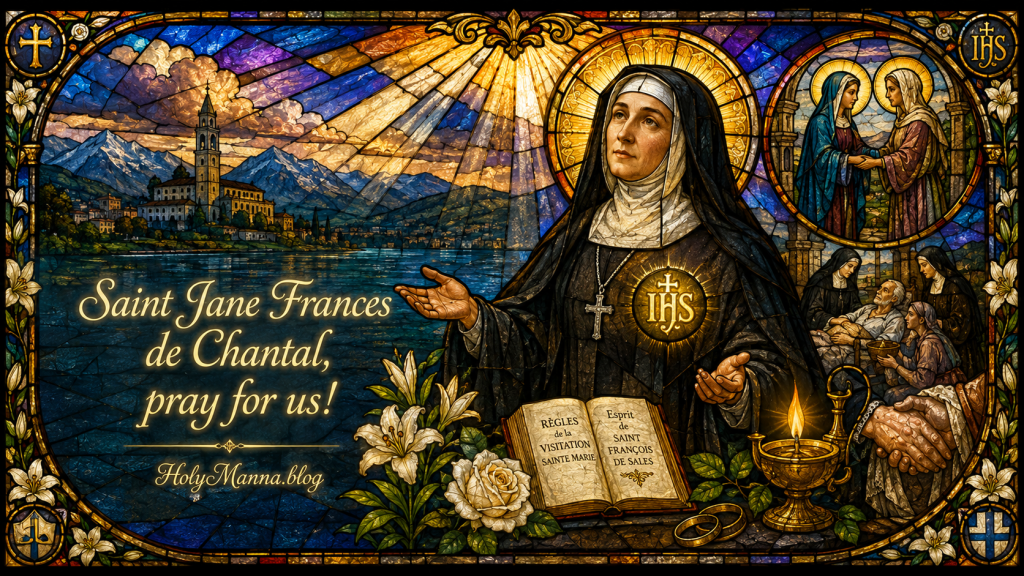
A Heart Widowed, a Heart Given
Some saints blaze across history like comets, converting nations and working wonders that fill entire chapters of the old chronicles. Saint Jane Frances de Chantal, celebrated on August 12th, is a different kind of light. She is the steady lamp in the window, the flame that refuses to go out no matter how hard the night wind blows. She was a daughter, a wife, a mother, a widow, and finally a religious foundress, and in every one of those states of life she pursued God with a fidelity that her contemporaries found astonishing. Together with Saint Francis de Sales she founded the Congregation of the Visitation of Holy Mary in 1610, an order that threw open its doors to the very women other communities turned away: widows, the frail, the sick, and the aging. By the time of her death in 1641, the Visitation had grown to more than eighty houses across Europe.
The Church honors her as the patron saint of forgotten people, widows, those suffering in-law problems, those grieving the loss of parents, and parents separated from their children. Every one of those patronages was earned in the crucible of her own life. Her story proves what the Church has always taught, that holiness is not reserved for a spiritual elite but is the vocation of every baptized soul. The Catechism states it plainly: “all Christians in any state or walk of life are called to the fullness of Christian life and to the perfection of charity” (CCC 2013). Jane Frances lived that truth in a castle, in a hostile in-law’s household, in a convent parlor, and in the silent interior darkness that shadowed her soul for decades. Her life asks each reader a quiet, insistent question. Can you keep loving God when every consolation is stripped away?
A Daughter of Dijon
Jeanne-Françoise Frémyot was born on January 28, 1572, in Dijon, the proud capital of Burgundy in eastern France. She entered the world in a nation tearing itself apart. The French Wars of Religion were raging, and the Frémyot household stood firmly on the side of the Catholic faith and the lawful crown. Her father, Bénigne Frémyot, served as president of the Parlement of Burgundy, one of the most respected legal positions in the realm, and he was known for his integrity during years when integrity could cost a man everything.
Sorrow found Jane early. Her mother died when Jane was still an infant, leaving Bénigne to raise his children alone. He proved a remarkable father, forming his daughter in doctrine, in prayer, and in a quick and confident intelligence. Near contemporary accounts describe a lively, bright girl with a firm Catholic backbone; one story from her childhood tells of the young Jane rebuking a Protestant nobleman in her father’s parlor over his denial of the Real Presence in the Eucharist. When her older sister married and left home, Jane became mistress of her father’s household while still in her teens, and the administrative skill she learned there would one day govern a religious order spanning a continent.
In 1592, at the age of twenty, she married Baron Christophe de Rabutin-Chantal, a soldier and courtier whose family estate at Bourbilly had fallen into disorder and debt. The young baroness rolled up her sleeves. She restored the finances, reestablished order among the household staff, and, most tellingly, brought back the daily celebration of Holy Mass in the castle chapel. She became famous throughout the region for her generosity to the poor, and tradition holds that she resolved never to refuse anyone who begged alms in the name of Christ, even those who returned again and again to test her. The marriage was profoundly happy. Of their six children, four survived infancy, one son and three daughters, and a witness at her canonization process testified that the couple were a model of holy marriage, saying “They had between them one heart and one soul.” Their home embodied what The Catechism calls the domestic church, the family as “a community of grace and prayer, a school of human virtues and of Christian charity” (CCC 1666).
Then, in 1601, the world broke. While hunting, a companion of the baron fired at what he thought was game and struck Christophe instead. The baron lingered nine days, forgiving the man from his deathbed, and then died. Jane was twenty-eight years old, a widow with four small children, and her grief was crushing. For months she could barely function. And beneath the grief lay a harder wound still, for she found that she could not forgive the man whose careless shot had destroyed her family. The struggle to release that resentment would become one of the great battles of her life, and one of the great victories.
Her trials multiplied. Her father-in-law, an aging and difficult man, threatened to disinherit her children unless she moved into his home at Monthelon. She obeyed for the sake of her children and spent roughly seven years there under the thumb of an insolent housekeeper who effectively ruled the household and treated the baroness like a servant. Jane answered contempt with patience and even educated the housekeeper’s children alongside her own. It is because of these years that the Church invokes her as patroness of those suffering in-law problems, and anyone who has endured a poisonous household knows exactly how heroic that patience was.
The turning point came in Lent of 1604. Her father invited her back to Dijon to hear the Lenten sermons of a visiting preacher, the Bishop of Geneva, a gentle Savoyard named Francis de Sales. Jane later recounted that she recognized in him the guide God had already shown her interiorly. She placed herself under his spiritual direction, and one of the most fruitful friendships in the history of the Church began.
Holiness in an Apron and a Ledger
What Francis de Sales gave Jane was not an escape from her life but a way of sanctifying it. He taught her that God was not waiting for her in some imagined cloister of the future; God was present in the nursery, in the account books, in the kitchen at Monthelon, and even at the table with her difficult father-in-law. Holiness, he insisted, is accomplished through the faithful, loving fulfillment of the duties of one’s state in life. This teaching, which the Church would echo centuries later in her universal call to holiness, transformed Jane. She began to live an intense interior life while fully embracing her responsibilities as mother, manager, and daughter-in-law.
Under his direction she also won the battle she had been losing for years. Grace worked slowly on her wounded heart until she was able to fully forgive the man who had killed her husband. She did not merely tolerate him. She welcomed him, and she eventually stood as godmother to his child, binding herself to his family in a bond of spiritual kinship. Let that sink in for a moment. The woman whose husband died from that man’s gun held that man’s baby at the font. The Catechism teaches with great realism about this kind of forgiveness: “It is not in our power not to feel or to forget an offense”, but the heart that surrenders the injury to the Holy Spirit finds that hurt can be purified into intercession (CCC 2843). Jane’s forgiveness was not a feeling. It was a decision renewed until love made it true.
One episode from her widowhood must be told carefully. The early accounts of her life, including the memoirs recorded by Mother Françoise-Madeleine de Chaugy, report that when a persistent suitor would not accept her refusal, Jane took a heated instrument and inscribed the holy name of Jesus over her heart, declaring that she belonged to God alone. The same accounts note that Francis de Sales was not pleased when he learned of it, for his spirituality prized gentleness over harshness, even toward oneself. This story comes from early sources close to the saint, though its details rest on those accounts and cannot be independently verified. It is best understood as a fierce gesture from an age of severe penances, a window into her totality of heart rather than a practice to imitate.
By 1610 her children were provided for. Her eldest daughter had married, another daughter had died, and her fourteen-year-old son was entrusted to the care of her father and her brother André, the Archbishop of Bourges. The parting from her son was wrenching, and later accounts tell of the boy dramatically protesting her departure; the famous story that he lay across the threshold so that his mother had to step over him is found in the traditional tellings of her life, though it cannot be verified as documented fact. On Trinity Sunday, June 6, 1610, in a modest house in Annecy called the Galerie, Jane and two companions, Marie-Jacqueline Favre and Charlotte de Bréchard, gave themselves to God as the first members of the Congregation of the Visitation of Holy Mary.
The Visitation was quietly revolutionary. Francis and Jane designed it for women whom the great penitential orders would never accept: widows, women of delicate health, the elderly, those without the physical strength for the fasts and vigils of the reformed Carmels. Its austerity would be interior, the mortification of the will, the crucifixion of self-love, humility, and gentleness. The founders originally envisioned an uncloistered community whose sisters would go out to visit the sick and the poor, which is why the order bears the name of Our Lady’s Visitation to Elizabeth. Church authorities of that era required formal enclosure, and the founders accepted the change with the obedience they preached, but the spirit of merciful welcome remained. In this the Visitation lived what The Catechism teaches about the works of mercy, that “giving alms to the poor is one of the chief witnesses to fraternal charity” (CCC 2447).
No catalog of dramatic wonders is attached to Jane’s lifetime, and honesty requires saying so plainly. Her contemporaries did not remember her for multiplying bread or raising the dead. They remembered her for something they considered just as supernatural: a charity that never ran dry and a soul that never let go of God. When plague devastated the region around Annecy in 1628, Mother de Chantal placed the resources of her monastery at the service of the sick and pressed the local authorities to do the same, refusing to let fear close the convent’s heart even as death moved through the streets. The order grew astonishingly under her governance, counting thirteen houses when Francis de Sales died in 1622 and roughly eighty-six by the time of her own death, a figure sources round slightly differently. She crossed France again and again by coach and on rough roads, founding, visiting, correcting, and encouraging her spiritual daughters.
Faithful in the Long Darkness
Jane Frances de Chantal was never called to shed her blood, and so the world might assume her path was gentle. It was not. Her hardships came in two forms, the deaths of nearly everyone she loved and an interior darkness that lasted, by the testimony of those who knew her best, most of her life.
Consider the losses. Her mother, in infancy. Her husband, at twenty-eight. Her daughter Charlotte as a child, and her beloved daughter Marie-Aymée in 1617. Francis de Sales, her spiritual father and dearest friend, died suddenly in December of 1622. Her only son, Celse-Bénigne, was killed in 1627 fighting English forces at the Île de Ré, leaving behind a baby daughter who would grow up to become the celebrated writer Madame de Sévigné. Her son-in-law and trusted collaborator died in 1632, in years when plague and war were carrying off friends and sisters across France. She outlived all but one of her children. Each grief she folded into the will of God, but she never pretended grief was painless, and neither should anyone who follows Christ.
The deeper trial was invisible. For decades, Jane suffered temptations against faith itself, obsessive doubts, interior dryness, and a darkness of soul that she could describe to almost no one. The world saw a serene, capable foundress. God alone saw the nightly combat. Saint Vincent de Paul, who became her spiritual director in Paris after the death of Francis de Sales, left a stunning testimony preserved in Butler’s Lives of the Saints. He wrote that “She was full of faith, yet all her life had been tormented by thoughts against it”, and he described interior trials so severe that she had to strive not to look within herself at all. Yet he insisted that through all of it her face never lost its serenity and her fidelity never once relaxed, which led him to conclude, “I regard her as one of the holiest souls I have ever met on this earth.”
This is where Jane becomes a doctor of the ordinary believer’s hardest hours. The Catechism acknowledges that faith is lived in shadow, teaching that “we walk by faith, not by sight”, and that believers can find their faith tested by evil, suffering, and apparent silence from heaven (CCC 164, quoting 2 Corinthians 5:7). It likewise names dryness as a real season of prayer, when the heart feels separated from God and clings to Him by naked will (CCC 2731). Jane did not treat her darkness as proof that God had abandoned her. She treated it as the place where love would be proven. She once told her sisters, in words recorded by her secretary and preserved by the Church in the Office of Readings for her feast, “Yield yourself fully to God, and you will find out what form your martyrdom will take.” For her, there was a martyrdom of love, a slow surrender that consumes the soul over a lifetime rather than in a single stroke of the sword, and she saw it echoed in the Scripture that says “love is as strong as death” (Song of Songs 8:6).
In her final years she was venerated across France, consulted by nobles and bishops, and even summoned to Paris at the wish of the queen, Anne of Austria. She found the attention mortifying and longed only for hiddenness. Returning from that journey in December 1641, she fell ill at the Visitation convent in Moulins. She died there on December 13, 1641, at the age of sixty-nine, repeating the holy name of Jesus.
Bronze Coffins Above a Blue Lake
The story does not end at Moulins. Saint Vincent de Paul later gave written testimony to something extraordinary that happened at the hour of her death, the only mystical vision he ever recounted of himself in his long life. He described seeing a small globe of fire rise from the earth and join a larger and more luminous globe, and the two together rise and merge into a still greater brightness, which he understood to be the soul of Mother de Chantal united with the soul of Francis de Sales in the glory of God. This account rests on his sworn testimony and the Church’s records of it; as a private mystical experience it cannot be verified in the manner of public fact, and it is presented here as the personal witness of a canonized saint.
Jane’s body was carried to Annecy and laid to rest near Francis de Sales, and the faithful sought her intercession from the beginning. Miracles were examined and approved through the formal processes of the Church, and she was beatified on November 21, 1751, by Pope Benedict XIV. Catholic accounts commonly report that hers was the first beatification ceremony celebrated in Saint Peter’s Basilica, a detail widely repeated in devotional sources though difficult to confirm against primary documents, and it is flagged here for that reason. Pope Clement XIII canonized her on July 16, 1767. The specific miracles accepted in those processes are recorded in the acts of the causes but are not widely detailed in accessible sources, so no miracle stories will be invented to fill the silence. In canonizing her, the Church exercised what The Catechism describes when it teaches that “By canonizing some of the faithful… the Church recognizes the power of the Spirit of holiness within her” (CCC 828).
Her relics endured their own via crucis. During the French Revolution the church in Annecy where the two founders rested was vandalized and turned to secular use. Today the bodies of Saint Jane Frances de Chantal and Saint Francis de Sales rest side by side in bronze sarcophagi in the Basilica of the Visitation, a striking pilgrimage church built between 1922 and 1930 on the heights of the Crêt du Maure, its bell tower rising above the old town and the impossibly blue waters of Lake Annecy. A living community of Visitation nuns still prays beside it, and the adjacent Salesian Museum preserves the memory of the two founders, who are honored as the patron saints of Annecy itself. Pilgrims come from around the world, and pilgrims who cannot travel may take comfort that her truest shrine is any heart that keeps loving God in the dark.
Her feast has wandered the calendar in a way worth knowing. It was long kept on August 21st, moved in 1969 to December 12th to stand near the anniversary of her death, and then transferred by Pope John Paul II to August 12th when the memorial of Our Lady of Guadalupe was inscribed on the universal calendar for December 12th. Her legacy, meanwhile, kept growing after her death in ways she never saw. Within the Visitation Order she founded, a humble nun of Paray-le-Monial named Saint Margaret Mary Alacoque received the revelations of the Sacred Heart of Jesus in the 1670s, so that the devotion which has set the whole Church ablaze with the love of Christ’s Heart first flowered in the soil Jane planted.
Lessons From the Lamp That Would Not Go Out
What does a seventeenth-century baroness have to say to a person scrolling through this post between meetings, school pickups, or hospital shifts? Almost everything.
First, she teaches that no state of life is a waiting room for holiness. Jane was not holy despite being a wife, a mother, and an estate manager; she became holy precisely in those duties, done with love. Whatever your vocation looks like today, it is the raw material of your sanctity. What ordinary duty in your life have you been treating as an obstacle to God rather than a path to Him?
Second, she teaches the long arithmetic of forgiveness. Jane could not forgive quickly, and the Church does not pretend anyone must feel forgiveness instantly. She moved by degrees, from avoiding the man, to greeting him, to welcoming him, to holding his child at the baptismal font. Forgiveness is a road walked, not a switch flipped, and grace supplies what the heart cannot (CCC 2843). Who is the person you have been unable to forgive, and what is one small, concrete step of mercy you could take toward them this week?
Third, she teaches fidelity in darkness. Feelings of doubt and dryness are not the same as unbelief; they can be the very furnace in which faith is purified into gold (CCC 164; CCC 2731). If your prayer feels empty, you are in the company of one of the holiest women the Church has ever raised to her altars. Keep showing up. Keep your appointment with God even when He seems not to keep His. When prayer feels like speaking into silence, will you stay at your post the way Jane did?
Finally, she teaches the Church to make room for the overlooked. Her order existed for the women nobody wanted, and her patronage of forgotten people is a standing commission to every believer. Look around your parish, your workplace, your street, and find the person everyone else has stopped seeing.
Engage With Us!
Saint Jane Frances de Chantal has walked through grief, injustice, spiritual darkness, and loss, and she has come out the other side crowned. Now it is your turn to sit with her story. Share your thoughts, your questions, and your own experiences in the comments below; this community grows stronger every time one reader tells the truth about their walk with God. To spark your reflection, consider these questions:
- Jane found holiness in managing a household and raising children before she ever entered religious life. Where is God asking you to seek Him inside your current responsibilities rather than apart from them?
- She spent years unable to forgive the man who killed her husband before grace finally prevailed. What resentment are you still carrying, and have you honestly asked God for the grace to release it?
- Saint Vincent de Paul revealed that her serene exterior hid decades of temptations against faith. Does knowing that a canonized saint struggled with doubt change how you view your own seasons of dryness?
- The Visitation was founded for women other orders rejected. Who are the forgotten people within your reach, and what would it cost you to welcome them?
- Jane endured the loss of nearly everyone she loved without letting go of God. What loss in your life still needs to be placed, deliberately and by name, into His hands?
Whatever answers rise up in your heart, do not let them stay theoretical. Take one of them into prayer tonight, and take another into action tomorrow. Live your faith out loud, forgive as you have been forgiven, stay faithful when the lights go out, and do everything, absolutely everything, with the love and mercy that Jesus taught us.
Saint Jane Frances de Chantal, pray for us!
Follow us on YouTube, TikTok, Instagram and Facebook for more insights and reflections on living a faith-filled life.


Leave a comment