Wednesday of the Nineteenth Week in Ordinary Time – Lectionary: 415
When Glory Seems to Leave the Room
Every believer eventually faces a season when God seems to have walked out of the building. The readings for this Wednesday of the Nineteenth Week in Ordinary Time meet that fear head-on and answer it with one of the most consoling truths in all of Scripture: God marks those who belong to Him, and He never leaves them without His presence. In the First Reading, the prophet Ezekiel watches the glory of the Lord depart from a temple defiled by idolatry, yet before a single blow of judgment falls, a man dressed in linen marks the foreheads of all who grieve over sin, and every marked soul is spared. In the Responsorial Psalm, Israel sings that the glory of the Lord is “higher than the skies,” beyond the reach of any catastrophe, praised from the rising of the sun to its setting. In the Holy Gospel, Jesus hands His Church the authority to bind and loose and then makes the promise that gathers the whole day into one sentence: where two or three come together in His name, He is there in their midst. Ezekiel prophesied among the exiles in Babylon around 593 BC, when the unthinkable loss of temple and homeland was unfolding, while Jesus spoke His words to a community He was founding to outlast every empire. Between those two moments stretches the story of a God whose glory can never be evicted, only ignored, and who chooses to dwell wherever His people gather, grieve, praise, and forgive in His name.
First Reading — Ezekiel 9:1-7; 10:18-22
The Mark That Spares and the Glory That Departs
Ezekiel was a priest who never served in the temple, because Babylon deported him in 597 BC alongside King Jehoiachin, roughly a decade before Jerusalem fell. By the river Chebar he received the visions of chapters 8 through 11 of The Book of Ezekiel, in which the Spirit carried him to the Jerusalem temple and showed him idolatry entrenched inside the house of the Lord. Today’s passage is the sentencing that follows that tour, and it carries the day’s central theme, because before judgment falls, God pauses everything to mark and protect those who still grieve over sin. The vision was fulfilled in 586 BC when Nebuchadnezzar destroyed the city, yet the deepest message here is not destruction but belonging.
Ezekiel 9:1-7; 10:18-22
The LORD cried loud for me to hear:
Come, you scourges of the city!
With that I saw six men coming from the direction
of the upper gate which faces the north,
each with a destroying weapon in his hand.
In their midst was a man dressed in linen,
with a writer’s case at his waist.
They entered and stood beside the bronze altar.
Then he called to the man dressed in linen
with the writer’s case at his waist, saying to him:
Pass through the city, through Jerusalem,
and mark a “Thau” on the foreheads of those who moan and groan
over all the abominations that are practiced within it.
To the others I heard the LORD say:
Pass through the city after him and strike!
Do not look on them with pity nor show any mercy!
Old men, youths and maidens, women and children–wipe them out!
But do not touch any marked with the “Thau”; begin at my sanctuary.
So they began with the men, the elders, who were in front of the temple.
Defile the temple, he said to them, and fill the courts with the slain;
then go out and strike in the city.Then the glory of the LORD left the threshold of the temple
and rested upon the cherubim.
These lifted their wings, and I saw them rise from the earth,
the wheels rising along with them.
They stood at the entrance of the eastern gate of the Lord’s house,
and the glory of the God of Israel was up above them.
Then the cherubim lifted their wings, and the wheels went along with them,
while up above them was the glory of the God of Israel.
Detailed Exegesis
Verse 1: “The LORD cried loud for me to hear: Come, you scourges of the city!”
The scourges are angelic agents of judgment, summoned by God Himself. Ezekiel’s vision insists that the coming Babylonian catastrophe is not random geopolitics but divine justice, still under God’s command even as everything collapses.
Verse 2: “With that I saw six men coming from the direction of the upper gate which faces the north, each with a destroying weapon in his hand. In their midst was a man dressed in linen, with a writer’s case at his waist. They entered and stood beside the bronze altar.”
The executioners come from the north, the direction from which Babylon’s armies would invade. In their midst stands a seventh figure clothed in linen, the priestly fabric of Leviticus 16:4, carrying not a weapon but a scribe’s kit. Mercy enters the scene dressed like a priest, and the company halts at the bronze altar as if judgment itself were a solemn liturgy.
Verse 3: “Then he called to the man dressed in linen with the writer’s case at his waist,”
Before any command to strike is given, God commissions the man of mercy, because in His heart the marking of the faithful precedes the judgment of the city.
Verse 4: “saying to him: Pass through the city, through Jerusalem, and mark a ‘Thau’ on the foreheads of those who moan and groan over all the abominations that are practiced within it.”
The Thau, or tav, is the last letter of the Hebrew alphabet, written in the ancient script of Ezekiel’s day as a simple cross-shaped mark. Notice who receives it. The marked are not the sinless but those whose consciences have not gone numb, the ones who still grieve over the abominations around them. Grief over sin, not flawless performance, is the criterion of belonging.
Verse 5: “To the others I heard the LORD say: Pass through the city after him and strike! Do not look on them with pity nor show any mercy!”
The severity of this command is meant to shake the reader. Prophetic vision speaks in the language of totality to convey the completeness of the coming catastrophe and how seriously God takes idolatry among His own people. Holiness and unrepented abomination cannot share one house forever.
Verse 6: “Old men, youths and maidens, women and children–wipe them out! But do not touch any marked with the ‘Thau’; begin at my sanctuary. So they began with the men, the elders, who were in front of the temple.”
Not one marked person may be touched, because God’s protection of His own is absolute, and judgment begins at the sanctuary with the elders who should have guarded the people’s faith. Privilege in God’s house brings accountability before honor.
Verse 7: “Defile the temple, he said to them, and fill the courts with the slain; then go out and strike in the city.”
The temple had already been defiled from within by idolatry, so the judgment only makes visible what sin had already accomplished, revealing that the building was never the point and fidelity always was.
Verses 18 and 19 of chapter 10: “Then the glory of the LORD left the threshold of the temple and rested upon the cherubim. These lifted their wings, and I saw them rise from the earth, the wheels rising along with them. They stood at the entrance of the eastern gate of the Lord’s house, and the glory of the God of Israel was up above them.”
The glory, the kavod, the radiant weight of God’s presence, departs in stages, pausing at the eastern gate as if reluctant to go. In Ezekiel 43 the prophet sees that glory return through the same eastern gate, a promise the Church connects to Christ entering Jerusalem from the east.
Verses 20 to 22 of chapter 10, as the Lectionary presents them: “Then the cherubim lifted their wings, and the wheels went along with them, while up above them was the glory of the God of Israel.”
The cherubim and the mysterious wheels reveal something the exiles desperately needed to hear: God’s throne has wheels. If the glory can leave the temple, it can also travel to Babylon and dwell among the deported, which is exactly where Ezekiel received these visions.
Teachings
The Church Fathers saw in the Thau a stunning prophecy of the cross. Tertullian, writing in the early third century in Against Marcion, Book III, Chapter 22, declared: “Now the Greek letter Tau and our own letter T is the very form of the cross, which He predicted would be the sign on our foreheads in the true Catholic Jerusalem.” Origen, in his Homilies on Ezekiel, reported that believers of his day saw in the cross-shaped ancient letter a prophecy of the sign traced on Christian foreheads. That interpretation echoed through history, for Pope Innocent III opened the Fourth Lateran Council in 1215 preaching on this passage, and Saint Francis of Assisi afterward adopted the Tau as his signature; his handwritten blessing for Brother Leo, signed with a Tau, survives in Assisi today. CCC 1296 gathers the whole thread into the teaching on Confirmation, saying of the anointing on the forehead: “This seal of the Holy Spirit marks our total belonging to Christ, our enrollment in his service for ever, as well as the promise of divine protection in the great eschatological trial.” Saint Peter took up the vision’s sobering side in 1 Peter 4:17: “For it is time for the judgment to begin with the household of God.”
Reflection
The people spared in Ezekiel’s vision were not the impressive ones but the ones who still grieved. A living conscience that moans over sin in the world and in the mirror is what God looks for when He marks His own. Consider a nightly examination of conscience, asking where the day drifted from God and where it drew near to Him. Make the sign of the cross slowly, remembering that this gesture is the ancient Thau claimed by Christ, and bring that grief to Confession, where the mark of mercy is renewed. Has anything in your life stopped bothering you that once broke your heart before God? When you trace the cross on your forehead, is it a mark of belonging or a reflex? Where might God be asking purification to begin in His sanctuary, starting with you?
Responsorial Psalm — Psalm 113:1-6
Praise That Rises with the Sun
Psalm 113 opens the collection known as the Hallel, Psalms 113 through 118, the great hymns of praise that Jewish families sang at Passover. When The Gospel of Matthew records that Jesus and the apostles sang a hymn after the Last Supper in Matthew 26:30, that hymn almost certainly came from this collection, which means these words were likely on the lips of Christ on the night before He died. Placed immediately after Ezekiel’s vision, the psalm functions as a quiet rebuttal to despair, insisting on the day’s central theme from the other direction: the glory that departed a defiled building was never diminished by leaving, because it remains enthroned above the heavens, untouchable by human failure.
Psalm 113:1-6
R. (4b) The glory of the Lord is higher than the skies.
or:
R. Alleluia.
Praise, you servants of the LORD,
praise the name of the LORD.
Blessed be the name of the LORD
both now and forever.
R. The glory of the Lord is higher than the skies.
or:
R. Alleluia.
From the rising to the setting of the sun
is the name of the LORD to be praised.
High above all nations is the LORD;
above the heavens is his glory.
R. The glory of the Lord is higher than the skies.
or:
R. Alleluia.
Who is like the LORD, our God, who is enthroned on high,
and looks upon the heavens and the earth below?
R. The glory of the Lord is higher than the skies.
or:
R. Alleluia.
Detailed Exegesis
Verses 1 and 2: “Praise, you servants of the LORD, praise the name of the LORD. Blessed be the name of the LORD both now and forever.”
The psalm summons the “servants of the LORD” to praise, and in the biblical imagination servanthood is a title of honor, the dignity of belonging to the true King rather than to Pharaoh or to Babylon. Blessing the Name “now and forever” is an act of defiance against every temporary catastrophe, declaring that no present darkness gets the final word.
Verses 3 and 4: “From the rising to the setting of the sun is the name of the LORD to be praised. High above all nations is the LORD; above the heavens is his glory.”
From east to west, across all space and all the hours of the day, praise never stops. For exiles surrounded by Babylonian power and propaganda, the claim that the Lord is “high above all nations” was a lifeline, because empires rise and fall while His glory sits above the heavens themselves, exactly where Ezekiel saw it go.
Verses 5 and 6: “Who is like the LORD, our God, who is enthroned on high, and looks upon the heavens and the earth below?”
The rhetorical question echoes the song of Moses at the sea in Exodus 15:11. The wonder of Israel’s God is a double wonder, transcendence joined to tenderness, a King enthroned so high that even the heavens are “below,” who nevertheless stoops to look upon the earth. The Church reads that stooping and finds its fulfillment in the Incarnation, when the One above the heavens bent all the way down into a manger.
Teachings
The Catechism teaches in CCC 2639: “Praise is the form of prayer which recognizes most immediately that God is God. It lauds God for his own sake and gives him glory, quite beyond what he does, but simply because HE IS.” That is precisely the movement of Psalm 113, which asks God for nothing and simply exults in who He is. The rest of the psalm, beyond today’s verses, sings of the God who raises the poor from the dust and seats them with princes, language that the Blessed Virgin Mary takes up in her Magnificat in Luke 1, where the lowly are lifted and the mighty cast down. The Hallel tradition adds a final layer of depth, because if Jesus sang these psalms after the Last Supper, then praise of the Father’s unshakable glory was His chosen prayer on the way to Gethsemane, teaching the faithful that praise is not the prayer of easy seasons only but the anchor of the hardest night.
Reflection
Praise tends to be the most neglected form of prayer, crowded out by requests and worries. Try beginning prayer with several minutes of pure praise before asking for anything, simply telling God who He is. Pray Psalm 113 at sunrise or sunset this week, letting the sun’s own schedule become a reminder that His name is praised from its rising to its setting. When was the last time you praised God simply because He is God, with no request attached? What would change in your hardest circumstances if praise became your first response instead of your last resort?
Holy Gospel — Matthew 18:15-20
How Love Confronts and Why Christ Stays
These verses sit at the heart of chapter 18 of The Gospel of Matthew, the fourth of the five great discourses of the Gospel, often called the ecclesial discourse because Jesus is giving His Church its family rules. The chapter opens with a child placed in the midst of the disciples, moves through the parable of the lost sheep, and ends with Peter being told to forgive seventy-seven times, so today’s teaching on correction is wrapped on every side in mercy. Jesus speaks here with startling practicality about what to do when a brother sins, and then He crowns the instruction with the promise that completes the day’s central theme, because the presence that departed Ezekiel’s temple now pledges to dwell wherever two or three gather in His name.
Matthew 18:15-20
Jesus said to his disciples:
“If your brother sins against you,
go and tell him his fault between you and him alone.
If he listens to you, you have won over your brother.
If he does not listen,
take one or two others along with you,
so that every fact may be established
on the testimony of two or three witnesses.
If he refuses to listen to them, tell the Church.
If he refuses to listen even to the Church,
then treat him as you would a Gentile or a tax collector.
Amen, I say to you,
whatever you bind on earth shall be bound in heaven,
and whatever you loose on earth shall be loosed in heaven.
Again, amen, I say to you, if two of you agree on earth
about anything for which they are to pray,
it shall be granted to them by my heavenly Father.
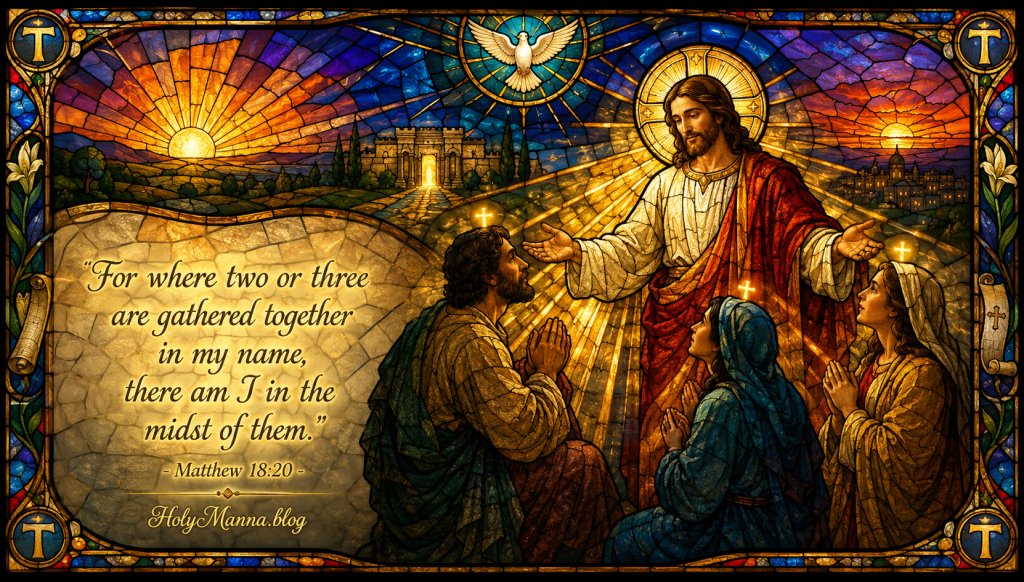
For where two or three are gathered together in my name,
there am I in the midst of them.”
Detailed Exegesis
Verse 15: “If your brother sins against you, go and tell him his fault between you and him alone. If he listens to you, you have won over your brother.”
The first step is private, personal, and direct. Jesus rules out the more comfortable alternatives of gossip, resentment, and public shaming, protecting the sinner’s reputation while pursuing his heart. The stated goal is not winning the argument but winning the brother, which reframes every difficult conversation as a rescue mission rather than a courtroom.
Verse 16: “If he does not listen, take one or two others along with you, so that every fact may be established on the testimony of two or three witnesses.”
Jesus cites the ancient legal standard of Deuteronomy 19:15, which protected the accused from a single hostile accuser. Truth must be established carefully, and the circle widens only as far as the brother’s resistance requires. Escalation in the Kingdom is always reluctant and always measured.
Verse 17: “If he refuses to listen to them, tell the Church. If he refuses to listen even to the Church, then treat him as you would a Gentile or a tax collector.”
The word translated Church, ekklesia, appears on the lips of Jesus only here and in Matthew 16:18, revealing that He envisioned a visible community with real authority to settle disputes. The final instruction sounds harsh until the reader remembers how Jesus Himself treated Gentiles and tax collectors, calling Matthew from his customs post in Matthew 9:9 and dining in his house. Even formal exclusion, the root of the Church’s later practice of excommunication, is medicinal, aimed at waking the sinner and welcoming him home.
Verse 18: “Amen, I say to you, whatever you bind on earth shall be bound in heaven, and whatever you loose on earth shall be loosed in heaven.”
The authority given to Peter alone in Matthew 16:19 is here extended to the apostolic community. Heaven pledges to ratify the Church’s judgments on earth, an astonishing delegation of divine authority to human beings that grounds the Church’s power to forgive sins, define doctrine, and govern her common life.
Verse 19: “Again, amen, I say to you, if two of you agree on earth about anything for which they are to pray, it shall be granted to them by my heavenly Father.”
The Greek verb for agree is symphoneo, the root of the word symphony, painting united prayer as voices tuned to one another and to God. The Father delights to answer a Church that prays in harmony, which quietly implies that division itself weakens prayer.
Verse 20: “For where two or three are gathered together in my name, there am I in the midst of them.”
A Jewish tradition preserved in the Mishnah, in Pirkei Avot 3:2, held that where two sit together over the words of Torah, the divine presence rests between them. Jesus takes that place Himself, promising His own presence where His people gather in His name, and the echo reaches from Emmanuel, “God is with us,” in Matthew 1:23 to His final promise to remain with the Church until the end of the age in Matthew 28:20. The glory that Ezekiel watched leave the temple has found its permanent home.
Teachings
The Catechism reads this passage as a foundation of the Church’s God-given authority. CCC 553 teaches: “The power to ‘bind and loose’ connotes the authority to absolve sins, to pronounce doctrinal judgments, and to make disciplinary decisions in the Church.” On the sacrament of Penance, CCC 1445 explains: “The words bind and loose mean: whomever you exclude from your communion, will be excluded from communion with God; whomever you receive anew into your communion, God will welcome back into his. Reconciliation with the Church is inseparable from reconciliation with God.” On Christ’s presence in the praying assembly, CCC 1088, quoting Sacrosanctum Concilium 7, teaches: “He is present, lastly, when the Church prays and sings, for he promised: ‘where two or three are gathered together in my name there am I in the midst of them.’” Saint Thomas Aquinas, treating this Gospel’s opening command in the Summa Theologiae, Part II-II, question 33, classifies fraternal correction as a genuine act of charity, a spiritual almsgiving owed to a brother whose soul is in danger, which is why the Church numbers admonishing the sinner among the spiritual works of mercy.
Reflection
This Gospel is one of the most practical passages Jesus ever spoke, and one of the least practiced. Before correcting anyone, pray for that person by name, asking God to prepare both hearts. Then go directly and privately, never through the group chat, the family grapevine, or the comment section. Be equally ready to receive correction with humility when someone loves enough to offer it. Finally, invest deliberately in gathered prayer, whether a family rosary, a parish holy hour, or simply arriving at Mass hungry for the promise of verse 20, because Christ keeps His word about being present. Is there a conversation you have been avoiding that love now asks you to have gently and in private? How do you respond when someone corrects you, and what does that response reveal? Where in your week could you gather with even one other person in the name of Jesus and claim His promised presence?
The Glory That Never Really Left
Taken together, the readings of this Wednesday tell a single sweeping story. In Ezekiel’s vision, sin drove the glory of the Lord from the temple, yet even at the edge of judgment God marked the foreheads of all who still grieved over evil, and not one of them was touched. The psalmist then lifted every eye upward to insist that the glory was never destroyed, only enthroned, “higher than the skies,” praised from the rising of the sun to its setting, far above every empire that ever frightened the people of God. And then Jesus finished the story in a way no exile by the river Chebar could have dreamed, promising that the presence which once departed the temple now dwells wherever two or three gather in His name, guarded by a Church with heaven’s own authority to bind, to loose, and to forgive. The mark on the forehead became the cross traced at Baptism and sealed at Confirmation, the sign of total belonging to Christ. The lesson for this ordinary Wednesday in August is anything but ordinary: God has never abandoned His people, and He is not about to start. The invitation is to live as one of the marked, grieving sin honestly, praising God defiantly, correcting and forgiving one another tenderly, and gathering eagerly where His presence is promised. Go to Mass this week with new eyes, return to Confession where binding and loosing becomes personal mercy, and trace the sign of the cross like someone who knows exactly what it means. The glory of the Lord is looking for hearts that still moan over sin and still sing His praise, and He delights to dwell in their midst.
Engage With Us!
Reflections, questions, and stories from fellow readers are a gift to this whole community, so please share yours in the comments below, where every voice helps someone else walk closer to Christ. Here are a few questions to spark that conversation:
- In Ezekiel 9:1-7 and Ezekiel 10:18-22, God marks those who moan and groan over the abominations around them. What sins in the world or in your own life has God been inviting you to grieve honestly rather than ignore?
- In Psalm 113:1-6, the name of the Lord is praised from the rising of the sun to its setting. What would it look like to frame your day, morning and evening, with deliberate praise this week?
- In Matthew 18:15-20, Jesus teaches that correction begins with a private, loving conversation. Is there a relationship in your life right now where truth and gentleness need to meet, and what is one step you could take toward that conversation?
- Considering the uniting message of all the readings, where do you most need to trust that God’s presence has not left, and how will you gather with others in His name to encounter Him there?
Living a life of faith is not about being flawless but about being marked, claimed by the cross of Christ and kept close to His heart. Keep grieving what wounds Him, keep praising Him from sunrise to sunset, and keep doing everything, especially the hard conversations, with the love and mercy Jesus taught His followers. He is in the midst of those who gather in His name, and that includes this little corner of the internet, where every comment shared in charity becomes its own small gathering of two or three.
Sacred Heart of Jesus, we trust in You!
Immaculate Heart of Mary, pray for us!
Saint Michael the Archangel, defend us in battle!
Follow us on YouTube, TikTok, Instagram and Facebook for more insights and reflections on living a faith-filled life.


Leave a comment