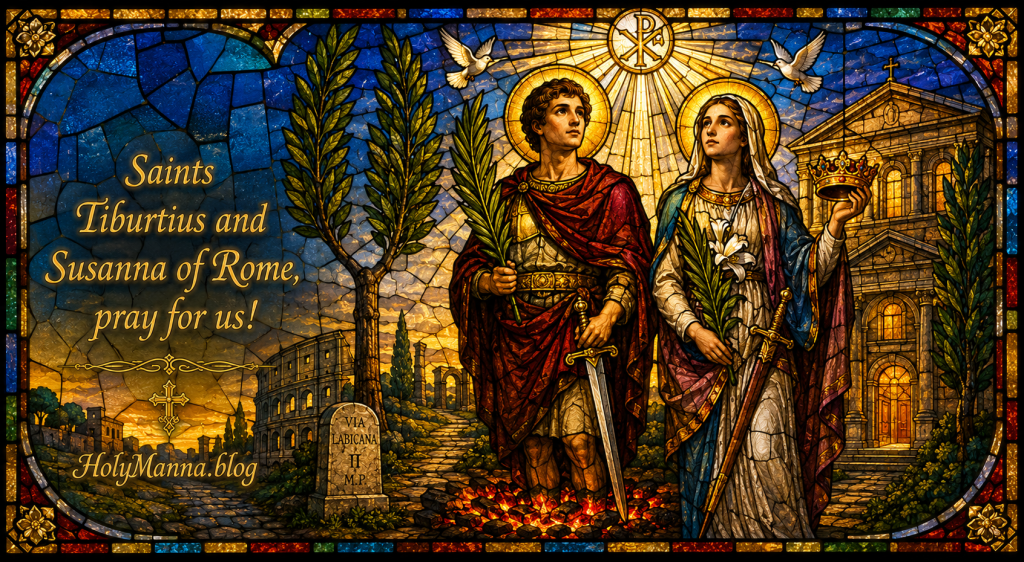
The Hidden Fire and the Quiet House
Some saints come down through history in pairs because they were family, or friends, or companions in the same prison cell. Saints Tiburtius and Susanna of Rome arrive as a pair for a humbler reason. They died in the same city, in the same era of persecution, and the Church has remembered them on the same day, August 11, since the earliest centuries of Christian Rome. They were not related to each other. They almost certainly never met. Yet the ancient martyrologies bound their names together, and for well over a thousand years Catholics who opened the Roman Martyrology on August 11 found these two Roman martyrs standing side by side, a young man and a young woman, each of whom looked the most powerful empire on earth in the eye and refused to deny Jesus Christ.
That refusal is the heart of everything that follows. The Church has always taught that this kind of witness is the highest form of fidelity a Christian can offer. The Catechism states it plainly: “Martyrdom is the supreme witness given to the truth of the faith: it means bearing witness even unto death.” (CCC 2473). Tiburtius and Susanna gave exactly that witness, he at a lonely milestone outside the city walls, she inside the walls of her own family home. Their stories reached later generations wrapped in dramatic accounts whose details cannot all be verified, and this post will be honest about that at every step. But beneath the storytelling stands something rock solid, attested by the oldest martyrologies, by the tombs, and by the churches built over their memory. Two real Christians really died for Christ in Rome, and the Church has never stopped saying their names.
Neither saint holds a formally documented patronage, so this post makes no patronage claims. What they hold instead is something every reader can receive directly, a lesson in quiet, immovable faithfulness when the pressure to compromise comes from the highest places imaginable.
A Prefect’s Son and a Priest’s Daughter
The traditions surrounding these two martyrs give each of them a striking family background, and both backgrounds must be presented for what they are, cherished stories handed down by the early Church rather than verified history.
The story of Tiburtius comes from the ancient Acts of Saint Sebastian, a hagiographical account composed generations after the events it describes. According to that account, Tiburtius was the only son of Chromatius, the prefect of Rome, a man whose job included condemning Christians to death. The story tells how God worked a stunning reversal inside that household. Chromatius the persecutor was converted through the ministry of Saint Tranquillinus and was baptized by a priest named Polycarp. His son Tiburtius was then won for Christ through the persuasion of Saint Sebastian himself, the great soldier martyr, who stood as the young man’s godfather at baptism. In one generation, in one house, the family of Rome’s chief magistrate passed from hunting the Church to belonging to it. It is a beautiful account, and it must be said plainly that it cannot be verified; historians note that neither Chromatius nor the judge Fabianus who later appears in the story can be found in the documented lists of Roman prefects, so the family framing belongs to the tradition rather than to established fact.
The story of Susanna comes from her own passio, an account composed in Rome in the second half of the fifth century, roughly one hundred and fifty to two hundred years after her death. According to that account, Susanna was the daughter of a Roman priest named Gabinius and the niece of Pope Saint Caius, who governed the Church from 283 to 296. She was raised in a deeply Christian home, formed in Scripture and prayer from childhood, and while still young she dedicated her virginity to God. The tradition even makes her family distant relatives of the Emperor Diocletian himself, which sets the stage for the drama that follows. Here again honesty is owed to the reader. Modern scholarship, including the careful work of the Bollandists who have studied these Acts for centuries, judges that the family relationships in the passio are literary inventions and that the narrative as a whole cannot be verified, while affirming that a real martyr named Susanna stands behind it. The oldest evidence for her is not the story at all. It is the ancient Martyrology of Saint Jerome, which records her on August 11 at the place called the two houses, beside the Baths of Diocletian, and the venerable Roman church that has carried her name since at least the fifth century.
So the reader meets two young Romans, one presented by tradition as a convert from the household of power, the other as a daughter of the Church’s own inner circle. History can confirm neither family tree. History can absolutely confirm what both of them did with their lives, because the Church of Rome watched them do it and never forgot.
Walking Through Fire and Winning Hearts at Home
The traditions attached to each saint describe how their faith showed itself before the final test came, and both accounts, though unverifiable, reveal what the early Church treasured in them.
The Acts of Saint Sebastian tell that Tiburtius, once baptized, did not treat his new faith as a private comfort. When Diocletian’s persecution made open Christianity a capital crime, he lay hidden in his father’s house, yet the tradition presents him as anything but timid. The most famous story about him describes the moment his hiding ended. Betrayed by an informer and hauled before the judge Fabianus, Tiburtius was ordered to prove his loyalty to Rome by offering incense to the gods. He refused and confessed Christ. The judge then put him to a trial by fire, commanding him to walk across a bed of red-hot coals. According to the story, Tiburtius armed himself with nothing but the sign of the cross, stepped barefoot onto the burning coals, and walked across them without suffering any injury at all. The courtroom should have fallen to its knees. Instead, the judge ascribed the miracle to magic, which tells the reader everything about a heart that has already decided not to believe. This account of the fiery ordeal is a story handed down in the Acts and it cannot be verified. What it preserves is the early Church’s conviction about who Tiburtius was, a man so certain of Christ that fire itself seemed a small thing.
Susanna’s tradition gives her a different battlefield, not a courtroom but a parlor, and her miracles were not wonders of nature but conversions of the heart. According to her passio, word of her virtue and beauty reached Diocletian, who decided she would make a fitting bride for his co-emperor Maximian. Marriage into the imperial family was the summit of everything Roman society could offer a young woman, wealth, rank, security, and the favor of the most powerful men alive. Diocletian sent his kinsman Claudius to the house of Gabinius to arrange the match. The story tells that Claudius came to negotiate a wedding and instead met Christ. Through the witness of Susanna and her father, Claudius was converted and baptized, together with his wife Prepedigna and their sons. The emperor, hearing nothing back, sent a second envoy, his own brother Maximus, and the same thing happened again. The household that was supposed to deliver Susanna to the palace was being delivered, family by family, to the Church. These conversions, and the martyrdoms of these converts that the tradition goes on to describe, come from the passio and cannot be verified. Yet the picture they paint rings true to everything the Church knows about how faith spreads, not by argument alone but by the sheer attractiveness of a soul that belongs completely to God. The Catechism teaches that “The disciple of Christ must not only keep the faith and live on it, but also profess it, confidently bear witness to it, and spread it.” (CCC 1816). The traditions of both saints show exactly that, faith kept, professed, and spreading, right up to the edge of the sword.
Why should the reader remember and emulate these two? Because between them they cover the two arenas where every Christian’s faith is actually tested. Tiburtius stands for the public test, the moment when confessing Christ costs something in front of hostile eyes. Susanna stands for the private test, the moment when the pressure comes wrapped in an attractive offer, delivered kindly, inside one’s own home, by people one cannot simply walk away from. Most believers will face far more of the second kind than the first. Susanna shows that it can be met with grace, and that meeting it faithfully can change the very people applying the pressure.
The Sword at the Third Milestone and the Sword in the Family Home
The martyrdoms themselves rest on far firmer ground than the stories that lead up to them. The Catholic Encyclopedia, summarizing the scholarly consensus, acknowledges that the Acts of Sebastian and of Susanna have rightly been questioned, and then adds the crucial affirmation that the martyrdoms and the death date of August 11 are established by the witness of the oldest martyrologies and the earliest places of worship. The deaths are history. The Church built altars over them while memory was still fresh.
For Tiburtius, the tradition recounts that after the miracle of the coals was dismissed as sorcery, the judge condemned him to death. He was led out of the city along the Via Labicana to the third milestone, to a spot the Romans called ad duas lauros, at the two laurel trees, and there he was beheaded, in or around the year 286. The traditional Roman Martyrology preserved the scene for centuries in a single compact entry: “At Rome, between the two laurels situate about three miles from the City, the birthday of St Tiburtius, Martyr, under the Judge Fabian, in the persecution of Diocletian. After he had walked barefoot on burning coals and confessed Christ with increased constancy, he was put to the sword.” (Roman Martyrology, August 11). A word about dates is owed here, because the sources genuinely disagree. The year 286 sits oddly beside the phrase about Diocletian’s persecution, since the empire-wide Great Persecution formally began in 303, and honest scholarship simply flags the tension rather than resolving it with false confidence. What no source disputes is the place, the manner of death, and the day, and the Martyrology’s word “birthday” carries the whole theology of martyrdom in miniature. The Church has always called the day a martyr dies his birthday, his dies natalis, because it is the day he is born into eternal life.
For Susanna, the tradition recounts an ending that is quieter and, in its way, more chilling. When it became clear that she would not marry Maximian, that her vow of virginity to Christ outweighed the will of the emperor, the machinery of the state came not to a public arena but to a private address. Around the year 295, at the command of Diocletian, Susanna was beheaded in her father’s own house. There was no crowd, no tribunal, no spectacle. The empire wanted her witness erased quietly. Instead, the quiet made it unforgettable. A further tradition adds that Serena, the wife of Diocletian, was secretly a Christian, and that she reverently took charge of the martyr’s body and honored her burial. That touching detail comes from the later accounts and cannot be verified.
Susanna’s refusal was not a rejection of marriage as such, which the Church holds sacred, but the keeping of a prior and total gift of herself to Christ. The Catechism describes the vocation she embodied: “From apostolic times Christian virgins and widows, called by the Lord to cling only to him with greater freedom of heart, body, and spirit, have decided with the approval of the Church to live in the respective states of virginity or perpetual chastity ‘for the sake of the Kingdom of heaven.’” (CCC 922). Susanna belongs to the very first generations of that apostolic line, a sister across the centuries to every consecrated woman since. Her death, like that of Tiburtius, fulfills the Lord’s own promise recorded in The Gospel of Matthew: “Everyone who acknowledges me before others I will acknowledge before my heavenly Father.” (Mt 10:32).
Laurels, Catacombs, and a Church That Kept Her Name
What happened after their deaths is where verifiable history grows richest, because the veneration of these two martyrs left marks on the city of Rome that can still be visited today.
Tiburtius was buried where he died, at Ad Duas Lauros on the Via Labicana, and his tomb became part of one of the most important funerary complexes of Christian Rome. That ground holds the famous catacombs of Saints Marcellinus and Peter, and nearby the Emperor Constantine raised the great mausoleum of his mother, Saint Helena. Within a century of the martyr’s death, Pope Saint Damasus I, the great fourth century champion of the Roman martyrs, sought out the tomb of Tiburtius and adorned it with one of his celebrated verse inscriptions. Part of that epigram survives in translation, and in it the successor of Peter humbly asks a young layman’s prayers: “Here for you will ever remain saintly honour and praises. Kind Tiburtius, beloved of God, I beg you take care of Damasus.” (Epigram of Pope Saint Damasus I). A pope begging the intercession of a martyr is the communion of saints in action, exactly as The Catechism describes it, teaching that the Church cherishes the memory of those in heaven so that, in the words it quotes from the Council, “the union of the whole Church in the Spirit may be strengthened.” (CCC 957). The current Roman Martyrology still points pilgrims to the spot: “At Rome, in the cemetery at the two laurel trees at the third milestone on the Via Labicana, Saint Tiburtius, martyr, whose praises Pope Saint Damasus sang.” (Roman Martyrology, August 11).
Susanna’s memorial became one of the most storied churches in Rome. The tradition holds that her father’s house, together with the adjoining house of Caius, the “two houses” near the Baths of Diocletian, was transformed into a place of Christian worship. Documented history confirms the essentials in a remarkable way. An ancient Roman titulus, one of the city’s original parish churches, stood exactly there, known first as the titulus of Gaius, and by the year 595 it was already recorded under Susanna’s name. The Martyrology of Saint Jerome, one of the oldest martyrologies of the Western Church, lists her on August 11 at the two houses beside the Baths of Diocletian, precisely where the Basilica of Santa Susanna alle Terme di Diocleziano stands to this day. Her relics rest beneath its altar. The church the visitor sees now is a baroque jewel whose facade, completed by Carlo Maderno in 1603, is counted among the masterpieces that shaped the architecture of the age; the same architect went on to design the facade of Saint Peter’s Basilica itself. For generations of American Catholics the church held a special place in the heart, serving through most of the twentieth century as the national church of the United States in Rome, and it remains in the loving care of a community of cloistered Cistercian nuns who have prayed there since the sixteenth century.
The liturgical history of the two saints also deserves honest telling. When the General Roman Calendar was revised in 1969, both commemorations were removed from the universal calendar, precisely because the Church chose to distinguish carefully between the verified and the traditional. Of Tiburtius the revisers noted that, apart from his name, the only certain fact is his burial at Inter Duas Lauros on an August 11, and Susanna’s veneration was retained specifically at her Roman basilica. Far from being a demotion of the martyrs themselves, this was an act of the very integrity this post has tried to practice, and both saints remain inscribed in the Roman Martyrology for August 11, permanently part of the Church’s official memory. No miracles after death are recorded for either saint in the reliable sources beyond this long history of veneration itself, and none will be invented here. Sixteen centuries of unbroken remembrance, a papal poem carved at a tomb, and a basilica that never surrendered a young woman’s name are their monument.
What the Quiet Martyrs Ask of You
It would be easy to file Tiburtius and Susanna away as figures from a world too distant to matter, an age of coals and swords and emperors. Look closer, and their situations start to feel uncomfortably familiar.
Tiburtius, as tradition presents him, was a young man from a privileged family who had every incentive to keep his faith invisible. He could have burned the incense, said the words, and gone home to a comfortable life. The world constantly offers you the same bargain in smaller currency. Stay silent when the faith is mocked in the group chat. Nod along when a conversation at work treats what is sacred as ridiculous. Trim your convictions to fit the room. The witness of Tiburtius insists that a Christian’s identity is not a private hobby but a public allegiance, and The Catechism confirms that this obligation belongs to every believer, not only to heroes, teaching that the witness of a Christian life and good works done in a supernatural spirit have great power to draw others to the faith (CCC 2044). When was the last time you let it cost you something, even something small, to be known as a follower of Jesus?
Susanna’s test may strike even closer to home, because her pressure came gift-wrapped. She was not threatened first; she was offered everything. The empire did not begin by hating her. It began by wanting her, on its own terms, at the price of the promise she had made to God. Most compromises in an ordinary life arrive exactly this way, as opportunities that merely require one small betrayal to accept. The relationship that asks you to set aside your moral convictions. The career step that requires dishonesty. The comfort that slowly crowds out prayer. Susanna’s whole life says that a promise made to God is not a bargaining position, and that a soul wholly given to Christ cannot be bought back in installments. Scripture seals her logic in The Book of Revelation: “Remain faithful until death, and I will give you the crown of life.” (Rev 2:10). What attractive offer in your life right now quietly asks you to loosen your grip on a promise you have made to God?
There is one more lesson, hidden in the very obscurity of these saints. Almost nothing certain is known about them, and yet the Church has spoken their names at the altar for sixteen hundred years. Heaven does not require that your faithfulness be famous, documented, or even noticed. It requires that it be real. A hidden act of integrity, an unseen refusal to compromise, a quiet keeping of your word to God in a house where no one applauds, all of it is written where it matters. If everything about your life were forgotten except your faithfulness, would there be enough faithfulness left to remember?
Practical steps follow naturally from their example. Begin the day by renewing, in one sentence of morning prayer, your baptismal allegiance to Christ, so that the day’s small tests meet a decision already made. Choose one setting this week, at work, at school, or online, where you will let your faith be visible rather than hidden. Guard one commitment you have made to God, a Sunday obligation, a daily prayer, a moral line, with the seriousness Susanna gave her vow. And ask the intercession of these two martyrs by name on August 11, joining your voice to a pope who did the same at a tomb by the laurel trees.
Engage With Us!
The story of Saints Tiburtius and Susanna belongs to the whole family of faith, and that includes you. Share your thoughts and reflections in the comments below. Which of these two witnesses speaks more directly to your own life right now, and why? Your reflections may be exactly the encouragement another reader needs today.
To help the conversation begin, consider these questions:
- Tiburtius is remembered for confessing Christ openly when hiding would have been safer. Where in your life are you tempted to keep your faith invisible, and what one step could make it visible this week?
- Susanna’s greatest test came as an attractive offer rather than a threat. What “good opportunity” in your life quietly asks you to compromise a promise you have made to God?
- Pope Saint Damasus asked a young martyr to pray for him. How often do you ask the saints for their intercession, and which saint might you begin asking daily?
- Almost nothing verifiable is known about these two martyrs except their faithfulness, yet the Church has remembered them for sixteen centuries. What would remain of your life if only your faithfulness were remembered?
- Both saints stood firm because their decision for Christ was made long before the moment of testing. What decision do you need to make now, in peace, so that it will hold later, under pressure?
However this post finds you, whether your faith feels like a fire that could walk on coals or a small flame guarded in a quiet house, take heart from these two Romans who would not bend. Live this day, and every day, with the courage of Tiburtius and the fidelity of Susanna, and do everything with the love and mercy that Jesus taught us.
Saints Tiburtius and Susanna of Rome, pray for us!
Follow us on YouTube, TikTok, Instagram and Facebook for more insights and reflections on living a faith-filled life.


Leave a comment