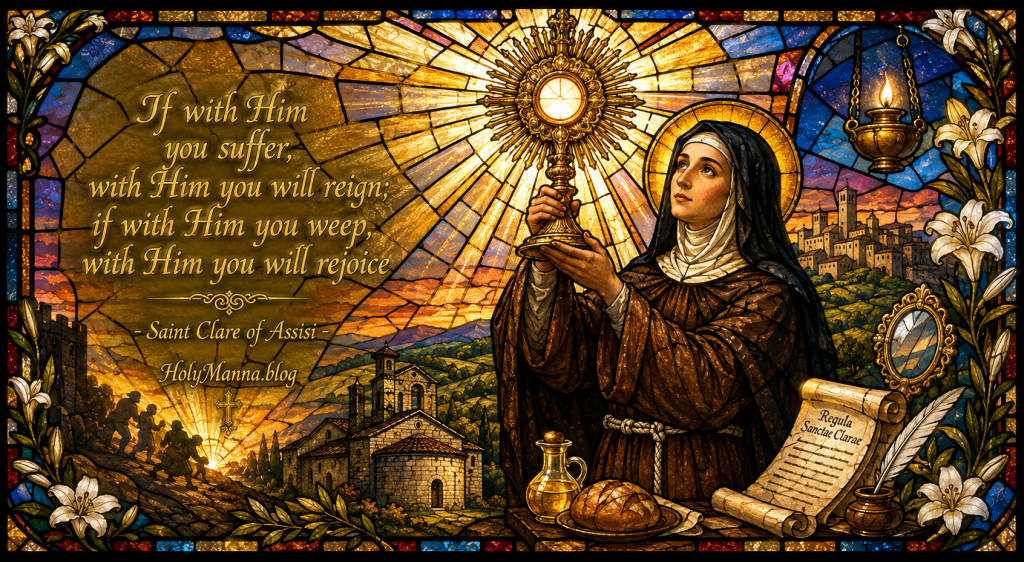
The Light of Assisi
On August 11th, the Church celebrates a woman whose very name means light. Saint Clare of Assisi, born Chiara Offreduccio in 1194, walked away from nobility, wealth, and an arranged future to follow Jesus Christ in a poverty so complete that popes themselves tried to talk her out of it. She never budged. For forty one years she lived behind the walls of a small monastery called San Damiano, and from that hidden place her influence spread across Europe and, eventually, across the centuries and into living rooms everywhere, because in 1958 Pope Pius XII named her the patroness of television. She is also venerated as the patroness of eye disorders, embroiderers and needleworkers, goldsmiths, and laundry workers, and cities from Santa Clara, California to Obando in the Philippines bear her name and her protection.
Clare was the first woman known to history to write a rule of religious life for women that received the Church’s approval, and she fought for that approval with a gentle stubbornness that lasted decades. The order she founded, the Poor Ladies of San Damiano, was renamed in her honor after her death and is known today as the Order of Saint Clare, the Poor Clares, with monasteries on every inhabited continent. The Church teaches that the profession of the evangelical counsels of poverty, chastity, and obedience belongs to a life consecrated to God, and that this consecrated life is one of the ways the faithful respond to the universal call to holiness (CCC 915). Clare did not merely respond to that call. She embodied it so completely that within two years of her death the Church raised her to the altars, exercising the solemn recognition by which the Church proclaims that certain faithful practiced heroic virtue and lived in fidelity to God’s grace (CCC 828).
Her story is not a quaint medieval tale. It is a direct challenge to every person who has ever wondered whether the Gospel can actually be lived without compromise. Clare answered that question with her whole life, and her answer was yes.
The Girl Who Ran Toward Poverty
Chiara Offreduccio was born in Assisi on July 16, 1194, though some older sources give 1193, into one of the city’s noble families. Her father, Favarone di Offreduccio, was a knight. Her mother, Ortolana, honored by the Church as Blessed Ortolana, was a woman of remarkable devotion who had made pilgrimages to the Holy Land, to Rome, and to Santiago de Compostela. A cherished tradition, recorded in the early Legend of Saint Clare, holds that while Ortolana prayed before her daughter’s birth, she understood that she would bring forth a light that would illumine the world, and so the child was named Chiara, meaning clear or bright. This account comes from the early sources as a devout report, and it cannot be verified as historical fact.
Clare’s childhood unfolded during violent civil conflict in Assisi between the old nobility and the rising merchant class, and for a time her family fled to safety in Perugia. Even as a girl she was known for her prayer, her modesty, and her quiet habit of setting aside food from the family table for the poor. As she grew into a young woman of notable beauty and standing, marriage proposals came, and she refused them.
Then Francis began to preach. During Lent of 1212, the young man who had stripped himself of his merchant father’s wealth to live the Gospel preached the Lenten sermons at the church of San Giorgio in Assisi, and the eighteen year old Clare heard him. Something caught fire in her. The two met privately, with chaperones, and Francis spoke to her of contempt for the world and love for Jesus Christ. Clare resolved to give everything away.
On Palm Sunday of 1212, sources record the date as March 18th or March 20th, Clare attended Mass at the cathedral dressed in her finest clothes. When the other young women went forward to receive their palms, Clare remained in her place, and the bishop himself came down and placed the palm in her hand. Many have seen in that gesture a quiet blessing on what was about to happen. That night, Clare slipped out of her family home, according to tradition through the small secondary entrance sometimes called the door of the dead, and hurried through the darkness to the Portiuncula, the little chapel where Francis and his brothers lived. There, before the altar of Our Lady of the Angels, she exchanged her fine gown for a rough tunic, and Francis cut off her hair as a sign that she now belonged entirely to Christ. She had heard the Lord’s invitation and taken it literally: “If you wish to be perfect, go, sell what you have and give to the poor, and you will have treasure in heaven; and come, follow me” (Mt 19:21).
Her family did not take it well. Francis placed Clare temporarily with Benedictine nuns, and when her relatives arrived to drag her home by force, she clung to the altar and pulled off her veil to reveal her shorn head. Faced with that sign of consecration, they gave up. Sixteen days later, her younger sister Catarina followed her, taking the religious name Agnes, and the family’s fury doubled. Her uncle Monaldo came with armed men to retrieve Agnes. The early Legend recounts that as the men tried to carry Agnes away, her body became so heavy that they could not lift her, while Clare prayed nearby, and the men abandoned the attempt. This dramatic account comes from the early sources as a story handed down in the tradition, and it cannot be verified.
Francis soon settled Clare and her first companions at San Damiano, the small church outside Assisi’s walls that he had rebuilt with his own hands after hearing the crucifix there tell him to repair God’s house. Clare would remain within its enclosure for the rest of her life. Around 1215, still in her early twenties, she reluctantly accepted the role of abbess at Francis’s insistence, and in time her own mother Ortolana and her sister Beatrice joined the community. The noble family that had tried to drag its daughters home ended up giving three of its women, and a mother, to God.
The Mirror of Christ
It would be easy to assume that a cloistered nun’s life leaves little to tell. Clare’s life proves the opposite. From San Damiano she became one of the most consequential women of the medieval Church, and she did it through three things: prayer, poverty, and an unshakable love for the Eucharist.
The Poor Ladies lived a life of startling simplicity. They went barefoot, slept on the ground, abstained from meat, kept long silences, and owned nothing, not as individuals and not as a community. This last point was the revolution. Monasteries in Clare’s day were expected to hold lands and revenues to guarantee their survival. Clare refused. She wanted her sisters to depend on Providence alone, exactly as Francis’s brothers did, and she petitioned the Pope for the right to own nothing. Pope Gregory IX granted her community the famous Privilege of Poverty in 1228, a document unlike anything the Church had issued before, a papal guarantee of the right to be poor. When Gregory, concerned for the sisters’ security, offered to release her from her vow of strict poverty, the early Legend records her answer in words that still ring: “Holy Father, I crave for absolution from my sins, but I desire not to be absolved from the obligation of following Jesus Christ.”
Clare understood poverty not as deprivation but as freedom for love. The Church teaches this same truth: the Lord grieves over the rich, because they find their consolation in the abundance of goods, and the precept of detachment from riches is obligatory for entrance into the Kingdom of heaven (CCC 2544 to 2547). Clare wrote it more beautifully in her First Letter to Agnes of Prague, the Bohemian princess who gave up a royal marriage to become a Poor Clare: “the kingdom of heaven is promised and given by the Lord only to the poor: for he who loves temporal things loses the fruits of love.”
Those four surviving letters to Agnes contain some of the most luminous spiritual writing of the Middle Ages. Clare’s great image is the mirror. Christ crucified is the mirror into which the soul must gaze daily, seeing there both His poverty and the person the soul is called to become. In her Third Letter she wrote: “Place your mind before the mirror of eternity! Place your soul in the brilliance of glory! Place your heart in the figure of the divine substance! And transform your whole being into the image of the Godhead Itself through contemplation!” In her final letter, written near death, she returned to the image one last time: “Queen and bride of Jesus Christ, look into that mirror daily and study well your reflection.” For Clare, contemplation was never escape. It was transformation. The Church echoes her when it teaches that contemplative prayer is a gaze of faith fixed on Jesus, in which the soul is purified and conformed to Him (CCC 2715).
God confirmed her hidden life with signs. The Process of Canonization, the sworn testimony gathered from her sisters within months of her death, records that one evening only a single loaf of bread remained in the monastery, with fifty sisters to feed. Clare ordered it divided, blessed it, and there was enough for all. The same testimony records a jar of oil that Clare blessed when the monastery had none, which was found full. The sisters testified under oath to healings Clare worked by tracing the Sign of the Cross over the sick, both sisters within the enclosure and townspeople brought to her, including a child with a growth over his eye and a friar afflicted in mind. These accounts carry the weight of sworn testimony given in a formal Church process, which is why the Church accepted them, and readers should know they rest on the word of eyewitnesses rather than on modern documentation.
Why should anyone remember Clare, and why emulate her? Because she demonstrates that the hidden life is not a lesser life. In an age that measures worth by visibility, followers, and output, Clare built nothing the world could see, and yet the Church declares that in the Body of Christ the contemplative members are among its most vital organs, for the Church’s holiness is nourished by hidden prayer (CCC 2687). Clare called herself the “little plant” of Saint Francis, and that little plant, rooted in one small garden, seeded a forest that now covers the earth.
Twenty Eight Years on a Sickbed and an Army at the Gate
Clare was never martyred, but her hardships were long, physical, and relentless, and she met every one of them with joy.
Her early austerities were so severe, fasting on bread and water, wearing rough haircloth, sleeping on vine branches, that Francis himself and the Bishop of Assisi ordered her to moderate them, commanding her to eat at least a little bread every day and to sleep on a proper mattress. She obeyed, because for Clare obedience was as precious as poverty. But her body had been spent, and from about 1224 until her death in 1253, nearly twenty eight years, she suffered chronic illness that often confined her to bed. She never wasted the suffering. Witnesses in the Process describe her propped up on her sickbed, spinning fine linens and sewing corporals and altar cloths, which she sent out to the poor churches of the surrounding valleys. Even flat on her back, she served the altar of God. She had written to Agnes of Prague the truth she was living: “If with Him you suffer, with Him you will reign; if with Him you weep, with Him you will rejoice.” The Church teaches exactly this participation in the Cross, that by suffering united to Christ the faithful complete in their flesh what is lacking in Christ’s afflictions for the sake of His Body (CCC 1508, Col 1:24).
Then there was the grief. Francis, her father in the faith, the man whose preaching had opened heaven to her, died in 1226. His brothers carried his body past San Damiano so that Clare and her sisters could look on his face one last time through the grille of their chapel. Clare outlived him by twenty seven years, guarding his ideal of poverty when even his own order began to soften it. In many ways, the second half of Clare’s life was a long, loving act of fidelity to a vision the world kept trying to dilute.
Her most dramatic trial came in September of 1240. The armies of Emperor Frederick II, then at war with the papacy, were ravaging the Spoleto valley, and among his troops were Saracen mercenaries with a reputation for savagery. A company of them scaled the walls of San Damiano itself and dropped into the cloister. The sisters ran in terror to Clare, who was sick in bed. She had herself helped to the door of the refectory and asked that the silver and ivory case containing the Blessed Sacrament be brought and placed before the invaders, and she prostrated herself in prayer before her Eucharistic Lord. The early Legend records that she prayed with tears, asking the Lord to defend the daughters she could not defend, and that she heard, as it were, the voice of a little child from the Host answering that He would always keep them in His care. A sudden terror seized the attackers, and they fled over the walls they had just climbed, harming no one. The following June, in 1241, when the imperial captain Vitale d’Aversa besieged the whole city of Assisi, Clare gathered her sisters, had ashes brought, and led them in fasting and prayer for the city, and the siege broke and the army withdrew. The details of the child’s voice from the Host come from the early sources as devout tradition and cannot be verified, though the deliverance of the monastery and the city is firmly rooted in the earliest accounts and sworn testimony.
This is why so many images of Clare show her holding a monstrance. Her weapon was the Eucharist, because her whole life was built on the truth the Church professes, that in the most blessed sacrament of the Eucharist the Body and Blood, together with the soul and divinity, of the Lord Jesus Christ, and therefore the whole Christ, is truly, really, and substantially contained (CCC 1374). Clare did not think the Host was a symbol. She staked her sisters’ lives on the Real Presence, and the Lord did not fail her.
Her final battle was fought with a pen. For decades Clare labored to secure permanent, papal approval of a rule of life written in her own hand, built on absolute poverty, something no woman had ever obtained. Pope Innocent IV visited her personally as she lay dying. On August 9, 1253, the papal bull Solet annuere arrived at San Damiano, formally approving Clare’s Form of Life. Witnesses say she kissed the document. Two days later, on August 11, 1253, having received everything she had asked of God on this earth, Clare died in peace, surrounded by her sisters. Her recorded final words, spoken quietly to her own soul, were preserved by the sisters who heard them: “Go forth in peace, for you have followed the good road. Go forth without fear, for He Who created you has made you holy, has always protected you, and loves you as a mother. Blessed be You, my God, for having created me.” When one of the sisters asked to whom she was speaking, she answered that she was speaking to her own blessed soul.
From a Crypt in Assisi to Every Screen on Earth
The people of Assisi did not wait for a formal process to call Clare a saint. Her funeral drew the Pope himself, and the crowds’ veneration was immediate. Just two years later, on September 26, 1255, Pope Alexander IV canonized her at Anagni in the bull Clara claris praeclara, a document that plays joyfully on her name, Clare, bright and clear, a light for the world. In 1260 her body was transferred from the church of San Giorgio to the newly built Basilica of Santa Chiara in Assisi, where it rests to this day.
The Process of Canonization and the early accounts record miracles at her intercession after death, including the healing of the sick who visited her tomb, cures of eye ailments, and favors granted to pilgrims who invoked her. Devotion to her as a healer of eye diseases grew through the centuries, a fitting patronage for the woman whose name means clarity and whose spirituality was all about seeing, gazing into the mirror of Christ. These individual healing accounts come from medieval records of veneration, and most of them cannot be verified today; they are presented here as the tradition has handed them down.
In 1850, after careful excavation beneath the high altar of her basilica, Clare’s remains were rediscovered and identified, and they are now venerated in the crypt, where her skeletal remains rest within a vested figure that pilgrims can see. Some popular accounts describe her body as incorrupt; the Church displays her actual bones within the effigy, and honesty requires saying so plainly, because Clare herself would want nothing exaggerated. Her basilica also shelters one of Christianity’s most beloved objects, the San Damiano Crucifix, the very cross that spoke to young Francis and told him to rebuild the Church. The Poor Clares have guarded it for nearly eight centuries. Assisi remains one of the great pilgrimage destinations of the Catholic world, and millions walk each year between the basilicas of Francis and Clare, the two poor lovers of Christ who still hold the town, and much of the world, in their grip.
Then came the twentieth century’s strangest tribute. Drawing on the sworn testimony that on a Christmas night when Clare was too sick to rise from bed, she saw and heard the Mass being celebrated in the Basilica of Saint Francis as though she were present in the church, Pope Pius XII declared her the patroness of television on February 17, 1958. The cloistered nun who never owned anything now watches over the most powerful communications medium ever built. Her spiritual daughters took the hint. In the United States, a Poor Clare nun of Perpetual Adoration named Mother Angelica founded the Eternal Word Television Network from a monastery garage in Alabama, and it grew into the largest religious media network on the planet. Clare’s light found the screens. The Poor Clares themselves remain her greatest living legacy, hundreds of monasteries across the world where women still go barefoot before the Blessed Sacrament and still own nothing, eight hundred years on, in the communion of saints by which the Church teaches that the intercession of those in heaven fixes the whole Church more firmly in holiness (CCC 956 to 957).
What the Mirror Shows You
Clare’s life asks every reader one uncomfortable question, and it is worth sitting with it. What would you refuse to be absolved from? Clare told a pope she wanted absolution from her sins but never from following Jesus Christ. Most people negotiate with the Gospel, keeping the comfortable parts and quietly filing the demanding parts under someday. Clare refused the negotiation, and what she got in exchange was not misery but a joy so obvious that princesses wrote to her asking how to find it.
Start where Clare started, with looking. Her whole spirituality was a daily, deliberate gaze into the mirror of Christ crucified. That is available to anyone. Ten minutes before a crucifix, ten minutes before the tabernacle, ten minutes with The Gospel of Matthew open on a phone screen on the train. The Church teaches that contemplation is a gaze of faith fixed on Jesus, and that this gaze purifies the heart (CCC 2715). When was the last time you simply looked at Christ, without asking for anything, without a list, just looking?
Then let the looking change the owning. Nobody is asked to imitate Clare’s poverty literally in the middle of a mortgage and a family, but everyone is asked to imitate its freedom. The Catechism is blunt that detachment from riches is necessary for entering the Kingdom (CCC 2544). There is a practical test hiding in Clare’s story: she gave away her inheritance before she gave away her hair, because she knew the money would call her back. What is the one possession, subscription, habit, or comfort that most owns you, and what would happen if you gave it away this month?
Then bring the fear to the Eucharist. When armed men came over the wall, Clare did not organize a defense; she carried her Lord to the door and knelt. Whatever is coming over the wall of an ordinary life, a diagnosis, a layoff, a marriage under strain, a child in trouble, Clare’s move is still available: adoration before strategy. What fear in your life right now have you never once brought and physically placed before the Blessed Sacrament?
Finally, learn her patience. Clare waited forty one years for the Church to approve her rule, and it arrived two days before she died. She teaches that fidelity is not measured in outcomes delivered on demand. Some prayers are answered on the second to last day. The reader who is tired of waiting for God should look hard at the dying woman kissing the papal bull, and take heart.
Engage With Us!
Saint Clare’s story has a way of finding the exact spot where each soul is still holding out on God, so share what it found in you. Drop your thoughts, your favorite moment from her life, or your own experience of choosing faith over comfort in the comments below; this community grows stronger every time someone speaks honestly.
Here are a few questions to pray with and to answer in the comments:
- Clare heard one Lenten sermon and changed her entire life; what is one word or truth you have heard recently that you sense God does not want you to walk away from?
- Clare’s family fought her vocation before three of them ended up joining her; who in your life might be watching your faith more closely than you think?
- If you gazed into the mirror of Christ crucified every day for a month, what do you think would be the first thing in your life to change?
- Clare placed the Blessed Sacrament between her sisters and an invading army; what battle are you currently fighting with your own strength that belongs in front of the tabernacle instead?
- Clare received the answer to her life’s prayer two days before she died; where is God asking you to keep being faithful without seeing results yet?
Whatever you carry into this week, carry it the way Clare carried everything, with open hands and a fixed gaze. Live simply enough that Christ has room to be your treasure, love the people in front of you with real sacrifice, and stay close to the Eucharist, because the same Lord who guarded San Damiano guards you. Go forth in peace, follow the good road, and do everything with the love and mercy that Jesus taught us.
Saint Clare of Assisi, pray for us!
Follow us on YouTube, TikTok, Instagram and Facebook for more insights and reflections on living a faith-filled life.


Leave a comment