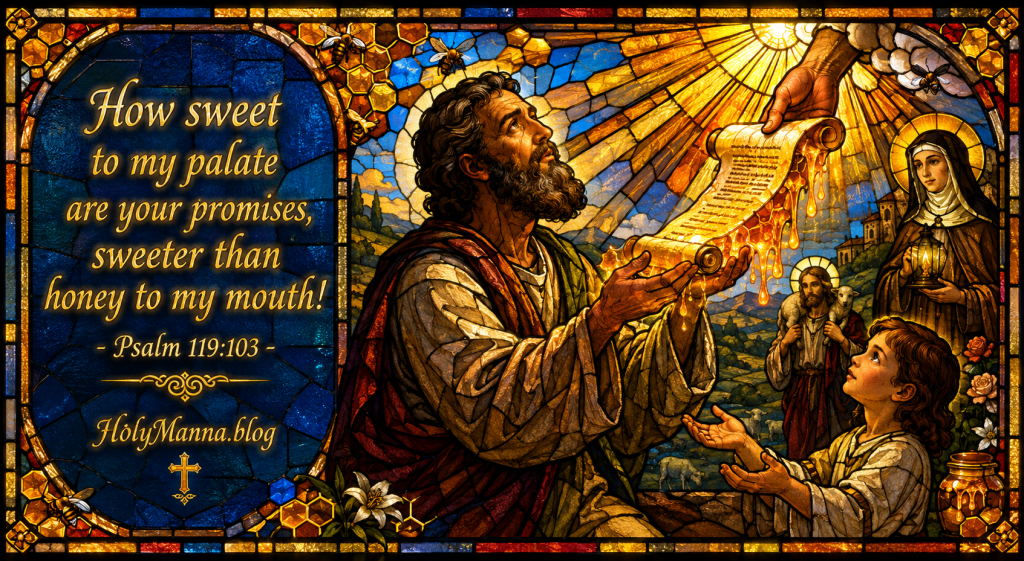
Memorial of Saint Clare, Virgin – Lectionary: 414
A Scroll, a Psalm, and a Child in the Middle of the Room
Some days the Church sets a table so carefully that every dish speaks to every other dish, and August 11, 2026, the Memorial of Saint Clare, Virgin, is one of those days. The readings for this Tuesday revolve around a single astonishing idea: God wants to be eaten, tasted, and savored, and the only people who can receive Him that way are the small ones. In the First Reading, the prophet Ezekiel, an exiled priest sitting by a canal in Babylon around 593 BC, is handed a scroll covered in lamentation and told to eat it. He obeys, and it tastes like honey. The Responsorial Psalm answers him across the centuries, as the psalmist sings that God’s promises are “sweeter than honey to my mouth” and gasps with open mouth in yearning for more. Then the Gospel takes the same hunger and gives it a face. When the disciples ask who ranks highest in the Kingdom, Jesus places a child, a person with no status, no income, and no leverage in the ancient world, in the middle of the room and says that this is what greatness looks like. The Church celebrates Saint Clare of Assisi today, a young noblewoman who gave away everything at eighteen to live in radical poverty beside the church of San Damiano, and she is the perfect patroness for these readings. She spent forty years doing exactly what Ezekiel, the psalmist, and the child all model: opening her hands, opening her mouth, and letting God fill her. The invitation today is simple and demanding. Come hungry, and come small.
First Reading — Ezekiel 2:8-3:4
When God Puts His Words in a Prophet’s Mouth
Ezekiel’s story begins with catastrophe. In 597 BC, the Babylonian king Nebuchadnezzar deported the young king Jehoiachin of Judah along with thousands of Jerusalem’s leading citizens, and among them was a priest named Ezekiel. He would never serve at the Temple altar he had trained for. Instead, five years into exile, beside the river Chebar in Babylon, the heavens opened and Ezekiel saw the overwhelming vision of God’s glory that fills the first chapter of his book. Today’s passage comes from the heart of his prophetic call, and it contains one of the strangest and most beautiful commands in all of Scripture, because God does not simply give Ezekiel a message to memorize but hands him a scroll to eat. The exiles to whom Ezekiel will preach are called a “house of rebellion,” and the prophet who confronts them cannot afford to be rebellious himself. Before he speaks a single word, he must take God’s word into his body, digest it, and let it become part of him. This is the day’s central theme in its rawest form: the Word of God is not information to be filed away but food to be consumed, and the one who consumes it obediently discovers that even a message of woe tastes like honey, because it comes from the mouth of the God who is love.
Ezekiel 2:8-3:4
The Lord GOD said to me:
As for you, son of man, obey me when I speak to you:
be not rebellious like this house of rebellion,
but open your mouth and eat what I shall give you.It was then I saw a hand stretched out to me,
in which was a written scroll which he unrolled before me.
It was covered with writing front and back,
and written on it was:
Lamentation and wailing and woe!He said to me: Son of man, eat what is before you;
eat this scroll, then go, speak to the house of Israel.
So I opened my mouth and he gave me the scroll to eat.
Son of man, he then said to me,
feed your belly and fill your stomach
with this scroll I am giving you.
I ate it, and it was as sweet as honey in my mouth.
He said: Son of man, go now to the house of Israel,
and speak my words to them.
Detailed Exegesis
Ezekiel 2:8 reads, “As for you, son of man, obey me when I speak to you: be not rebellious like this house of rebellion, but open your mouth and eat what I shall give you.” God addresses Ezekiel as “son of man,” in Hebrew ben adam, a title that appears over ninety times in this book and stresses the prophet’s smallness before the divine glory. He is a mere mortal, a child of Adam, standing before the Creator. The command is double: obey, and open your mouth. Obedience here is not grim compliance but receptive trust, the willingness to be fed by Another.
Ezekiel 2:9 continues, “It was then I saw a hand stretched out to me, in which was a written scroll which he unrolled before me.” The hand stretched out toward the prophet is pure gift. Ezekiel does not climb up to seize the word; the word comes down to him. The Church has always seen in such gestures a foreshadowing of the Incarnation, when the eternal Word would stretch out toward humanity in flesh.
Ezekiel 2:10 says, “It was covered with writing front and back, and written on it was: Lamentation and wailing and woe!” Ancient scrolls were normally written on one side only. A scroll covered front and back means the message is complete and full; there is no blank space left for the prophet to add his own opinions. The content is sorrowful because Ezekiel must announce judgment on Jerusalem before he can announce restoration.
Ezekiel 3:1 reads, “He said to me: Son of man, eat what is before you; eat this scroll, then go, speak to the house of Israel.” The order of the verbs matters enormously. Eat first, then go, then speak. No authentic proclamation of God’s word is possible until the messenger has first interiorized it.
Ezekiel 3:2 states simply, “So I opened my mouth and he gave me the scroll to eat.” Where Israel closed itself in rebellion, Ezekiel opens himself in obedience. His open mouth is the exact posture the Responsorial Psalm will celebrate.
Ezekiel 3:3 declares, “Son of man, he then said to me, feed your belly and fill your stomach with this scroll I am giving you. I ate it, and it was as sweet as honey in my mouth.” Here is the miracle. A scroll full of lamentation tastes sweet, because sweetness comes not from the content but from the Source. Communion with God delights the soul even when His message is hard. Saint John experiences the same wonder in Revelation 10:9-10, where he too eats a scroll that is honey-sweet in his mouth, showing that this pattern belongs to every servant of the Word.
Ezekiel 3:4 concludes, “He said: Son of man, go now to the house of Israel, and speak my words to them.” Only now, with the word inside him, is Ezekiel sent. He will speak “my words,” God’s words, not his own.
Teachings
The Church teaches exactly what this scene dramatizes. The Catechism declares in CCC 104, “In Sacred Scripture, the Church constantly finds her nourishment and her strength, for she welcomes it not as a human word, ‘but as what it really is, the word of God.’” Scripture is nourishment, food for the belly of the soul, precisely as Ezekiel experienced it. Pope Saint Gregory the Great, a Doctor of the Church, preached a famous series of homilies on Ezekiel in Rome in the year 593, while Lombard armies threatened the city, and in reflecting on the prophet’s commission he confessed how heavily the call to preach weighed on him. He said, “Note that a man whom the Lord sends forth as a preacher is called a watchman. A watchman always stands on a height so that he can see from afar what is coming. Anyone appointed to be a watchman for the people must stand on a height for all his life to help them by his foresight.” Gregory understood that the preacher must first stand close to God, feeding on His word, before he can help anyone else see, and every catechist and parent teaching a child to pray stands in Ezekiel’s line.
Reflection
You cannot give what you have not first received, and you cannot speak a word you have never tasted. The practical invitation of this reading is the ancient practice of praying with Scripture slowly, sometimes called lectio divina, where you read a short passage, chew on it, and let it settle into your belly like bread. Try taking one verse from today’s readings and carrying it through your entire day, returning to it at red lights and in checkout lines. When was the last time the Word of God tasted sweet to you, and what was happening in your life at that moment? Is there a hard truth from God, written like lamentation on a scroll, that you have been refusing to open your mouth and receive?
Responsorial Psalm — Psalm 119:14, 24, 72, 103, 111, 131
The Longest Love Song Ever Written to God’s Law
Psalm 119 is the giant of the Psalter, an acrostic poem of 176 verses in which each set of eight lines begins with a successive letter of the Hebrew alphabet, running from aleph to tau. It is, quite literally, love for God’s word from A to Z. The psalmist rotates through eight near-synonyms, including decrees, commands, statutes, precepts, words, promises, ordinances, and way, so that the Law is examined like a diamond turned slowly in the light. Modern ears sometimes hear the word law and think of paperwork and penalties, but for the psalmist the Torah is the revelation of God’s own heart, the map He lovingly handed His people so they could walk toward Him without getting lost. The Church chose today’s six verses with obvious care, because they translate Ezekiel’s experience into prayer. The prophet ate the scroll and found it sweet as honey; the psalmist sings back with the refrain, “How sweet to my taste is your promise!” taken from verse 103. This psalm is the hinge of the whole liturgy, teaching the congregation to respond to God’s word not with analysis but with appetite.
Psalm 119:14, 24, 72, 103, 111, 131
R. (103a) How sweet to my taste is your promise!
In the way of your decrees I rejoice,
as much as in all riches.
R. How sweet to my taste is your promise!
Yes, your decrees are my delight;
they are my counselors.
R. How sweet to my taste is your promise!
The law of your mouth is to me more precious
than thousands of gold and silver pieces.
R. How sweet to my taste is your promise!
How sweet to my palate are your promises,
sweeter than honey to my mouth!
R. How sweet to my taste is your promise!
Your decrees are my inheritance forever;
the joy of my heart they are.
R. How sweet to my taste is your promise!
I gasp with open mouth,
in my yearning for your commands.
R. How sweet to my taste is your promise!
Detailed Exegesis
Psalm 119:14 sings, “In the way of your decrees I rejoice, as much as in all riches.” The psalmist stacks God’s decrees against every treasure the world offers and finds the scales tipping toward God. Joy, not obligation, is the keynote of true obedience.
Psalm 119:24 continues, “Yes, your decrees are my delight; they are my counselors.” Kings kept royal counselors close at hand for every decision. The psalmist gives that intimate advisory role to God’s word, consulting it before consulting his own preferences.
Psalm 119:72 declares, “The law of your mouth is to me more precious than thousands of gold and silver pieces.” Notice the phrase “law of your mouth.” The Torah is not an anonymous code carved by a committee; it proceeds from the mouth of a living, speaking God, which is precisely why it can feed the mouth of the one who prays.
Psalm 119:103 exclaims, “How sweet to my palate are your promises, sweeter than honey to my mouth!” This is the verse that binds the whole liturgy together. In the ancient world honey was the sweetest substance known, and the psalmist insists that God’s promises surpass it. Jewish tradition even developed the custom of giving children a taste of honey when they began studying the sacred letters, so the sweetness of the word would be their first memory of it.
Psalm 119:111 affirms, “Your decrees are my inheritance forever; the joy of my heart they are.” An inheritance in Israel meant land, the family’s permanent stake in God’s promise. The psalmist claims the word itself as his estate, a property no exile or invader can seize, which would have comforted deportees like Ezekiel profoundly.
Psalm 119:131 closes with startling physicality, “I gasp with open mouth, in my yearning for your commands.” Here is Ezekiel’s open mouth again, and here also is the hungry openness of a child. The psalmist pants for God’s word the way a runner pants for air, because for him it is just as necessary for life.
Teachings
The Catechism gathers this entire spirituality into one urgent exhortation in CCC 133, which teaches, “The Church ‘forcefully and specifically exhorts all the Christian faithful . . . to learn the surpassing knowledge of Jesus Christ, by frequent reading of the divine Scriptures. Ignorance of the Scriptures is ignorance of Christ.’” That final sentence comes from Saint Jerome, the great fourth-century Doctor of the Church who spent decades in Bethlehem translating the Bible into Latin, and the Second Vatican Council enshrined his words in Dei Verbum. Jerome’s point is the psalmist’s point. Scripture is not a subject to master but a Person to encounter, and the one who never opens the book never fully tastes the sweetness of the Lord who speaks through it. Saint Clare of Assisi lived this psalm behind the walls of San Damiano, where the word of God and the Eucharist were the entire wealth of women who owned nothing, and her letters show a soul so saturated in Scripture that its phrases became her natural vocabulary.
Reflection
Sweetness in prayer is not automatic; it grows with familiarity, the way a favorite meal becomes more beloved each time it is shared. If Scripture has felt dry to you lately, consider that appetite often returns through small, faithful tastes rather than heroic feasts. Commit to one psalm verse each morning this week, spoken aloud before your phone gets a vote in your day. Which of the psalmist’s images, riches, counselors, honey, or inheritance, best describes what the word of God has actually been in your life so far? What would need to change in your daily routine for you to gasp with yearning for God’s commands rather than merely tolerate them?
Holy Gospel — Matthew 18:1-5, 10, 12-14
The Day Jesus Answered Ambition with a Child
This passage opens the fourth of Matthew’s five great discourses, often called the ecclesial discourse, because in chapter 18 Jesus teaches His disciples how life inside His community must work. The occasion is embarrassing, because the men Jesus has chosen to lead His Church approach Him asking who will be greatest in the Kingdom of heaven. In the honor-driven culture of the first-century Mediterranean world, a child sat at the very bottom of the ladder, holding no legal standing, no wealth, and no power to repay a favor. So when Jesus places a child in the middle of a circle of grown men debating their own greatness, the gesture lands like thunder. The passage then unfolds the tenderness behind the challenge, revealing that these little ones have angels who behold the Father’s face, and that the Father Himself is like a shepherd who leaves ninety-nine sheep to chase down the single stray. On the memorial of Saint Clare, who abandoned nobility to become one of Christ’s little ones, the Gospel reads almost like her biography written twelve centuries in advance.
Matthew 18:1-5, 10, 12-14
The disciples approached Jesus and said,
“Who is the greatest in the Kingdom of heaven?”
He called a child over, placed it in their midst, and said,
“Amen, I say to you, unless you turn and become like children,
you will not enter the Kingdom of heaven.
Whoever becomes humble like this child
is the greatest in the Kingdom of heaven.
And whoever receives one child such as this in my name receives me.“See that you do not despise one of these little ones,
for I say to you that their angels in heaven
always look upon the face of my heavenly Father.
What is your opinion?
If a man has a hundred sheep and one of them goes astray,
will he not leave the ninety-nine in the hills
and go in search of the stray?
And if he finds it, amen, I say to you, he rejoices more over it
than over the ninety-nine that did not stray.
In just the same way, it is not the will of your heavenly Father
that one of these little ones be lost.”
Detailed Exegesis
Matthew 18:1 reads, “The disciples approached Jesus and said, ‘Who is the greatest in the Kingdom of heaven?’” The question exposes hearts still shaped by worldly categories. Jesus has just predicted His Passion, and His closest friends are discussing promotions.
Matthew 18:2 continues, “He called a child over, placed it in their midst.” Jesus teaches with a living parable. The child does nothing, says nothing, and earns nothing, which is exactly the point. The child simply stands where Jesus places him.
Matthew 18:3 declares, “and said, ‘Amen, I say to you, unless you turn and become like children, you will not enter the Kingdom of heaven.’” The solemn “Amen” signals maximum seriousness, and the word “turn” carries the force of conversion. This is not advice for reaching the top but the condition for entering at all, because childlikeness means total dependence on the Father.
Matthew 18:4 teaches, “Whoever becomes humble like this child is the greatest in the Kingdom of heaven.” Jesus does not abolish greatness; He redefines it. The ladder of the Kingdom is climbed downward, and the humblest person in the room is the highest.
Matthew 18:5 adds, “And whoever receives one child such as this in my name receives me.” Christ identifies Himself with the small and overlooked. Hospitality toward the least is hospitality toward the Lord Himself, a truth He will repeat on a cosmic scale in Matthew 25.
Matthew 18:10 warns, “See that you do not despise one of these little ones, for I say to you that their angels in heaven always look upon the face of my heavenly Father.” This verse is the classic scriptural foundation for the Church’s teaching on guardian angels. The people the world ranks lowest have advocates standing in the throne room of God, gazing on the Father’s face without interruption. Despising a little one means despising someone heaven treasures.
Matthew 18:12 asks, “What is your opinion? If a man has a hundred sheep and one of them goes astray, will he not leave the ninety-nine in the hills and go in search of the stray?” By ordinary accounting, risking ninety-nine to recover one is madness. Divine love does not do ordinary accounting.
Matthew 18:13 promises, “And if he finds it, amen, I say to you, he rejoices more over it than over the ninety-nine that did not stray.” Heaven’s economy runs on rejoicing. The recovered sheep occasions greater joy precisely because it was lost.
Matthew 18:14 concludes, “In just the same way, it is not the will of your heavenly Father that one of these little ones be lost.” Where Luke’s version of this parable addresses Pharisees grumbling about sinners, Matthew’s version addresses disciples, making it a charter for the Church. The community of Jesus must be a place where no little one, no struggling believer, no wandering soul, is ever written off.
Teachings
Saint John Chrysostom, the golden-mouthed Doctor of the Church, preached on this very passage in his Homily 58 on Matthew and explained why Jesus chose a child as His model. He taught, “Since both from envy the little child is pure, and from vainglory, and from longing for the first place; and he is possessed of the greatest of virtues, simplicity, and whatever is artless and lowly. Not courage then only is wanted, nor wisdom, but this virtue also, humility I mean, and simplicity.” The Catechism confirms the teaching on the angels of the little ones in CCC 336, which states, “From its beginning until death, human life is surrounded by their watchful care and intercession. ‘Beside each believer stands an angel as protector and shepherd leading him to life.’” The interior quotation belongs to Saint Basil the Great. The Catechism likewise teaches in CCC 2559 that “humility is the foundation of prayer.” No saint embodies today’s Gospel more visibly than the woman on the calendar. Saint Clare of Assisi renounced her noble inheritance in 1212, at about eighteen years of age, to follow the way of Saint Francis, and she spent the rest of her life at San Damiano in voluntary littleness. In her Second Letter to Agnes of Prague, written to a princess who made the same choice, Clare gave the whole program of childlike discipleship in a single line, urging her, “Gaze upon Him, consider Him, contemplate Him, as you desire to imitate Him.” She likewise admonished her sisters, “to strive always to imitate the way of holy simplicity, humility, and poverty.” Clare became great by becoming small, and the Church has never forgotten her.
Reflection
Becoming like a child does not mean becoming childish or passive. It means letting God be your Father in practice and not just in vocabulary, trusting Him with tomorrow, and refusing the exhausting game of comparison the disciples were playing. Try one concrete act of downward mobility this week, such as taking the task nobody wants, letting someone else receive the credit, or spending unhurried time with a person who can do absolutely nothing for your career. Then consider the stray sheep. Somebody in your life has wandered, and the Father is not willing to lose them. Whose greatness do you envy, and what would it cost you to stop climbing and start trusting? Is there a little one in your family, parish, or workplace whom you have quietly despised or dismissed, and how will you receive them this week in the name of Jesus?
Come Hungry, Come Small, Come Home
Set the three readings side by side and a single portrait of the disciple emerges. Ezekiel stands with his mouth open, eating a scroll he did not write, and finds it sweet as honey. The psalmist gasps with open mouth, yearning for commands he treasures above gold. The child stands in the middle of the room, empty-handed and unimpressive, and Jesus crowns that emptiness as the true greatness of heaven. The lesson running through all of it is that God fills the ones who admit they are hungry and carries the ones who admit they are small. The world trains people to arrive full, credentialed, and self-sufficient, but the Kingdom’s door is low, and only those who bend down in humility pass through it. Saint Clare of Assisi understood this with total clarity, walking away from wealth at eighteen and discovering in poverty a sweetness that gold and silver never gave her family’s palace. Her counsel to gaze upon Him, consider Him, and contemplate Him remains the simplest recipe for becoming childlike, because the soul that stares long enough at Jesus slowly stops staring at itself. The call to action today is wonderfully concrete. Open the Scriptures tonight and actually taste one verse instead of skimming ten. Go to Mass this week and receive the Word made flesh with the open-mouthed hunger of Ezekiel and the open-hearted trust of a child. And if some part of your soul has strayed into the hills, stop running, because the Shepherd is already searching, and heaven is preparing to rejoice over you.
Engage With Us!
The conversation does not end when the post does, so please share your reflections in the comments below, because your story of tasting God’s word or rediscovering childlike trust may be exactly the encouragement another reader needs today. Here are some questions to pray with and respond to:
- In Ezekiel 2:8-3:4, the prophet must eat the scroll before he can speak for God. What is one concrete way you can interiorize Scripture this week before sharing your faith with others?
- In Psalm 119:14, 24, 72, 103, 111, 131, the psalmist calls God’s promises sweeter than honey and more precious than gold. Which possession or ambition competes hardest with God’s word for your delight, and why?
- In Matthew 18:1-5, 10, 12-14, Jesus places a child in the midst of status-seeking disciples and reveals the Father’s heart for the stray sheep. Who is the little one or the wanderer God is asking you to receive, and what is your first step toward them?
- Taking all the readings together with the witness of Saint Clare, what would it look like for you to come to God this week hungry, small, and completely trusting?
However you answer, know that the journey matters more than polished words. Keep opening your mouth to receive what God longs to give, keep shrinking in the world’s eyes so you can grow in heaven’s, and keep doing everything, from the biggest sacrifice to the smallest kindness, with the love and mercy Jesus taught us.
Sacred Heart of Jesus, we trust in You!
Immaculate Heart of Mary, pray for us!
Saint Michael the Archangel, defend us in battle!
Follow us on YouTube, TikTok, Instagram and Facebook for more insights and reflections on living a faith-filled life.

 Holy Manna!
Leave a comment