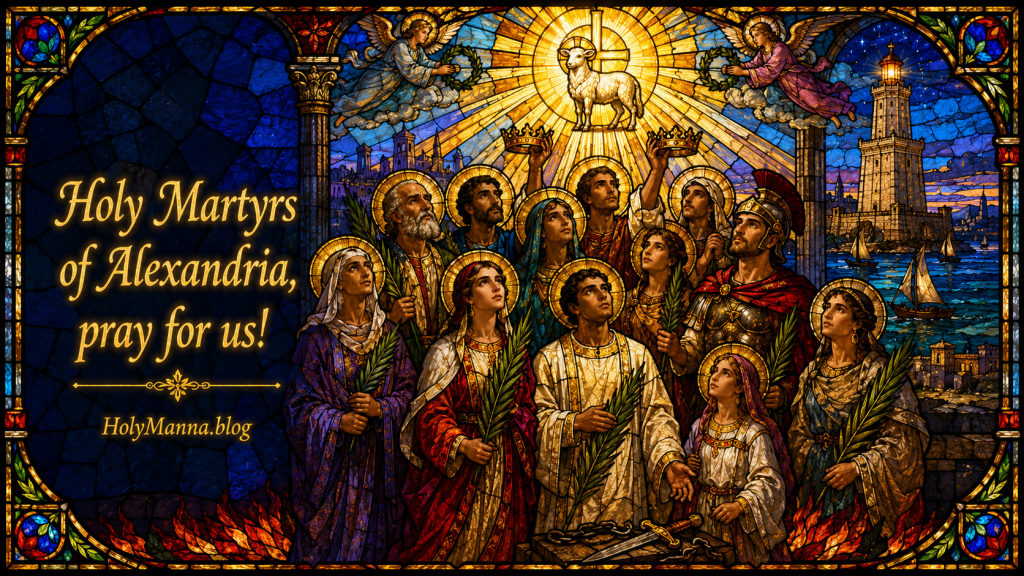
The City That Would Not Bow
On August 10th, the Roman Martyrology pauses over a commemoration unlike most others in its pages. There is no single name to honor, no birthplace to record, no relic to venerate. The entry simply states that at Alexandria in Egypt, during the persecution of the emperor Valerian and under the prefect Aemilianus, holy martyrs were long afflicted with various cruel and refined tortures and obtained the crown of martyrdom by different forms of death. That is the whole of it. An entire company of Christians, men and women, young and old, soldiers and civilians, remembered together as one because history never recorded them one by one.
Yet what looks at first like an absence is actually a treasure. The Martyrs of Alexandria are among the best documented anonymous martyrs of the early Church, because their own bishop, St. Dionysius the Great, lived through the persecution beside them, stood trial under the same prefect, and wrote letters describing what he saw. Those letters were preserved by the historian Eusebius of Caesarea in his Church History, and through them the voice of a third century shepherd still testifies to the courage of his flock. The Catechism teaches that “the Church has painstakingly collected the records of those who persevered to the end in witnessing to their faith. These are the acts of the Martyrs. They form the archives of truth written in letters of blood” (CCC 2474). The Martyrs of Alexandria belong to those archives, and their page, though unsigned, is written in the same ink.
Their commemoration falls on a striking date. August 10th is the feast of St. Lawrence, the great deacon of Rome, who died in the very same persecution, under the very same imperial edict, in the very same year of 258. While Rome remembers her most beloved deacon on his gridiron, the Martyrology quietly adds that far to the south, across the Mediterranean, an entire church was passing through the same fire. Rome and Alexandria, the two greatest cities of the empire, were bleeding together for the same Lord.
A Church Born in the Shadow of the Lighthouse
To understand who these martyrs were, the reader has to understand the city that formed them. Alexandria in the third century was the second city of the Roman Empire, a sprawling port of commerce, philosophy, and learning, crowned by its famous lighthouse and its celebrated libraries. According to the constant tradition of the Church, the Gospel arrived there through St. Mark the Evangelist, who is honored as the founder of the Alexandrian church and its first bishop. By the time of the events of this story, Alexandria had become one of the intellectual centers of Christianity, home to the famous catechetical school where teachers like Clement of Alexandria and Origen had trained generations of believers to love both faith and reason.
The Christians of Alexandria were not strangers to suffering. Less than a decade before Valerian, the emperor Decius had unleashed an empire wide persecution that demanded every subject sacrifice to the Roman gods and obtain a certificate proving it. Alexandria had endured mob violence and judicial terror; some believers had apostatized under pressure, many had fled, and many had died. St. Dionysius, who became bishop around the year 248, had himself been hunted and had escaped arrest during those years. So the community that faced Valerian’s persecutors in 257 and 258 was a tested church, a church of survivors, penitents, converts, and children of martyrs. Their conversion story, taken as a whole people, was the story of a pagan metropolis slowly turning toward Christ, household by household, over two centuries of preaching, catechesis, and blood.
What makes their formation remarkable is how ordinary it was. Dionysius describes no army of ascetic heroes. He describes a congregation. There were priests and deacons, certainly, but also matrons and maidens, old men and boys, soldiers still in the ranks and tradesmen still at their stalls. These were people who had learned the faith at the Sunday assembly, at the baptismal font, and at the family table. The Catechism teaches that “martyrdom is the supreme witness given to the truth of the faith: it means bearing witness even unto death” (CCC 2473), and Alexandria proves that this supreme witness does not require an extraordinary biography. It requires ordinary fidelity, held onto when the cost suddenly becomes everything.
The Trial That Was Taken Down Word for Word
The persecution that swept over them had a strange beginning. Eusebius preserves the testimony of Dionysius that Valerian started his reign as the friendliest emperor the Church had yet known. Dionysius wrote that “his entire house was filled with pious persons and was a church of God” (Eusebius, Church History VII.10). Then everything turned. Dionysius laid the blame on Macrianus, the emperor’s chief finance minister and a devotee of Egyptian occult arts, who persuaded Valerian that the Christians were the obstacle to his fortunes. In 257 an edict ordered the clergy to sacrifice to the gods and forbade Christians to hold assemblies or even to enter their own cemeteries. In 258 a second and far harsher edict followed, commanding that bishops, priests, and deacons be executed outright. This second edict is the one that killed Pope St. Sixtus II at Mass in the catacombs, then St. Lawrence in Rome, then St. Cyprian in Carthage. It is the edict under which Alexandria’s martyrs won their crowns.
In Alexandria the man charged with enforcement was Aemilianus, the acting prefect of Egypt. And here the historical record offers something rare and precious: an official transcript. When Dionysius was arraigned with the priest Maximus and the deacons Faustus, Eusebius, and Chaeremon, the proceedings were recorded, and Dionysius later quoted the record in a letter defending himself against a rival. The prefect opened by appealing to the clemency of the emperors, urging the Christians to worship the gods that preserve the empire. Dionysius answered with words that ring across seventeen centuries: “Not all people worship all gods; but each one those whom he approves. We therefore reverence and worship the one God, the Maker of all; who has given the empire to the divinely favored and august Valerian and Gallienus; and we pray to him continually for their empire that it may remain unshaken” (Eusebius, Church History VII.11). Aemilianus pressed him: who forbids you to worship this god of yours, so long as you also worship the gods whom all know? The answer was four words: “We worship no other” (Eusebius, Church History VII.11).
Earlier in the same letter Dionysius summarized his stand before the prefect with a sentence borrowed straight from the apostles: “We must obey God rather than men” (Acts 5:29, quoted in Eusebius, Church History VII.11). The Church has never forgotten that principle. The Catechism enshrines it as binding on every believer in every age, teaching that “the citizen is obliged in conscience not to follow the directives of civil authorities when they are contrary to the demands of the moral order, to the fundamental rights of persons or the teachings of the Gospel” (CCC 2242), and the Catechism cites that very verse from The Acts of the Apostles as its warrant. What Dionysius said in a Roman courtroom in 257, the universal Church still professes.
The bishop and his companions were not executed at that hearing. Aemilianus banished them to Cephro, a remote village on the edge of the Libyan desert, and forbade all Christian assemblies. What happened next reads like a page from The Acts of the Apostles. The exiles refused to treat banishment as defeat. Believers followed them out from the city, Egyptians from the countryside joined them, and a congregation sprang up in the wilderness. Dionysius wrote with wonder that “in Cephro a large church gathered with us of the brethren that followed us from the city, and those that joined us from Egypt; and there ‘God opened unto us a door for the Word’” (Eusebius, Church History VII.11, quoting Colossians 4:3). He added that although the exiles were at first persecuted and stoned by the local pagans, “afterwards not a few of the heathen forsook the idols and turned to God” (Eusebius, Church History VII.11). The persecution meant to silence the Gospel carried it to a place that had never heard it. No wonder working is recorded of these confessors and martyrs, and none needs to be invented; the conversion of hostile strangers in a desert village, accomplished by exiles with nothing but their witness, is exactly the kind of quiet providence that Scripture teaches the reader to recognize as God’s hand.
Scourging, Fire, and the Sword
While the bishop endured exile, the city he loved endured worse. The August 10th commemoration belongs above all to those who stayed behind in Alexandria and paid the full price. Dionysius described them in a letter to two brethren named Domitius and Didymus, and his words form the historical heart of this feast. He wrote: “As our people are many and unknown to you, it would be superfluous to give their names; but understand that men and women, young and old, maidens and matrons, soldiers and civilians, of every race and age, some by scourging and fire, others by the sword, have conquered in the strife and received their crowns” (Eusebius, Church History VII.11).
Every phrase of that sentence deserves to be weighed. Men and women. Young and old. Maidens and matrons. Soldiers and civilians. Every race and every age. The persecution did not select the strong or spare the weak; it cut across the whole congregation, and the whole congregation stood. Some were beaten to death. Some were burned. Some were beheaded. The Roman Martyrology echoes this testimony when it records that they were long afflicted with various cruel and refined tortures and obtained the crown of martyrdom by different forms of death. The word that Dionysius chose for what they did is not that they suffered or that they perished but that they conquered. In the eyes of their bishop, every stroke of the executioner was a defeat for the executioner.
The terror did not end quickly. Dionysius reported that the prefect “continues to put to death in a cruel manner those who are brought to trial. And he destroys some with tortures, and wastes others away with imprisonment and bonds; and he suffers no one to go near them” (Eusebius, Church History VII.11). Yet even under that watch, the Church found ways to love her own. Dionysius singled out his deacon Eusebius as one whom God had strengthened “to fulfill energetically the ministrations for the imprisoned confessors, and to attend to the dangerous task of preparing for burial the bodies of the perfected and blessed martyrs” (Eusebius, Church History VII.11). Picture that ministry for a moment. A deacon slipping through a hostile city to wash and shroud the mangled bodies of his friends, knowing that the same edict that killed them applied to him. The corporal works of mercy were being performed at the risk of martyrdom, for the bodies of martyrs.
The Church teaches that such deaths are not tragedies to be mourned so much as baptisms to be celebrated. The Catechism affirms that “the Church has always held the firm conviction that those who suffer death for the sake of the faith without having received Baptism are baptized by their death for and with Christ” (CCC 1258). If there were catechumens among Alexandria’s fallen, and in a growing church there very likely were, their blood was their font. And for all of them, baptized and catechumen alike, the promise of the Lord in The Book of Revelation applied in its most literal sense: “Be thou faithful unto death: and I will give thee the crown of life” (Revelation 2:10).
The reader should know plainly what the record does and does not contain. It contains no names for these martyrs, no ages, no individual stories, and no dramatic escapes or displays of divine protection. Dionysius told his correspondents that naming them all would be superfluous, and so their names went unrecorded on earth. The Church has never regarded that as a loss of glory. Scripture itself gives the pattern in St. John’s vision of heaven: “After this I saw a great multitude, which no man could number, of all nations, and tribes, and peoples, and tongues, standing before the throne, and in sight of the Lamb, clothed with white robes, and palms in their hands” (Revelation 7:9). The Martyrs of Alexandria stand inside that multitude. Their anonymity on earth is simply the shadow cast by how brightly they are known in heaven.
The Harvest After the Storm
The persecution ended the way the martyrs’ faith always insisted it would, with the empire humbled and the Church still standing. In the year 260 Valerian marched east against Persia and was captured alive by the Persian king, the only Roman emperor ever taken prisoner by a foreign enemy. His son Gallienus, now ruling alone, reversed his father’s policy entirely. Eusebius records that Gallienus “immediately restrained the persecution against us by public proclamations, and directed the bishops to perform in freedom their customary duties” (Eusebius, Church History VII.13), and he preserves the actual rescript, addressed by name to Dionysius and other bishops, restoring to the Church her places of worship. It was the first document of toleration ever addressed by a Roman emperor to Christian bishops as such. The men who had signed death warrants for Christians were succeeded by a ruler writing polite legal letters to their pastors. The blood of Alexandria’s martyrs had purchased, in God’s providence, the first legal breathing space the Church ever knew.
Honesty requires saying that no posthumous miracles, relic translations, shrines, or pilgrimages are recorded for this anonymous company. Because their names were never written down, no individual tombs became centers of veneration, and later Catholic sources attribute no specific wonders to their intercession. Their afterlife in the Church took a different and arguably more remarkable form: they were remembered as a body, generation after generation, in the ancient martyrologies of the West, and they hold their place in the Roman Martyrology to this day. The Catechism explains why the Church refuses to let such memories die, teaching that “it is not merely by the title of example that we cherish the memory of those in heaven; we seek, rather, that by this devotion to the exercise of fraternal charity the union of the whole Church in the Spirit may be strengthened” (CCC 957). To commemorate the Martyrs of Alexandria on August 10th is not an act of nostalgia. It is an act of communion with living members of the Body of Christ.
The impact of their witness can also be traced through the survivors. The priest Maximus, who stood beside Dionysius before the prefect, went on to succeed him as bishop of Alexandria. The deacon Eusebius, who had buried the martyrs at the risk of his life, became bishop of Laodicea in Syria. And the deacon Faustus, spared in this persecution, lived on for nearly half a century until, as Eusebius records, “being very old and full of days, he closed his life by martyrdom, being beheaded” (Eusebius, Church History VII.11) in the persecution of Diocletian. The church that Valerian tried to exterminate spent the next generations sending out bishops, forming saints, and preparing an old man to finish, around the year 300, the confession he had begun in 257. Alexandria itself went forward to give the Church some of her greatest defenders of the faith, including St. Athanasius in the following century, heirs of a local church that had learned under Aemilianus exactly what fidelity costs and exactly what it wins.
What the Nameless Teach the Named
The Martyrs of Alexandria pose a quiet challenge to a generation that measures significance in visibility. They achieved the greatest act a Christian can perform, the supreme witness of martyrdom, and received in exchange no earthly recognition at all. No feast day of their own on the general calendar, no basilica, no hashtag, not even a name. And they are in glory. Their lives argue that God’s accounting and the world’s accounting have almost nothing in common, and that a person’s eternal weight is determined entirely by fidelity, not by fame. If every trace of your name vanished from the earth tomorrow, would the substance of your faith remain, known to God alone, and would that be enough for you?
Their story also dignifies ordinary Christian life in a way few stories can. These were not professional holy people. They were parishioners. The maidens and matrons of Dionysius’s letter had been, weeks earlier, women managing households and haggling in the market. The soldiers had been drawing pay from the very empire that killed them, and praying for its emperors, as their bishop testified at trial, even while refusing its idols. Faithfulness in ordinary things prepared them for faithfulness in the ultimate thing. The daily habits that seem small, honest prayer, Sunday worship, refusal of the little idols of comfort and approval, are the training ground where crowns are actually won. Which small daily compromise, the one that feels harmless, would you need to surrender if you began taking your own baptism as seriously as Alexandria took theirs?
There is a lesson too in the deacon Eusebius, creeping through the city to bury the dead. Not everyone in Alexandria died a martyr; some were called instead to serve the martyrs, at real risk, in hidden works of mercy. The Church needs both witnesses in the arena and hands in the shadows. In the present day this might look like standing publicly for an unpopular truth of the faith, or it might look like quietly caring for someone the world has discarded, visiting the imprisoned, honoring the dead, defending the absent. Where in your own life is God opening a door for the Word, perhaps in the very place that feels most like an exile?
Finally, the martyrs teach the right posture toward hostile power. Dionysius did not curse the emperors; he told the prefect to his face that the Church prayed continually for them. He simply refused, with perfect courtesy and perfect firmness, to give them what belongs to God alone. That combination of civic love and doctrinal immovability remains the Catholic standard. The believer today is not asked to hate any culture or government, but is absolutely asked to say, when it matters, that four word sentence from the Alexandrian courtroom, that there is no other whom Christians worship. When the moment comes to choose between belonging and believing, and for most people it comes quietly rather than dramatically, do you already know what you will say?
Engage With Us!
The story of the Martyrs of Alexandria belongs to the whole Church, which means it belongs to you. Share your thoughts and reflections in the comments below; your voice may be exactly the encouragement another reader needs today. Here are some questions to begin the conversation.
- Dionysius answered the prefect with the words of the apostles, that God must be obeyed rather than men. In what area of modern life do you find that principle most difficult to live out?
- The martyrs of Alexandria are unnamed, yet fully known to God. How does their anonymity change the way you think about recognition, social media, and the desire to be seen?
- The exiles at Cephro turned their banishment into a mission, and pagans came to faith through them. Can you recall a season of your life when a setback became, in hindsight, an open door for God?
- The deacon Eusebius risked his life to bury the martyrs with dignity. Which hidden work of mercy might God be inviting you to take up this week?
- An entire congregation, of every age and rank, stood firm together. What could your parish or family do to build that kind of shared courage before any trial arrives?
The Martyrs of Alexandria did not know their names would be forgotten, and it would not have troubled them if they had known. They fixed their eyes on the only audience that matters and finished their race. Go and do likewise in the life set before you this day. Be faithful in the small things, courageous in the hard things, and generous in the hidden things, and do everything with the love and mercy that Jesus taught us, until the day when the great multitude no one can number turns out to have room in it for you.
Holy Martyrs of Alexandria, pray for us!
Follow us on YouTube, TikTok, Instagram and Facebook for more insights and reflections on living a faith-filled life.


Leave a comment