The Treasures of the Church
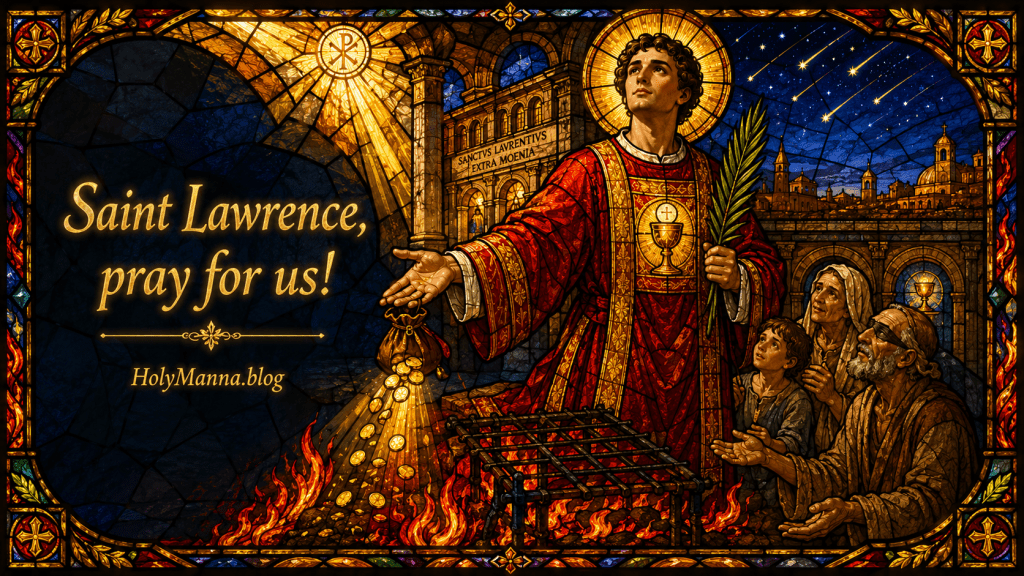
Every August 10th, the Church celebrates one of the most beloved martyrs in her entire history, and Rome celebrates one of her own patrons. Saint Lawrence was a deacon, the archdeacon of the Roman Church, entrusted by Pope Sixtus II with the material goods of the Church and with the care of her poor. When the Emperor Valerian unleashed his persecution in the year 258 and demanded that Lawrence hand over the treasures of the Church, the young deacon gave an answer that has echoed for over seventeen centuries. He gathered the poor, the sick, the blind, and the forgotten, presented them to the Roman prefect, and declared, according to the account of Saint Ambrose, “These are the treasures of the Church.”
That single sentence tells the reader almost everything about why the Church has never stopped talking about him. Lawrence understood, at the cost of his own life, what the Catechism of the Catholic Church teaches about the poor: “The works of mercy are charitable actions by which we come to the aid of our neighbor in his spiritual and bodily necessities” (CCC 2447). For Lawrence, the poor were never a budget line or a burden. They were the wealth of the Bride of Christ.
His witness was so powerful, and his cult so ancient, that his name was written into the Roman Canon, the oldest Eucharistic Prayer of the Church of Rome, where it is still spoken at the altar today. His feast day holds the liturgical rank of Feast in the universal calendar, an honor granted to very few martyrs. He is the patron of deacons, of cooks and chefs, of the poor, of librarians and archivists, of comedians, and of firefighters, and he stands alongside Saints Peter and Paul as a patron of the city of Rome itself. A treasurer, a servant, a martyr, and, as the reader will see, a man who could joke in the middle of his own execution; Saint Lawrence is proof that holiness and joy belong together.
A Son of Spain on the Road to Rome
The historically certain facts about Lawrence’s early life are few, and honesty demands saying so up front. What the documents establish beyond doubt is this: Lawrence was one of the seven deacons of the Church of Rome under Pope Sixtus II, he held the office of archdeacon with responsibility for the Church’s goods and almsgiving, and he was put to death on August 10th in the year 258. The ancient calendar of the Roman Church known as the Depositio Martyrum, compiled around the year 336, already lists his feast on that date, which shows that Christians were honoring him within living memory of his death. For a third century martyr, that is a remarkably solid foundation.
Everything about his origins comes from later tradition, and it should be received as tradition. That tradition holds that Lawrence was born in Hispania, in the town of Huesca in what is now the region of Aragon in Spain, sometime in the early third century; other traditions name Valencia or Tarragona instead. The same tradition gives him parents named Orentius and Patientia, who are themselves venerated as martyrs in Spain. It further tells that the young Lawrence went to the city of Caesaraugusta, modern Zaragoza, to study, and that there he met a respected Greek teacher of the faith who would one day become Pope Sixtus II. When Sixtus went to Rome, the story goes, Lawrence followed him, and when Sixtus was elected to the Chair of Peter in 257, he ordained Lawrence a deacon and set him over the Church’s charitable treasury, though Lawrence was still a young man. These details of his birthplace, family, and formation cannot be verified from contemporary sources, and the reader should hold them as the cherished tradition of the Church in Spain rather than as documented history.
What is not in doubt is the office he held and what it meant. A deacon in the early Church was ordained for service, especially service at the altar and service to the poor. The Catechism teaches that the sacrament of Holy Orders marks deacons “with an imprint (‘character’) which cannot be removed and which configures them to Christ, who made himself the ‘deacon’ or servant of all” (CCC 1570). Lawrence lived that configuration to Christ the Servant so completely that the Church has held him up ever since as the very model of the diaconate. Whatever the details of his road to Rome, the destination is certain: a young man standing at the altar beside the Pope, holding the chalice at the Holy Sacrifice, and holding the purse of the poor in his other hand.
Keeper of the Treasury, Servant of the Poor
To understand why Lawrence matters, the reader has to understand what his job actually was. As archdeacon of Rome, Lawrence was the first among the seven deacons who served the Roman Church. He assisted the Pope at the liturgy, and he administered the Church’s material goods, which above all meant distributing alms. The Church in Rome at that time supported widows, orphans, the sick, and the destitute by the hundreds. Lawrence knew the poor of Rome by face and by name, because caring for them was his daily work. When later generations called him the keeper of the treasures of the Church, they meant both things at once: the money and vessels in his care, and the poor whom that money existed to serve.
This is why his story lands so hard. Lawrence did not stumble into his famous answer under pressure. His whole life as a deacon had already taught him where the Church’s real wealth was located. Scripture had told him plainly, in words the Church still sings on his feast: “Lavishly he gives to the poor; his generosity shall endure forever” (Psalm 112:9). Saint Paul had told him: “God loves a cheerful giver” (2 Corinthians 9:7). Lawrence simply believed it, all the way down.
Tradition also attaches miracles to his ministry, especially during the final days of his life. The later accounts of his martyrdom, written several centuries after his death, tell that while Lawrence was held in custody he healed the blind by prayer and the sign of the cross. One story tells of a man named Lucillus, a fellow prisoner who had lost his sight, whom Lawrence baptized; at his baptism the man received his sight, and many other blind men then came to Lawrence and were healed. Another story tells that his jailer, a soldier named Hippolytus, was so moved by what he saw in Lawrence, including the healing power that flowed through him, that he believed in Christ and was baptized, and later gave his own life as a martyr. These stories come from accounts written long after the events and cannot be verified.
Even setting the unverifiable stories aside, the verified shape of his life already showcases what God can do through one faithful servant. Lawrence’s compassion was not private sentiment; it was the organized, daily mercy of the Church in action. The Catechism teaches that “love for the poor is even one of the motives for the duty of working so as to ‘be able to give to those in need’” (CCC 2444, quoting Ephesians 4:28). Lawrence is what that paragraph looks like with a face, a name, and a feast day. He is worth remembering and emulating because he shows that administration, budgets, logistics, and paperwork, the unglamorous machinery of charity, can be a path to the highest sanctity when they are done for love of Christ in the poor.
Three Days to Gather the Treasure
In August of 258, the Emperor Valerian issued a brutal edict: bishops, priests, and deacons were to be put to death immediately. This is documented history, preserved in a letter written that very month by Saint Cyprian, the bishop of Carthage, who would himself die a martyr under the same persecution. Cyprian reported to a fellow bishop that Pope Sixtus II had been executed on August 6th in the cemetery where he was celebrating the sacred mysteries, and four deacons with him. Four days later, on August 10th, Lawrence followed. Those dates, that sequence, and Lawrence’s death for Christ are as certain as anything in the third century can be.
Around that certain core, the Church received from Saint Ambrose of Milan, writing about one hundred and thirty years later in his work De Officiis, the two scenes that the world has never forgotten. Ambrose tells that as Pope Sixtus was being led away to die, Lawrence met him on the road and cried out to him with words that still pierce the heart: “Where are you going, father, without your son? Where are you hurrying, holy priest, without your deacon? You were never accustomed to offer the sacrifice without your minister.” And Sixtus, in Ambrose’s account, answered his deacon with a prophecy: “I am not leaving you or forsaking you, my son. Greater struggles are reserved for you. After three days you will follow me.”
Ambrose then tells what Lawrence did with his three days. The prefect of Rome, knowing that the deacon held the Church’s treasury, demanded that Lawrence surrender it. Lawrence asked for time to gather the wealth, and he spent the time distributing everything the Church possessed to the poor of the city. On the third day he appeared before the prefect leading a procession of the poor, the blind, the lame, the widows, and the orphans, and when he was asked where the promised treasures were, he pointed to them and said, “These are the treasures of the Church.”
The enraged prefect, tradition tells, then ordered a slow and theatrical death: Lawrence was stretched over a gridiron with burning coals beneath it, roasted alive over a low fire. And it is here that the tradition preserves one of the most astonishing sentences in the history of the martyrs. Ambrose records that after Lawrence had suffered a long while over the flames, he said to his executioners words rendered in English as, “It is roasted; turn it over and eat.” The saying is popularly retold as Lawrence telling his torturers that he was done on one side and asking to be turned over. This holy defiance, this joke told from inside the fire, is the reason the Church honors Lawrence as the patron of comedians and of cooks. He died praying, tradition adds, for the conversion of the city of Rome.
Honesty requires the reader to know how these accounts stand historically. The meeting with Sixtus and the gridiron itself come to us from Ambrose, from the poet Prudentius, and from an epigram of Pope Saint Damasus, all writing in the late fourth century on the basis of the oral tradition of the Roman Church rather than written records. Scholars have long noted that Valerian’s edict called for immediate execution, which normally meant beheading, as happened to Pope Sixtus, and some have proposed that a copyist’s error in an early text turned the Latin words for “he suffered” into the words for “he was roasted,” giving rise to the gridiron account. That remains a scholarly hypothesis, not a finding. What can be said with confidence is that the gridiron tradition is very early, attested within about a century of his death by three major witnesses, and that the Church has handed it down ever since. The details of the martyrdom, including the famous words, come from tradition and cannot be verified from contemporary documents; the martyrdom itself, on August 10th, 258, is beyond doubt.
However the sword or the fire came, the meaning is the same, and the Catechism states it plainly: “Martyrdom is the supreme witness given to the truth of the faith: it means bearing witness even unto death” (CCC 2473). Lawrence bore that witness with a generosity so extravagant, and a joy so unbreakable, that the Church of Rome dated a new era of courage from his death. Prudentius went so far as to present Lawrence’s martyrdom as the beginning of the end for idolatry in Rome, the moment the old gods began to lose the city.
The Fire That Spread Across the World
Lawrence was buried on the Via Tiburtina in the catacomb of Cyriaca, named in tradition for a devout widow who had assisted him in serving the poor. His tomb almost immediately became one of the most venerated places in Rome. In the fourth century, the Emperor Constantine raised a basilica over the site, which grew through the centuries into the great church of San Lorenzo fuori le Mura, Saint Lawrence outside the Walls, one of the Seven Pilgrim Churches of Rome that pilgrims have visited for centuries, especially in Jubilee years. In the sixth century, Pope Pelagius II opened Lawrence’s tomb to lay beside him the relics of Saint Stephen, the first martyr of the Church; to this day the deacon martyr of Jerusalem and the deacon martyr of Rome rest together under one altar. The gridiron venerated as the instrument of his death is kept in the Roman church of San Lorenzo in Lucina, his head is preserved and venerated at the Vatican, and the church of San Lorenzo in Panisperna traditionally marks the place of his execution. At one point, medieval Rome counted more than thirty churches dedicated to him, a density of devotion surpassed only by the greatest saints.
Miracle stories gathered around his intercession. One tradition holds that in the early fourth century the city of Rome was spared from a devastating fire through the intercession of Saint Lawrence, which strengthened his reputation as a protector of the city and later as a patron invoked against fire. This story cannot be verified. Another famous tradition touches the most storied relic in Christendom: it holds that Lawrence, as keeper of the Church’s goods, had in his care the very chalice of the Last Supper, and that before his arrest he sent it to his homeland in Spain for safekeeping. The Santo Cáliz, the Holy Chalice venerated today in the Cathedral of Valencia, is attached to this tradition. This story likewise cannot be verified.
The cultural reach of this one Roman deacon is honestly staggering. Every August, the Perseid meteor shower streaks across the night sky near his feast, and Christian folk tradition long ago named those falling lights the Tears of Saint Lawrence, fiery drops remembering the fiery death of the martyr. In 1557, King Philip II of Spain won the Battle of Saint Quentin on August 10th, the feast of Saint Lawrence, and in gratitude he built one of the monumental buildings of Europe, the monastery and palace of San Lorenzo de El Escorial near Madrid, designing its vast floor plan in the shape of a gridiron in honor of the saint. In 1535, the French explorer Jacques Cartier, arriving at a great gulf in the New World around the saint’s feast, gave Lawrence’s name to the waters; the Gulf of Saint Lawrence and the Saint Lawrence River carry the Roman deacon’s name across Canada to this day. In Rome, in Huesca, and in towns from Malta to the Philippines that hold him as patron, his feast is still kept with processions and celebrations, and in Italy many families spend the night of August 10th watching the sky for his tears.
All of this devotion rests on a truth the Catechism teaches about every saint in glory: “They do not cease to intercede with the Father for us, as they proffer the merits which they acquired on earth through the one mediator between God and men, Christ Jesus” (CCC 956). The Church does not honor Lawrence as a memory. She asks his prayers as a living member of the Body of Christ, more alive now than ever.
What Do You Count as Treasure?
Lawrence’s life presses one question on every reader, and it is worth sitting with rather than rushing past: What do you count as treasure? The Lord Himself said that where a person’s treasure is, there the heart will be also, in The Gospel of Matthew, chapter six. Lawrence answered with his life. Handed the entire wealth of the Church of Rome, he counted the poor as the treasure and the gold as the tool. The Catechism teaches that “Jesus enjoins his disciples to prefer him to everything and everyone, and bids them ‘renounce all that [they have]’ for his sake and that of the Gospel” (CCC 2544). That preference is not reserved for martyrs in ancient Rome. It is the daily calling of every baptized Christian.
There are concrete ways to weave Lawrence’s witness into ordinary life. The reader can begin by looking at the poor the way Lawrence did, not as a category but as persons with faces and names, and can choose one regular, concrete act of mercy: a monthly commitment to a food pantry, a standing gift to a trusted Catholic charity, a habit of actually stopping to speak with the person asking for help. The reader can also imitate Lawrence’s hidden faithfulness, because before the gridiron there were years of unglamorous service, budgets and distributions and errands done for love of Christ. Whoever manages money, at home or at work, can manage it the way Lawrence did, as a steward rather than an owner. Whose needs has God quietly placed within your reach, and what would it look like to treat those people as treasure this week?
And then there is his joy. Lawrence teaches that cheerfulness is not the opposite of seriousness about the faith; it is one of its fruits. A Christian who can keep peace, and even humor, in suffering is preaching a sermon no argument can match, because such peace points beyond this world. Jesus said, “Unless a grain of wheat falls to the ground and dies, it remains just a grain of wheat; but if it dies, it produces much fruit” (John 12:24), and the Church reads those very words at Mass on Lawrence’s feast. His death produced fruit that is still growing eighteen centuries later. When suffering comes to you, in small ways or great, do you meet it with bitterness, or is there room yet for trust, and even for joy? The reader does not need a persecution to practice this. Traffic, illness, disappointment, and ordinary Tuesdays offer plenty of grains of wheat to surrender.
Engage With Us!
The story of Saint Lawrence has been setting hearts on fire for over seventeen hundred years, and HolyManna would love to hear what it stirred in yours. Share your thoughts and reflections in the comments below; your words might be exactly the encouragement another reader needs today. To go deeper, consider praying with these questions this week:
- Saint Lawrence called the poor the treasures of the Church. Who are the poor within your reach right now, and how might God be asking you to serve them concretely this month?
- Lawrence served faithfully in hidden, practical work long before his famous witness. What hidden responsibility in your life could become an offering to God if you did it with greater love?
- Facing death, Lawrence kept his peace and even his humor. What does his joy in suffering reveal about where his trust was placed, and where is God inviting you to trust Him more?
- The Church has prayed with Saint Lawrence’s name in the Roman Canon for centuries. How might remembering the saints at Mass change the way you experience the liturgy this Sunday?
Saint Lawrence gave everything, held nothing back, and met the fire with a smile because he knew exactly Whom he served. May his prayers obtain for every reader a generous heart and an unshakable joy. Go into this week determined to live your faith out loud, to treasure the people God treasures, and to do everything, from the greatest sacrifice to the smallest chore, with the love and mercy that Jesus taught us.
Saint Lawrence, pray for us!
Follow us on YouTube, TikTok, Instagram and Facebook for more insights and reflections on living a faith-filled life.


Leave a comment