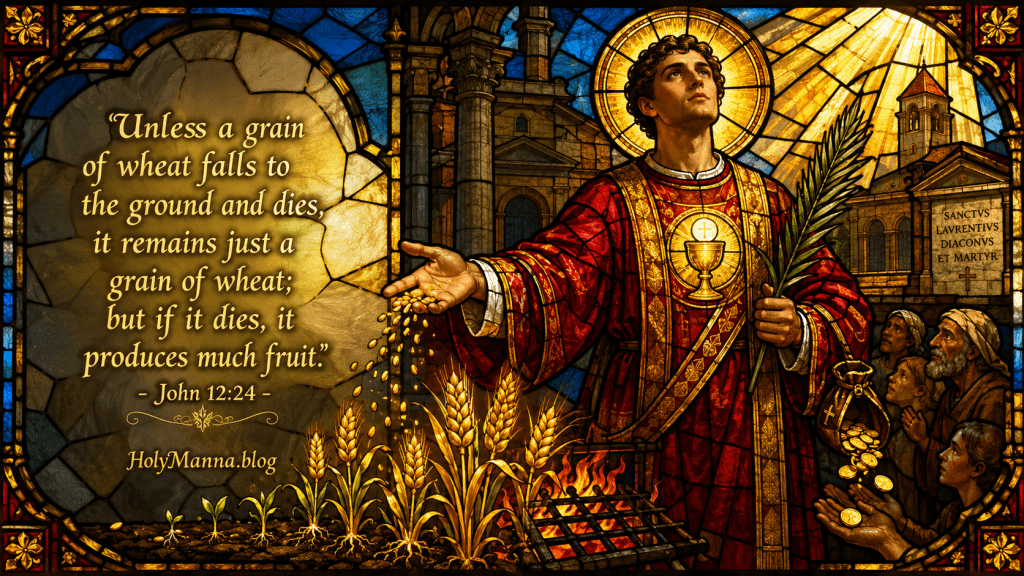
Feast of Saint Lawrence, Deacon and Martyr – Lectionary: 618
A Feast Written in Fire and Generosity
Some feast days whisper, and some blaze. August 10 blazes. The Church celebrates the Feast of Saint Lawrence, Deacon and Martyr, one of the most beloved figures of the early Roman Church, a man so venerated that his name still stands in the Roman Canon of the Mass and his date of death appears in a Roman calendar of martyrs written around the year 336. In August of 258, the Emperor Valerian decreed that every bishop, priest, and deacon in the empire be put to death. Pope Sixtus II was seized while celebrating the liturgy and executed on August 6. Four days later, on August 10, his archdeacon Lawrence, the man entrusted with the treasury of the Roman Church and the care of her poor, followed his bishop into glory.
The readings the Church selects for this feast form a single golden thread. Saint Paul tells the Corinthians that “whoever sows bountifully will also reap bountifully” and that “God loves a cheerful giver.” The Psalmist paints the portrait of a man who “lavishly… gives to the poor” and whose “heart is firm, trusting in the LORD.” Then Jesus delivers the paradox at the center of everything: “unless a grain of wheat falls to the ground and dies, it remains just a grain of wheat; but if it dies, it produces much fruit.” The central theme uniting this feast is the economy of God, in which nothing given away for love of Christ is ever lost. It is sown. Lawrence gave away the Church’s treasure, then gave away himself, and the harvest is still coming in seventeen centuries later.
First Reading — 2 Corinthians 9:6-10
The Economy of Grace and the Cheerful Giver
Around the year 57, Saint Paul was organizing one of the most remarkable projects of the apostolic age, a great collection taken up among the Gentile churches of Macedonia and Achaia for the impoverished Christians of Jerusalem. Famine and persecution had left the mother church destitute, and Paul saw in this collection something far greater than charity. It was a visible sign that Jew and Gentile now formed one Body in Christ. Chapters 8 and 9 of The Second Letter to the Corinthians are his appeal to a wealthy but distracted congregation, and this passage is its beating heart. The Church places it on the lips of the liturgy today because Lawrence was, quite literally, the man in charge of the collection. As archdeacon of Rome, he held the purse of the Church and distributed her alms, and he understood Paul’s teaching so deeply that he staked his life on it.
2 Corinthians 9:6-10
Brothers and sisters:
Whoever sows sparingly will also reap sparingly,
and whoever sows bountifully will also reap bountifully.
Each must do as already determined, without sadness or compulsion,
for God loves a cheerful giver.
Moreover, God is able to make every grace abundant for you,
so that in all things, always having all you need,
you may have an abundance for every good work.
As it is written:
He scatters abroad, he gives to the poor;
his righteousness endures forever.
The one who supplies seed to the sower and bread for food
will supply and multiply your seed
and increase the harvest of your righteousness.
Detailed Exegesis
Verse 6: “Whoever sows sparingly will also reap sparingly, and whoever sows bountifully will also reap bountifully.”
Paul opens with an agricultural principle every ancient reader knew by instinct. A farmer who hoards his seed out of fear guarantees a thin harvest, while the farmer who scatters generously appears wasteful in spring yet feasts in autumn. Paul lifts this law of the field into the spiritual order. Generosity is not loss but planting, and the measure of the harvest is set at the moment of sowing.
Verse 7: “Each must do as already determined, without sadness or compulsion, for God loves a cheerful giver.”
Paul refuses to manipulate. Giving must flow from a deliberate interior decision, not from guilt, social pressure, or reluctance. The Greek word behind “cheerful” is hilaron, the root of the English word hilarious, and it describes a joy that spills over. God does not need the gift; He delights in the giver whose heart has become like His own. This is the verse that tradition saw fulfilled in Lawrence, who according to the accounts of the early Church kept his joy, and even his humor, to the very end.
Verse 8: “Moreover, God is able to make every grace abundant for you, so that in all things, always having all you need, you may have an abundance for every good work.”
Here is the answer to the fear that makes people clutch their possessions. The giver never outruns God. Paul piles up words of totality, every grace, all things, always, all you need, to insist that divine provision is not rationed. The purpose of abundance, though, is striking. God supplies not so that the believer may accumulate, but so that the believer may have “an abundance for every good work.”
Verse 9: “As it is written: He scatters abroad, he gives to the poor; his righteousness endures forever.”
Paul reaches back to Psalm 112, the very psalm the Church sings today, and quotes verse 9 directly. The lectionary pairing is deliberate and beautiful. The righteous man scatters his gifts the way a sower scatters seed, without anxiously tracking where each grain lands, and what endures forever is not his fortune but his righteousness. The only wealth that survives death is the wealth that was given away.
Verse 10: “The one who supplies seed to the sower and bread for food will supply and multiply your seed and increase the harvest of your righteousness.”
Paul closes by naming the true source of the whole cycle. Even the seed in the sower’s hand was a gift. God supplies the resources, multiplies the offering, and grows the harvest, which means the giver is never truly the owner but always the steward. Paul promises that the generous life produces a harvest of righteousness that God Himself tends.
Teachings
The Church has read this passage into her very worship. CCC 1351 teaches, “From the very beginning Christians have brought, along with the bread and wine for the Eucharist, gifts to share with those in need. This custom of the collection, ever appropriate, is inspired by the example of Christ who became poor to make us rich.” From the earliest centuries, it was the deacons who carried those gifts from the altar to the hungry, which is exactly the office Lawrence held. The Catechism also names almsgiving among the greatest acts of Christian love. CCC 2447 teaches, “Among all these, giving alms to the poor is one of the chief witnesses to fraternal charity: it is also a work of justice pleasing to God.”
Saint Ambrose, writing in the late fourth century, preserved the most famous account of how Lawrence lived this reading. When the Roman prefect demanded that Lawrence hand over the treasures of the Church, the deacon asked for time, distributed the Church’s goods to the needy, and then assembled the poor, the sick, and the suffering before the prefect. According to Ambrose’s account in De Officiis Ministrorum, Lawrence pointed to them and declared, “These are the treasures of the Church.” Ambrose then asks the question that has echoed through the centuries: “What better treasures has Jesus than those in which he loves to be seen?” (De Officiis Ministrorum II, 28, 140). In one gesture, Lawrence preached this entire reading. The Church’s wealth was already sown in the poor, exactly where Christ promised to be found.
Reflection
This reading asks you a blunt question: do you give like a sower or save like a hoarder? Practical steps make the answer concrete. Review one recurring expense this week and redirect it to a person or ministry in genuine need. Decide your giving in advance, prayerfully and deliberately, so that generosity flows from conviction rather than impulse or guilt. Give something that costs you comfort, not just surplus, whether that is money, an evening of your time, or patience with a difficult family member. Then watch your own heart as you do it. Do you release the gift with joy, or does sadness and compulsion creep in? Ask the Holy Spirit to transform duty into delight, because God is not measuring the size of your gift but the cheerfulness of your heart. If Christ asked you today where your treasures are, could you point to the poor you have loved?
Responsorial Psalm — Psalm 112:1-2, 5-9
The Portrait of a Man Whose Heart Is Firm
Psalm 112 is a wisdom psalm, composed as an acrostic in which each line begins with a successive letter of the Hebrew alphabet, a poetic way of saying that generosity and justice cover life from A to Z. It is also the twin of Psalm 111. The two psalms mirror each other line by line, and the parallel carries a stunning theological claim: Psalm 111 describes the gracious and merciful works of God, while Psalm 112 describes the man who fears the Lord, using the very same vocabulary. The person who delights in God’s commands gradually takes on the family resemblance of God Himself. The Church sings this psalm today because it reads like a portrait of Lawrence painted seven centuries before his birth, a man gracious and lavish toward the poor, unafraid of an evil report, steadfast while looking down upon his foes.
Psalm 112:1-2, 5-9
R. (5) Blessed the man who is gracious and lends to those in need.
Blessed the man who fears the LORD,
who greatly delights in his commands.
His posterity shall be mighty upon the earth;
the upright generation shall be blessed.
R. Blessed the man who is gracious and lends to those in need.
Well for the man who is gracious and lends,
who conducts his affairs with justice;
He shall never be moved;
the just one shall be in everlasting remembrance.
R. Blessed the man who is gracious and lends to those in need.
An evil report he shall not fear;
his heart is firm, trusting in the LORD.
His heart is steadfast; he shall not fear
till he looks down upon his foes.
R. Blessed the man who is gracious and lends to those in need.
Lavishly he gives to the poor,
his generosity shall endure forever;
his horn shall be exalted in glory.
R. Blessed the man who is gracious and lends to those in need.
Detailed Exegesis
Verses 1-2: “Blessed the man who fears the LORD, who greatly delights in his commands. His posterity shall be mighty upon the earth; the upright generation shall be blessed.”
The psalm opens where all biblical wisdom opens, with the fear of the Lord, which is not terror but the awe-filled reverence of a creature before its Creator. Notice that this man does not merely obey the commandments; he “greatly delights” in them. Obedience has ripened into love. The promise of a mighty posterity found a literal fulfillment in Lawrence, whose spiritual descendants, the countless faithful inspired by his witness, span every continent.
Verse 5: “Well for the man who is gracious and lends, who conducts his affairs with justice.”
The blessed man is not a recluse. He handles money, makes loans, and conducts affairs, yet everything passes through the filter of graciousness and justice. Holiness here is startlingly practical. It looks like fair dealing, honest accounts, and open hands, which is precisely the kind of sanctity demanded of a deacon entrusted with the treasury of the Church of Rome.
Verse 6: “He shall never be moved; the just one shall be in everlasting remembrance.”
The Hebrew idea of remembrance is not nostalgia but living presence before God and His people. The verse proved almost prophetic for Lawrence. Rome remembered him with such devotion that Constantine raised a shrine over his tomb on the Via Tiburtina, today the Basilica of Saint Lawrence Outside the Walls, and the Church still speaks his name in the first Eucharistic Prayer.
Verses 7-8: “An evil report he shall not fear; his heart is firm, trusting in the LORD. His heart is steadfast; he shall not fear till he looks down upon his foes.”
Twice the psalmist mentions the heart, and twice he mentions fearlessness, because the two rise and fall together. The man whose security rests in the Lord can hear the worst news imaginable, even an imperial edict of death, without being unmoored. His victory is not aggression but endurance; he simply outlasts his foes by standing on something they cannot touch.
Verse 9: “Lavishly he gives to the poor, his generosity shall endure forever; his horn shall be exalted in glory.”
The psalm crescendos in the verse Saint Paul quotes in today’s First Reading. The word “lavishly” deliberately breaks the logic of careful accounting, and the horn, an ancient symbol of strength and honor, is exalted not through conquest but through mercy. Glory, the psalm insists, belongs to the extravagant giver.
Teachings
The refrain the Church places on every tongue today, “Blessed the man who is gracious and lends to those in need,” turns the psalm from a description into an aspiration. The fearlessness of verses 7 and 8 is what the Church calls the virtue of fortitude. CCC 1808 teaches, “Fortitude is the moral virtue that ensures firmness in difficulties and constancy in the pursuit of the good. It strengthens the resolve to resist temptations and to overcome obstacles in the moral life. The virtue of fortitude enables one to conquer fear, even fear of death, and to face trials and persecutions.” Saint Ambrose, in De Officiis Ministrorum, preserves a tradition that shows this psalm lived out in real time. When Pope Sixtus II was being led to execution, Lawrence wept, not from fear, but because he was being left behind, asking his bishop where he was going without his deacon. Sixtus, according to Ambrose’s account, consoled him with the promise that Lawrence would follow him in three days. A heart that grieves at missing martyrdom is a heart the psalmist would recognize, firm, steadfast, and trusting in the Lord.
Reflection
The psalm hands you a mirror rather than a lecture. When an evil report comes into your life, a frightening diagnosis, a layoff, a betrayal, where does your heart run first? Practice building a firm heart in small ways. Begin each morning this week by praying one verse of Psalm 112 slowly, letting it settle before checking your phone. Choose one financial decision, even a modest one, and conduct it with deliberate graciousness, a fair price, a forgiven debt, a generous tip. When anxiety rises, speak the psalmist’s words aloud: “his heart is firm, trusting in the LORD.” Fearlessness is not a personality trait but a fruit of trust, grown one act of confidence at a time. What would your week look like if you truly believed that lavish generosity, not careful self-protection, is the road to glory?
Holy Gospel — John 12:24-26
The Law of the Grain of Wheat
The setting of this Gospel is charged with electricity. Jesus has just entered Jerusalem to shouts of Hosanna, and some Greeks, Gentiles drawn to the God of Israel, have approached Philip with a simple request to see Jesus. Their arrival signals to Jesus that His hour has come, the hour when His mission bursts beyond Israel to embrace the whole world. But instead of celebrating His growing fame, Jesus answers with one of the most piercing paradoxes in all of Scripture, drawn from the humblest of images, a single grain of wheat. In three short verses He lays down the fundamental law of the Kingdom, the law of fruitfulness through death, and then extends it to everyone who would follow Him. The Church proclaims this passage on August 10 because Lawrence obeyed it to the letter, and the harvest of his dying is still being gathered.
John 12:24-26
Jesus said to his disciples:
“Amen, amen, I say to you,
unless a grain of wheat falls to the ground and dies,
it remains just a grain of wheat;
but if it dies, it produces much fruit.
Whoever loves his life loses it,
and whoever hates his life in this world
will preserve it for eternal life.
Whoever serves me must follow me,
and where I am, there also will my servant be.
The Father will honor whoever serves me.”
Detailed Exegesis
Verse 24: “Amen, amen, I say to you, unless a grain of wheat falls to the ground and dies, it remains just a grain of wheat; but if it dies, it produces much fruit.”
The double amen is Jesus’ most solemn formula, reserved for truths on which everything depends. A grain of wheat kept safe in a jar is preserved but sterile; only when it is buried, broken open, and seemingly destroyed does its hidden life multiply. Jesus is speaking first of Himself. His death, which will look like utter failure, will produce the Church, the sacraments, and the salvation of the world. The image also quietly redefines safety. The seed that refuses the soil is not saved; it is wasted.
Verse 25: “Whoever loves his life loses it, and whoever hates his life in this world will preserve it for eternal life.”
The word “hates” is a Semitic idiom of comparison, meaning to love less by contrast, just as elsewhere Scripture speaks of loving one and hating another to express preference. Jesus is not commanding self-loathing; He is exposing the great irony of self-preservation. The person who makes this earthly life the supreme good will watch it slip away, while the person who holds it loosely for the sake of Christ receives it back transfigured and eternal. The verse turns every human instinct for self-protection on its head.
Verse 26: “Whoever serves me must follow me, and where I am, there also will my servant be. The Father will honor whoever serves me.”
Jesus now makes the grain of wheat personal. To serve Him is to follow Him, and His road runs through the Cross before it reaches glory. Yet the promise attached is breathtaking. The servant will be where the Master is, which means nothing less than heaven itself, and the Father Himself will honor the one who serves the Son. The infinite God stooping to honor a creature is a reversal no human religion would have dared to invent. The Greek word for servant here is diakonos, the very word from which the office of deacon takes its name, and the early Church could not have missed the connection on the feast of her most famous deacon.
Teachings
Saint Augustine preached on this feast around the year 400, and his words in Sermo 304 remain the finest commentary on how Lawrence fulfilled this Gospel. Augustine says of Lawrence that “he performed the office of deacon; it was there that he administered the sacred chalice of Christ’s blood; there that he shed his own blood for the name of Christ,” and he summarizes the saint’s whole life in a single sentence: “He loved Christ in his life, he imitated him in his death.” The Catechism gives this pattern its name. CCC 2473 teaches, “Martyrdom is the supreme witness given to the truth of the faith: it means bearing witness even unto death. The martyr bears witness to Christ who died and rose, to whom he is united by charity. He bears witness to the truth of the faith and of Christian doctrine. He endures death through an act of fortitude.”
Tradition, recorded by both Saint Ambrose and the poet Prudentius, holds that Lawrence was executed by being roasted alive on a gridiron, and that even in the flames his cheerful heart did not fail him, telling his executioners, according to the tradition, “I am cooked on that side; turn me over.” Honesty requires noting that early scholarship, including the Catholic Encyclopedia, observes that these details rest on oral tradition and that Lawrence may in fact have been beheaded like Pope Sixtus. What is beyond doubt is the martyrdom itself, attested within a century of his death, and the astonishing fruit it bore. Tertullian had already written of the martyrs in his Apologeticus that “the blood of Christians is seed,” and Rome proved him right. Devotion to Lawrence spread so rapidly that Augustine could tell his congregation the deacon’s fame was known everywhere, and Augustine widened the lesson for those never called to die: “in the Lord’s garden are to be found not only the roses of His martyrs. In it there are also the lilies of the virgins, the ivy of wedded couples, and the violets of widows” (Sermo 304). Every state of life has its own way of falling into the ground.
Reflection
Most readers will never face a Roman prefect, but the grain of wheat still asks for your life, just in smaller denominations. What are you keeping safe in the jar, a talent unshared, a forgiveness withheld, a comfort you refuse to disturb? Choose one seed this week and let it fall. Volunteer for the task at your parish that nobody wants. Have the humble conversation that costs your pride. Offer up a hidden sacrifice, unnoticed by everyone except the Father who honors those who serve His Son. Consider also the quiet witness of daily fidelity, what the Church has long called white martyrdom, the slow poured-out love of parenting, caregiving, honest work, and prayer when no one is watching. If the Father promises to honor whoever serves Jesus, why do you still hesitate to serve Him in the hidden places? The grain that dies is the only grain with a future.
The Harvest That Outlasts the Fire
Step back and the three readings fuse into one blazing image. Paul promises that the bountiful sower will reap bountifully. The psalmist sings of the fearless man who gives lavishly to the poor and is remembered forever. Jesus reveals the deepest reason why it all works: the grain of wheat that falls and dies produces much fruit. Saint Lawrence stands at the intersection of all three texts like a living commentary. He sowed the Church’s treasure into the hands of the poor, cheerfully and without compulsion. His heart stayed firm before an emperor’s edict. And on August 10, 258, he fell into the ground like the grain his Master described, trusting that God, who supplies seed to the sower, would supply the harvest.
He did. Seventeen centuries later, a basilica guards his tomb, the Roman Canon speaks his name at altars on every continent, and his story still unsettles comfortable hearts, which is exactly what the stories of the saints are for. The treasures of the Church are still the poor. The road to glory still runs through generosity. The only life preserved for eternity is still the life given away.
So take the feast personally. Find one place this week where fear has been rationing your generosity, with money, with time, with mercy, and sow bountifully there instead. Bring a gift for the poor to the altar, the way the first Christians did. Ask Saint Lawrence, the cheerful giver who laughed in the face of death, to intercede for a heart that gives with joy. The fire tested him and found pure gold. Let the smaller fires of ordinary sacrifice do the same, one fallen grain at a time.
Engage With Us!
Your reflections matter here, and this community grows richer every time someone shares honestly, so please add your thoughts in the comments below. Consider these questions as a starting point:
- In 2 Corinthians 9:6-10, Saint Paul writes that God loves a cheerful giver. Where in your life do you give with genuine joy, and where has giving become reluctant or pressured?
- Psalm 112:1-2, 5-9 describes a man whose heart is firm and who does not fear an evil report. What news or worry most threatens your peace right now, and what would trusting the Lord with it actually look like this week?
- In John 12:24-26, Jesus teaches that the grain of wheat must fall to the ground and die to bear fruit. What is one comfort, habit, or ambition He may be inviting you to surrender so that something greater can grow?
- Taken together, these readings reveal that nothing given away for love of Christ is ever lost. Where is God inviting you to stop protecting and start sowing?
However the Lord is speaking to you today, do not let the moment pass unanswered. A life of faith is built from small, brave acts of generosity repeated until they become a heart like His. Go into this week resolved to do everything, the giving, the serving, even the suffering, with the love and mercy Jesus taught us.
Sacred Heart of Jesus, we trust in You!
Immaculate Heart of Mary, pray for us!
Saint Michael the Archangel, defend us in battle!
Follow us on YouTube, TikTok, Instagram and Facebook for more insights and reflections on living a faith-filled life.

 Holy Manna!
Leave a comment