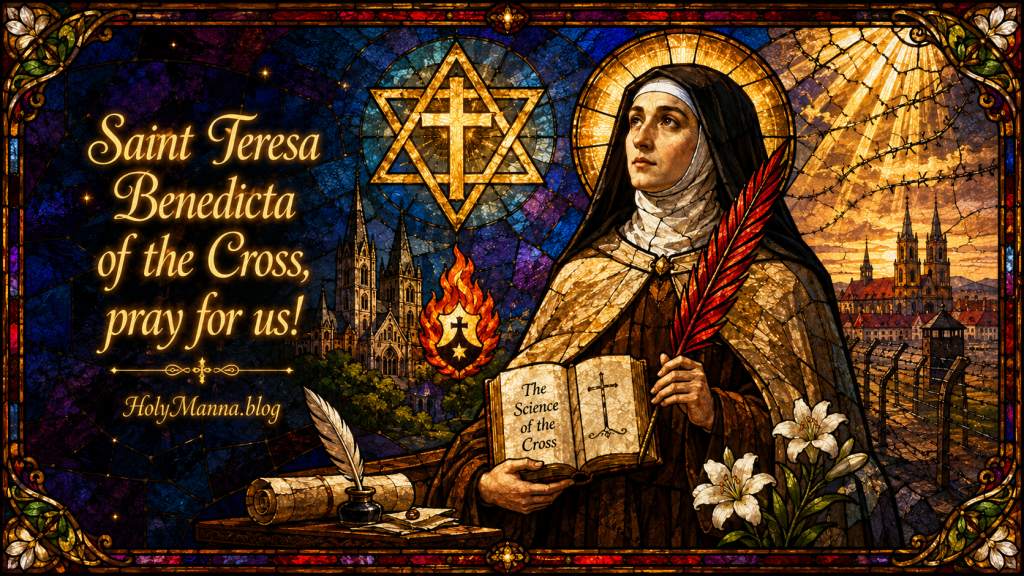
A Light in History’s Darkest Century
Some saints feel distant, wrapped in centuries of stained glass and incense. Saint Teresa Benedicta of the Cross is not one of them. She rode trains, wrote academic papers, argued philosophy over coffee, worried about her career, and loved her mother fiercely. She was born Edith Stein in 1891 and died in the gas chamber at Auschwitz-Birkenau on August 9, 1942. Her life spans the modern world at its most brilliant and its most monstrous, and she walked through both with her eyes wide open and her heart fixed on Christ.
The Church celebrates her on August 9th, the anniversary of her death. She is remembered as a philosopher of the first rank, a convert from atheism, a Discalced Carmelite nun, and a martyr who went to her death saying she was going for her people. In 1999, Pope St. John Paul II named her co-patroness of Europe, alongside St. Bridget of Sweden and St. Catherine of Siena, entrusting the whole continent to the intercession of a woman the continent had murdered.
Her story matters because it answers a question so many people carry quietly: Can an honest, intelligent, modern person really believe this? Edith Stein spent decades demanding the truth from life, refusing every comfortable half answer, and the search led her straight to the Cross. The Catechism teaches that the desire for God is written in the human heart, because man is created by God and for God, and that God never ceases to draw man to Himself (CCC 27). Her whole life reads like a commentary on that single paragraph.
A Daughter of Israel Who Stopped Praying
Edith Stein was born on October 12, 1891, in Breslau, Germany, a city that today is Wrocław, Poland. She was the youngest of eleven children in a devout Jewish family, though several of her siblings died in infancy. The day of her birth fell that year on Yom Kippur, the Day of Atonement, the holiest day of the Jewish calendar. Her mother always treasured that coincidence, and years later Edith herself came to see it as a quiet sign of the destiny God had prepared for her.
Her father, Siegfried, died suddenly on a business trip before Edith turned two. Her mother, Auguste, a woman of iron faith and iron will, took over the family lumber business and raised her children alone, keeping the Sabbath and the feasts with devotion. Edith adored her. Yet the daughter’s path bent away from the mother’s faith early. Around the age of fourteen, by her own account in her memoir Life in a Jewish Family, Edith deliberately gave up praying. She did not drift into unbelief; she chose it, with the same seriousness she brought to everything. For years she considered herself an atheist, though she never stopped asking the questions that only God can answer.
She was, by every account, dazzling. She studied psychology at the University of Breslau, then moved in 1913 to Göttingen to study under Edmund Husserl, the founder of phenomenology and one of the most influential philosophers of the age. She belonged to a circle of extraordinary minds, including Max Scheler and Adolf Reinach. When the First World War broke out, she interrupted her studies to serve as a Red Cross volunteer nursing aide in an Austrian field hospital, tending soldiers sick with typhus and dysentery. In 1916 she completed her doctorate summa cum laude with a dissertation titled On the Problem of Empathy, and Husserl chose her as his personal assistant. She sought a professorship, and she was repeatedly blocked, largely because she was a woman. The academy was not ready for her. Heaven, as it turned out, had other plans.
Two encounters cracked her unbelief open. The first came in 1917, when her friend Adolf Reinach was killed in the war. Edith went to help his young widow, Anna, expecting to find a woman destroyed. Instead she found a Christian whose grief was shot through with hope in the crucified and risen Christ. Edith later described that meeting as her first real encounter with the power of the Cross, the moment her unbelief collapsed even if her faith had not yet been born.
The second encounter came in the summer of 1921. Staying with her friend Hedwig Conrad-Martius in Bergzabern, Edith pulled a book off the shelf almost at random one evening. It was the autobiography of St. Teresa of Ávila, the great Carmelite mystic and reformer. Edith read the entire book in a single night. When she closed it at dawn, she said simply, “This is the truth.” The woman who had demanded truth from philosophy for twenty years recognized it at last, not as a proposition but as a Person. She bought a catechism and a missal, studied them, and presented herself for baptism. On January 1, 1922, Edith Stein was baptized into the Catholic Church. The Catechism teaches that baptism seals the Christian with the indelible spiritual mark of belonging to Christ, a seal that no sin can erase (CCC 1272). She would carry that seal to Auschwitz.
Her conversion cost her dearly. Her beloved mother wept when Edith told her, and she never reconciled herself to her daughter’s Catholic faith. This wound never closed. Edith kept visiting her mother, kept accompanying her to synagogue, kept loving her without reserve. She never treated her Jewish heritage as something left behind. She understood herself, always, as a daughter of Israel who had found Israel’s Messiah.
The Scholar Who Became a Bride of the Cross
Edith wanted to enter a Carmelite monastery almost immediately after her baptism. Her spiritual directors wisely told her to wait. Her mother’s grief was still raw, and the Church needed her voice in the world. So for more than a decade she poured herself out as a teacher and a public Catholic intellectual, and the Church in Germany was richer for it.
From 1923 to 1931 she taught at Saint Magdalena’s, a Dominican school for training women teachers in Speyer. She lived simply, prayed for long hours before the tabernacle, and quietly gave away much of her salary to the poor. During these years she undertook the demanding work of bringing the Catholic intellectual tradition into conversation with modern philosophy. She translated St. Thomas Aquinas’s great treatise on truth, De Veritate, into German, along with the letters and diaries of St. John Henry Newman. She became one of the most sought after Catholic lecturers in Europe, speaking across Germany and beyond on the dignity and vocation of women. Her talks, gathered in Essays on Woman, argued that women possess a particular genius for empathy, for nurturing the whole person, and that this genius is needed everywhere, in the home, the school, the professions, and the Church.
It is worth pausing on how she understood truth, because it is the key to her whole life. She did not believe that faith asked her to stop thinking. She believed that all truth, wherever it is found, leads to God, and that the human mind is made for truth the way the eye is made for light. The Catechism echoes this conviction when it teaches that man tends by nature toward the truth and is obliged to honor and bear witness to it (CCC 2467). Edith Stein bore that witness first with her pen, and finally with her blood.
In 1932 she accepted a lectureship at the German Institute for Scientific Pedagogy in Münster. It lasted barely a year. In 1933 the Nazis came to power, and their racial laws stripped her of her position because she was born a Jew. She saw with terrible clarity what was coming. That April she wrote a personal letter to Pope Pius XI, pleading with the Church to raise its voice against the persecution of the Jewish people. The letter, published by the Vatican in 2003, shows a woman who understood the storm before almost anyone else.
With the world’s doors closing, the door she had longed for finally opened. In October 1933 she entered the Discalced Carmelite monastery of Cologne. She was forty two years old, a famous scholar scrubbing floors as a novice, and by every account she was radiantly happy. She received the religious name Teresia Benedicta a Cruce, Teresa Blessed by the Cross. The name was her own request, and it was a prophecy. She made her final vows in 1938. Inside the cloister she completed her philosophical masterwork, Finite and Eternal Being, an attempt to unite the phenomenology of her youth with the wisdom of St. Thomas.
No miracles are recorded from her lifetime, and honesty requires saying so plainly. Her contemporaries did not report healings at her hands or wonders at her word. What they reported was something quieter and, in its way, just as arresting: a stillness, a purity of attention, a charity that seemed to come from somewhere else. The Catechism teaches that all Christians are called to the fullness of Christian life and to the perfection of charity, and that this holiness is the true program of every vocation (CCC 2013). Her miracle, during her lifetime, was simply that she said yes to that call without holding anything back.
Come, Let Us Go for Our People
After Kristallnacht in November 1938, when synagogues burned across Germany and the persecution turned openly violent, it became clear that Sister Teresa Benedicta’s presence endangered her whole community. On the night of December 31, 1938, she was smuggled across the border to the Carmel of Echt in the Netherlands. Her sister Rosa, who had also become a Catholic, joined her there and served the community as portress.
Edith did not mistake Echt for safety. In 1939 she wrote a testament offering her life to God in advance, for the Jewish people, for the Church, for the deliverance of Germany, and for peace in the world. She had taken the Cross into her name; now she took it into her will. In 1941 her superiors asked her to write a study of St. John of the Cross for the four hundredth anniversary of his birth. She threw herself into the work, which she titled The Science of the Cross. She was still writing it when the SS came for her. The manuscript was left unfinished on her desk, which may be the most fitting ending any of her books could have had, since she finished the argument with her life.
In 1942 the Nazis began the mass deportation of Dutch Jews. The Catholic bishops of the Netherlands refused to stay silent. On Sunday, July 26, 1942, a public protest against the deportations was read from every Catholic pulpit in the country. The Nazi retaliation was swift and calculated. On Sunday, August 2, 1942, the SS arrested the Catholics of Jewish descent in Holland, roughly two hundred and forty four souls, among them priests and religious. That evening two SS officers appeared at the Carmel of Echt and gave Sister Teresa Benedicta and Rosa minutes to leave. As the neighbors gathered in shock at the convent door, witnesses heard Edith’s last words to her frightened sister: “Come, let us go for our people.”
The sisters were taken first to the camp at Amersfoort, then to the transit camp at Westerbork. Survivors who passed through Westerbork in those days and lived to testify described her presence there in words that still stop the heart. Amid the terror, she moved among the prisoners like a woman at peace, washing children, combing their hair, feeding them, caring for little ones whose mothers were too shattered by shock to function. One witness compared her to a Pietà, sorrow itself made calm by love. A Dutch official at Westerbork later testified that he offered to make a final attempt to have her released, and that she refused. She told him that baptism should not become an unfair advantage, and that if she could not share the fate of her brothers and sisters, her life in a certain sense was destroyed.
On August 5, 1942, she sent a last letter to her prioress from the camp. In it she wrote, “One can gain a science of the Cross only if one feels the weight of the Cross pressing down with all its force.” Two days later she and Rosa were loaded into a sealed freight car headed east. There is a moving testimony from a station master at Schifferstadt in Germany, who reported that as the deportation train paused there, Edith sent greetings through him to the sisters she had known in Speyer. The account rests on a single witness, and it cannot be verified.
The train reached Auschwitz-Birkenau. According to the documentation later certified by the Dutch Red Cross, Sister Teresa Benedicta of the Cross and her sister Rosa were killed in the gas chamber on August 9, 1942, almost certainly on the day of their arrival. She was fifty years old. She left no grave and no bodily relics. Her body, like the bodies of the millions murdered with her, was destroyed by her killers.
The Church formally recognizes her death as martyrdom, and the Catechism explains why that word matters so much: martyrdom is the supreme witness given to the truth of the faith, the witness of one who bears testimony even unto death (CCC 2473). She was arrested because she was born a Jew, and she was arrested in that particular roundup because the Catholic Church had spoken out and the Nazis wanted revenge on Catholic Jews. In her, the hatred of her people and the hatred of the faith met, and she answered both with the offering she had already made in 1939. Pope St. John Paul II beatified her in Cologne on May 1, 1987, declaring her a martyr of the Church.
A Miracle in Massachusetts and a Patroness for Europe
Because she was beatified as a martyr, no miracle was required for her beatification. For canonization, one was. God provided it in a way that seems almost deliberately designed to carry her signature.
In March 1987, a two year old girl in Massachusetts named Teresia Benedicta McCarthy got into the family medicine supply and swallowed a massive overdose of Tylenol, many times the lethal dose. She was rushed to Massachusetts General Hospital, where doctors diagnosed catastrophic, irreversible liver damage along with failing kidneys. The family was told the child could not survive, and she was placed on a transplant list. Her father, a priest of the Melkite Catholic Church, along with dozens of relatives and friends, began praying intensely for the intercession of the nun the little girl had been named after, Sister Teresia Benedicta of the Cross. Within days the child made a complete recovery. Her liver and kidneys, which specialists had written off, appeared healthy. The physician who treated her, Dr. Ronald Kleinman, a Jewish pediatric specialist, later testified before the Congregation for the Causes of Saints and stated publicly that he considered her recovery miraculous. One detail gives the story its final polish: the little girl had been born on August 8, 1984, a date which, in the time zone of Auschwitz, was already August 9th, the anniversary of the saint’s death. The Church investigated the healing and formally declared it a miracle obtained through the intercession of Blessed Teresa Benedicta.
On October 11, 1998, Pope St. John Paul II canonized her in St. Peter’s Square. At the canonization Mass he preached one of the most quoted homilies of his pontificate, distilling her whole witness into a single charge to the Church: “St Teresa Benedicta of the Cross says to us all: Do not accept anything as the truth if it lacks love. And do not accept anything as love which lacks truth! One without the other becomes a destructive lie.” In the same homily he quoted her own words about her heritage and her vocation: “Beneath the Cross I understood the destiny of God’s People.”
One year later, on October 1, 1999, he named her co-patroness of Europe in the apostolic letter Spes Aedificandi, placing her beside St. Bridget of Sweden and St. Catherine of Siena as a spiritual mother of the continent. The choice was deliberate and piercing. Europe, which had gassed her, would now be commended to her prayers. Her canonization was not without pain; some in the Jewish community objected that she was murdered not for her Catholic faith but for her Jewish blood, and the Church has answered not by minimizing that truth but by binding her memory to the memory of the Shoah itself, so that she can never be venerated without the six million being remembered.
Her legacy today is vast. Since she has no relics, her memory is kept through her writings, her manuscripts preserved at the Edith Stein Archive in the Cologne Carmel, her family home in Wrocław, which is now a house of study and remembrance, the Carmel of Echt, and memorials at Auschwitz-Birkenau. Schools, churches, and student centers across Germany and around the world bear her name. Her philosophical work on empathy is studied today in secular universities that would once have denied her a chair. And every believer who venerates her stands inside the mystery the Catechism describes when it teaches that the communion of saints joins the pilgrims on earth to those in heaven in one exchange of spiritual goods (CCC 957).
Taking Up the Cross in an Ordinary Week
It would be easy to admire Saint Teresa Benedicta from a safe distance, the way one admires a mountain. Her intellect, her courage, and her death can all feel far beyond ordinary life. But she would have rejected that distance completely, because the heart of her story is not genius or heroism. The heart of her story is honesty before the truth, and that is available to everyone.
She teaches, first, that the search for truth is holy even when the searcher does not yet know God. She spent years as an atheist, and God wasted none of them. Every honest question she asked was secretly a step toward Him. Is there a question about faith that you have been avoiding because you fear where the answer might lead? Her life suggests that the fear is misplaced. Truth, followed faithfully, leads home.
She teaches, second, that conversion is not a single night but a long obedience. The night she read St. Teresa of Ávila was dramatic, but what followed was twenty years of daily fidelity: Mass, prayer before the tabernacle, hidden generosity, patient love for a mother who could not understand her. The Catechism teaches that the way of perfection passes by way of the Cross, and that there is no holiness without renunciation and spiritual battle (CCC 2015). Most of that battle, for her and for every believer, was fought in small, unglamorous choices. What is one small, daily fidelity that God may be asking of you right now?
She teaches, third, how to carry suffering. She did not seek the Cross out of gloom; she accepted it out of love, uniting her offering to the offering of Christ. The Catechism teaches that Jesus calls his disciples to take up their cross and follow him, and that he grants them the privilege of sharing in his redemptive sacrifice (CCC 618). When she said, “Come, let us go for our people,” she was not surrendering to evil. She was making her death a gift, for her Jewish people and for the whole Church. Few will ever face what she faced, but everyone faces something: illness, grief, injustice, loneliness. Her witness says those things need not be wasted. Offered to God, they become fruitful. When suffering comes into your life, do you carry it alone, or do you place it in the hands of Christ?
Finally, she teaches that love and truth can never be separated. In an age that treats truth as a weapon and love as mere niceness, her canonization homily stands as a rule of life. Speak the truth, always, and speak it only in love. Love generously, always, and never let love become a lie.
Engage With Us!
The story of Saint Teresa Benedicta of the Cross has stirred hearts for more than eighty years, and it surely stirs something in yours. Share your thoughts and reflections in the comments below; this community grows stronger every time someone speaks honestly about their walk with God. To guide your reflection, here are a few questions to pray with this week.
- Edith Stein searched for truth for decades before she found Christ. Where are you, honestly, in your own search, and what is one step you could take this week to seek Him more deliberately?
- Her conversion wounded her relationship with her mother, yet she never stopped loving her. Is there someone in your life who does not understand your faith, and how can you love that person more patiently?
- She wrote that the science of the Cross is learned only when the Cross presses down with all its force. What cross are you carrying right now, and have you offered it to God as she offered hers?
- John Paul II said in her name that truth without love, and love without truth, becomes a destructive lie. Where in your daily life do you find it hardest to hold truth and love together?
Saint Teresa Benedicta of the Cross gave everything, her brilliance, her freedom, and finally her life, because she had found the truth and the truth was a Person. You are invited into that same friendship today, not someday, but today. Live this week with her courage and her honesty. Seek the truth without fear, love without counting the cost, and do everything with the love and mercy that Jesus taught us. Saint Teresa Benedicta of the Cross, pray for us.
Saint Teresa Benedicta of the Cross, pray for us!
Follow us on YouTube, TikTok, Instagram and Facebook for more insights and reflections on living a faith-filled life.

 Holy Manna!
Leave a comment