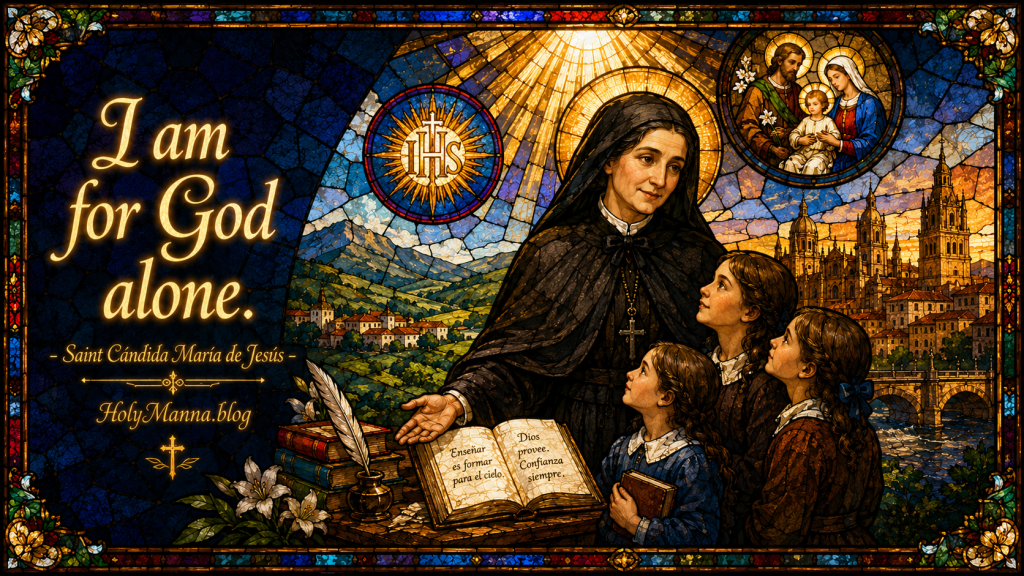
The Servant Girl Who Built Schools for the Forgotten
Some saints thunder across history with armies, cathedrals, or volumes of theology trailing behind them. Others arrive quietly, carrying a mop bucket and a heart entirely surrendered to God. Saint Cándida María de Jesús belongs firmly to the second kind, and that is precisely why she matters so much today. Born Juana Josefa Cipitria y Barriola in the green hills of the Basque Country in 1845, she was a poor weaver’s daughter who never attended school as a child, who barely spoke Spanish until adulthood, and who was still learning to read and write in her twenties. Yet this same woman founded the Congregation of the Daughters of Jesus, known affectionately as the “Jesuitinas,” an institute that has educated generations of children across Europe, Latin America, and Asia. She was canonized by Pope Benedict XVI on October 17, 2010, becoming the first woman from her native province of Guipúzcoa ever raised to the altars.
She is honored as the patroness of the Daughters of Jesus, and she is also invoked as a patroness of educators, a fitting title for a woman who spent forty years making sure that girls whom society had written off could sit in a classroom and discover their dignity as daughters of God.
Her life is a living illustration of what the Church teaches about holiness, namely that it is offered to everyone. The Catechism declares that “all Christians in any state or walk of life are called to the fullness of Christian life and to the perfection of charity” (CCC 2013). A servant girl scrubbing floors in Burgos heard that call, answered it, and changed the world. If God could do that with her, what might He be waiting to do with you?
From the Berrospe Farmhouse to the Servants’ Quarters
Juana Josefa was born on May 31, 1845, in the Berrospe farmhouse in Andoain, a small town tucked into the misty mountains of Guipúzcoa in the Basque Country of northern Spain. Her father, Juan Miguel Cipitria, was a weaver, and her mother, María Jesús Barriola, kept the home. The family was poor and large; Juana Josefa was the eldest of seven children, and the accounts of her childhood agree that instead of going to school she stayed home to care for her younger brothers and sisters. She was confirmed in 1848, when confirmation was commonly given to very young children in Spain, and she made her First Communion in 1855.
The family’s poverty forced a series of uprootings that shaped her entire life. In 1854 the Cipitrias moved to the town of Tolosa in search of work. In 1862, when Juana Josefa was seventeen, she left the Basque Country altogether and traveled to Burgos in Castile to work as a domestic servant, sending her wages home to help her family. It is difficult to overstate how disorienting this must have been. She was a native Basque speaker who barely knew Castilian Spanish, a farm girl in a strange city, an illiterate teenager surrounded by people who could read. In Burgos she entered the service of the family of the magistrate José de Sabater, and when the Sabaters relocated to Valladolid, she went with them.
It was in the servants’ quarters that her sanctity first became visible. She was known for giving away what little she had to the poor at the door, and the most famous story of her early life comes from this period. When she was warned that her constant generosity to the poor could cost her the position she desperately needed, she answered with the words that Pope Benedict XVI would quote at her canonization nearly a century and a half later: “Where there is no room for the poor, there is no room for me.” She meant it. She was prepared to lose her livelihood rather than close her hand to Christ in the poor. The Church teaches exactly this priority when the Catechism states that “the Church’s love for the poor . . . is a part of her constant tradition” (CCC 2444), and that works of mercy toward the needy are “among the witnesses to charity” by which we will be judged (CCC 2447).
Already as a young woman she had settled the fundamental question of her existence. Her personal motto, repeated throughout her life and recalled even on her deathbed, was simple and total: “I am for God alone.” Everything that followed flowed from that sentence.
In Valladolid in 1868, God placed the decisive human instrument in her path. She met Father Miguel José Herranz, a Jesuit priest who became her spiritual director. Under his guidance she was formed in the spirituality of Saint Ignatius of Loyola, her fellow Basque, learning to seek and find God’s will through prayer, discernment, and generous service. Father Herranz saw in this nearly illiterate servant girl what the world could not see, a soul of extraordinary depth and infinite possibilities. Sacred history is full of such moments, for as Saint Paul wrote, “God chose what is foolish in the world to shame the wise, God chose what is weak in the world to shame the strong” (1 Corinthians 1:27).
Then came the graces that changed everything. According to her own testimony, preserved by her congregation, she experienced a profound encounter with Jesus Christ in prayer on Good Friday, March 26, 1869. This account rests on her personal testimony and the tradition of the Daughters of Jesus, and it cannot be externally verified. What is thoroughly documented in the congregation’s history is what happened one week later. On April 2, 1869, kneeling before the altar of the Holy Family in the church known as El Rosarillo in Valladolid, she begged the Lord once more to make His will clear, and she received with unmistakable clarity the inspiration to found a congregation bearing the name Daughters of Jesus, dedicated to the salvation of souls through the education and instruction of children and young people. A servant who could barely write had just been handed a mission to teach.
The Foundress Who Could Not Yet Read
What Mother Candida did next is the reason the Church holds her up as a model, and it is the heart of why the reader should remember her. She did not wait until she was qualified. She did not wait until she had money, connections, or credentials. She trusted that what God asks, God supplies, and she acted. The Catechism teaches that faith is “man’s response to God” and that by faith “man completely submits his intellect and his will to God” (CCC 142 and CCC 143). Her whole life was that submission made visible.
On December 8, 1871, the feast of the Immaculate Conception, Juana Josefa and five companions attended Mass at La Clerecía, the great Jesuit church in Salamanca, and the Congregation of the Daughters of Jesus was born. She took the religious name Cándida María de Jesús. Consider the audacity of the setting. Salamanca was one of the most storied university cities of Europe, a city of scholars, and into it walked a Basque servant woman with almost no formal education, founding a teaching order. She began with nothing except, as her spiritual daughters later put it, the confidence that comes from knowing that what one undertakes is what God wants.
The timing was providential. Spain in the last third of the nineteenth century largely excluded women and the poor from serious education. Mother Candida aimed her congregation straight at that wound. On December 8, 1873, she and her first sisters professed vows. In January 1874 the congregation opened its first school in Salamanca in the old House of Concord. From there the work spread rapidly across Spain, to towns such as Peñaranda de Bracamonte, Arévalo, and her childhood home of Tolosa. Her schools welcomed rich and poor girls alike, boarders and day students, and she established Sunday schools so that domestic servants, girls living the very life she herself had lived, could receive an education on their one free day. She provided advanced formation for her sisters and for older students, effectively training women teachers at a time when that was rare. The Church would later articulate the principle she lived by when the Catechism affirmed that “the right and the duty of parents to educate their children are primordial and inalienable” (CCC 2221), a right that presupposes schools willing to serve every family, including the poorest.
No miracles worked during her lifetime are documented in the historical sources, and honesty requires saying so plainly. Her congregation and her biographers point instead to something the Church has always regarded as equally wondrous, the visible transformation of thousands of lives through one hidden woman’s obedience. The daily multiplication of bread in her story took the form of classrooms opened, servant girls taught to read, and vocations awakened. Among those vocations was one she foresaw with striking clarity. She once told a young student, “You will be a Daughter of Jesus.” That student, María Antonia Bandrés y Elósegui, entered the congregation, died young in the odor of sanctity in 1919, and was beatified on the very same day as her foundress, May 12, 1996.
Her zeal was missionary to the core. She dreamed aloud in words her daughters never forgot: “To the end of the world I would go in search of souls.” In the autumn of 1911, the year before her death, she saw that dream take flesh when the first group of Daughters of Jesus sailed for Brazil, the congregation’s first mission beyond Spain. In her letters she poured out gratitude for the vocation she and her sisters shared: “How grateful we must be for the very great benefit the Lord did us by calling us to this our beloved congregation so that we should be his dear daughters and brides and save many souls for heaven!”
Poverty, Papers, and the Long Obedience
Mother Candida was never martyred, but her road was steep from beginning to end, and her hardships deserve to be told in full, because they are the hardships most believers actually face: poverty, humiliation, bureaucratic struggle, and the slow surrender of cherished plans.
The first hardship was the poverty and dislocation of her youth. She knew hunger, family separation, exhausting labor, and the quiet contempt that educated society reserved for an illiterate Basque servant who stumbled through Castilian. When God called her to found a teaching congregation, the apparent absurdity of the call was itself a cross. She had to learn to read and write as an adult while simultaneously drafting the foundational documents of a religious institute, leaning on Father Herranz, who put the Summary of the Ignatian Constitutions within her reach.
The second great hardship was the decades-long battle over her Constitutions. Mother Candida had received a clear charism at El Rosarillo, an Ignatian congregation of women dedicated to education for the salvation of souls, and she wrote Constitutions to express it. The diocesan bishop approved them in 1872, but in successive revisions and approvals over the following decades, elements she considered essential to the Ignatian spirit of the institute were stripped away. She did not quietly accept this. On August 30, 1902, the year after Pope Leo XIII granted the congregation pontifical recognition on July 30, 1901, she traveled to Rome personally to defend the Ignatian character of her original text. It is a remarkable image, the former servant girl standing in the offices of the Roman Curia, contending respectfully but firmly for the charism God had entrusted to her. She did not win in her lifetime. The Constitutions she longed for were restored only after the Second Vatican Council, decades after her death. She died still waiting, still trusting, a living example of the Catechism’s teaching that hope is “the theological virtue by which we desire the kingdom of heaven and eternal life as our happiness, placing our trust in Christ’s promises and relying not on our own strength, but on the help of the grace of the Holy Spirit” (CCC 1817).
Her final years brought the ordinary hardships of age and the weight of governing a growing congregation, and through them she remained what she had always been, a woman of the Eucharist and of the will of God. She died in Salamanca on August 9, 1912, at the age of sixty-seven, in the city that had watched her grow from an unknown foundress into a figure everyone simply called Mother Candida. Those who knew her described her as a holy woman, and the people of Salamanca came in great numbers to bid her farewell. Pope Benedict XVI later recalled that the resolve of her youth, to live only for God, was a decision she maintained faithfully and remembered even as she lay dying. She finished exactly as she began: “I am for God alone.”
The Coma That Ended in Wonder
Devotion to Mother Candida began at her death and never stopped. A reputation for holiness surrounded her memory in Salamanca, where her remains are venerated, and her cause for beatification advanced through the twentieth century. Pope John Paul II declared her Venerable in 1993, recognizing her heroic virtue. A miracle attributed to her intercession was then investigated in Spain and approved by John Paul II in 1995. The medical details of that first cure are not described in the sources consulted for this post, and it is presented here simply as a cure the Church investigated and formally recognized. On May 12, 1996, in Saint Peter’s Square, John Paul II beatified Mother Candida together with her spiritual daughter, Blessed María Antonia Bandrés, the very student to whom she had once said, “You will be a Daughter of Jesus.” At the beatification, the Holy Father taught that a profound experience of God’s love had led Blessed Candida to answer that love with generosity and decisiveness.
The miracle that opened the door to her canonization is well documented and stunning. Sister María del Carmen del Val, a religious of Mother Candida’s own congregation, was struck by progressive multifocal leukoencephalopathy, a devastating disease of the brain. She fell into a coma that lasted twelve days, and her doctors ruled out any possibility of recovery. Her sisters invoked the intercession of Mother Candida, and the dying religious recovered in a manner medicine could not explain. The Church subjected the case to its full scrutiny, first the medical panel, then the theologians, then the members of the Congregation for the Causes of Saints, and Pope Benedict XVI formally approved the miracle on July 3, 2009. This careful process reflects what the Catechism teaches about such signs, that miracles “strengthen faith in the One who does his Father’s works; they bear witness that he is the Son of God” (CCC 548), for every miracle wrought through a saint is finally the work of Christ Himself.
On October 17, 2010, in Saint Peter’s Square, Benedict XVI canonized Cándida María de Jesús alongside five other blesseds, including Saint André Bessette of Canada and Saint Mary MacKillop of Australia. Preaching on the Gospel of the persistent widow from The Gospel of Luke, chapter 18, the Pope pointed to Mother Candida as proof that when the Son of Man comes, He will still find faith on earth. He reminded the world of her defining sentence about the poor and praised the way this woman of scarce means inspired other sisters to follow Jesus and to dedicate themselves to teaching and to the advancement of women.
Her canonization made her the first woman from Guipúzcoa ever declared a saint, joining a Basque spiritual lineage that includes Saint Ignatius of Loyola, whose spirituality she had absorbed and handed on. Her feast is celebrated on August 9, the day of her death, and in the schools of the Daughters of Jesus her birthday, May 31, remains a beloved celebration for sisters and students alike. Today her congregation serves across Europe, Latin America, and Asia; the sisters reached the Philippines in 1932, beginning at Pototan in Iloilo, and their schools around the world still carry the charism born at El Rosarillo. The Roman Martyrology remembers her soberly and beautifully, recording that at Salamanca in Spain died Saint Cándida María de Jesús Cipitria, who founded the Congregation of the Daughters of Jesus to collaborate in the Christian formation of children.
What a Servant Girl Teaches the Rest of Us
Mother Candida’s life lands differently once the reader realizes that she possessed none of the advantages usually associated with great founders. She was not wealthy, not educated, not well connected, and for much of her life not even literate. What she possessed was total availability to God, and her story insists that availability is the only credential heaven actually requires. The Catechism teaches that “the vocation of humanity is to show forth the image of God and to be transformed into the image of the Father’s only Son” (CCC 1877), and that vocation is no respecter of résumés.
Her love for the poor offers the first practical lesson. She risked her employment rather than turn away the needy, decades before she ever wore a habit. Most believers will never found a religious order, but every believer decides daily whether there is room for the poor in their budget, their schedule, and their attention. When was the last time generosity actually cost you something you wanted to keep? The Church calls this the preferential love for the poor and roots it in the judgment scene of The Gospel of Matthew, chapter 25, where Christ identifies Himself with the least of His brothers (CCC 2443 through CCC 2449).
Her patience under frustration offers the second lesson. She spent thirty years watching her Constitutions be edited away from the vision God had given her, appealed respectfully to legitimate authority, and died without seeing the outcome. She teaches that fidelity is measured not by results witnessed but by trust maintained. Is there a prayer you have quietly stopped praying because the answer has been slow? The persistent widow of Luke 18, the very Gospel proclaimed at her canonization, was her lifelong companion.
Her passion for education offers the third lesson. She believed that teaching a child to read, to think, and to know Jesus Christ was a work of salvation. Parents helping with homework, catechists preparing a lesson, teachers grading late into the night, and mentors investing in a struggling young person all stand inside her charism whether they know it or not. Who in your life is waiting for you to believe in them the way Father Herranz believed in a servant girl who could not write her own name?
A simple way to honor her this week would be to pray her motto slowly each morning, “I am for God alone,” and then to perform one hidden act of service before nightfall, telling no one. That was her entire method, and it made her a saint.
Engage With Us!
Mother Candida began as the least likely founder in Spain and ended as the first canonized woman of her homeland, all because she never negotiated with the words “I am for God alone.” Share your thoughts and reflections on her remarkable life in the comments below; your story of faith might be exactly what another reader needs today.
- Mother Candida said, “Where there is no room for the poor, there is no room for me.” What would change in your weekly routine if you adopted that sentence as your own?
- She answered God’s call while still illiterate, trusting that God would supply what she lacked. What perceived lack are you currently using as a reason to delay something God may be asking of you?
- She waited her entire life for her Constitutions to be restored and never saw it happen. How do you respond when faithfulness produces no visible results?
- She told a young student, “You will be a Daughter of Jesus,” and the prophecy came true. Whose vocation or potential could you name and encourage this week?
- Her motto was “I am for God alone.” What competes most fiercely with God for your heart, and what one step could you take today to hand it over?
Saint Cándida María de Jesús proves that heaven builds its greatest works from the materials the world discards. Live this day with her courage and her simplicity. Serve someone quietly, trust God with what has not yet been answered, and do everything with the love and mercy that Jesus taught us. Saint Cándida María de Jesús, pray for us!
Saint Cándida María de Jesús, pray for us!
Follow us on YouTube, TikTok, Instagram and Facebook for more insights and reflections on living a faith-filled life.


Leave a comment